
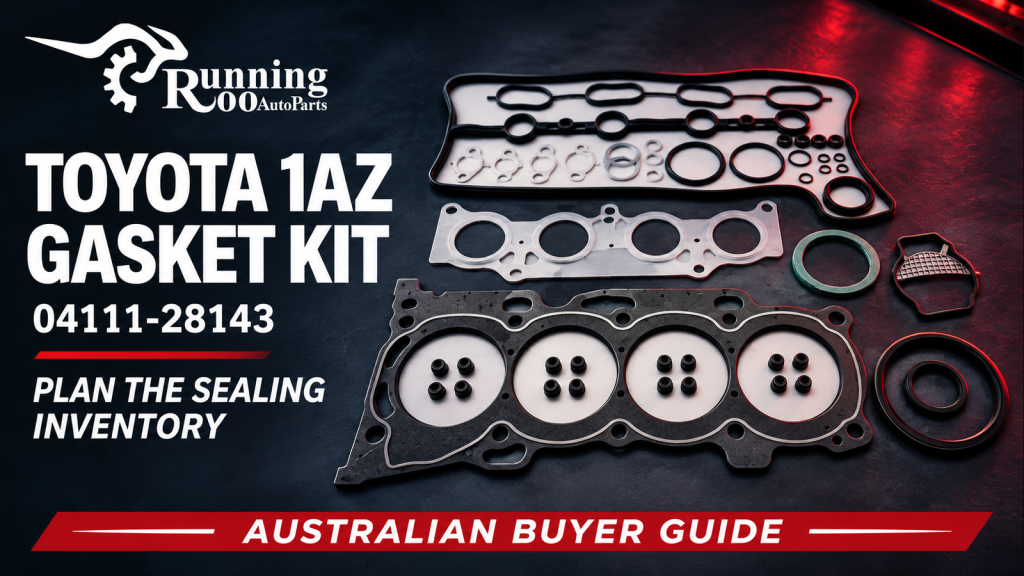
A Toyota 1AZ full gasket kit can make an engine repair easier to organise, provided the workshop knows exactly which sealing items it needs and the buyer confirms what the kit contains. The word “full” should not be treated as a promise that every item required for every possible repair is in one box. A useful order matches the identified engine, the planned dismantling and an agreed contents list.

RunningRoo offers a kit listed under reference 04111-28143 for the Toyota 1AZ engine, described as one full gasket set including a head gasket. This Australian buying guide concentrates on building a sealing inventory around that real offer. It does not provide a universal 1AZ overhaul procedure or assume that a gasket set contains head bolts, machining services, fluids or every part encountered after dismantling.
Begin with the engine actually being repaired
Provide the vehicle VIN or chassis identification, complete engine code and any known engine replacement history. The broad 1AZ description is useful, but it does not remove the need to confirm the exact application. If the engine is already out of the car, give the workshop's identification of the installed engine rather than relying only on the vehicle's registration details.
Use 04111-28143 as the listed reference in the enquiry and ask RunningRoo to verify it against the job. Do not assume it is interchangeable with another similar gasket-set number, a 2AZ set or a kit advertised for a different Toyota engine. The correct comparison requires the actual application and required sealing items, not simply a matching manufacturer name.
The product description specifically requests identifying information, photographs and dimensions where relevant. That is an invitation to resolve the application before ordering. Send the information the workshop has established, and clearly label anything that remains uncertain. A provisional enquiry is appropriate while diagnosis continues; a final order should be tied to a confirmed requirement.
Build the inventory from the dismantling plan
Ask the workshop which assemblies it expects to remove and which sealing items the applicable service procedure requires for that work. The resulting list should be a repair-specific inventory. It should not be created by counting shapes in a marketplace photograph and assuming each one will be needed on your engine.
Separate the list into confirmed requirements, items awaiting inspection and items outside the gasket kit. For example, a head-gasket line can be confirmed as part of the supplier's stated offer, while another seal must be checked against the detailed contents. Fasteners and fluids should remain separate purchasing questions unless expressly included in the current package.
Give each requirement a plain-language description and the workshop's part reference where available. That makes the list usable by both supplier and installer. “The small round one in the corner” is difficult to reconcile if the product photograph changes. A named item with a reference and quantity is much easier to check before the engine is ready for assembly.
What the current description confirms
The current RunningRoo description confirms one set for Toyota 1AZ, including a head gasket. It does not provide a comprehensive itemised inventory for every seal visible in the product photograph. That limitation should lead to a contents enquiry, not an invented list. Ask for the current pack details if a particular gasket or seal is essential to your planned work.
A product photograph remains useful as an overview. It can help the workshop recognise the type of set being discussed and identify questions for the seller. It should not be promoted into a technical drawing or a guaranteed count of every small component unless the seller confirms that the image represents the current supplied contents.
When comparing two kits, use the same workshop inventory for both. A lower displayed price may reflect a different selection of parts rather than a better offer for the same repair. A concise contents comparison reveals whether a second order would still be needed, without making unsupported claims about one brand's quality or performance.
| Inventory line | Current evidence | Action before reassembly |
|---|---|---|
| Engine application | Listing identifies Toyota 1AZ | Verify VIN, complete engine code and installed configuration |
| Head gasket | Explicitly included in the description | Confirm the correct application and supplied version |
| Other gaskets and seals | Product photo provides an overview | Obtain itemised confirmation against the workshop list |
| Head bolts or other fasteners | Not established as kit contents | Order separately if the correct procedure requires them |
| Sealant and fluids | Not established as kit contents | Let the workshop specify the application and quantity |
| Machining or inspection work | A service, not a gasket-kit item | Agree scope directly with the repairer |
Why sealing work is more than replacing a visible gasket
Elring's official cylinder-head-gasket information describes the need to seal combustion gas, coolant and oil, with designs matched to particular engines. Its professional installation material emphasises suitable sealing surfaces and the correct installation approach. This supports treating the gasket as part of an engineered joint, not as a universal sheet that compensates for any underlying engine condition. Elring: cylinder-head gasket engineering principles; not the brand of this kit Elring: cylinder-head gasket technical guide; general installation principles
Those sources provide general manufacturer background; they do not identify the brand or construction of the RunningRoo kit and do not supply Toyota-specific limits for this repair. Ask the workshop which current manufacturer information governs its inspection and assembly. The correct surface requirements, tightening process and any additional assessment must come from that application-specific information.
For the buyer, the practical consequence is to agree the inspection stage before committing to a final reassembly date. If the workshop finds an issue that changes the repair, the inventory may also change. Purchasing a gasket set does not establish that the head, block or other components are suitable for reuse, and this guide makes no remote diagnosis of their condition.
Keep head bolts on a separate line
A full gasket kit and a head-bolt set are different offers. Ask the workshop to specify what the engine procedure requires for fasteners and keep that requirement visible in the purchasing list. Do not assume bolts are included merely because the head gasket is included, and do not decide reuse from a generic internet statement.
RunningRoo already has a separate guide to the Toyota 1AZ and 2AZ head-bolt offer. That article covers the fastener purchase question, while this one covers the gasket-set inventory. Read it as related planning information, not as proof that every fastener set discussed there matches every engine covered by this gasket listing.
The same discipline applies to other parts outside the set. Ask whether each additional item is required by the repair procedure, justified by inspection or optional. This lets the owner understand the actual job without turning a gasket purchase into an undefined “replace everything” order. The workshop should explain the scope using the engine's findings.
Plan for information discovered during dismantling
Some repair details cannot be settled until the engine has been assessed. Agree how the workshop will communicate any change in scope and who will update the supplier. A photograph and revised parts reference can resolve an enquiry more quickly than a message saying that the kit is “wrong” when the underlying repair requirement has changed.
Keep the original proposed inventory and mark revisions with dates. If an additional sealing item becomes necessary, record why it was added and whether it is included in the supplied set. This avoids buying the same item twice or overlooking a small component because several people assume someone else has ordered it.
Do not open or discard all packaging before the workshop has checked the application and contents. Keep each identifiable component associated with its package where practical. The installer should handle and prepare the sealing parts under the appropriate instructions. The owner's role is to preserve a clear inventory and order record, not to apply sealants or alter gaskets in anticipation of the job.
An inventory example for a planned head repair
Imagine a workshop recommending a cylinder-head repair on a confirmed 1AZ application. It supplies a list of required sealing items and separately lists fasteners, fluids and inspection work. The owner sends that list to RunningRoo with the VIN and engine information, asking which lines are included in the 04111-28143 offer.
The supplier confirms the head gasket and responds to the remaining contents questions. Any unconfirmed line stays open until resolved. The owner then compares the complete requirement with the delivered set before the workshop begins reassembly. This process is useful even if every item turns out to be included, because the agreement is explicit rather than assumed.
Now consider a wider repair after further inspection. The workshop adds another required seal. The owner checks whether it is already in the kit before purchasing a duplicate. The updated inventory makes the change visible and keeps the repair discussion specific. This example describes an ordering method, not a prediction about which components your engine will need.
Melbourne collection and Australian delivery
RunningRoo is Australian-operated in Blackburn VIC, with Melbourne local pickup by appointment and friendly support for fitment enquiries. Send the vehicle and engine details before travelling so the team can discuss the actual kit and current stock. A collection appointment is most useful after the workshop has clarified its inventory.
For delivery elsewhere in Australia, provide the destination postcode and whether the package is going to the owner or workshop. Ask about fast dispatch of confirmed stock and the current delivery estimate. Do not book a final reassembly deadline on the assumption that every postcode receives the same service or that a kit order settles all remaining repair requirements.
If the workshop is receiving the parcel, include its job reference and confirm that it accepts customer-supplied parts. Keep the supplier confirmation available to the receiver. The person opening the package should be able to compare it with the agreed contents, not reconstruct the order from a telephone conversation the owner had several days earlier.
Inspect the delivered set against the agreed list
Check the package reference and compare the supplied contents with the written confirmation before fitting. If something is unclear, photograph the complete layout without mixing it with unrelated workshop stock and contact RunningRoo. Explain which inventory line is in question. A named missing item or application concern is easier to investigate than an unexplained photo of several gaskets.
Do not trim, drill or modify a gasket to make an uncertain match fit. Stop and resolve the application with the supplier and installer. The workshop should use the correct manufacturer procedure for installation, including any specified orientation and surface preparation. This article intentionally provides no universal sealant instruction, tightening value or machining tolerance.
After the repair, retain the invoice, kit reference and workshop record. If the engine has been changed from its original specification, keep that identification with the vehicle file. Future parts enquiries will be easier when the owner can distinguish the vehicle's original details from the configuration actually repaired.
Make the next conversation specific
A useful enquiry reads: “Please confirm this 04111-28143 kit against my VIN and installed engine code, and confirm the attached sealing inventory.” Add the workshop's diagnosis and any relevant OE references or photographs. Ask which items are included, which need separate supply and when confirmed stock can be collected or dispatched.
Call 0425 890 125 if the inventory needs discussion. RunningRoo's friendly support can help identify the offered set and supply details, while the repairer decides what the engine requires. Keeping those responsibilities clear produces a better purchase than treating “full kit” as an answer to every repair question.
Frequently asked questions
Does “full gasket kit” mean every part needed for a 1AZ repair is included?
No universal promise should be inferred. The current description confirms one set including a head gasket. Match the detailed contents to the workshop's repair-specific inventory and keep fasteners, fluids and services separate unless expressly included. The required scope depends on the identified engine and actual work.
Can I choose this set using only the 1AZ engine-family name?
Use the complete engine identification, VIN or chassis details and the listed reference to obtain fitment confirmation. Tell RunningRoo about an engine swap or imported application. A broad family name is a useful lead, but it is not a substitute for checking the installed engine and required components.
Are head bolts supplied with the gasket set?
They are not established as included by the current description. Ask the workshop what fasteners the applicable procedure requires and obtain separate supply confirmation. Do not assume that a head gasket and bolts are bundled simply because they may both be involved in the same repair.
Should I add sealant to every gasket?
Do not use a universal sealant rule. The installer must follow the correct instructions for each joint and component. This guide does not specify a Toyota assembly method or endorse adding material to compensate for an uncertain fit. Resolve the application and procedure before installation.
What if dismantling reveals another required seal?
Update the workshop inventory and ask whether the item is already in the supplied set before ordering it again. Keep the change and supplier response with the job record. A revised repair scope should be made explicit rather than hidden inside an assumption about what “full” includes.
Can RunningRoo help with an urgent Australian workshop order?
Contact the team with the VIN, engine code, OE reference, diagnosis and required contents. Ask about current stock and fast dispatch, or arrange Melbourne pickup by appointment. Call 0425 890 125 before setting the workshop's final assembly date, particularly if some inventory lines are still unconfirmed.
Related reading: Toyota 1AZ 2AZ Head Bolt Set Australia: RAV4, Noah and Voxy Repair-Scope Guide. This separate guide covers a different component or search question; it does not establish interchangeability with the product discussed here.
Sources and scope
Product details and availability were checked on 11 November 2026. Retailer listings establish the offer; manufacturer sources below support only the technical points identified in the article. Current vehicle-specific workshop information takes priority over general background.