
A clear bank reference is more useful than “the chain on this side”
Subaru EZ36 timing chain bank identification in Australia becomes a practical issue when an owner, workshop and parts supplier are discussing the same engine from different viewpoints. A photograph taken from the front, a scan-tool description and a retail listing can use different labels. Before ordering, the workshop should connect those labels to the applicable Subaru component identification rather than rely on a casual description of left or right.
This guide focuses on keeping the left, right and idler-chain records clear during an EZ36 parts enquiry. It is not an installation guide, a diagnosis from a photograph or a claim that one bank should be repaired independently of the other. The technician must establish the fault, choose the correct procedure and determine the scope. The owner’s task is to make sure the approved requirement reaches the supplier accurately.
For a confirmed compatible repair, compare Timing Chain Kit Fit Subaru Legacy Outback Tribeca 3.6L H6 DOHC EZ36D 2008-2015 — RunningRoo with the matching RunningRoo eBay listing. RunningRoo offers Australian-operated support from Blackburn, Victoria, Melbourne local pickup by appointment and fast dispatch subject to stock and order confirmation. Call 0425 890 125 with the VIN, fitted engine code, relevant OE references and the workshop’s itemised request.

Use the 3.6-litre material, not a generic H6 illustration
Subaru of America’s H6 Technician Reference Booklet includes distinct 3.6-litre sections covering chains, right and left chain removal and chain installation. Its 3.6 discussion also covers dual AVCS. See Subaru of America H6 Technician Reference Booklet, 2009 (archived original). Because the booklet contains material for more than one H6 configuration, the engine-specific section matters. An illustration found elsewhere in the same document is not automatically the correct reference for an EZ36.
The booklet is archived manufacturer training. It provides background for understanding the system, while the repairer still needs current vehicle-specific service information. This article does not reproduce the timing-mark arrangement or convert a training illustration into a do-it-yourself procedure. It uses the distinction between components to improve the accuracy of the purchasing and repair records.
Establish a shared naming convention before discussing a side
Ask the technician to use the manufacturer’s component names when requesting parts. If the conversation includes “left”, “right”, “bank one” or “bank two”, have the workshop explain how those descriptions relate to the particular component being discussed. Do not infer the answer from where the owner stood while taking a photograph or from the side of the steering wheel.
A useful photograph can carry the workshop’s own clear label and the relevant component reference. The label should explain the viewpoint if that matters to the enquiry. Avoid adding a confident bank number yourself when the original information only says “this side”. The supplier should receive the technician’s identified requirement, not an interpretation introduced during forwarding.
If two documents appear to disagree, stop the purchasing assumption and ask the repairer to reconcile them. A short clarification at this stage is more useful than ordering a second part to cover uncertainty. The correct result is one agreed description linked to the vehicle and the applicable service information.
What the current retail package says
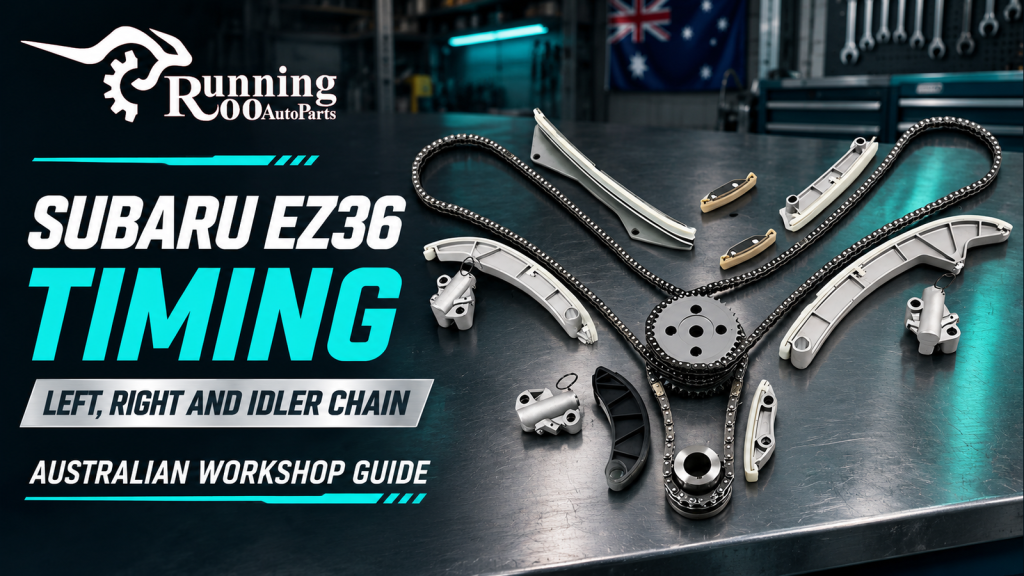
The RunningRoo listing states a left chain with 150 links, a right chain with 154 links and an idler chain with 30 links. It also lists one idler gear, one crank gear, three tensioner adjusters, four chain guides and four tensioner guides. These are the seller’s package descriptions and quantities; they are not a substitute for checking the vehicle-specific requirement.
Do not assume that every camshaft adjuster, seal, fastener or other component needed for a broader repair is supplied. In particular, an article discussing bank identification should not turn a chain-kit listing into a promise that all AVCS components are included. Ask the workshop to identify any separate requirement and confirm it independently.
Use Timing Chain Kit Fit Subaru Legacy Outback Tribeca 3.6L H6 DOHC EZ36D 2008-2015 — RunningRoo for the current product description and photographs, or the matching RunningRoo eBay listing for the corresponding marketplace offer. RunningRoo can clarify the stated inventory, while the installer must determine whether that inventory matches the planned work. Save the final confirmation instead of relying only on an old screenshot or a shortened product title.
Why chain counts belong in an inventory, not a diagnosis
Link counts can help distinguish catalogue descriptions, but they do not tell an owner why the engine is behaving a particular way. They also do not replace OE comparison, VIN information or the technician’s application check. Treat them as one part of identifying a package rather than the entire basis for ordering it.
The same caution applies to a photograph showing several loops of chain. It can illustrate the seller’s offer, but it cannot establish the condition of the chain in the vehicle. A marketing image is not a timing diagram and should not be used to determine routing or installation position. Technical work must follow the correct procedure.
If the workshop requests a reference that is not stated in the retail description, ask the supplier for clarification. Do not create a missing specification from a visual estimate. An incomplete identification should remain openly incomplete until the relevant parties confirm it.
A bank-and-component record for the parts enquiry
| Record field | What the workshop should identify | Why the distinction matters |
|---|---|---|
| Vehicle and engine | VIN, fitted engine code and build information | Keeps the enquiry attached to the actual vehicle |
| Component position | Manufacturer-defined left, right or idler designation | Avoids ambiguity from the camera viewpoint |
| Reference information | Relevant OE number or approved component identifier | Supports a specific compatibility enquiry |
| Required scope | Components to replace and any conditional items | Prevents a full-kit assumption from replacing diagnosis |
| Retail inventory | Confirmed chain, gear, guide and adjuster quantities | Makes missing additional items visible |
| Completion record | Components actually fitted and checks performed | Preserves accurate service history |
The table is a record template, not an instruction to remove or inspect components yourself. The repairer decides which identification can be obtained safely and when it is needed. If an owner has only the VIN and a provisional recommendation, that is a starting point for discussion rather than a reason to invent the remaining fields.
Keep a scan-tool label separate from the parts order
An owner may arrive with a screenshot containing a bank reference or a camshaft-related description. Give the original screenshot to the workshop, including the complete wording if available. Do not reduce it to “left chain failed” unless the technician has actually reached that conclusion. Diagnostic descriptions and replacement component names serve different purposes.
Ask for the workshop’s interpretation and the next diagnostic step. A code report is evidence to assess, not an automatic shopping list. The technician should explain why the proposed part is relevant to the confirmed finding and whether other assessment remains necessary. This guide deliberately gives no code-to-part substitution chart.
When forwarding information to RunningRoo, include the final parts request rather than expecting the supplier to diagnose the engine from a cropped scan image. Friendly support can help with product identification. The repairer remains responsible for deciding what must be repaired and how to verify the result.
Preserve left and right descriptions through the ordering process
A common communication problem is that a detailed workshop request becomes shortened at each step. “Manufacturer-defined right-side component with this reference” may become “right timing part” in a message and “Subaru chain” in a shopping note. Keep the complete approved description together with the order so the original meaning is not lost.
If more than one person coordinates the repair, nominate a single current parts list. Record changes in that list when the workshop revises its recommendation. Do not leave two conflicting versions in circulation and assume the supplier will know which one is final. A dated confirmation is a simple way to preserve the latest instruction.
This approach is especially useful when the vehicle and owner are in different places. A family member collecting parts in Melbourne should have the confirmed order details, not a verbal description of the side of an engine. Pickup becomes a straightforward handover of an identified order rather than a new fitment decision at the counter.
Do not turn a bank-specific finding into a universal repair rule
A repairer may identify a concern associated with one part of the system. That does not mean this blog can prescribe a partial repair, nor does it mean every component must automatically be renewed. Ask the technician to explain the scope it recommends and the evidence supporting that recommendation.
Keep required work, optional work and inspection-dependent work distinct. If the final decision needs further access, agree on when the owner will be contacted and what information will support the next approval. The number of components in a retail package should not determine the diagnosis.
Likewise, do not use a previous invoice stating “chain replaced” to assume all banks, guides and adjusters were renewed. Read the actual itemised record if it exists. Where the history is uncertain, tell the workshop. An honest gap in the service record is more useful than a reconstructed certainty.
Check fitment beyond Outback, Legacy or Tribeca
The listing names Subaru Legacy, Outback and Tribeca 3.6-litre EZ36D applications with a stated year range. Treat those details as catalogue information to verify. Provide the VIN privately, fitted engine code and requested OE information, particularly if the vehicle has a known engine change or an uncertain history.
The Australian registration year should not be used as the sole identifier. The supplier and installer may need build details or component references to resolve the match. Ask what evidence is needed rather than selecting the closest-looking kit. Keep any confirmation tied to the specific product and order.
If photographs are requested, use accessible labels or workshop-supplied images. Avoid dismantling a vehicle simply to make a retail enquiry. The repairer can advise which information is useful and obtain it at the appropriate stage of its work.
Arrange Australian supply with a clear handover plan
RunningRoo’s Blackburn pickup is by appointment. Call 0425 890 125 after the scope and order are confirmed, and agree on who will collect the package. For shipped orders, ask about fast dispatch from available stock and obtain the relevant delivery estimate. Dispatch timing and workshop completion timing are separate arrangements.
Ask whether the installer accepts customer-supplied parts and when it will inspect the package. Keep the seller’s inventory available during that check so that any discrepancy is discussed before installation. Do not assume a delivery signature means the technician has approved the application or checked every item.
At completion, retain the itemised repair invoice with the product order and the identification record. The resulting history should say what was actually fitted, not simply that a large kit was purchased. That clarity will help the next professional assessment if the vehicle develops a different concern later.
Label photographs without changing the original evidence
When a workshop supplies photographs, retain the original images and add any explanatory note as a separate caption or accompanying message. A tight crop may remove the context that identifies the viewpoint. Keep at least one wider image if the technician considers it useful, and do not redraw timing marks or add bank labels based on a guess.
If the same photograph is forwarded to the supplier, include the workshop’s wording and the specific question it is intended to answer. An image of a component can support identification without proving the cause of a fault. This distinction helps the supplier respond to the parts enquiry while preserving the technician’s responsibility for interpreting the engine’s condition and choosing the repair.
Frequently asked questions
Can I identify the required chain by standing in front of the car?
Do not base the order on an informal viewpoint. Ask the workshop to use the manufacturer’s component designation and relevant reference. A labelled photograph can help, but the technician should establish what the label means for the actual vehicle and repair.
Are the three listed chains the same length?
The current listing describes 150-link left, 154-link right and 30-link idler chains. These are package identifiers, not installation instructions. Confirm the actual application with the VIN, fitted engine code and installer’s requirement rather than choosing from link count alone.
Does this package include every AVCS component?
Do not assume that it does. The stated inventory lists chains, selected gears, tensioner adjusters and guides. If the workshop requires an AVCS-related component or another item outside that inventory, obtain a separate, specific supply confirmation before proceeding.
Does a bank-related code prove I need a chain kit?
A scan description requires professional interpretation and the appropriate diagnostic process. It should not be converted directly into a parts order. Give the full information to the workshop and request a confirmed requirement before asking the supplier to match the product.
Can RunningRoo help organise the order for my workshop?
Yes, product identification and ordering questions can be discussed through Timing Chain Kit Fit Subaru Legacy Outback Tribeca 3.6L H6 DOHC EZ36D 2008-2015 — RunningRoo, the matching RunningRoo eBay listing or by calling 0425 890 125. RunningRoo is Australian-operated with friendly support, Melbourne pickup by appointment and fast dispatch subject to confirmed availability. Diagnosis and installation remain with the qualified repairer.
Related reading and RunningRoo video
Read the related RunningRoo product-identification guide. Use that guide for the catalogue discussion and this article for the specific workshop question above.
Watch RunningRoo: Timing Chain Rattle: Wear Symptoms & When to Replace. This is general background from the RunningRoo AutoParts channel, not a demonstration of this exact supplied component, confirmation of fitment or a substitute for the vehicle-specific repair procedure.
Confirm your parts enquiry with RunningRoo
Send your VIN privately, fitted engine code, relevant OE number and the installer-approved parts list before ordering. Contact RunningRoo support or call 0425 890 125. RunningRoo is Australian-operated in Blackburn, Victoria. Melbourne local pickup is by appointment; ask about fast dispatch after stock, fitment and order timing are confirmed. Friendly support can help clarify the product enquiry while the qualified repairer remains responsible for diagnosis and installation.
Technical references and scope
Subaru of America H6 Technician Reference Booklet, 2009 (archived original). Manufacturer material provides the limited technical background cited in the article. Additional technical sources, where used, are linked beside the relevant discussion. Archived training and general system explanations are not current VIN-specific repair instructions. The discussion questions and planning examples are editorial guidance. Retail descriptions establish the seller’s stated offer, not manufacturer approval or universal compatibility.