
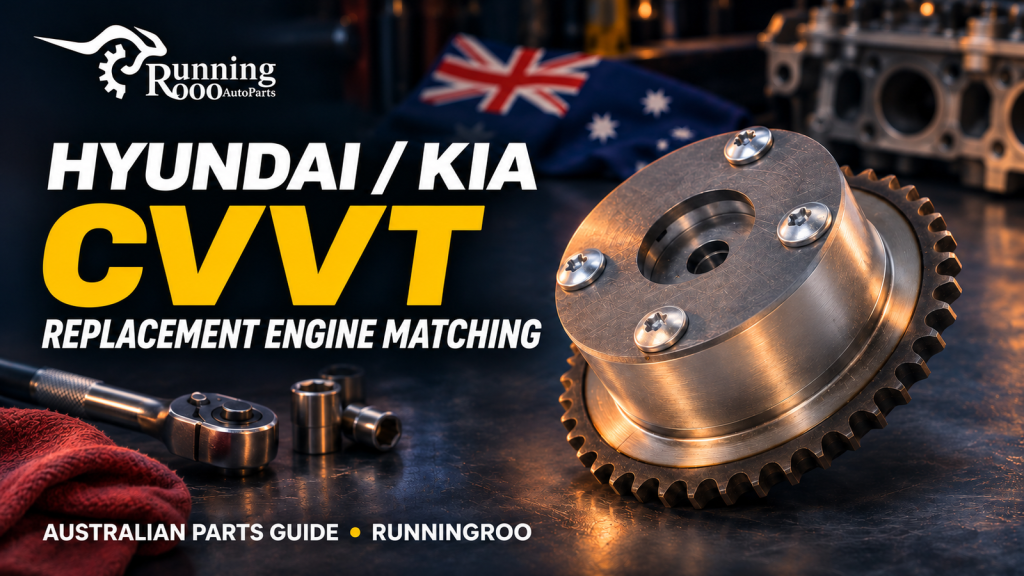
A Hyundai or Kia that has received a replacement engine can create an awkward CVVT parts question: should the supplier follow the vehicle VIN, the donor engine or the gear already fitted? The answer starts with reconciling those records. A VIN describes an important part of the vehicle's identity, but it cannot by itself explain every change made during an engine replacement. The workshop needs to establish the actual assembly and the component required before a new gear is ordered.

This Australian guide focuses on that identification problem. RunningRoo's selected offer is an intake CVVT gear listed under reference 24350-2E201. It is an enquiry option, not approval for a conversion or every engine that can be fitted to a particular body. If the engine history is uncertain, provide that uncertainty honestly along with the VIN, fitted engine code, donor records where available, OE markings and professional diagnosis. A complete explanation is more useful than choosing whichever number appears most familiar.
Keep the vehicle identity and engine identity together
Start a parts file with the vehicle VIN, build details and registration information. Then add what is known about the fitted engine: its code, identification markings, replacement date and any supporting invoice. Keep the two sets of information linked, rather than replacing the vehicle record with a vague note that a different engine is fitted. A supplier and workshop may need both to understand the enquiry.
Do not assume that replacement means modified. The replacement could be intended as an equivalent assembly, or it could involve differences that need further checking. The point is to establish the facts rather than guess. Ask the mechanic what evidence confirms the fitted specification and whether any relevant components were transferred from the previous engine. The owner does not need to identify those components personally, but should preserve the workshop's explanation.
Find out what the donor paperwork actually says
A receipt may identify an engine supplier, a donor vehicle, an assembly code or only a broad model description. Record the level of detail it provides. A document saying Hyundai 2.0 engine does not necessarily identify every part fitted to the completed vehicle. If a more detailed record is available from the installer or supplier, obtain it before treating a registration-based catalogue result as final.
Keep dates and job references with the paperwork so a later enquiry can be traced efficiently. Avoid sharing an entire donor vehicle history publicly when only a component identification question is being asked. Send the relevant vehicle and engine information directly to the workshop or parts supplier through the appropriate channel. Clear records help the enquiry without requiring unrelated personal information from a previous owner.
Distinguish the complete engine from transferred components
Ask the installing workshop whether the replacement was a bare assembly, a more complete unit or another supplied configuration. Those commercial descriptions can vary, so a written inventory is more useful than assuming that a complete engine included every external or timing-control component. The repair history should explain what was retained, transferred or replaced where that information affects the present parts request.
This question matters because the part currently visible on the engine may not have arrived with the donor assembly. It could have been transferred during installation or changed later. That does not automatically make it incorrect, but it means its presence alone is not proof of the required replacement reference. The mechanic should reconcile the fitted component with the actual engine and applicable manufacturer parts information before recommending a new gear.
Use the manufacturer system description within its limits
Hyundai's manufacturer brochure for the stated Malaysian Sonata specification identifies dual CVVT in the engine information. That supports understanding CVVT as part of an engine system, with application-specific details still to establish. The brochure is not a donor-engine interchange catalogue, a conversion approval or an Australian fitment guarantee for 24350-2E201. Use current manufacturer parts and repair information for the actual vehicle and assembly. Hyundai Sonata manufacturer brochure, Malaysian specification
For an engine-replacement enquiry, do not let a familiar system name stand in for a component match. Two descriptions containing CVVT or the same capacity can still require different identification work. The workshop needs to specify the required camshaft position and complete OE reference. RunningRoo can then discuss a concrete product rather than being asked to infer the answer from a broad engine-family label.
| Record | What to capture | Question it helps answer |
|---|---|---|
| Vehicle record | VIN, build details and original specification | What did the vehicle start with? |
| Replacement record | Engine code, invoice and donor details where available | What assembly was intended to be fitted? |
| Installation record | Relevant retained or transferred components | Does the current gear belong to the donor assembly? |
| Current component | Markings and clear photographs | What is physically fitted now? |
| Workshop diagnosis | Confirmed fault and requested cam position | Why is a replacement gear needed? |
| Approved order | Exact reference, product link and quantity | What has the installer agreed to fit? |
Do not let a familiar VIN result end the investigation
A registration or VIN search can return a plausible component, but a plausible result is not the same as a reconciled repair history. If the workshop knows that the engine has been replaced, that fact should be considered before approval. Ask whether the catalogue result matches the fitted assembly and whether any difference needs further checking. Do not hide the replacement history because the first search result seems convenient.
The same caution applies in the other direction. A donor-engine description should not automatically erase the vehicle context or prove that every donor component is appropriate in the completed installation. The qualified workshop must determine the correct configuration. This guide does not approve engine interchange, control-system compatibility or a conversion method. It explains the records needed to avoid ordering a CVVT gear from incomplete information.
Treat the old gear's marking as evidence, not the whole answer
A clear photograph of the old component's marking can be extremely useful for a supplier enquiry. Include an overall view so the position and component are not confused with another part removed at the same time. If the marking is unclear, ask the workshop to record what it can establish rather than inventing missing digits. The complete reference matters more than a close visual resemblance to a catalogue image.
However, copying the old reference without checking the history can preserve a previous mismatch. If the workshop's catalogue, the donor record and the fitted marking disagree, document the discrepancy and resolve it. The solution may require more information from the installer, engine supplier or manufacturer parts source. It should not be chosen by whichever reference happens to be available for immediate dispatch.
Keep the fault diagnosis separate from identity checking
An engine-history problem and a CVVT fault are different questions. Establishing which gear is fitted does not prove that the gear is defective. The workshop still needs to diagnose the complaint using the appropriate information for the actual assembly. Record the symptom, relevant diagnostic findings and the reason the mechanic recommends replacement. Avoid treating uncertainty about the donor engine as evidence that all its timing-control parts are wrong.
Likewise, a confirmed fault does not automatically answer the fitment question. The repair requires both a justified component replacement and an accurately identified part. If either remains uncertain, stock can be checked provisionally while the investigation continues. The order should not be presented as final until the installer has enough information to approve the specific component and application.
Where the 24350-2E201 offer fits into the enquiry
The selected RunningRoo product describes one intake CVVT gear under reference 24350-2E201. Use the exact link when asking the workshop to review the option. Do not assume that it includes an exhaust gear, oil-control valve, sensor, chain or every fastener required for the job. The advertised item is a specific supply offer to compare with the mechanic's approved parts request.
If the workshop specifies a different reference, ask it to explain the match or any applicable supersession. A similar prefix is not sufficient evidence that two numbers identify the same component. This is especially important when paperwork from an engine replacement contains several part numbers without descriptions. Give each number a component name and source, so the supplier can see what is confirmed and what is still being investigated.
Build one approved parts request
Once the information agrees, create a concise request containing the vehicle VIN, fitted engine identity, required camshaft position, full OE reference and exact product link. Add a short note about the replacement-engine history and the workshop's conclusion. If photographs are relevant, label them clearly. The purpose is a single record that the owner, supplier and installer can all use without reconstructing the conversation from separate messages.
If an alternative is proposed after the request has been approved, send it back to the installer for review before dispatch or fitting. Do not treat an alternative offered for the original vehicle as automatically correct for the replacement engine. This extra check can be brief when the records are good, but it should not be skipped simply because the vehicle is waiting in the workshop.
Inspect the delivery while it is still unused
On arrival, compare the supplied label, quantity and relevant features with the approved request. If something differs, contact RunningRoo with the order details and the mechanic's explanation. Keep the component clean and unused while the discrepancy is resolved. Do not modify it to match an uncertain interface or combine parts from multiple applications based on appearance.
The installer also needs to identify any additional consumables and follow the correct current procedure. A suitable gear does not remove the need for proper alignment, fastening and validation. This article deliberately does not offer a generic installation sequence for an engine whose history requires reconciliation. The workshop must use the information appropriate to the actual completed assembly.
Create a repair record that resolves the old uncertainty
After the job, retain the installed-part reference and the explanation of how it was matched. If the workshop clarified the fitted engine specification, preserve that information with the vehicle records. The next mechanic should not have to repeat the same investigation because the invoice says only VVT replaced. Clear documentation is especially valuable when the vehicle is sold or serviced by a different workshop.
The record should also state what concern was addressed and how the repair was checked. Correct identification and successful validation are related but separate achievements. Do not claim that a matched gear proves every aspect of an engine replacement is correct. Any unresolved issue should remain visible in the job history rather than being lost behind a broad statement that the replacement engine has now been sorted.
Related RunningRoo reading: Hyundai Kia Intake CVVT 24350-2E201: Identify the Right Gear Before Ordering. That article addresses a related but separate question or application; it does not establish interchangeability with this product.
Arrange Australian supply after the match is clear
RunningRoo offers Australian-operated support, Melbourne local pickup in Blackburn VIC by appointment and fast dispatch subject to confirmed stock and preparation. Share the approved request before booking collection or arranging shipment directly to a workshop. If the vehicle is already dismantled, say what has been confirmed and what remains uncertain so the supply conversation stays accurate.
A hypothetical owner with a replacement engine might initially have only a registration number and an old receipt. The practical next step is to obtain the fitted engine details and the mechanic's parts request, not guess between two similar gears. This example illustrates the information flow rather than a particular customer case. A well-documented enquiry can save repeated messages and reduce the chance of a wrong component reaching the workbench.
Frequently asked questions
Can I order the gear using the vehicle VIN alone after an engine replacement?
The VIN remains important, but the workshop should reconcile it with the fitted engine and relevant replacement history. Do not assume that a catalogue result for the original specification answers every question about the current assembly. Provide the engine code, available donor records, component markings and the mechanic's approved request as well.
Is the old gear's part number always the correct replacement reference?
Not automatically. It shows what is fitted, which is useful evidence, but a previous installation may need to be checked. If the marking disagrees with the donor record or manufacturer catalogue, ask the workshop to resolve the discrepancy. Do not copy an uncertain reference into a new order simply because it is readable.
Does the 24350-2E201 listing approve my engine conversion?
No. It is a standalone intake-gear offer to consider after the application is established. It does not approve engine interchange, control-system compatibility or the completed conversion. A qualified workshop must determine the correct configuration using the relevant manufacturer information and the actual vehicle and engine records.
What if I have no donor-engine paperwork?
Tell the workshop and supplier that the history is incomplete. Ask the mechanic what identification can be established from the fitted assembly and available records. Do not invent a donor model or choose the most convenient catalogue description. A provisional stock enquiry is possible while the technical identification is completed.
Does the offer include both intake and exhaust gears?
The selected page describes one intake gear. Confirm the current inventory with RunningRoo. If the workshop needs another cam position, a pair or additional components, list those requirements separately. The quantity and component description should be part of the approved request rather than inferred from a general CVVT label.
Can RunningRoo supply the confirmed item locally?
Call 0425 890 125 with the approved link, VIN, fitted engine details, OE reference and workshop findings. Confirm stock and contents before arranging Melbourne pickup by appointment or Australian dispatch. RunningRoo can help with the parts enquiry, while diagnosis, application approval, installation and validation remain with the qualified workshop.
Related RunningRoo video
Variable Valve Timing Explained | VVT, VVT-i, VANOS & Valve Lift | RunningRoo. This channel video provides related educational context. It is not proof that the filmed component is the exact supplied item, a vehicle-specific diagnosis or a substitute for current manufacturer procedures.
Sources and scope
Offer and stock information checked on 16 November 2026. Retailer descriptions identify the offered contents; the manufacturer sources support the technical points attributed to them within their stated market and model scope. The purchasing examples and suggested questions are editorial guidance. Use current vehicle-specific manufacturer information and professional diagnosis for the actual repair.