
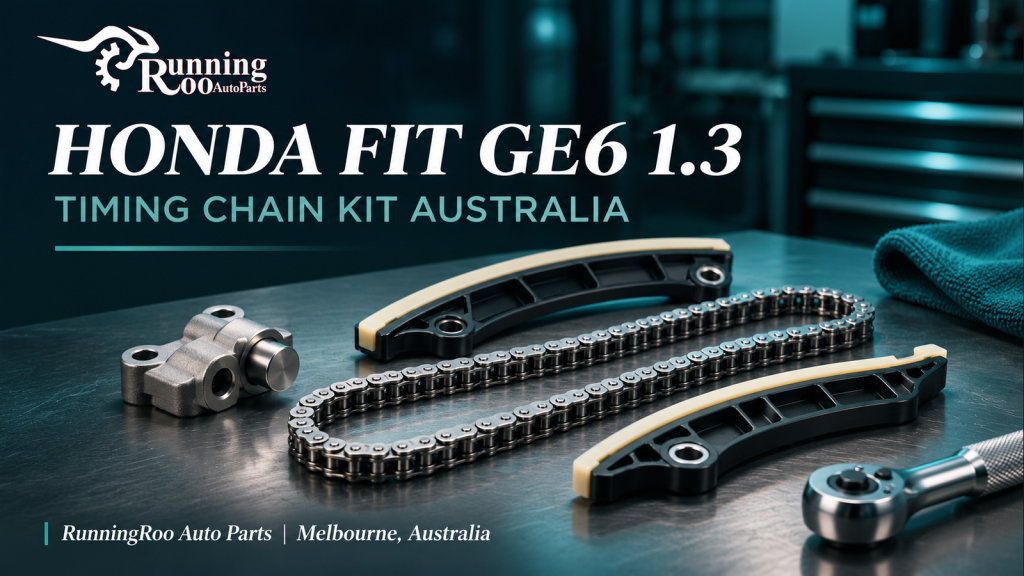
Searching for a Honda Fit GE6 1.3 timing chain kit in Australia requires more care than selecting “Honda Jazz” from a model list. The GE6 designation and the engine code are different identifiers. Honda's Japanese model archive identifies the relevant GE6 model with the L13A engine, while RunningRoo's offer is titled as a four-piece kit for the 2009 Fit 1.3L GE6. Bring those details together with the actual vehicle record before placing an order.

This guide is written for owners and workshops dealing with a Fit or an uncertain Jazz/Fit parts enquiry, particularly when the vehicle's original market matters. It concentrates on the specific four-piece listing and its identification questions. It does not extend the product to every Jazz, Fit, GE-series car or L-series engine. A careful enquiry should establish the installed engine, the required component versions and the exact contents of the offered package.
GE6 is not the engine code
Honda's official archive for the model introduced in October 2007 and ending in September 2010 distinguishes vehicle types DBA-GE6 and DBA-GE7 from the engine designation L13A. It lists a displacement of 1,339 cc for that engine information. This is useful manufacturer evidence for separating chassis and engine identity. It is Japanese-market background, not a blanket Australian fitment statement for the RunningRoo kit. Honda Japanese Fit archive: GE6 vehicle and L13A engine identification; not universal Australian fitment
That distinction corrects an easy misunderstanding in online listings. A seller may place “GE6” beside the word engine as shorthand for the application, but a workshop should not copy that shorthand into the engine-code field. Record the complete vehicle identification and the actual engine marking or manufacturer record. If the supplier asks for an engine code, supply that information rather than repeating the model designation.
An Australian registration description may use a market-specific capacity or model name. Do not resolve a mismatch by choosing whichever label seems closest to the product title. Ask the workshop to reconcile the documents with the actual car. A photograph of the identification plate can help the supplier read what is present, while the installing professional should confirm which technical information and parts references apply.
Build year, registration year and original market
The RunningRoo title names the 2009 Fit 1.3 GE6. Treat that as the offer's stated application, not a reason to ignore other identifiers. A vehicle can have a registration date that does not describe its production specification in full. Imported cars can also carry records from more than one country. Keep those dates and markets separate in the enquiry rather than compressing them into “2009 Honda.”
If the car was imported, provide the original chassis details and any manufacturer information available to the workshop. Explain whether an Australian VIN has been assigned or whether another identification format appears on the original documents. This article does not prescribe an import-registration process. It simply recommends supplying the genuine identifiers exactly as recorded so the parts enquiry does not begin with an invented or shortened number.
The installed engine matters as well. If a previous repair involved an engine replacement, the vehicle's original data may no longer describe every component now present. Provide the replacement history and let the workshop identify the assembly. Do not assume that all engines sold under the same broad family label use the same timing components. The aim is an order for the engine being repaired, supported by the vehicle's history, not an order based on the badge alone.
What the four-piece offer does and does not confirm
RunningRoo's product title specifies a four-piece timing chain kit. The descriptive text refers generally to timing-system components but does not provide a sufficiently precise, itemised four-line packing list to establish every supplied part here. Consequently, this guide does not invent a chain, guide, tensioner and sprocket combination. Ask for the current packing list and a clear product photograph before the workshop approves the order.
This is an important distinction between a package count and a repair scope. Four pieces can describe an offer, but it does not prove that every item needed under the vehicle-specific repair procedure is included. The mechanic should identify its required components first, then compare them with the supplier's confirmed contents. Any additional fasteners, sealing materials or other assessed parts should be discussed separately rather than assumed to be inside the box.
The matching eBay item is useful for confirming that the same named offer is available through RunningRoo's store. Its listing identity and the website product identity should both be retained with the enquiry. If the two descriptions appear inconsistent, request clarification before purchase. Do not combine details from separate listings into a hypothetical larger kit that neither channel actually offers.
| Identifier or document | Why it matters | What to avoid |
|---|---|---|
| Vehicle/chassis identity | Establishes the actual Fit application | Calling GE6 the engine code |
| Engine identity | Confirms the installed engine for parts research | Assuming the engine is original |
| Build and registration records | Separates production from registration history | Using one year as the whole specification |
| OE references | Connects required components to manufacturer information | Ordering from appearance alone |
| Four-piece packing list | Defines the supplier's actual package | Inventing unlisted contents |
| Workshop diagnosis | Explains the proposed repair | Treating an online noise comparison as proof |
Keep the 1.3 enquiry separate from a 1.5 kit
A nearby listing for a Fit GE8 1.5 timing kit is not automatically an alternative for this enquiry. The similar vehicle name can make the distinction easy to overlook, particularly when search engines group the results together. Send the exact GE6 1.3 product link to the installer and supplier. If another product is recommended, ask why it matches the identified engine rather than accepting the recommendation because it is also a Fit kit.
The same care applies to broader Honda VTC discussions. A useful article about a K-series actuator or an Accord timing-chain repair is not a specification for an L13A application. Related educational material can explain general concepts, but its component numbers, tools and procedures should not migrate into this order. This guide deliberately avoids importing installation instructions from a different Honda engine family.
When a workshop checks the OE catalogue, ask it to record the references it actually needs. Preserve suffixes and complete numbers. If a component has a replacement reference, the workshop or supplier should explain that relationship using appropriate evidence. Do not assume two numbers are equivalent because an online marketplace placed them together. Clear reference information is especially valuable when an imported vehicle is unfamiliar to a local parts counter.
Let the diagnosis establish the need for a kit
The presence of a timing chain in a product title does not mean the car needs a timing-chain replacement. The workshop should assess the reported concern and explain its findings. Provide the service history, any warning information and a plain description of when the symptom occurs. If a noise recording is available, treat it as background for the professional, not a diagnosis the owner must make independently.
Ask the mechanic which parts are confirmed to need replacement and which are still subject to inspection. If the repair scope remains uncertain, say that in the supplier enquiry. The supplier can clarify the package without being asked to diagnose an unseen vehicle from a model name. A practical plan allows the workshop to complete its assessment before the owner commits to components that may not match the eventual requirement.
No tightening values, timing marks or chain-tensioner release sequence are supplied in this article. Those details must be obtained from current Honda workshop information for the installed engine. A qualified installer should use the correct equipment and procedure. The article's contribution is the identification and ordering discipline that helps the correct parts reach that installer.
Create an inventory the workshop can approve
Ask the workshop to prepare a short required-parts list and send it with the vehicle identifiers. RunningRoo can then confirm which of those items are in the four-piece offer. Mark any unresolved position or component version as awaiting confirmation. This is preferable to relying on a general description that says a kit is complete without explaining complete for which operation.
Once the packing list is confirmed, compare it with the workshop's procedure-based requirements. Keep any separately sourced items visible on the same job sheet. The customer should be able to see whether the quote covers only the kit or also includes additional components and installation. A transparent scope makes it easier to plan the appointment and reduces the chance of discovering an omitted item after work has started.
If the supplier provides a current photograph, use it to support the written inventory, not to replace the reference check. Ask the workshop to assess any difference between the supplied item and its required specification before installation. Do not assume that an unfamiliar shape is an acceptable revision, or that a familiar shape proves the correct version. A documented answer is more useful than a visual guess.
Plan the order around an imported vehicle's information needs
An imported Fit may require more preparation than a familiar local-market enquiry simply because the records need to be reconciled. Allow time for that work before booking a fixed installation date. The extra step is not a judgement about the vehicle's quality; it is a way to ensure everyone is discussing the same specification. Ask the workshop which identifier it needs from the owner and avoid sending unrelated paperwork that makes the enquiry harder to follow.
RunningRoo is Australian-operated in Blackburn VIC and offers friendly support with product enquiries. Melbourne customers can arrange pickup by appointment after the order is confirmed. Interstate workshops can discuss dispatch and delivery details. Fast dispatch remains subject to stock and the agreed order; the availability of a listing does not eliminate the need to establish the actual application.
Use a single order reference when the owner and mechanic both contact the supplier. Include the exact website or eBay product link each time. This helps prevent the conversation drifting to a 1.5-litre package or a different Honda engine because someone uses only the word Fit. A concise, consistent enquiry often resolves more than a long series of messages with incomplete identifiers.
Receiving and documenting the confirmed kit
When the parts arrive, the workshop should compare the delivery with the agreed packing list and application information before fitting. Keep the packaging references and invoice available. If a discrepancy is found, contact RunningRoo with the order details and clear photographs. The best time to resolve an uncertain component is before installation, while its identity and original packaging remain easy to document.
After the repair, retain the fitted-part description and the engine identity used for the order. Ask the workshop record to state the work actually performed rather than relying on the kit title as a complete repair description. This will help the next service provider understand what was changed, especially if the vehicle's import or engine history was previously unclear.
If the original concern persists, return to the attending professional for assessment. Do not assume that the newly fitted chain package explains every symptom, and do not treat recent replacement as evidence that an ongoing warning is harmless. The supplier can provide product information, while the workshop must assess the car. That separation keeps future communication factual and avoids blaming or approving a component without evidence.
Related RunningRoo video
RunningRoo: timing chain rattle, wear symptoms and assessment. This is related educational context, not confirmation that the filmed part is the exact supplied item or that its procedure applies to this engine or transmission. Use current manufacturer information and professional diagnosis for the actual vehicle.
Frequently asked questions
Is GE6 the engine code?
Honda's archive distinguishes the GE6 vehicle designation from the L13A engine designation for the relevant Japanese-market model. Supply both the vehicle and engine identifiers when enquiring. Do not use the listing's shorthand as a replacement for checking the actual car, especially if its history includes an engine replacement.
Will this fit an Australian Honda Jazz 1.3 or 1.4?
That is not confirmed by this guide. Market names and capacity labels are insufficient to establish compatibility. Provide the VIN or original chassis identity, engine code, build information and OE references. Ask the supplier and qualified installer to match the exact offered package to the actual vehicle.
What are the four pieces?
The title specifies four pieces, but the current descriptive text does not support a precise item-by-item count here. Obtain the supplier's written packing list before purchase. The article deliberately does not invent missing contents. Compare the confirmed list with the workshop's requirement rather than assuming all necessary parts are included.
Can I use the GE8 1.5 kit instead?
Do not substitute it on the basis of the Fit name. It is a different named application and needs its own evidence of compatibility. If a workshop recommends another product, ask it to identify the reason using the installed engine and required references. Similar titles or photographs are not enough.
Does an imported car need different ordering information?
It may need its original chassis and market records considered alongside Australian documents. Give the supplier the identifiers exactly as recorded and tell the workshop about any engine replacement. Do not shorten unfamiliar numbers or assume the registration description contains every technical detail needed for the parts match.
How do I contact RunningRoo for this kit?
Call 0425 890 125 or use the linked product enquiry with the vehicle identity, engine code, OE references and workshop diagnosis. RunningRoo provides friendly Australian support, Melbourne pickup in Blackburn by appointment and dispatch subject to confirmed stock. Ask for the four-piece packing list as part of the same enquiry.
Related reading: Honda Fit GE8 1.5 Timing Chain Kit: Understanding the Four-Piece Listing. This guide covers a separate question or package; the link does not establish component interchangeability.
Sources and scope
Product offer and stock status checked on 12 November 2026. Retailer descriptions identify the offered parts; manufacturer material supports only the technical points attributed to it. Workshop planning examples are editorial guidance, not vehicle-specific procedures. Current manufacturer information for the actual vehicle takes priority.