
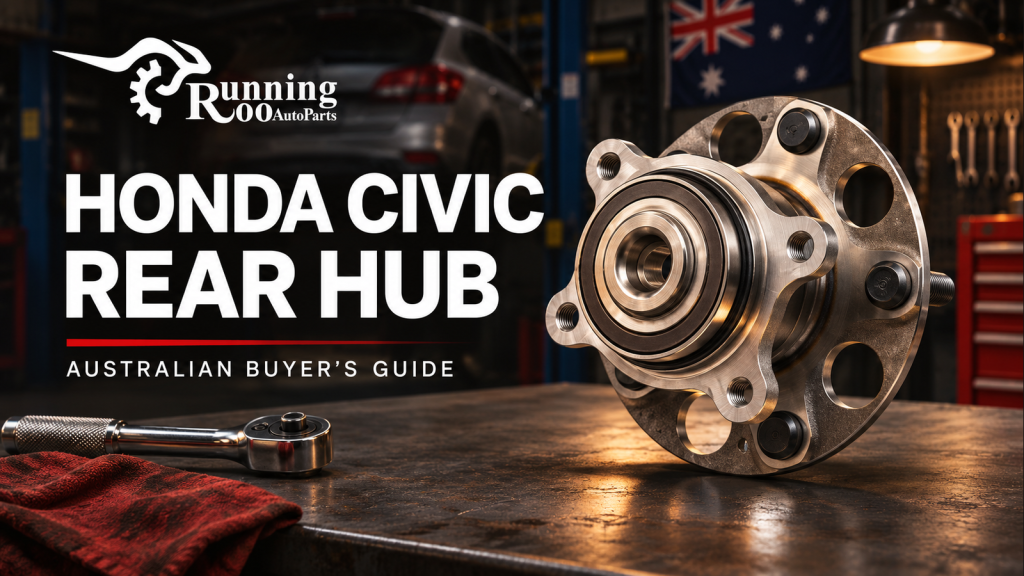
Buying a Honda Civic FD or FN rear wheel hub in Australia is easier when the enquiry starts with the actual vehicle and the number of assemblies required. A listing that mentions FD1, FD2, FD3 and FN2 is not a declaration that every Civic sold during those years uses an identical rear hub. Body style, build information and original equipment details need to accompany the model name. This guide focuses on the single rear assembly offered by RunningRoo and the checks that help a workshop order it correctly.
The current Honda Civic FD FN Rear Wheel Hub Australia at RunningRoo offer describes one rear wheel bearing hub assembly. The corresponding matching RunningRoo eBay listing provides another purchasing route for the identified item. Before checkout, compare the exact offer with your repairer’s written request, rather than treating the image as a complete repair kit. If you need help collecting the right information, call 0425 890 125. RunningRoo provides friendly Australian-operated support, Melbourne local pickup in Blackburn by appointment, and fast dispatch for confirmed available stock.

One rear hub means one repair position
The most important quantity detail is explicit: the offer is for one assembly. It is not automatically a left-and-right pair. If a workshop recommends work on both rear corners, ask it to state the quantity and identify whether the same verified reference is required at each position. An online title containing several model codes describes potential applications, not the number of parts in the carton.
Equally, buying two units should follow an agreed repair scope. A noise complaint does not establish that both sides need replacement, and this article does not recommend replacing either side without assessment. The owner’s task is to make the order match the professional recommendation. That can mean one assembly, two separately confirmed assemblies, or a different component entirely if diagnosis points elsewhere.
Ask what the workshop expects an assembly to contain. The product page says one full hub assembly, but this wording should not be stretched to include every fastening, brake component, sensor or consumable used during the job. A useful order note lists the supplied assembly separately from additional workshop materials. It also names the rear corner being repaired, so that the parts invoice can be connected to the work completed.
FD, FN and engine information belong in the enquiry
RunningRoo’s application text mentions a range of Civic configurations, including sedan and hatchback descriptions. These are seller application leads that need checking against the specific car. They are not independent Honda certification, and they should not override the VIN or a repairer’s catalogue lookup. Send the build month and year, chassis/model code, body style and any original part identification that the workshop can obtain.
Engine code still belongs in the vehicle record even though this is a wheel-end component. An engine description can help distinguish vehicles that share a registration year or badge. It is not the decisive hub specification by itself. A broad description such as “2008 Civic” leaves more uncertainty than a VIN-backed enquiry that identifies the body and variant and includes the required axle position.
Imported vehicles deserve the same care. If the car was privately imported or has a history of modifications, say so before asking for a match. A registration search or local trim name may not explain its original specification. Where a replacement suspension or wheel-end assembly was previously fitted, the professional should establish what is actually on the car and what parts information applies to the proposed repair.
Read dimensions as a check, not as permission to fit
The current retailer description contains a rounded flange measurement in one section and a more precise outside-diameter figure elsewhere. It also lists height, stud and ABS-related details. That is useful material for a supplier enquiry, but it is not enough to approve a hub solely by comparing a ruler measurement with a web page. Ask RunningRoo to confirm the current supplied unit against the workshop’s reference.
In particular, do not resolve a difference between a photograph, a rounded headline measurement and a specification table by choosing whichever looks most familiar. Record the discrepancy and request an answer. A part can appear similar while differing in a feature that matters to the installation. Conversely, packaging or photography changes can make a correct part look different. The documented match should determine the purchase.
Keep measurements taken by the workshop separate from dimensions copied from the listing. Label each source clearly in the enquiry. This gives the supplier a chance to distinguish an actual mismatch from a transcription error or a different measuring point. Avoid dismantling the vehicle at home just to obtain a measurement when the repairer can identify the requirement through the vehicle and original component records.
| Check | Useful information | Purchase decision |
|---|---|---|
| Quantity | One assembly is listed | Confirm whether the repair needs one or two units |
| Vehicle identity | VIN, build, body and FD/FN code | Match the specific configuration |
| Position | Rear axle and identified repair corner | Do not substitute a front-hub listing |
| Original reference | Workshop parts lookup or readable original marking | Verify the complete reference before ordering |
| Dimensions | Clearly labelled workshop and listing figures | Resolve differences with the supplier |
| ABS wording | Assembly features versus a separate wheel-speed sensor | Confirm exactly what is supplied |
ABS wording does not define every component in the box
The retailer description uses ABS and integral tone-ring terminology. Treat that as a reason to ask a precise question about the supplied hub, rather than assuming a separate electrical sensor and wiring harness are included. A product page can refer to a signal-generating feature as part of an assembly without supplying every adjacent component involved in the vehicle’s wheel-speed system.
For general handling context, NTN-SNR wheel bearing failure and handling guide recommends keeping wheel-bearing work clean, avoiding damage to magnetic encoder surfaces where present, using appropriate tooling and following vehicle-manufacturer tightening instructions. This guidance supports careful professional handling; it does not prove the detailed encoder construction or sensor content of this Civic offer. It is also not a substitute for Honda service information for the actual car.
Ask your repairer to identify whether the enquiry concerns a mechanical wheel-end complaint, an ABS-related complaint, or both. That distinction helps prevent an owner from purchasing a hub because a dashboard warning happened to appear. If the workshop needs a separate sensor, connector or related component, make sure it is listed separately rather than presumed to be included with this single hub assembly.
Give the workshop a clear account of the problem
Describe what you noticed in ordinary terms: when the sound began, whether it changed after tyre work, and whether a warning appeared at the same time. Avoid announcing that a particular rear bearing has failed unless the professional has confirmed it. The purpose of your observations is to help the workshop investigate, not to turn an uncertain noise description into a parts diagnosis.
A useful repair request also includes recent maintenance and previous wheel-end work. Bring the invoice if a hub, brake or suspension component was replaced earlier. This may help the workshop understand the configuration and avoid duplicating work, but a previous invoice is not proof of the current condition. Let the repairer explain which findings support replacement and which checks remain outstanding.
Ask for the recommendation in a form that can be sent to the supplier. “One rear hub assembly for this VIN, with the following reference and required accessories” is easier to fulfil than “Civic bearing noise”. If the workshop is still diagnosing, obtain a quotation without treating it as a confirmed order. A clear distinction between estimating and authorising prevents avoidable returns and delays.
Compare the complete repair cost rather than the part alone
The advertised assembly price is only one part of a workshop quotation. Ask the repairer to separate diagnosis, the hub, any required additional hardware and labour. This article does not provide a universal installed price because the vehicle, confirmed scope and workshop circumstances have not been assessed. An inexpensive component can still be the wrong purchase if it does not satisfy the actual requirement.
Review Honda Civic FD FN Rear Wheel Hub Australia at RunningRoo alongside the workshop quote. Confirm whether the repairer will supply all materials or expects you to bring the assembly. Some workshops have their own arrangements for customer-supplied parts, so settle those before buying. Retain the supplier’s written fitment response and current terms with the invoice; they are more useful than a cropped screenshot of the product title.
If you prefer the matching RunningRoo eBay listing route, check the current quantity, delivery details and terms on that offer. Do not assume a shared product photograph makes every channel’s transaction conditions identical. Keep the exact item link in your enquiry, especially if you have compared several similar Civic hubs. That makes it clear which offer the supplier has been asked to confirm.
Melbourne pickup and Australian delivery planning
For a car already booked into a Melbourne workshop, appointment-based Blackburn collection can be useful once the part match and stock are confirmed. Agree who will collect the order and what reference they should bring. Call 0425 890 125 before travelling. RunningRoo’s local support can help with the order details, while the repairer remains responsible for the vehicle-specific diagnosis and installation plan.
If you are ordering from elsewhere in Australia, provide the destination postcode and confirm current dispatch arrangements. Fast dispatch refers to handling confirmed available stock; it should not be read as a guaranteed arrival date for every suburb or regional address. Ask the workshop when it needs the component and allow room for the fitment enquiry to be resolved before the car is left waiting.
Avoid booking a non-refundable or tightly timed repair around an unconfirmed part. A better sequence is to get the workshop recommendation, verify the current offer, agree collection or delivery and then settle the installation date. Friendly Australian-operated assistance is most effective when the enquiry includes a full reference and a clear deadline, rather than only a make and model.
Receiving and documenting the assembly
On receipt, compare the package identification and quantity with the confirmed order before handing the unit to the repairer. Keep the protective packaging intact until the workshop is ready to inspect it. If a marking differs, request clarification before fitting. Do not discard the invoice or packaging because an assembly looks similar to a photograph; those records support a straightforward enquiry if a discrepancy emerges.
Ask the workshop to record the part used and the rear position repaired. Its completion report should relate to the complaint that brought the car in and the checks required by the applicable procedure. An invoice that merely says “bearing” leaves less useful history than one identifying the assembly and location. Keep the report alongside the supplier confirmation for future maintenance.
Where the repairer finds additional work necessary, ask it to explain the change in scope before more parts are ordered. A new issue discovered during a job does not automatically mean the supplied hub was wrong. The aim is a traceable decision at each stage: what was diagnosed, what was ordered, what was received and what was fitted. That record protects both the owner’s budget and the workshop’s ability to complete the repair coherently.
Frequently asked questions
Is this Civic rear hub sold as a pair?
No. The identified RunningRoo offer describes one full rear hub assembly. If the workshop needs two units, confirm both quantity and suitability before checkout. Do not infer pair supply from multiple model codes or from a photograph that shows an assembly from more than one angle.
Does the FD1 FD2 FD3 FN2 title guarantee my car fits?
No blanket guarantee is made here. The codes narrow the enquiry, while VIN, build details, body style, original reference and the required rear position establish the actual request. Treat the retailer’s application list as a starting point for checking the specific Civic.
Does ABS wording mean a separate sensor comes with it?
Not necessarily. Ask for a written explanation of the supplied assembly’s features and whether any separate sensor or wiring is included. The product wording should not be expanded into a complete wheel-speed-system package without confirmation from the seller.
Can I choose the hub by flange diameter alone?
No. Dimensions are useful comparison information, but they do not replace a vehicle and part-reference match. If listing dimensions or workshop measurements differ, resolve that before fitting. The current retailer description includes more than one way of expressing flange size, so a written check is sensible.
Can RunningRoo diagnose the noise over the phone?
A parts enquiry cannot replace inspection of the vehicle. Ask a qualified workshop to identify the required repair and then send that recommendation to RunningRoo. Friendly support can help clarify the offer, package and availability without promising that a hub will cure an unverified complaint.
Where can Australian buyers order this assembly?
Use Honda Civic FD FN Rear Wheel Hub Australia at RunningRoo or the matching matching RunningRoo eBay listing, after the vehicle and package have been confirmed. Call 0425 890 125 for order assistance, Melbourne pickup in Blackburn by appointment or dispatch enquiries. Keep the VIN, reference, quantity and workshop requirements with the order.
Related guide with a different scope
Wheel Bearing and Hub Assembly Failure: Symptoms and Replacement Guide. This covers a different component, engine or background topic. It is not an interchange claim. The specific buying decision in this article remains tied to its named product and verified vehicle requirement.
Sources and evidence boundaries
NTN-SNR wheel bearing failure and handling guide. Manufacturer information supports only the limited context described above. Retail contents and application leads come from the linked seller offers and are not independent OEM certification. Use the applicable complete service information for the actual vehicle and repair.
Review the RunningRoo product and the corresponding eBay offer, or call 0425 890 125. Contact RunningRoo with VIN, engine code and OE details for friendly Australian-operated support. Ask about Melbourne local pickup in Blackburn by appointment and fast dispatch for confirmed available stock; confirm item-specific fulfilment before booking labour.