
A Ford Ranger 2.2 timing chain repair should finish with more than a quiet engine and a box of removed parts. The owner needs to know what was found, which components were replaced, whether the original complaint has been checked again, and what to watch for after collection. For an Australian work ute, that handover also helps the next mechanic understand the repair without starting the investigation from the beginning.

This guide is for owners and workshops planning the acceptance of a confirmed timing repair. It is not a remote diagnosis or an instruction to replace every Ranger chain at a fixed distance. RunningRoo's relevant offer is a timing chain kit listed for selected 2.2 and 2.4 Duratorq applications. Suitability still depends on the actual engine, VIN, OE references and supplied configuration. Agree the diagnosis and handover requirements before ordering, so the parts purchase supports a defined job.
Start the handover record before dismantling
Write down the original complaint in the owner's words, then add the workshop's findings separately. A noise heard on the first start after overnight parking is a different observation from a noise that remains at operating temperature. Record when the concern began, whether the vehicle was recently serviced and whether any previous timing work is known. These details help the technician reproduce the complaint; they do not identify a failed chain by themselves.
Keep the initial diagnostic report with the estimate. If fault codes were present, retain their full descriptions and relevant operating information before anything is cleared. If the diagnosis relied on a mechanical inspection, ask for a short explanation of the finding and an identifying photograph where practical. A photograph should show the component and location clearly. A close-up of an unidentified worn surface can be difficult to interpret later, especially when several parts were removed together.
Match the engine actually fitted to the ute
The registration and model badge are useful starting points, but the repair record should include the VIN, build details, engine code and any known replacement-engine history. This matters when a parts title also mentions Transit, Defender or Mazda BT-50 applications. A shared family description is not a statement that every chain, guide and gear is interchangeable across those vehicles. Confirm the catalogue match for the particular engine before accepting the delivery.
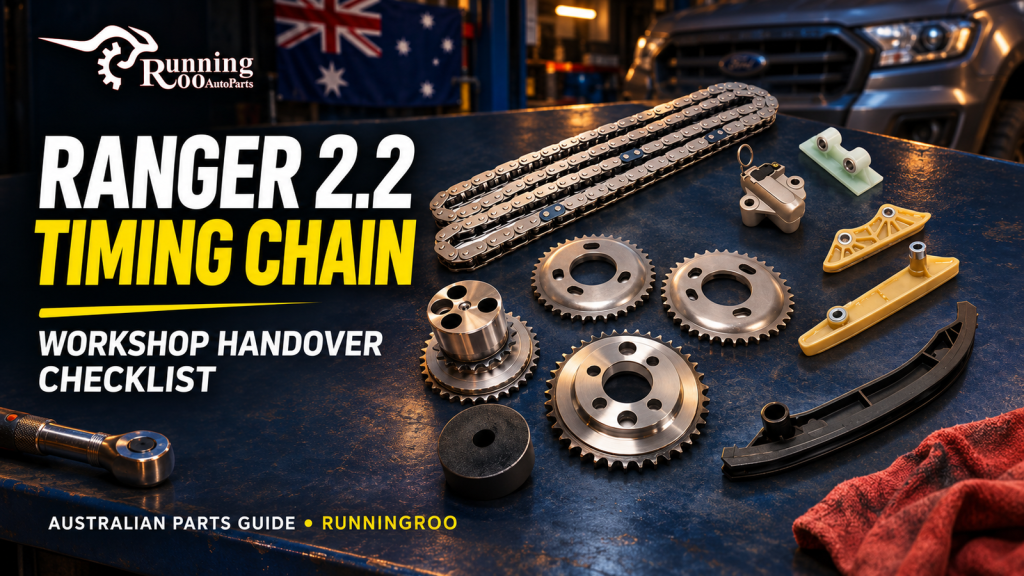
The RunningRoo product page describes one chain, one tensioner, four timing guide rails and four timing gears. The linked eBay offer currently describes two chains and five gears, with one tensioner and four guides. These published inventories differ: do not assume that the two checkout options contain an identical package. Confirm the required configuration with RunningRoo and the installer before choosing either offer. Have the mechanic compare the delivered components with the approved parts list before assembly. If a reference or shape differs, resolve it with the supplier while the parts remain clean and unused. Avoid modifying a component simply to make an uncertain application fit.
Divide the quote into diagnosis, parts and validation
A useful estimate distinguishes the investigation from the repair and the final checks. The diagnosis explains why the timing system is being opened. The parts section identifies what will be renewed. The validation section explains how the workshop will establish that the job addressed the confirmed fault. These three sections make it easier to compare quotations without assuming that the lowest parts total represents the same amount of work.
Ask which seals, fasteners, fluids and other consumables are additional to the kit. Do not assume that four supplied gears mean every component behind the cover must be changed, or that a kit includes a pump, complete cover or every single-use fastener. The workshop should use current Ford repair information to decide which parts can be retained and which must be renewed. RunningRoo can confirm the package contents; the installing mechanic determines the vehicle-specific repair scope.
| Handover item | Useful record | Why it helps |
|---|---|---|
| Vehicle identity | VIN, build details, engine code and OE references | Connects the installed parts to the actual engine |
| Original complaint | Conditions, workshop findings and diagnostic report | Provides a meaningful before-and-after comparison |
| Supplied parts | Kit item, invoice and additional consumables | Prevents a vague record of a complete kit |
| Mechanical work | Workshop confirmation against current Ford procedure | Records that assembly requirements were addressed |
| Final checks | Relevant scan results, leakage checks and complaint recheck | Separates installation from validation |
| Owner instructions | Follow-up advice and symptoms to report | Makes collection useful rather than rushed |
Ask for confirmation of the procedure, not a guessed torque sheet
The appropriate Ford workshop information should govern timing position, holding tools, fastener replacement and tightening. This article intentionally does not provide a generic sequence or tightening value. A number copied from a different Duratorq application can look precise while being inappropriate for the vehicle on the hoist. The useful handover question is whether the current procedure for the identified engine was followed, and whether any unexpected condition changed the original plan.
A workshop can record that confirmation without supplying every internal work instruction. For example, its job card might identify the repair information used, the components installed and any additional issue found during access. This creates accountability while recognising that the repair is professional work. If the owner supplies the kit, agree beforehand how the workshop handles a mismatch or missing consumable. Making that arrangement before dismantling reduces pressure to improvise later.
Make the oil information specific and traceable
Ford's Australian Ranger owner manual identifies the relevant Duratorq diesel engine variants and provides oil checking and specification guidance. Its maintenance advice includes checking on level ground, using the specified oil and avoiding overfilling or unapproved additives. The manual is an owner reference for its stated build range, not a timing-chain installation manual. Consult the edition that applies to the vehicle rather than transferring a specification from another market or model year. Ford Ranger Australian owner manual, June 2015
At collection, ask the workshop to record the oil product and specification used if an oil change formed part of the repair. A note saying only fresh oil leaves an avoidable gap in the history. Also record the filter and any subsequent service advice. Do not add a thickener, flushing product or other treatment to make a remaining noise less noticeable without discussing it with the mechanic. A changed sound is not equivalent to a confirmed mechanical repair.
Recheck the actual complaint under suitable conditions
If the original concern occurred after an overnight stop, a brief warm start immediately after assembly may not reproduce the relevant condition. Discuss what validation is reasonable before the vehicle is collected. The workshop may need time for a further start, a controlled assessment or a road check appropriate to the repair. The owner should not feel obliged to collect the vehicle before the agreed verification has been completed simply because the new chain has been installed.
Equally, do not set an unrealistic requirement that all engine sound must disappear. A diesel engine contains multiple sources of normal and abnormal noise, and a timing repair is not a promise to renew every part of the engine. Ask whether the specific diagnosed concern is resolved and whether any separate observation remains. If another noise needs investigation, it should be described honestly on the handover record rather than folded into an unsupported claim that the entire engine is now perfect.
Keep scan results in context
A final scan can be useful evidence, but a screen with no stored codes is not a complete mechanical inspection. Ask the mechanic to explain what was checked and whether the relevant operating conditions were reached. If an unrelated historical code remains, it should be identified as such. Clearing all records without retaining the original report makes a later comparison harder and can leave the owner uncertain about what the workshop actually repaired.
The same principle applies to a road test. A successful short drive is useful within its conditions, but it cannot guarantee every future operating state. The handover should say what was done without exaggeration. Owners who use the ute for work can then plan its return to service around the mechanic's actual advice. Do not invent a universal running-in distance or towing restriction for every chain replacement; those instructions need to come from the applicable procedure and the repairing workshop.
Photograph the parts without losing their identity
When practical, ask for a photograph of the delivered kit before installation and of significant removed components. Keep the product reference and invoice with those images. If the workshop identifies a damaged guide, its location and relationship to the job should be recorded. A collection of loose parts on a bench is less useful if nobody can later explain which item came from the vehicle and which was a spare from the package.
Retain removed parts only by agreement with the workshop and in a safe, suitable container. The purpose is traceability, not a substitute for professional inspection. Avoid posting a photograph online and treating a stranger's guess as stronger evidence than a documented examination. If a supplier enquiry becomes necessary, clear photographs and the mechanic's explanation are generally more useful than a short message saying that the new kit did not fix the car.
Plan collection around parts confirmation
For Melbourne customers, local pickup from RunningRoo in Blackburn VIC is by appointment. Arrange the collection after the product match and current stock are confirmed. For an interstate workshop, ask about dispatch options and the delivery address before booking a tightly timed installation. Fast dispatch and a carrier's delivery time are different parts of the process; neither should be converted into an unconditional promise that a vehicle will be ready on a particular day.
Send the same identification information to the supplier and the installer. A mechanic who has approved one specific kit should not receive a different package selected later because the title looks similar. If the scope changes after inspection, update the parts list and authorisation together. This keeps a practical repair moving while protecting the owner from paying for components that were never shown to be needed.
Related RunningRoo reading: Ford Ranger 2.2 TDCi Timing Chain Kit Guide. That article addresses a related but separate question or application; it does not establish interchangeability with this product.
An example of a clear collection conversation
Consider a hypothetical owner who reports a start-up concern and authorises a workshop-confirmed timing repair. At collection, the mechanic explains the original finding, identifies the kit and additional seals, confirms that the applicable assembly procedure was used, and describes the complaint recheck. The owner receives the invoice, relevant diagnostic records and follow-up advice. This is an example of useful documentation, not a claim about a particular customer's vehicle or a standard outcome for every Ranger.
If the original complaint remains, the conversation changes. The workshop should explain the evidence, what has been ruled out and what investigation is proposed next. The owner can then make an informed decision. Ordering another component because the first repair was expensive is not a diagnostic strategy. RunningRoo's role is to help supply the correctly identified parts and answer package questions, with friendly Australian support when the workshop needs additional information.
Frequently asked questions
Is a quiet engine enough to sign off a timing-chain job?
It is encouraging, but the handover should relate to the original diagnosis and the checks actually completed. Ask what components were changed, whether the relevant complaint was reproduced again and whether any separate concern remains. A quiet warm idle alone should not be presented as proof that every possible timing or engine issue has been eliminated.
Does the advertised Ranger kit automatically fit my 2.2 diesel?
No. Confirm the VIN, build details, engine code and OE references against the actual supplied kit. Titles can cover several vehicles and engine versions. The workshop should approve the configuration before installation, especially when a replacement engine or previous timing repair may have changed what is fitted to the vehicle.
Should every timing gear in the box be installed?
That decision belongs to the applicable repair procedure and the workshop's findings. First establish that the package is correct, then confirm the planned scope. Do not use a parts count as a diagnosis. Likewise, do not assume that a component can safely be retained simply because it is not included in the chosen kit.
Does a chain repair require special oil additives?
Do not assume so. Use the oil specification and maintenance instructions applicable to the vehicle, and discuss any proposed treatment with the mechanic. Ford's owner guidance cautions against oil additives and engine treatments. Keep the oil details on the invoice so later servicing can follow the correct history rather than a guess.
What should I send RunningRoo before collecting the kit?
Provide the VIN, engine code, build details, complete OE references and the mechanic's diagnosis or parts request. Include clear photographs where identification is uncertain. Confirm current package contents and stock before arranging Melbourne local pickup. This is particularly useful if the car is already dismantled and the workshop needs a specific configuration.
Can RunningRoo arrange Australian supply for my workshop?
Ask about current stock, dispatch options and the destination before scheduling the job. RunningRoo is Australian-operated and offers friendly support and Melbourne pickup by appointment. Call 0425 890 125 to discuss the exact listing. Delivery arrangements support the repair plan, but the installing workshop remains responsible for diagnosis, installation and validation.
Related RunningRoo video
Timing Chain Rattle: Wear Symptoms & When to Replace | RunningRoo. This channel video provides related educational context. It is not proof that the filmed component is the exact supplied item, a vehicle-specific diagnosis or a substitute for current manufacturer procedures.
Sources and scope
Offer and stock information checked on 16 November 2026. Retailer descriptions identify the offered contents; the manufacturer sources support the technical points attributed to them within their stated market and model scope. The purchasing examples and suggested questions are editorial guidance. Use current vehicle-specific manufacturer information and professional diagnosis for the actual repair.