
By RunningRoo Auto Parts — written from the desk of our Product Manager
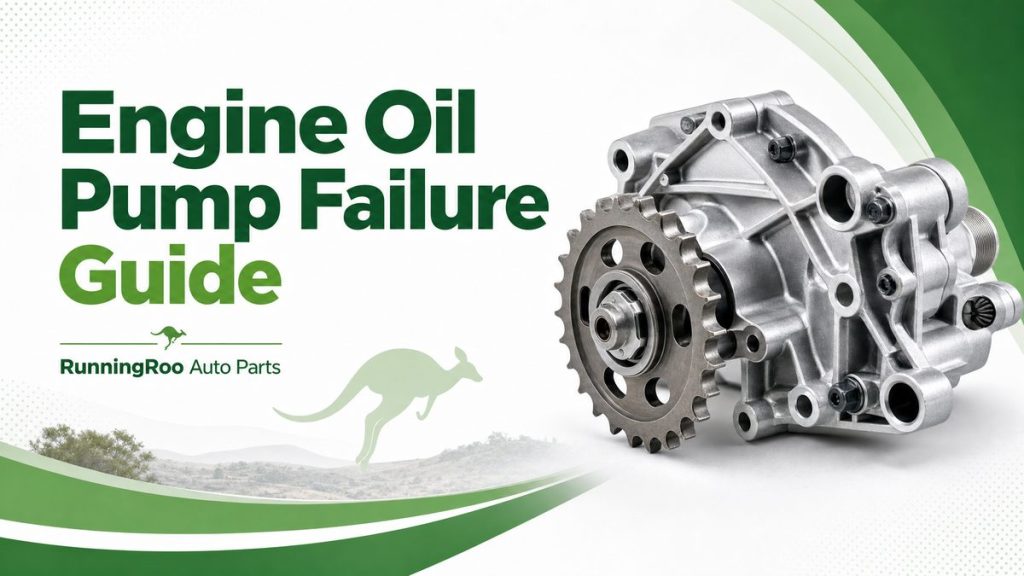
The engine oil pump is the heart of the lubrication system, and when it weakens, every bearing in the engine suffers. A failing pump rarely announces itself loudly at first — often the first signs are a flickering oil-pressure light, a noisy valve train or a drop in pressure at hot idle. Because the damage it causes is internal and expensive, an oil-pressure problem is one of the few faults that should never be ignored. This guide explains how the oil pump works, how to recognise a failing one and how to plan the repair, including the drive chain and sprockets that should be renewed at the same time.
RunningRoo Auto Parts – Based in Melbourne, Australia 🇦🇺
Free 24/7 Pickup Available (Contact 0425890125)
Any questions? Message or Call us anytime! We’re here to help.
Why Choose RunningRoo?
Aussie Owned & Operated | Fast Shipping | Friendly Support
What the oil pump does
The oil pump draws oil from the sump and forces it through the filter and the oil galleries to the bearings, camshafts, turbocharger and, on modern engines, the variable valve timing system and the timing chain tensioner. Most pumps are gear or rotor pumps driven directly by the crankshaft or by a separate chain, and their output pressure is regulated by a pressure-relief valve.
Because the pump handles the full flow of oil at all engine speeds, its clearances are tight and it is sensitive to contamination. Dirt, metal particles and sludge wear the rotors and housing, the relief valve can stick, and the clearances open up until the pump can no longer build pressure at low engine speed. At that point the oil-pressure warning appears, usually at hot idle first.
The symptoms of a failing oil pump
The most important symptom is a low oil-pressure warning light that flickers at idle or illuminates at low engine speed, particularly when the engine is hot. A worn pump is often accompanied by increased engine noise — a rattling valve train or a deep knocking from the bottom end — because the bearings are no longer being fed properly. Variable valve timing and timing-chain tensioners, which depend on oil pressure, may also become noisy or set fault codes.
These symptoms can also be caused by low oil level, a blocked filter or a faulty pressure switch, so a pressure test with a mechanical gauge is the essential next step. The table below separates the causes.
| Symptom | Likely cause | First check |
|---|---|---|
| Oil light at hot idle | Worn pump or thin oil | Check level; test pressure with a gauge |
| Rattling valve train | Low pressure to top end | Test pressure; inspect pump |
| Knocking from bottom end | Serious bearing wear | Stop driving; professional inspection |
| VVT / tensioner noise | Low oil pressure | Test pressure; check oil |
| Pressure drops as engine warms | Pump wear opening clearances | Gauge test at hot idle |
Diagnosing oil pressure properly
Never condemn the pump on the warning light alone. Check the oil level and condition first, because low or heavily diluted oil can drop the pressure without any pump fault. Screw a mechanical gauge into the pressure switch port and compare the readings with the manufacturer’s specification at idle and at higher engine speed. If the pressure is below specification with fresh oil of the correct grade, the pump or its relief valve is the likely cause.
If the pump is chain-driven, the drive chain, tensioner and sprockets should be inspected at the same time, because a stretched or failed drive chain produces the same low-pressure result and is often the true culprit on engines where the pump is driven separately from the timing chain.
What the repair involves
Replacing an oil pump is usually a sump-off job, and on some engines the front cover, timing chain or balance shafts must also be removed to reach it. Because the labour is significant, the sensible approach is to renew everything in the oil-pump drive path while you are there — the pump, the drive chain and sprocket, the tensioner and the seals — rather than replacing the pump alone and paying the labour twice if the chain fails later.
After fitting the pump, the engine must be primed before starting so it is not started dry, and the oil and filter should be changed with the correct specification oil. The engine should then be run and the pressure confirmed with the gauge before it is returned to service.
Preventing oil pump failure
The best protection for an oil pump is clean oil at the correct level and grade, changed on schedule. Sludge and metal particles are the pump’s enemies, so a car that has run long intervals on the wrong oil is far more likely to suffer pump wear. Addressing any oil-pressure warning immediately is equally important, because the pump is cheap compared with the engine it protects.
At RunningRoo we supply complete oil pumps and oil-pump drive chain kits for the popular BMW, Mercedes-Benz, Nissan, Mitsubishi, Honda, Hyundai and VW/Audi applications on Australian roads, so owners can buy a quality kit at trade pricing and have their preferred workshop fit it.
Gear pumps, rotor pumps and drive types
Oil pumps come in a few designs, and the type affects how they wear and how they are driven. A gear pump uses two meshing gears to move oil, while a rotor or gerotor pump uses an inner and outer rotor. Both work well, but both are precision components with tight clearances, so any dirt or metal particle that passes through them accelerates wear. The pressure-relief valve, which opens to limit maximum pressure, is a common wear point on both designs because it can stick or lose tension.
The drive arrangement matters for the repair. On many engines the pump is driven directly by the crankshaft, so the pump nose and its seal are the only wear items. On others the pump is driven by a separate chain from the crankshaft, in which case the chain, tensioner and sprocket wear with the pump and should be renewed together. On some engines the pump is integral with the balance-shaft assembly, which makes the job larger and the correct fitment even more important.
Reading oil pressure the right way
Oil pressure is not a single number — it changes with engine speed and temperature, so a correct reading means comparing the gauge against the specification at both cold idle and hot idle, and at higher revs. Pressure that is fine when cold but drops below specification when hot points to pump wear opening the clearances, or to oil that is too thin. Pressure that is low at all speeds suggests a relief valve stuck open, a blocked pickup or a worn pump.
Because the warning switch only triggers at a low threshold, a mechanical gauge test reveals problems long before the light comes on. If you are chasing a suspected pump fault, this gauge reading is the single most valuable piece of information, and it is worth doing before any parts are ordered.
Priming the pump and confirming the repair
After a new oil pump is fitted, the engine must not be started dry. The pump, its pickup and the galleries need to be primed with oil, either by packing the pump with assembly lubricant or by cranking the engine with the fuel or ignition disabled until oil pressure builds on the gauge. Starting an engine immediately after a pump replacement can spin the bearings without oil for the first critical seconds and undo all the good work.
Once primed, start the engine and confirm the pressure with a mechanical gauge at idle and at higher revs, comparing the readings against the specification. Listen for any unusual noise from the valve train and check for leaks around the sump and pump before refitting the undertray. Only return the car to service when the pressure is correct and stable and the low-pressure light stays off.
This confirmation step is the difference between a repair that is known to be right and one that is assumed to be right. Because the whole point of the job is to protect the bearings, taking the extra minutes to verify pressure properly is never wasted time.
Frequently asked questions
What are the symptoms of a failing oil pump?
A low oil-pressure light at hot idle, a noisy valve train, VVT or tensioner noise, and in severe cases a knocking bottom end.
Can a bad oil pump cause a low oil-pressure light?
Yes, although low oil level, a blocked filter or a faulty pressure switch can cause the same light, so the pressure should be checked with a mechanical gauge.
Do I need to replace the oil pump drive chain too?
Usually yes. On engines with a separate oil-pump chain, the chain, tensioner and sprocket wear together with the pump and should be renewed at the same time.
How much does an oil pump replacement cost in Australia?
It depends on access, but because the sump or timing cover must usually come off, labour is significant. A quality pump and drive-chain kit keeps the parts cost reasonable.
Can I drive with a low oil-pressure light on?
No. Stop as soon as it is safe. Low oil pressure can destroy the bearings in seconds, so treat it as an emergency.
What is the difference between a gear pump and a rotor pump?
Both are positive-displacement designs that move oil, just with different internal rotors. They fail in the same ways through clearance wear, contamination or a sticking relief valve.
Does oil pressure change with engine temperature?
Yes. Pressure is higher when the oil is cold and thick, and it drops as the oil warms and thins. A pressure that falls below specification at hot idle is a classic sign of pump wear.
Does a new oil pump need to be primed?
Yes. The pump and galleries must be primed with oil before the first start, or the bearings can spin without lubrication for the critical first seconds.
Can a blocked oil filter cause low oil pressure?
Yes. A blocked filter or a stuck pressure-relief valve can drop the pressure, which is why the filter and oil are checked before the pump is condemned.
Shop the parts mentioned in this guide
- Engine Oil Pump 1211A039 for Mitsubishi Delica / Outlander / Lancer / ASX 2007–2017
- Oil Pump with O-Rings for Dodge Journey JC 2.7L 2009–2010
- Oil Pump Chain Drive Set for BMW N52 / N55 / S55, X5 / X6 / 335i / 640i 3.0L
- Engine Oil Pump Drive Chain Set for Mercedes-Benz M272 / M273 / M276
Watch on RunningRooAuto YouTube
- RunningRoo Auto Parts – trusted Melbourne parts support
- RunningRoo Auto Parts – product and fitment channel
RunningRoo Auto Parts – Based in Melbourne, Australia 🇦🇺
Free 24/7 Pickup Available (Contact 0425890125)
Any questions? Message or Call us anytime! We’re here to help.
Why Choose RunningRoo?
Aussie Owned & Operated | Fast Shipping | Friendly Support
Sources and further reading
- Oil pump (internal combustion engine) — Wikipedia
- Bosch — automotive lubricating systems
- RACV — car maintenance and repair guidance
- CarsGuide — Australian motoring advice
RunningRoo Auto Parts – Based in Melbourne, Australia 🇦🇺
Free 24/7 Pickup Available (Contact 0425890125)
Any questions? Message or Call us anytime! We’re here to help.
Why Choose RunningRoo?
Aussie Owned & Operated | Fast Shipping | Friendly Support