
By RunningRoo Auto Parts — written from the desk of our Product Manager
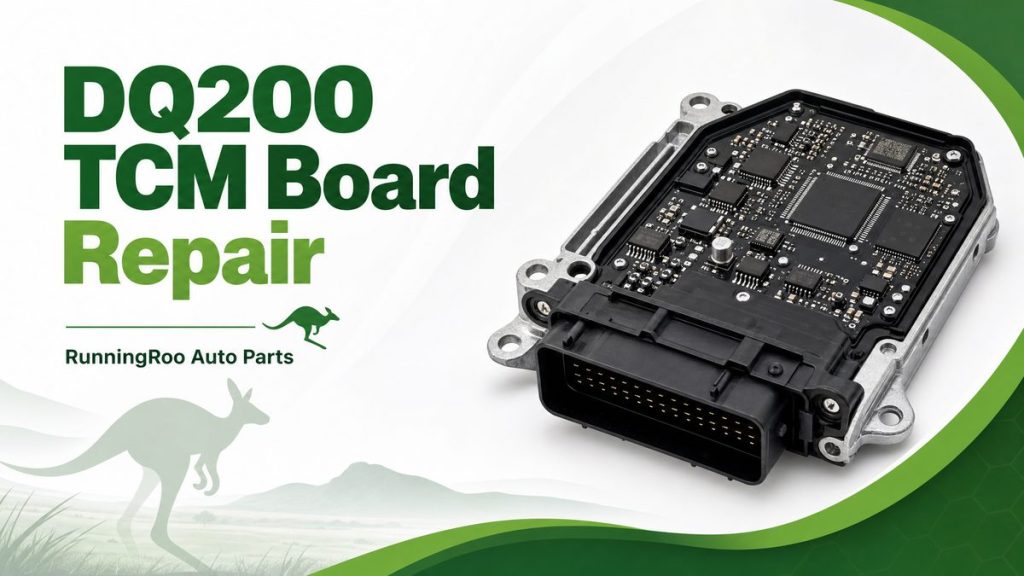
Inside every DQ200 mechatronic unit sits a small electronic board that is the gearbox’s brain — the TCM, or transmission control module, often called the TCU. It reads the gearbox sensors, commands the solenoids and talks to the rest of the car over the CAN network. When this board fails, the gearbox can go dead, throw communication faults or refuse to start correctly. The board is the electronic half of the DQ200 mechatronic, and understanding it separately from the hydraulic valve body is the key to a cost-effective repair. This guide explains what the TCM board does, how to recognise a failing one and how to replace or repair it.
RunningRoo Auto Parts – Based in Melbourne, Australia 🇦🇺
📞 Free 24/7 Pickup Available (Contact 0425890125)
💬 Any questions? Message or Call us anytime! We’re here to help.Why Choose RunningRoo?
✅ Aussie Owned & Operated | 🚚 Fast Shipping | 🤝 Friendly Support
What the TCM computer board does
The TCM board is the electronic controller mounted to the DQ200 mechatronic. It reads the input-speed, output-speed, pressure and temperature sensors, drives the hydraulic solenoids and shift forks, and communicates with the engine control unit and other modules over the CAN bus. It also stores the gearbox coding and the learned values for clutch and fork adaptation.
Because the board is sealed inside the gearbox and works in hot, vibrating conditions, its failures are usually electronic: cracked solder joints, failed memory, corrupted firmware, failed CAN transceivers or water damage through the connector. Unlike the hydraulic valve body, which wears mechanically, the board tends to fail suddenly and completely.
The symptoms of a failing TCM board
The most common symptom is a gearbox that stops working with a “lost communication with TCM” code, or a car that will not start because the modules cannot see the gearbox controller. Other symptoms include coding or component-protection faults after a battery change, permanent limp mode, and random or intermittent gearbox faults that come and go.
| Symptom | Likely cause | First check |
|---|---|---|
| Lost communication with TCM | TCU board or wiring | Check connector; test power and ground |
| Coding / component protection fault | TCU memory or coding | Re-code; test the board |
| Gearbox dead, no fault codes | TCU board failure | Bench-test the TCU |
| Intermittent gearbox faults | TCU board or connector | Inspect connector for corrosion |
Repair or replace the board?
A TCM board can sometimes be repaired at board level — reflowing cracked solder joints, replacing failed components or reflashing corrupted firmware — but this is specialist electronics work and is not always reliable. For most Australian owners, the practical choice is a tested or remanufactured TCU with the correct part number, fitted and coded correctly.
Because the board is coded to the vehicle and protected by Volkswagen’s component-protection system, a replacement TCU must be matched to the car before it will work. Confirm the coding path and part number before ordering, and buy from a supplier who tests the board and offers a warranty.
The part numbers that matter
The DQ200 TCU is identified by the mechatronic part number, commonly 0AM927769D, 0AM927769E, 0AM927769G or 0AM927769K, with the later 0CW units on newer models. The index letter matters, as does the software version, so always match the number on your original unit and confirm the generation with your workshop.
Fitting and coding the TCU
Replacing the TCU means removing the mechatronic or separating the electronic module from the valve body, depending on the generation. After fitting, the unit must be coded, component protection removed, and a basic-settings routine run so the gearbox re-learns the clutch and fork positions. Skipping this stage is the most common reason a new TCU still leaves the gearbox in limp mode.
For most owners, the sensible approach is to buy a quality, tested TCU and have a VW gearbox specialist fit and program it. That way you pay trade pricing for the part while leaving the coding and adaptation to someone who does it every day.
Board-level repair explained
Board-level repair of a DQ200 TCM means opening the electronic module and fixing the circuit board itself — reflowing cracked solder joints, replacing failed components or reflashing corrupted firmware. It is specialist work that requires electronics experience, the correct components and a clean environment, and it is not always reliable because the fault can return.
For most owners, the practical choice is a tested or remanufactured TCU with the correct part number, fitted and coded correctly. A remanufactured board is rebuilt with new components and re-tested, which is usually more dependable than a one-off repair on an old board.
The most common TCM fault codes
The codes that point to the DQ200 TCM are stored in the transmission controller. “Lost communication with TCM” means the other modules cannot see the gearbox controller, which is usually the board, its connector or the wiring. Coding or component-protection faults point to the board’s memory or coding, while random gearbox faults that come and go often indicate an intermittent board or connector problem.
Reading the transmission controller’s own codes, not just the engine codes, is the key step, because the engine computer often stores only a generic transmission fault. A bench test of the TCU is the reliable way to confirm a board fault before spending on a replacement.
Component protection and coding
The DQ200 TCU is tied to the vehicle by Volkswagen’s component-protection system and stores the gearbox coding. A replacement board must be unlocked, coded and adapted using a suitable diagnostic tool such as VCDS or ODIS, and a basic-settings routine must be run so the gearbox re-learns the clutch and fork positions.
This coding stage is not optional, and it is the most common reason a replacement TCU still leaves the gearbox in limp mode. Factor the coding and adaptation labour into the budget, and have a specialist handle the programming if you are not confident with diagnostic tools.
Frequently asked questions
What is the difference between a TCM and a TCU?
They are the same thing on the DQ200 — the transmission control module (TCM) and transmission control unit (TCU) both refer to the electronic board that controls the gearbox.
What are the symptoms of a bad TCM board?
Lost communication faults, a dead gearbox, coding or component-protection faults, permanent limp mode, and intermittent gearbox faults.
Can a TCM board be repaired?
Sometimes, through board-level electronics work or a firmware reflash, but a tested or remanufactured TCU is usually more reliable.
Does a new TCM need coding?
Yes. It must be coded to the vehicle, component protection removed, and basic settings run before it will work correctly.
Which part number do I need?
Match the number on your original unit — commonly 0AM927769D, 0AM927769E, 0AM927769G or 0AM927769K — and confirm the 0AM or 0CW generation.
Can I reflash a TCM board myself?
Reflashing requires specialist tools and firmware, and a failed flash can brick the board. It is best left to a specialist.
What does “lost communication with TCM” mean?
It means the other vehicle modules cannot communicate with the gearbox controller, usually caused by the TCM board, its connector or the wiring.
Key takeaways
The TCM board is the electronic brain of the DQ200 gearbox, and its failure usually shows as a communication fault, a coding fault or a dead gearbox. Confirming the fault with a scan and a bench test before ordering, matching the part number and generation, and completing the coding and basic settings after fitting are the keys to a reliable repair.
For most owners the best value is a remanufactured or tested TCU with a written warranty, fitted and programmed by a VW specialist. That avoids the unreliable gamble of an untested board while keeping the parts cost well below a dealer unit.
How to confirm the right TCU before ordering
The TCM board must match the mechatronic part number and the vehicle’s software, so gather the part number from your original unit, the VIN and the build year, and confirm them with the supplier. The index letter — D, E, G or K — matters, as does the 0AM or 0CW generation, because the software and hardware revisions are not interchangeable.
Confirm whether the board is supplied tested or remanufactured, whether it is supplied in a state your workshop can code, and what warranty applies. Clarifying these details before ordering prevents the most common cause of a replacement TCU failing to work: a part-number or coding mismatch.
TCM fault or wiring fault?
Before condemning the TCM board, the wiring and connector must be checked, because a corroded or loose connector produces exactly the same “lost communication” symptoms. Inspect the gearbox connector for corrosion, water ingress and bent pins, and check the power and ground at the TCU before assuming the board is dead.
A quick way to separate the two is a bench test of the TCU, or swapping in a known-good board with the correct coding. If the wiring is sound and the board fails a bench test, the board is the culprit; if the board tests good, the fault is elsewhere in the harness or the vehicle’s network.
Choosing a remanufactured TCM
A remanufactured TCM is a used board that has been disassembled, repaired with new components and re-tested to a written procedure. It is usually the best balance of price and reliability, because the known failure points have been addressed and the board is verified before dispatch. A tested used board is cheaper but has not been rebuilt, so its remaining life is unknown.
Whichever you choose, buy from a supplier who states the part number, describes what was repaired or tested, and offers a warranty. The cheapest untested board is a false economy on a part that requires coding and labour to fit.
Will a second-hand TCM work without coding?
No. Component protection and vehicle coding mean the board must be matched to the car before it will operate normally.
How do I protect a new TCM board?
Keep the gearbox oil clean, ensure the connector is sealed and free of moisture, and avoid jump-starting or battery problems that can spike the electronics.
How long does a DQ200 TCM replacement take?
The physical fit is usually quick, but the coding and basic-settings routine can add an hour or more, so plan for a half-day at a specialist workshop.
Shop the parts mentioned in this guide
- DQ200 0AM Transmission Control Module (TCU) for Audi / VW 0AM927769D
- DQ200 0AM TCU 0AM927769K for Audi / VW — eBay
- DQ200 0AM Transmission Control Module (TCU) 0AM927769K — eBay
- 0CW DQ200 7-Speed DSG Mechatronic (Valve Body & TCU) 0AM927769K
Watch on RunningRooAuto YouTube
- RunningRoo Auto Parts – trusted Melbourne parts support
- RunningRoo Auto Parts – product and fitment channel
RunningRoo Auto Parts – Based in Melbourne, Australia 🇦🇺
📞 Free 24/7 Pickup Available (Contact 0425890125)
💬 Any questions? Message or Call us anytime! We’re here to help.Why Choose RunningRoo?
✅ Aussie Owned & Operated | 🚚 Fast Shipping | 🤝 Friendly Support
Sources and further reading
- Direct-shift gearbox — Wikipedia (DQ200 0AM)
- BorgWarner — transmission control systems
- Volkswagen Australia
- RACV — car maintenance and repair guidance
RunningRoo Auto Parts – Based in Melbourne, Australia 🇦🇺
📞 Free 24/7 Pickup Available (Contact 0425890125)
💬 Any questions? Message or Call us anytime! We’re here to help.Why Choose RunningRoo?
✅ Aussie Owned & Operated | 🚚 Fast Shipping | 🤝 Friendly Support