
By RunningRoo Auto Parts — written from the desk of our Product Manager
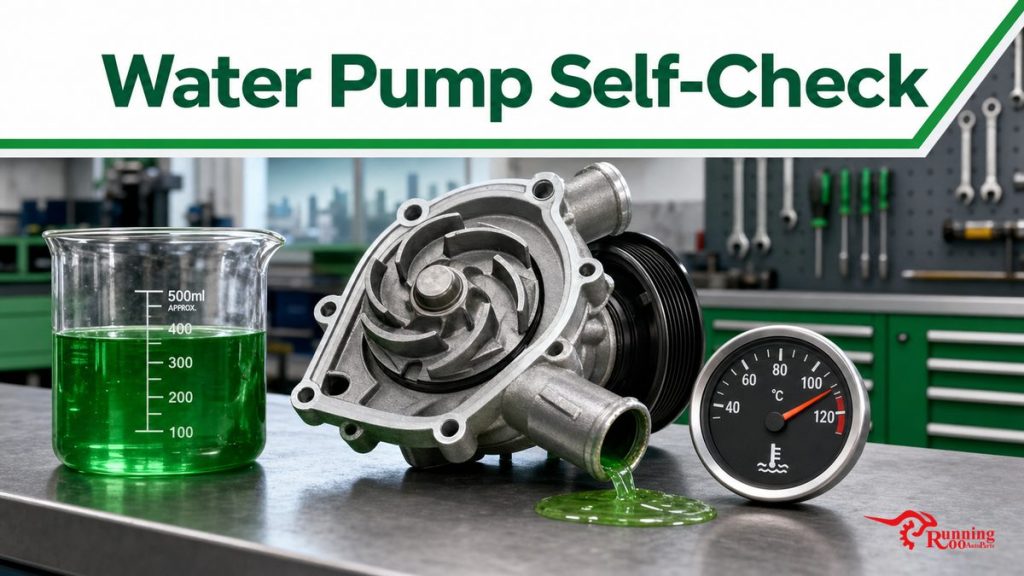
The water pump is buried in the cooling system, but it announces its condition through three things you can check without removing a single part: a leak, a noise and a temperature. A careful look at the coolant level, a listen around the front of the engine and a watch on the temperature gauge will catch most water pump problems at the cheap stage, long before the engine overheats.
This guide lists the water-pump checks an owner can do at home, what each finding means, and when the job needs a workshop. It is written for Australian owners who have spotted a stain, heard a noise or seen the gauge move.
RunningRoo Auto Parts – Based in Melbourne, Australia 🇦🇺
📞 Free 24/7 Pickup Available (Contact 0425890125)
💬 Any questions? Message or Call us anytime! We’re here to help.Why Choose RunningRoo?
✅ Aussie Owned & Operated | 🚚 Fast Shipping | 🤝 Friendly Support
The three checks, and why they matter
The water pump fails through its seal, its bearing or both, and the three home checks map directly onto those failure modes. A coolant leak points to the seal, a rumbling or whining noise points to the bearing, and a rising temperature gauge points to the failure of either one affecting circulation. Together they cover the whole problem.
The table below maps each check to its likely meaning.
| Check | What it can reveal |
|---|---|
| Coolant level and leaks | A failing seal |
| Front-of-engine noise | A failing bearing |
| Temperature gauge | Lost circulation or coolant |
Doing all three gives you a clear picture before you call the mechanic.
Checking the coolant level and leaks
The first check is the coolant. Look at the level in the reservoir when the engine is cold, and look under and around the front of the engine for a drip, a dried stain or a crust of coolant. Coolant is usually green, pink or orange and has a sweet smell, and a slowly dropping level is the classic sign of a small pump seal leak.
The weep hole under the pump is designed to leak slightly as a warning before the seal fails completely, so a small drip there is a signal to investigate, not just to top up and forget.
Listening for a bearing noise
The second check is a listen. Start the engine and listen around the front for a rumbling, whining or grinding noise that changes with engine speed. That sound points to a worn water-pump bearing, and it will usually get louder over time as the bearing wears further.
The table below summarises what the noise can mean.
| Noise | Likely meaning |
|---|---|
| Rumble or whine | Water-pump bearing wear |
| Grinding | Advanced bearing failure |
| Noise that changes with speed | A rotating component, likely the pump |
A new noise that was not there before is always worth having checked.
Watching the temperature gauge
The third check is the temperature gauge. A gauge that creeps higher than normal, especially in traffic or under load, is the engine telling you the cooling system is struggling. By the time the gauge rises, the leak or the bearing failure has already begun to affect circulation, so this is the late warning rather than the early one.
The gauge is a lagging indicator, which is why the leak and the noise are the better early checks. If the gauge has already moved, the problem is further along than it needed to be.
The signs that need a workshop
Some findings need a workshop rather than more home observation. A visible coolant leak, a new bearing noise, a gauge that climbs, or a low-coolant warning on the dash are all reasons to have the cooling system pressure-tested and the pump inspected. The pressure test finds the exact source of a leak, and the inspection confirms the pump rather than guessing.
The table below lists the workshop triggers.
| Finding | Action |
|---|---|
| Visible leak or dropping level | Pressure test |
| New front-end noise | Inspect the pump |
| Climbing gauge | Diagnose promptly |
| Low-coolant warning | Check and pressure test |
Catching these early keeps the repair at the pump stage rather than the head-gasket stage.
What you can and cannot confirm at home
At home you can spot a leak, hear a noise and watch the temperature, but you cannot pressure-test the system or inspect the pump’s bearing play without access. The home check is a screening exercise that tells you something is wrong and gives you the information to describe it, while the workshop’s pressure test and inspection are what confirm the pump.
Knowing that boundary is how you use the home check properly: as the first step, not the whole diagnosis.
Keeping the cooling system healthy
The same habits that catch a failing pump also protect it. Keep the coolant at the correct level and specification, renew it on the manufacturer’s interval, and investigate the first stain, noise or temperature rise. On a timing-belt engine, budget the pump into the belt service rather than waiting for it to fail on its own.
The coolant’s condition matters as much as its level, because its corrosion protection and lubricating properties are what keep the pump seal alive. A well-maintained cooling system is the cheapest insurance against the roadside breakdown and the engine damage that follow neglect.
Checking a mechanical versus an electric pump
The home checks change slightly depending on whether the pump is mechanical or electric. A mechanical pump leaks from its seal and rumbles from its bearing, so the coolant check and the listen are the right tools. An electric pump may fail through its motor or control module and announce itself with a stored cooling-fault code instead of a visible leak, so a scan is the first check.
Knowing which type your car has changes where to look first. The symptoms that matter are the same, but the order in which they are checked is different.
A quick home checklist
The whole home check fits into a short list: check the coolant level and look for leaks, listen around the front for a new noise, watch the temperature gauge, and scan for any stored cooling-fault code on an electric-pump engine. Run through those steps and you will know whether the cooling system needs a workshop.
The table below summarises the checklist.
| Step | What to look for |
|---|---|
| Coolant and leaks | Low level, drip or stain |
| Front-end listen | Rumble, whine or grind |
| Temperature gauge | Creeping higher than normal |
| Scan (electric pump) | Stored cooling code |
That list turns a vague worry into a clear picture before the phone call.
The bottom line
The water pump is a small part protecting a large engine, and its warnings are easy to spot once you know what to look for. A leak, a noise and a temperature rise are the three signals, and acting on the first one keeps the repair at the price of a pump rather than the price of an engine.
Check the coolant, listen to the front of the engine, watch the gauge, and the pump will rarely surprise you.
A simple rule to remember
If there is one rule for the water pump, it is that the leak, the noise and the temperature are the same warning in three forms, and the first one you notice is the cheapest time to act. The pump does not heal itself, and every kilometre with a failing seal or bearing moves the repair closer to an overheating engine.
Check the coolant, listen to the front of the engine and watch the gauge, and you will catch the pump at the stage where a replacement is a small job rather than the start of a much larger one.
A final word
The water pump is one of the easier components to stay ahead of, because its three warnings are all things you can check at home in a few minutes. The leak, the noise and the temperature are the pump’s way of telling you it is on the way out, and the first one you notice is the cheapest time to act.
Build the three checks into your routine, and the pump will rarely make the decision for you at the side of the road.
A note to close
The water pump’s three warnings are all within reach of a quick home check, and the first one you notice is the cheapest time to act. Check the coolant, listen to the front of the engine and watch the gauge, and the pump will rarely make the decision for you.
Frequently asked questions
What are the three water pump checks I can do at home?
Check the coolant level and leaks, listen for a bearing noise, and watch the temperature gauge.
What does a coolant leak mean?
Usually a failing pump seal, often showing as a drip from the weep hole or a dried stain.
What does a bearing noise sound like?
A rumbling, whining or grinding noise from the front of the engine that changes with speed.
When should I go to a workshop?
With a visible leak, a new noise, a climbing gauge or a low-coolant warning.
Can I confirm a pump failure at home?
You can spot the signs, but the pressure test and inspection are what confirm the pump.
Why is the temperature gauge a late warning?
By the time it rises, circulation is already affected, so the leak and the noise are earlier signs.
Does the coolant condition matter?
Yes. Old or incorrect coolant ages the seal and can cause sludge that damages the pump.
How do I protect the cooling system?
Keep the coolant at the right level and specification, renew it on schedule, and act on the first sign.
Shop the products mentioned in this guide
- 161A0-39035 Electric Water Pump for Toyota Camry / Lexus / Corolla Hybrid
- Cooling Additional Water Pump for Audi A4 B8 / A5 / A6 C6 C7 / Q5 Q7 / VW Amarok Touareg
- Electric Coolant Water Pump for BMW F30/F31/F10/F25/E84/E89 X1 520i 320i N20B20A
- Water pumps on eBay
Watch on RunningRooAuto YouTube
- RunningRoo Auto Parts – trusted Melbourne parts support
- RunningRoo Auto Parts – product and fitment channel
RunningRoo Auto Parts – Based in Melbourne, Australia 🇦🇺
📞 Free 24/7 Pickup Available (Contact 0425890125)
💬 Any questions? Message or Call us anytime! We’re here to help.Why Choose RunningRoo?
✅ Aussie Owned & Operated | 🚚 Fast Shipping | 🤝 Friendly Support
Sources and further reading
- ACCC – Consumer rights and guarantees
- Product Safety Australia – vehicle recalls
- RACV – car maintenance and repair guidance
- API – Engine oil standards
Cooling-system service intervals, coolant specifications and water-pump replacement procedures are set out in each manufacturer’s workshop manual. Always use the coolant specification and concentration your vehicle’s manufacturer specifies, and confirm the correct pump for your engine before ordering.
RunningRoo Auto Parts – Based in Melbourne, Australia 🇦🇺
📞 Free 24/7 Pickup Available (Contact 0425890125)
💬 Any questions? Message or Call us anytime! We’re here to help.Why Choose RunningRoo?
✅ Aussie Owned & Operated | 🚚 Fast Shipping | 🤝 Friendly Support