
By RunningRoo Auto Parts — written from the desk of our Product Manager
The water pump is one of those parts that does its job silently until it doesn’t, and when it fails, the consequences arrive quickly. Because it is buried in the cooling system and, on many engines, driven by the same timing belt or chain that keeps the valves in time, a water pump failure is rarely a simple standalone repair. Understanding whether your engine uses a mechanical or an electric pump, and what else should be renewed at the same time, is how you avoid a repeat visit.
This guide explains the difference between mechanical and electric water pumps, how each one fails, the warning signs to watch for, and the parts that should be renewed alongside the pump. It is written for Australian owners and workshops who want the cooling system fixed once, properly.
RunningRoo Auto Parts – Based in Melbourne, Australia 🇦🇺
📞 Free 24/7 Pickup Available (Contact 0425890125)
💬 Any questions? Message or Call us anytime! We’re here to help.Why Choose RunningRoo?
✅ Aussie Owned & Operated | 🚚 Fast Shipping | 🤝 Friendly Support
The two types of water pump
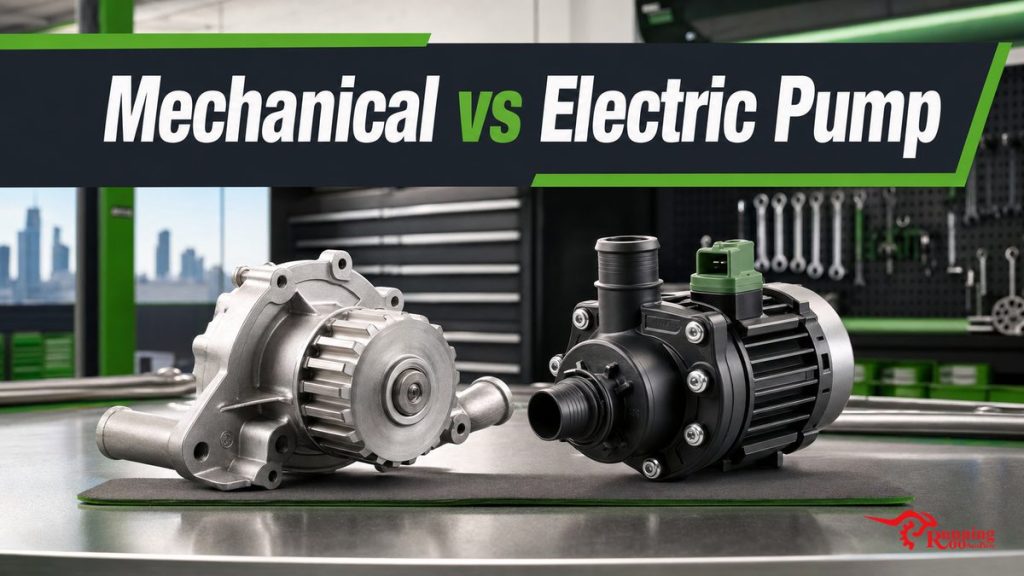
A mechanical water pump is driven directly by the engine, usually through the timing belt, the timing chain, an accessory belt or, on some engines, a dedicated drive. It is always turning when the engine runs, circulating coolant through the block, the cylinder head and the radiator. An electric water pump, by contrast, is driven by its own motor and is controlled by the engine computer, so it can run at variable speed and can even keep circulating coolant after the engine is switched off, which is valuable on turbocharged and hybrid engines.
The distinction matters for diagnosis and repair. A mechanical pump is usually replaced as part of a timing-belt service because it lives behind the same covers, while an electric pump is often replaced on its own but may be located in an awkward spot that adds labour.
How a mechanical pump fails
Mechanical pumps fail in two main ways. The bearing can wear, producing a rumbling or whining noise and eventually allowing the shaft to wobble, which destroys the seal and leaks coolant. Or the impeller can corrode or break, reducing flow even though the pump still turns. The first sign is often a small coolant leak from the weep hole under the pump, followed by overheating, a rising temperature gauge or a low-coolant warning.
The table below summarises the classic failure signs for each pump type.
| Pump type | Common failure signs |
|---|---|
| Mechanical | Coolant leak from weep hole, bearing noise, overheating |
| Electric | Intermittent overheating, stored cooling-fault codes, pump not running |
Both types share one universal warning: any unexplained coolant loss or rising temperature deserves immediate attention, because the cooling system does not fix itself.
How an electric pump fails
Electric water pumps fail through motor or control-module faults, or through the same seal and impeller problems as a mechanical pump. The difference is that an electric pump failure often announces itself through the diagnostic system first, with a stored cooling-fault code or a warning on the dash, before the temperature gauge climbs. Intermittent overheating, a pump that does not run when commanded, or a vehicle that cools erratically are the tell-tale signs.
Because the electric pump is computer-controlled, diagnosis usually starts with a scan rather than a visual inspection. Testing the pump’s power supply and signal, and confirming whether it runs when commanded, separates a failed pump from a wiring or control-module fault.
Why the pump is so often part of a bigger job
On many engines the water pump sits behind the timing belt or timing chain covers, so the labour to reach it is the labour of a timing job. When a timing belt is due, the pump is replaced at the same time because the belt already has to come off and the pump is at the same stage of life. Failing to do so means paying for the labour twice when the pump lets go shortly after the belt service.
The same logic applies to the thermostat, the coolant and the drive components. When the cooling system is opened for a pump, renewing the thermostat, replacing the coolant with the correct specification, and checking the hoses and drive components is the difference between a repair that lasts and one that leaks again in six months.
The parts to replace alongside a pump
The exact list depends on the engine, but the sensible additions are the thermostat, the coolant, and the relevant gaskets or seals. On a timing-belt engine, the belt and tensioner are already part of the job. On a chain-driven pump, the chain and its components may or may not be disturbed, but any seal touched on the way in should be renewed on the way out.
| Situation | Parts to renew alongside the pump |
|---|---|
| Timing-belt-driven pump | Belt, tensioner, idlers, thermostat, coolant |
| Chain-driven or belt-driven, cooling service | Thermostat, coolant, gaskets/seals, hoses as needed |
| Electric pump | Coolant, thermostat, control checks, gaskets/seals |
The coolant deserves particular attention. Using the correct coolant specification and the correct concentration is essential to corrosion protection, and mixing incompatible coolants can cause sludge that damages the new pump and blocks the radiator.
The warning signs not to ignore
The early warnings of water-pump trouble are a small coolant leak, a stain or crust of dried coolant around the pump, a rumbling or whining noise from the front of the engine, and a temperature gauge that creeps higher than normal. On electric-pump engines, a stored cooling-fault code or a pump that is not running are the equivalents. Any of these should be investigated before the engine overheats.
Overheating is the expensive outcome, because it can warp the cylinder head and blow the head gasket, turning a pump replacement into a major engine repair. The pump is a cheap part relative to the engine it protects, which is why prompt attention is always the cheapest path.
Diagnosis before parts
Before a pump is replaced, the cooling system should be pressure-tested to find the leak, the pump inspected for bearing play and leakage, and the thermostat and coolant condition checked. On an electric-pump engine, the scan and the power and signal test are the first steps. This order prevents the classic mistake of replacing a good pump when the real fault is a thermostat, a leaking hose or a failed control circuit.
The temperature gauge is a lagging indicator, so by the time it rises the cooling system is already struggling. The diagnostic and inspection steps are what catch a failing pump at the leak or noise stage, before the gauge ever moves.
Keeping the cooling system healthy
The best protection is routine maintenance: keep the coolant at the correct level and specification, renew it on the manufacturer’s interval, and replace the thermostat and coolant whenever the pump is renewed. Watch for the first small leak or new noise, and have the cooling system pressure-tested if you suspect a problem. On a timing-belt engine, plan the pump into the belt service rather than waiting for it to fail on its own.
For Australian owners, summer heat and long highway runs make the cooling system a safety-critical system in a very direct way. A well-maintained pump and fresh coolant are cheap insurance against the roadside breakdown and the engine damage that follow a neglected cooling system.
Coolant specification: why the right coolant protects the pump
The coolant is not just coloured water, and the pump’s life depends on using the right one. The correct coolant specification provides corrosion protection for the alloy components the coolant touches, lubricates the water-pump seal, and raises the boiling point so the system can run hotter without boiling over. Using the wrong coolant, mixing incompatible types, or running the wrong concentration can cause sludge, corrosion and seal damage that shorten the life of a brand-new pump.
This is why a pump replacement should always include fresh coolant in the correct specification and concentration, not a top-up of whatever is on the shelf. The coolant and the pump are partners in the same system, and a new pump fed with old or incorrect coolant is starting its life at a disadvantage.
Mechanical vs electric: which is more expensive to replace
Neither type is automatically cheaper, because the cost is driven by access and by what else must come off, not by the pump alone. A mechanical pump on a timing-belt engine is usually replaced during the belt service, so its standalone part price hides the larger timing job that accompanies it. An electric pump is often a dearer part but may be replaced on its own, although its location can add labour on engines where it sits behind covers or brackets.
The practical lesson is to think in terms of the complete job rather than the pump price. On a belt-driven engine, budgeting the pump into the belt service is the cheapest way to own it; on an electric-pump engine, budgeting the thermostat and coolant into the pump job is the equivalent discipline. Either way, the pump itself is the small share of a cooling-system repair, and the labour is the part you do not want to pay twice.
Frequently asked questions
How do I know if my water pump is mechanical or electric?
Check your vehicle’s specifications. Many belt-driven engines use a mechanical pump, while many modern turbo and hybrid engines use an electric pump.
What are the first signs of a failing water pump?
A coolant leak or dried coolant stain near the pump, a rumbling or whining noise, and a temperature gauge that creeps higher than normal.
Can an electric water pump fail without leaking?
Yes. An electric pump can fail through its motor or control module, producing intermittent overheating and stored fault codes without an external leak.
Why should I replace the water pump with the timing belt?
Because the pump usually sits behind the timing covers and is at the same stage of life, so replacing both together avoids paying for the labour twice.
Should I replace the thermostat with the water pump?
Usually yes. The thermostat is cheap, lives in the same system and is best renewed whenever the cooling system is opened.
What coolant should I use?
The coolant specification and concentration recommended by your vehicle’s manufacturer. Do not mix incompatible coolant types.
What happens if I ignore a failing water pump?
The engine can overheat, which risks a warped cylinder head or blown head gasket — a far more expensive repair than the pump.
How do I protect my cooling system?
Keep the coolant at the right level and specification, renew it on schedule, and investigate the first leak, noise or temperature rise promptly.
Shop the products mentioned in this guide
- 161A0-39035 Electric Water Pump for Toyota Camry / Lexus / Corolla Hybrid
- Cooling Additional Water Pump for Audi A4 B8 / A5 / A6 C6 C7 / Q5 Q7 / VW Amarok Touareg
- Electric Coolant Water Pump for BMW F30/F31/F10/F25/E84/E89 X1 520i 320i N20B20A
- Water pumps on eBay
Watch on RunningRooAuto YouTube
- RunningRoo Auto Parts – trusted Melbourne parts support
- RunningRoo Auto Parts – product and fitment channel
RunningRoo Auto Parts – Based in Melbourne, Australia 🇦🇺
📞 Free 24/7 Pickup Available (Contact 0425890125)
💬 Any questions? Message or Call us anytime! We’re here to help.Why Choose RunningRoo?
✅ Aussie Owned & Operated | 🚚 Fast Shipping | 🤝 Friendly Support
Sources and further reading
- ACCC – Consumer rights and guarantees
- Product Safety Australia – vehicle recalls
- RACV – car maintenance and repair guidance
- API – Engine oil standards
Cooling-system service intervals, coolant specifications and water-pump replacement procedures are set out in each manufacturer’s workshop manual. Always use the coolant specification and concentration your vehicle’s manufacturer specifies, and confirm the correct pump for your engine before ordering.
RunningRoo Auto Parts – Based in Melbourne, Australia 🇦🇺
📞 Free 24/7 Pickup Available (Contact 0425890125)
💬 Any questions? Message or Call us anytime! We’re here to help.Why Choose RunningRoo?
✅ Aussie Owned & Operated | 🚚 Fast Shipping | 🤝 Friendly Support