
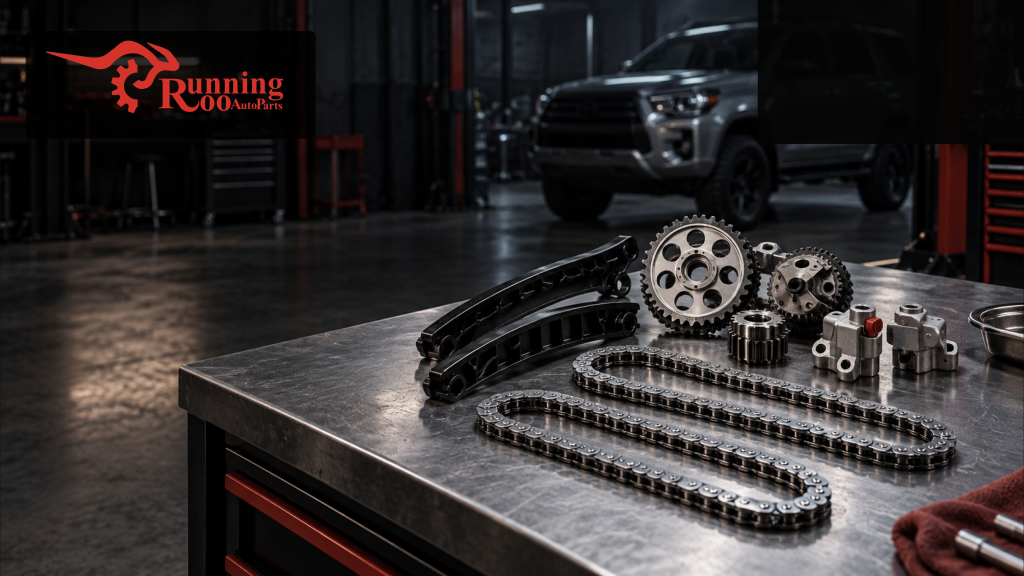
Toyota Hilux, Fortuner & Prado 1GD/2GD Timing Chain Kit: VIN-First Buying Guide
Buying a 1GD FTV timing chain kit should begin with the engine and identification details, not with a photo that looks close enough. Australia has a large population of Toyota Hilux, Fortuner, Prado and HiAce diesels, but a model name alone is not a safe parts identifier. Production dates, market specification, engine family, supersessions and previous repairs can all alter the answer.
This guide is for owners and workshops assessing the RunningRoo timing chain kit listed for Toyota 1GD and 2GD 2.4L/2.8L diesel applications. It explains what to collect before ordering, how a timing-chain repair differs from fault finding, and what a workshop should confirm before installation. It is not a substitute for Toyota repair information or a diagnosis of an individual vehicle.
Start here: view the RunningRoo Toyota 1GD/2GD timing chain kit, then compare the vehicle VIN, engine code, original part numbers and the product-page fitment notes before purchase.
Quick answer: is this the right timing chain kit?
The product may be relevant where the vehicle is a Toyota diesel using the 1GD or 2GD engine family and the product-page application matches the actual vehicle. The correct process is to supply a full VIN and, where possible, photographs of the existing components and original-number markings. A listing title such as “Hilux timing chain kit” is not proof of compatibility.
Toyota technical information identifies the 1GD-FTV and 2GD-FTV as related modern diesel engine families, with 2.8L and 2.4L displacement variants respectively. That is useful engine-family context; it is not permission to treat every diesel Toyota of a similar year as identical. See Toyota\’s 1GD/2GD technical material for the manufacturer engine-family reference.
A timing chain is part of the mechanical relationship between crankshaft and camshaft(s). If a vehicle has a warning lamp, noise, starting problem or correlation-related scan result, a competent workshop needs to establish the cause before ordering parts. Chain stretch, a guide issue, tensioner performance, oil-condition concerns, sensor signals and non-timing faults can produce overlapping symptoms. Replacing parts without that assessment can add cost without resolving the original concern.
Identify the vehicle before searching by price
For a useful fitment check, prepare the following information before contacting RunningRoo or booking work:
| Evidence to collect | Why it matters |
|---|---|
| 17-character VIN | Resolves the vehicle build and market configuration |
| Engine code | Separates 1GD/2GD from other Toyota diesels |
| Build month and year | Helps with production-change checks |
| Current part numbers | Provides the strongest comparison with the replacement scope |
| Clear component photos | Lets a seller identify obvious layout differences |
| Fault report and repair findings | Keeps a purchase tied to a diagnosis rather than a guess |
Do not rely only on a vehicle badge. “Prado”, “Hilux” and “Fortuner” can describe different drivetrain, engine and production combinations. Similarly, an online marketplace may show a broad model-year range because one part has several possible applications. Treat that range as a screening step. The product page and a VIN-based check decide whether to proceed.
For vehicles already disassembled, record the original components before they are discarded. A readable part number, the guide shape, tensioner layout and chain count can all assist a workshop or parts specialist. This is especially important when the engine has a repair history, has been imported, or has received a replacement engine.
What the timing system does—and what it does not prove
The timing system coordinates crankshaft rotation with the camshaft operation needed for the engine\’s valve events. The exact design, service procedure and measurements are vehicle-specific. Toyota\’s engine-control documentation also shows the role of position feedback in engine management; see its 1GD engine-control reference. That reference supports the general point that engine systems use crank/cam-related feedback. It does not show that a particular warning light or scan code means a chain kit is required.
That distinction matters for a high-conversion but responsible parts page. An unusual rattle, difficult starting, rough running, reduced power or a diagnostic code can be a reason to arrange inspection. They are not a remote diagnosis. A workshop may need to check oil condition and service history, scan data, mechanical timing position and related components before deciding whether timing-system work is warranted.
If the workshop confirms a timing repair, ask it to define the repair scope in writing. Is the quote for a chain only, a chain and guides, a tensioner, seals, sprockets, or a broader repair? Does the selected kit contain every component required for that particular job? The answers should be compared with the live RunningRoo product description—not assumed from a generic image.
A practical pre-order decision chart
Use this sequence to avoid ordering a 1GD FTV timing chain kit on incomplete evidence.
- Confirm engine family: Does the VIN/dealer or workshop data show 1GD-FTV or 2GD-FTV?
- Read the live product page: Is the stated engine, vehicle and production information consistent with the vehicle record?
- Confirm repair scope: Has a workshop explained why timing work is being carried out and which pieces need replacement?
- Compare the kit contents: Are the listed contents appropriate to the workshop\’s scope? Do not assume ancillary seals or hardware are included.
- Check original numbers and photographs: Where available, compare them before the vehicle is left in pieces.
- Hold off if anything conflicts: Send the VIN, engine code and images for review before purchasing.
| Situation | Best next action |
|---|---|
| VIN and engine code agree with listing | Confirm kit contents, stock and workshop timing |
| Vehicle has a scan code but no inspection | Obtain a diagnostic report |
| Engine code is uncertain | Verify through dealer/workshop data |
| Repair is already under way | Photograph and retain identifying information |
| Kit content differs from workshop scope | Clarify additional parts before ordering |
Questions to settle with the workshop before parts arrive
The most useful conversation is specific. Rather than asking whether a chain kit “will fix it”, ask what evidence has led the technician to timing-system work and what checks remain. A written description can be short: the confirmed engine code; the condition observed; the components proposed for replacement; and whether further parts may be required once covers are removed. That record helps both the vehicle owner and the installer make an apples-to-apples comparison with the product listing.
Ask whether the workshop wants the complete kit on site before it begins the job. Some workshops prefer to inspect all supplied items and keep the vehicle until the repair has been verified; others will assess first and call with a final parts list. Neither approach is inherently right or wrong. The important point is that the owner does not make assumptions about labour time, additional seals or the availability of unrelated components.
Oil condition and maintenance records are also useful context. They do not prove the source of a present fault, and a blog cannot interpret them for an individual engine. They can, however, help a technician form a complete picture while inspecting a mechanical timing concern. Bring any recent servicing invoices, reports of earlier engine work and the date when a symptom first appeared. Clear factual information is better than a remembered description such as “it has always sounded like that”.
Where the vehicle is modified, imported or fitted with an engine that may not be original, make that clear at the beginning. The registration record can still be useful, but the engine identifier and actual installed components deserve extra attention. This is another reason the VIN-first process includes physical part-number comparison when it is available.
Finally, agree on the boundary between diagnosis and installation. A kit is ordered after a compatibility check; installation starts only when the workshop is satisfied that the vehicle and repair scope match. Keeping those decisions separate protects the buyer from treating a retail part as a diagnostic conclusion.
Workshop planning for Australian owners
Timing-system work is not a typical driveway accessory installation. Access requirements, locking procedures, torque specifications, sealing surfaces, fluids and post-repair verification should be handled using vehicle-specific information and suitable tools. A workshop should inspect for any related conditions it considers relevant, including oil-service history and surrounding components exposed during the repair.
For an Australian owner, practical planning also matters. Ask the workshop when it needs the vehicle, whether it wants the kit supplied before booking, whether it will inspect the delivered parts before installation, and whether it needs extra parts after inspection. Keep the order confirmation, VIN details and product packaging with the job record. These details make later questions much easier to resolve.
Do not promise a vehicle to a trip, work roster or tow booking until the workshop has assessed it. Lead times depend on the vehicle condition and what the technician discovers. A timing chain product is a component purchase; it cannot guarantee the condition of the rest of the engine or the outcome of a repair.
Before opening packaging, compare the received item with the invoice and the product listing. If a fitment concern appears, pause the installation and contact the seller with the VIN, engine code, order number and clear photos. This is usually faster and safer than modifying a part to fit.
Buying checklist before you add the kit to cart
Use this final check before ordering the RunningRoo Toyota diesel timing chain kit:
- Full VIN recorded and supplied where requested.
- 1GD-FTV or 2GD-FTV confirmed from reliable vehicle data.
- Live product page checked for current application and kit contents.
- Workshop diagnosis and repair scope discussed.
- Original part numbers or clear photos available if the engine is open.
- Delivery timing and return/installation conditions read before work begins.
This process is deliberately more careful than a generic “fits Hilux” search. It lowers the chance of an avoidable fitment delay and gives the workshop the information it needs to plan the repair correctly.
Frequently asked questions
Does a timing-chain noise mean I need a complete kit?
Not necessarily. Noise has several possible causes. Have a qualified workshop inspect the vehicle and define the repair scope before ordering parts.
Is 1GD the same as 2GD for every part?
No. They are related Toyota diesel families, but individual components and applications still require VIN, engine-code and product-page checking.
Can I use the Hilux year to confirm fitment?
No. Year is a helpful filter only. Use the VIN, engine code and current listing information for the final decision.
What should I send for a fitment check?
Send the VIN, engine code, build date if available, original part numbers and clear photographs of removed parts or labels.
Should I buy before my workshop diagnoses the fault?
If the repair reason is uncertain, arrange diagnosis first. A product listing cannot confirm the cause of a warning light or running issue.
Does this guide replace Toyota repair instructions?
No. Use Toyota\’s vehicle-specific repair information and a qualified technician for installation procedures, torque data and diagnostic decisions.
Sources and editorial note
Toyota technical information is referenced above only for engine-family and engine-control context: 1GD/2GD engine-family material and 1GD engine-control material. RunningRoo is not affiliated with or endorsed by Toyota. Recheck the live RunningRoo product page before purchase because listing details and availability can change.