
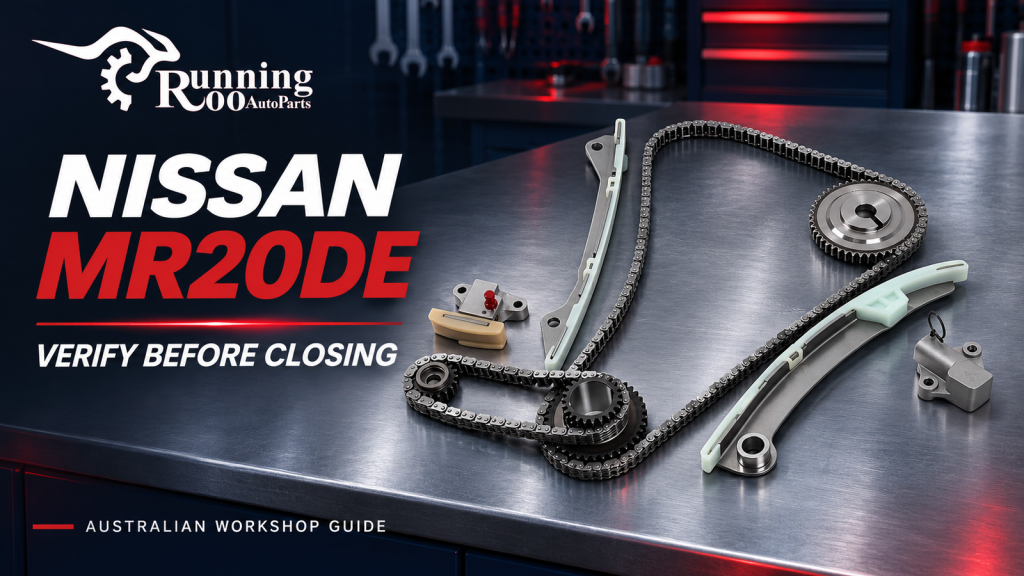
Nissan MR20DE timing chain verification should be planned before the front cover is closed, not left until a warning light appears after collection. For an Australian owner arranging a chain repair, the useful question is what evidence the workshop will retain to show that the applicable assembly checks were completed. A kit purchase, an installation photograph and a final road test each answer different questions. A good repair record connects them without treating any one of them as complete proof.
RunningRoo offers a Timing Chain Kit Fits Nissan Tiida 1.8L MR18DE QASHQAI 2.0L MR20DE 05-10 and the corresponding matching RunningRoo eBay listing. The listing covers specified MR18DE/MR20DE applications and describes its own components. Confirm the VIN, installed engine, OE references and workshop diagnosis before purchase. RunningRoo is an Australian-operated business in Blackburn, Melbourne, offering friendly support, local pickup by appointment and fast dispatch arrangements for confirmed stock. Call 0425 890 125 with the installer’s parts list and any application questions.

Why this guide concentrates on verification
A general article about chain noise can help an owner understand when to seek diagnosis. Once a repair has been approved, the question changes: how will the workshop establish that the correct parts were fitted and the prescribed checks were completed? This article focuses on that handover between parts selection, assembly records and final verification. For the broader symptom discussion, see Nissan MR18DE/MR20DE Timing Chain Noise: Full Guide.
Owners do not need to supervise the mechanic or interpret timing marks themselves. They can reasonably ask for a clear description of the repair and its verification. The workshop remains responsible for choosing the applicable service information, carrying out the work and deciding what records are appropriate. Asking about the process before the booking gives both parties time to agree what will be documented.
Avoid demanding a particular photograph as though it could replace the technician’s procedure. A single view may omit an important reference point or show the assembly at an intermediate stage. Useful documentation explains what a photograph represents and when it was taken. It should support the workshop’s findings rather than invite an owner to approve mechanical timing from an image on a phone.
The manufacturer basis for checking marks
The Nissan 2008 Sentra Engine Mechanical manual’s MR20DE section distinguishes chain-link matching marks from sprocket references and calls for repeated alignment checks during assembly. It also identifies a particular groove when discussing the intake sprocket’s matching reference. Read the archived original Nissan 2008 Sentra Engine Mechanical manual, MR20DE section (archived original). These details demonstrate why “the marks looked close” is inadequate, but the Sentra manual must not be treated as the installation procedure for every Australian Qashqai, Tiida or X-Trail application.
Ask the workshop to use the current manual for the actual vehicle and engine. A shared engine-family label is not permission to transfer every drawing, lower-drive arrangement or component description between applications. The technician should resolve any difference between the retail listing, the installed engine and the applicable manufacturer illustration before assembly continues.
Identify the application before opening the package
Provide the VIN, engine code, build information and the workshop’s required references. Explain any engine replacement or previous modification that may affect identification. Australian registration year alone is not enough to settle every application detail, particularly when a vehicle has been imported or has received a replacement engine. The supplier and installer need the most specific available identity information.
The linked kit’s description includes a main chain and other drive components. Its wording should be compared with the installer’s requirements rather than copied into a repair order without checking. In particular, the retail description uses “balance shaft” terminology for a lower-drive component group, while the cited Sentra manual discusses an oil-pump drive arrangement. This difference must be resolved for the actual application; this article does not assert that those assemblies are interchangeable.
If the workshop identifies a mismatch or cannot confirm an item, pause the order or installation while it is clarified. That is a productive outcome of the check, not an inconvenience to work around. A supplier can confirm what the listing offers; the technician establishes whether that package matches the vehicle and the approved repair scope.
Agree the verification points before the repair
Ask which stages will be checked and recorded. The answer may include received-parts comparison, application-specific assembly checks, pre-closure inspection and final operational verification. The precise method belongs to the manufacturer procedure and the workshop’s professional practice. The owner’s role is to understand that there is a defined process rather than assuming that a running engine is the only acceptance criterion.
It is useful to distinguish an installation record from a diagnostic record. The first explains what was fitted and checked during assembly. The second explains why the repair was needed and whether the original complaint was addressed. Keeping both prevents a common gap: a detailed parts invoice with no explanation of the fault, or a fault-code printout with no record of the work performed.
Discuss any limitations in advance. A workshop may not routinely photograph every stage, and access or cleanliness requirements may make some images inappropriate. A written confirmation referencing the applicable checks can be more useful than a large collection of unlabelled photographs. The objective is a coherent repair record, not an impressive-looking folder with no context.
A practical verification record
| Stage | Record to request | Question it answers |
|---|---|---|
| Before ordering | VIN, engine identity and approved parts list | Is this the correct application and repair scope? |
| On receipt | Package references and contents comparison | Did the supplied parts match the agreed order? |
| During assembly | Confirmation of applicable manufacturer checks | Was the procedure followed for this engine? |
| Before closure | Labelled inspection or workshop sign-off | Were relevant checks completed while access was available? |
| After assembly | Verification of the original complaint and relevant checks | What was established before release? |
| At collection | Itemised invoice and any follow-up instructions | What should the owner retain and monitor? |
This table intentionally avoids torque values, improvised locking methods and a universal sequence for rotating the engine. Those details must come from the correct service procedure. A consumer article should not turn a documentation checklist into a partial installation guide that leaves out necessary precautions or application differences.
Understand the limits of coloured-link photographs
A coloured link is an assembly reference within a particular procedure. A photograph should identify the stage at which it was taken and the reference points being checked. Do not use an unlabelled image of a different engine, or an image taken at an unknown point in the job, as the standard against which your workshop’s work must be judged.
Similarly, do not decide that the engine is correctly timed merely because two visible marks align in one photograph. The relevant manufacturer procedure defines the full relationship and the required checks. If a photo creates concern, ask the technician to explain it with reference to that procedure. Avoid directing further engine rotation or dismantling based on a social-media comparison.
The same caution applies after the vehicle has been run. This guide does not offer a rule about where coloured links must appear after an arbitrary number of rotations. If a later inspection is needed, the workshop should use the manufacturer’s verification method for that situation. Keeping installation references and later diagnostic checks distinct prevents an incomplete visual comparison from becoming a false diagnosis.
Compare kit contents without assuming completeness
Before ordering the Timing Chain Kit Fits Nissan Tiida 1.8L MR18DE QASHQAI 2.0L MR20DE 05-10, send the live listing to the installer and ask it to identify any additional required items. A retail kit is a defined collection of parts. It is not automatically every seal, fastener, fluid, tool or consumable needed for the complete job. Anything not clearly included should remain an open question until confirmed.
If you prefer the matching RunningRoo eBay listing, use the item number and current description rather than relying on an old screenshot. Listings and stock can change. Keep the order confirmation with the repair documents and ask the workshop to record any supplied components that were not fitted. This is especially helpful when a kit contains options or when inspection changes the agreed scope.
An OE reference is a compatibility aid, not a claim of Nissan manufacture. Ask about brand, condition and the current listing terms separately from the fitment decision. RunningRoo’s friendly support can help clarify the offered package, but the installer must still confirm that it suits the diagnosed repair on the identified vehicle.
Handling a discrepancy before the cover is closed
If the workshop finds a component that differs from the required specification, record the package label, order number and the specific discrepancy. Clear information is more useful than saying the kit “looks wrong”. Explain which item is in question and what the installer expected to receive. Photographs should show readable markings and the relevant comparison without exposing unrelated customer information.
Do not modify a questionable component simply to make it resemble the old one. Ask the supplier and installer to resolve the discrepancy first. Equally, a visual difference does not automatically prove incompatibility; an authorised replacement can differ in appearance. The decision needs a documented reference match or reliable application confirmation, not an assumption in either direction.
Where the repair scope changes after inspection, obtain an updated list before ordering additional parts. This keeps the original quote, the revised requirement and the final invoice consistent. It also helps explain why a vehicle remains in the workshop longer than expected without blaming a supplier for an item that was never included in the original order.
Plan Australian supply around the workshop schedule
RunningRoo can discuss Melbourne local pickup by appointment in Blackburn and fast dispatch for available stock. Confirm the actual collection arrangement or delivery estimate before committing to a dismantling date. A parcel marked dispatched has not yet been received and checked by the installer. Allow time for both delivery and the workshop’s package inspection.
For regional or interstate jobs, send the complete enquiry early. Include the VIN, engine code, OE references and the approved parts list in one message where possible. This reduces repeated clarification and helps the supplier identify the exact package being discussed. Call 0425 890 125 when a time-sensitive question needs direct attention, while retaining written confirmation of the final order details.
A useful booking plan includes responsibility for receiving the parcel, checking the contents and contacting the supplier if needed. If the owner buys the parts but the workshop receives them, make sure both have the order reference. That simple arrangement can prevent delays caused by a package arriving without enough information to identify the intended job.
What to retain after collection
Keep the final itemised invoice, supplier receipt, engine identification and any workshop verification notes together. Record any follow-up visit recommended by the installer. If the original concern was intermittent, retain the description used at the first appointment so that a later conversation can compare the same symptom rather than a vague recollection.
If a new warning or noise appears, contact the workshop with that information. Do not assume that a recently fitted chain kit proves every engine concern must relate to the timing repair. The previous records are a starting point for assessment, not a diagnosis. They also help distinguish a supplied-part enquiry from a separate issue outside the agreed work.
Frequently asked questions
Can I approve timing alignment from a workshop photograph?
A photograph can support an explanation, but it is not a substitute for the technician’s complete checks. Ask what stage it shows and which procedure applies. The workshop should confirm the result; an owner should not be expected to validate mechanical timing from an isolated image.
Does the Sentra manual apply to every MR20DE vehicle?
No. It is cited as manufacturer background for the importance of alignment checks. The actual vehicle’s service information governs the repair. Differences in application and lower-drive configuration must be resolved before using a drawing or selecting components.
Is the lower chain in the listing always the same assembly described in another manual?
Do not assume that. The listing and the cited manual use different terminology, which is a reason for an application-specific check. Ask the installer to identify the required assembly and compare references, quantities and configuration with the supplier before ordering.
Does the kit include every item needed to finish the repair?
Only the explicitly listed contents should be assumed included. Ask the workshop for any additional sealing items, fasteners, fluids or other materials required by its procedure. Confirm uncertain items with RunningRoo before the booking rather than discovering an omission after dismantling.
Can RunningRoo help with Melbourne pickup?
Yes, contact the Australian-operated RunningRoo team to confirm availability and arrange Blackburn pickup by appointment. Fast dispatch options can also be discussed. Call 0425 890 125 and compare the Timing Chain Kit Fits Nissan Tiida 1.8L MR18DE QASHQAI 2.0L MR20DE 05-10 with the matching RunningRoo eBay listing using your confirmed vehicle and parts information.
Related RunningRoo video
Watch Timing Chain Rattle: Wear Symptoms & When to Replace for general timing-chain background. It is not an MR20DE assembly demonstration and does not replace the current Nissan repair procedure. Use it alongside the workshop discussion, not as the source of installation marks or settings.
The most useful outcome is a matched parts order and a clear verification record. Confirm the application, agree the checks, inspect the supplied package and retain the completion documents. RunningRoo can assist with the parts and Australian supply arrangements once the workshop has defined the repair.