
“Replace the timing chain” needs a more precise description
For an Australian Hyundai iLoad or iMax owner researching a D4CB three-chain repair, a short quotation can leave an important question unanswered: which parts of the drive are actually included? A retail package may list three chains, while a workshop conversation mentions an upper chain or a lower drive. Before comparing prices or ordering, ask the repairer to translate those expressions into a named, vehicle-specific scope.
This article explains how to organise that scope. It does not assume that every D4CB requires all components to be replaced together, and it does not recommend a partial repair without inspection. The aim is to distinguish the technician’s findings, the work being authorised and the contents of the package being purchased. Those three records should agree before installation begins.
For an installer-confirmed requirement, review Timing Chain Kit Suit HYUNDAI iLoad Starex H-1 iMax KIA SORENTO 2.5L CRDi D4CB — RunningRoo and the matching RunningRoo eBay listing. RunningRoo is an Australian-operated parts business in Blackburn, Victoria. Friendly support is available on 0425 890 125. Melbourne local pickup requires an appointment, and fast dispatch is subject to confirmed stock, fitment and order timing rather than a guaranteed delivery date for every destination.

What the manufacturer manual helps you distinguish
Hyundai’s D 2.5 CRDI engine mechanical manual identifies timing chains A, B and C and describes related sprocket and balance-shaft work. It therefore provides a more specific framework than the singular expression “the chain”. See Hyundai 2008 D 2.5 CRDI engine mechanical manual (archived original). The cited document is an archived original manual; the installer must select the current procedure appropriate to the vehicle and engine version being repaired.
Do not allocate the retail chains to installation positions by guessing from their lengths or a marketing photograph. The workshop should use the applicable component identification and procedure. This guide uses upper and lower drive language only as a prompt to clarify a quotation. It does not replace the manufacturer’s nomenclature or supply a chain-routing diagram.
Begin with the complaint and the confirmed finding
A useful job sheet first records why the vehicle entered the workshop. The owner’s observation might be a sound, a warning or a previous technician’s recommendation. Keep that observation separate from the workshop’s diagnosis. “Owner reports a noise” and “technician has identified the required repair” are different stages, even when they appear in the same conversation.
Ask whether the scope has been established or remains dependent on further inspection. A provisional estimate should say what is still unknown and when the repairer expects to resolve it. This is especially useful for a working iLoad where the owner must plan transport, deliveries or staff arrangements. The practical schedule should reflect uncertainty rather than hide it behind an apparently final parts list.
Avoid ordering a broad package solely because it contains more pieces. Equally, avoid assuming the smallest package must be sufficient. The appropriate order follows the diagnosed requirement and the installer’s approved scope. A seller can clarify what is included, but the product listing cannot decide how much work an individual engine needs.
Ask the workshop to name each part of the planned drive repair
Request the terminology used in the applicable service information and have it connected to the estimate. If the quote says “upper chain”, ask which associated guides, tensioner and sprockets are included in that line. If lower-drive work is also intended, ask for it to be stated explicitly. The question is about clarity, not a request to dictate a mechanical procedure.
A workshop may have sound reasons for recommending a particular scope. Ask for those reasons in plain language and distinguish required work from work proposed subject to inspection. The owner should understand which decision is being made now and which will be made after additional access. That keeps an initial booking from being mistaken for unlimited authorisation.
If the vehicle has already been partly dismantled by another repairer, disclose that fact. Provide the available job notes and the state in which it was transferred. Do not describe the repair as a routine unopened-engine job if the receiving workshop needs to assess previous work. Accurate handover information helps it decide what must be verified before proceeding.
Match the retail inventory to the job, line by line
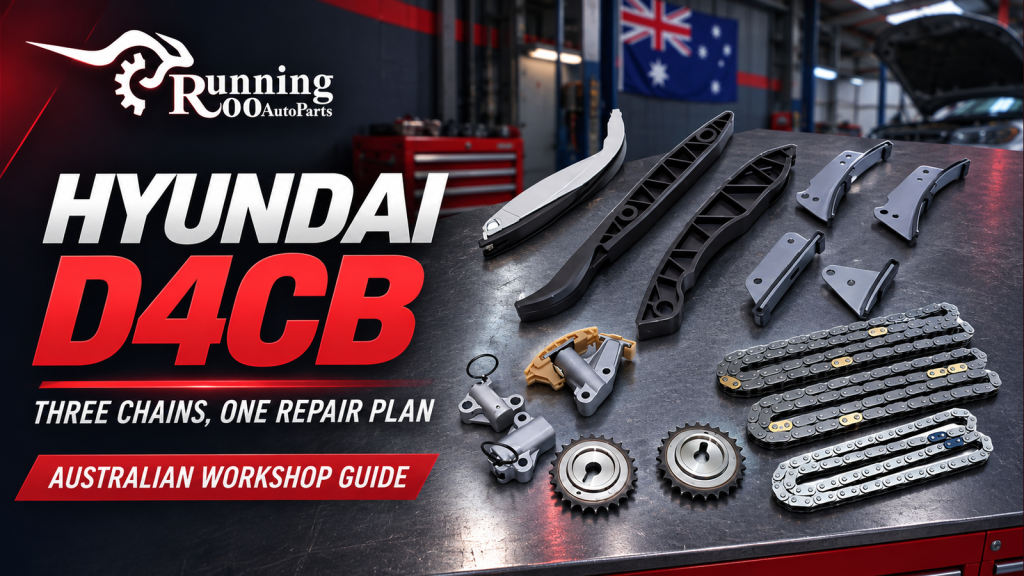
The current RunningRoo D4CB listing states three chains of 98, 90 and 80 links, three tensioners, seven guides and two cam gears. These are seller-declared package contents. They do not mean every possible sprocket, seal, fastener or other item involved in a particular repair is included. Ask the installer to compare its requirement with the package rather than rely on the word “complete”.
The chain lengths are useful catalogue identifiers, but they are not a standalone fitment test. The vehicle’s VIN, fitted engine code, relevant OE references and the workshop’s identified requirement still matter. If a component in the package is described differently from the job sheet, resolve the terminology before fitting rather than assuming the difference is merely cosmetic.
You can check the current offer at Timing Chain Kit Suit HYUNDAI iLoad Starex H-1 iMax KIA SORENTO 2.5L CRDi D4CB — RunningRoo or the matching RunningRoo eBay listing. Send RunningRoo the approved list and any clear identification information requested by the installer. Keep a copy of the supplier’s confirmation with the purchase record, especially if the vehicle is being repaired away from the owner’s home location.
Use a scope matrix instead of a vague “full kit” label
| Scope question | Record needed | Point to resolve before ordering |
|---|---|---|
| Which chains are being replaced? | Installer’s named components | Do the job and the three-chain package correspond? |
| Which guides are included in the repair? | Itemised requirement | Does the kit’s stated guide inventory cover it? |
| Which tensioners are required? | Installer-approved quantities and references | Are additional items needed? |
| Are gears or sprockets being renewed? | Named components and inspection decision | Do not assume every gear is included |
| What sealing and fastening items are needed? | Separate workshop list | Confirm supply outside the stated kit inventory |
| What remains conditional? | Inspection and approval point | Avoid treating an estimate as a final diagnosis |
This matrix is designed for a customer and supplier discussion. It does not prescribe which components must be renewed, how to release a tensioner or how to position any shaft. Those decisions belong to the qualified technician using the correct service information. Its purpose is to make the commercial scope understandable without inventing technical instructions.
Separate access costs from the parts inventory
Two estimates can use the same phrase while covering different work. Ask the repairer to explain which labour operations are included and whether the scope assumes anything about the condition of components that have not yet been inspected. A lower headline figure is difficult to compare if one estimate includes additional work and the other does not.
Do not request a guaranteed total based only on a photograph of a retail kit. The package describes supplied parts, not the condition of the vehicle or every operation required to finish the job. A meaningful comparison uses the same confirmed scope and states any exclusions. If a figure is provisional, keep that label visible when discussing it with another workshop.
For a business vehicle, also separate repair cost from scheduling expectations. Ask when the vehicle will be assessed, when a final scope can be approved and which parts must be available before the main work begins. These are practical appointment questions. They do not imply that every D4CB repair takes the same time or that a supplier can predict workshop completion.
Keep replacement decisions tied to evidence
The phrase “while we are there” should lead to an explanation. Ask which components have a confirmed reason for replacement and which are being discussed as an optional or conditional part of the job. The technician’s recommendation should be understandable enough for the owner to approve the scope without interpreting a technical manual independently.
There is no universal replacement interval or fixed failure mileage offered here. A previous owner’s account of a chain replacement should be treated as history to verify, not proof that every related component is new. If an invoice is available, check what it actually lists. If the record is missing, tell the workshop rather than filling the gap with an assumption.
The same discipline applies after the current repair. An invoice that identifies the work is more useful than an unsupported statement that the entire engine has been renewed. Keep the scope precise so future assessments can distinguish parts that were replaced, parts inspected and parts outside the authorised job.
Confirm D4CB identity without relying on the badge alone
The listing refers to Hyundai iLoad, Starex, H-1 and iMax, and Kia Sorento applications. Those names do not remove the need to check the particular vehicle. Provide the VIN privately, fitted engine code, build information and any relevant OE references requested. Mention known engine replacement or uncertainty about the vehicle’s history at the start of the enquiry.
If the workshop can provide clear photographs of accessible labels or removed components, include them with its parts request. Do not ask an owner to dismantle the engine merely to obtain a number. Where the information is incomplete, ask what additional evidence would resolve the match. A candid uncertainty is easier to address than an incorrect part reference presented as certain.
Confirm the same requirement with the party fitting the parts. A customer-supplied kit should be accepted and checked by the workshop under an agreed arrangement. The supplier’s product confirmation and the installer’s diagnosis have different roles, and both need to be clear before a purchase is treated as ready for installation.
Plan Blackburn pickup or delivery around the final list
RunningRoo’s Melbourne local pickup option is by appointment in Blackburn. Call 0425 890 125 once the required kit and any outstanding questions have been confirmed. Arrange collection of the correct order rather than arriving with an unresolved list and assuming every additional item will be available immediately.
For delivery, ask about fast dispatch for available stock and obtain the appropriate carrier estimate for the destination. Dispatch and arrival are separate events. If the workshop’s booking depends on the parcel, tell it the actual status rather than promising a date based on a general website phrase. RunningRoo’s friendly support can help coordinate the parts side of the plan.
When several people are involved, nominate one person to approve changes. A fleet manager, driver and technician can otherwise send different versions of the requirement. Keep the latest approved scope together with the order confirmation so that a provisional message does not accidentally become the purchasing instruction.
The handover record should preserve the three-chain scope
At completion, ask the repairer for an itemised invoice and a plain-language summary of the checks performed. The record should identify the work actually carried out, including any change approved after inspection. Do not assume that buying a three-chain kit proves every component in the package was fitted; the installer’s completion record is the relevant evidence.
Retain unused items only according to the agreed workshop and supplier arrangements, and keep their identification clear. If a concern remains, discuss it with the repairer and preserve the observations. A future diagnosis should start from accurate history, not an inflated description of the previous job.
Frequently asked questions
Does D4CB mean I can choose a kit by engine code alone?
The engine code is important, but the enquiry should also include the VIN, build details and relevant OE information requested by the installer or supplier. A broad engine-family label does not replace checking the actual application and the specific parts required for the approved repair.
Must every D4CB repair replace all three chains?
This article does not make that universal recommendation. The qualified repairer must determine the appropriate scope using inspection and applicable manufacturer information. The purpose of the three-chain discussion is to ensure the estimate and order are explicit, not to prescribe maximum or minimum replacement without evidence.
Does the kit include every gear and sealing item?
Do not assume so. The stated inventory includes two cam gears alongside the three chains, tensioners and guides. Ask the installer to list any further sprockets, seals, fasteners or other requirements separately and obtain confirmation of supply before the installation stage.
Can the chain link counts tell me where each chain goes?
Use the applicable manufacturer procedure and component identification, not this buying guide, to establish installation positions. The listed counts help describe the package but do not form a routing instruction or sufficient fitment check. A qualified technician must confirm the complete application and procedure.
Where can I check the current offer and collection arrangements?
Review Timing Chain Kit Suit HYUNDAI iLoad Starex H-1 iMax KIA SORENTO 2.5L CRDi D4CB — RunningRoo and the matching RunningRoo eBay listing, then call 0425 890 125 with the approved requirement. RunningRoo offers Australian-operated support and Melbourne pickup in Blackburn by appointment. Ask about fast dispatch after fitment and current availability are confirmed; delivery timing remains dependent on the chosen service and destination.
Related reading and RunningRoo video
Read the related RunningRoo product-identification guide. Use that guide for the catalogue discussion and this article for the specific workshop question above.
Watch RunningRoo: Timing Chain Rattle: Wear Symptoms & When to Replace. This is general background from the RunningRoo AutoParts channel, not a demonstration of this exact supplied component, confirmation of fitment or a substitute for the vehicle-specific repair procedure.
Confirm your parts enquiry with RunningRoo
Send your VIN privately, fitted engine code, relevant OE number and the installer-approved parts list before ordering. Contact RunningRoo support or call 0425 890 125. RunningRoo is Australian-operated in Blackburn, Victoria. Melbourne local pickup is by appointment; ask about fast dispatch after stock, fitment and order timing are confirmed. Friendly support can help clarify the product enquiry while the qualified repairer remains responsible for diagnosis and installation.
Technical references and scope
Hyundai 2008 D 2.5 CRDI engine mechanical manual (archived original). Manufacturer material provides the limited technical background cited in the article. Additional technical sources, where used, are linked beside the relevant discussion. Archived training and general system explanations are not current VIN-specific repair instructions. The discussion questions and planning examples are editorial guidance. Retail descriptions establish the seller’s stated offer, not manufacturer approval or universal compatibility.