
A leaking timing cover and a worn timing chain are different findings
A search for a 2TR-FE timing cover reseal in Australia often starts with an oil mark on the driveway or a workshop comment about the front of the engine. It can quickly turn into a shopping list for a complete timing chain kit. Those are two separate decisions. A confirmed sealing problem explains why oil is escaping; a recommendation to replace the chain needs its own supporting assessment. Neither the location of a stain nor the fact that the cover may be removed automatically proves that the chain requires replacement.
This guide helps Hilux and HiAce owners organise that conversation before buying parts. It focuses on the boundary between resealing work and a timing-drive repair, rather than repeating a general list of timing-chain symptoms. The useful outcome is a written scope that identifies the confirmed fault, the proposed work, the components needed and any inspection that remains outstanding. A qualified repairer must establish the actual cause and use current Toyota information for the fitted engine.
If your workshop has confirmed a compatible chain-kit requirement, start with Timing Chain Kit Fits Hilux Hiace 2.7L 2TR-FE 2005–2015 with Guides — RunningRoo and the matching RunningRoo eBay listing. RunningRoo offers friendly support from an Australian-operated business in Blackburn, Victoria. Call 0425 890 125 with the VIN, engine code and installer’s parts list. Melbourne local pickup is by appointment; fast dispatch can be discussed once fitment, stock and order timing are confirmed.

What the Toyota information establishes
Toyota’s RM1151E component drawings for the 2TR-FE show the timing-chain arrangement alongside associated cover, gasket and seal components. The drawings distinguish these components rather than presenting a seal and a chain as one interchangeable repair item. They provide useful orientation, but an exploded view alone does not diagnose a leak or specify what a particular vehicle needs. See Toyota RM1151E, 2TR-FE chain component drawings (archived original).
The practical distinction in this article is an editorial way to organise the purchasing decision. It is not a Toyota rule that every reseal must include chain replacement, or that chain components should always be reused. Ask the repairer to identify the applicable repair procedure and explain its recommendation for the vehicle in front of it. An archived drawing is supporting background, not the latest VIN-specific workshop instruction.
Start with a precise description of the leak finding
Ask the workshop to describe the observed source, not simply the area where oil has collected. “Oil around the front of the engine” is a useful initial observation, but it is less specific than a documented source established during assessment. Request a photograph or a plain-language explanation where practical. The aim is not to diagnose the vehicle remotely; it is to understand which joint, seal or component the quotation addresses.
Record whether the assessment is final or provisional. If the workshop needs further access before it can identify the source, that uncertainty belongs in the estimate. An owner can reasonably approve an inspection stage without approving every possible subsequent repair. Make sure the repairer knows how to contact you when that stage is complete, especially if the Hilux or HiAce is used for work and you will be away from your phone.
Describe what you noticed without changing it into a conclusion. Useful information includes when the mark was first seen, whether a previous repair was performed and any documented maintenance or top-ups. Avoid labelling the issue “chain failure” because a search result used that phrase. Accurate observations help the workshop; a predetermined diagnosis can make the conversation less clear.
Separate the estimate into two decisions
Ask for one line describing the sealing work and another describing any proposed timing-drive replacement. The two operations may share access, but shared access does not make their purposes identical. A quote can explain that some labour overlaps while still identifying the reason for each replacement component. This makes it easier to understand what has been confirmed and what is being recommended conditionally.
A useful estimate also states what happens if the inspection finds something different. For example, additional assessment might be required before a chain-kit order is finalised. Treat such a scenario as a planning example, not a claim about common 2TR-FE failures. Agree on an approval point so that an expanded scope is discussed before extra parts are ordered or work is carried out.
A repair-scope table for the workshop conversation
| Decision | Evidence to request | Purchasing consequence |
|---|---|---|
| Confirmed external leak | Identified source and proposed sealing operation | Order the specific sealing items approved by the installer |
| Timing-drive replacement proposed | Separate explanation of the timing finding | Confirm the exact compatible chain-kit inventory |
| Inspection still incomplete | What must be inspected and when | Keep the parts list provisional |
| Shared access mentioned | Which labour operations overlap | Assess the quote without assuming all accessible parts need replacement |
| Additional components required | Named items outside the retail kit | Obtain a separate availability and price confirmation |
| Repair completed | Itemised invoice and verification summary | Retain an accurate record of what was actually replaced |
This table is a communication aid, not a repair sequence. The workshop determines the safe inspection method and the applicable technical checks. Its value is in preventing a broad phrase such as “front engine repair” from concealing several different assumptions between the customer, technician and parts supplier.
What this RunningRoo kit actually offers
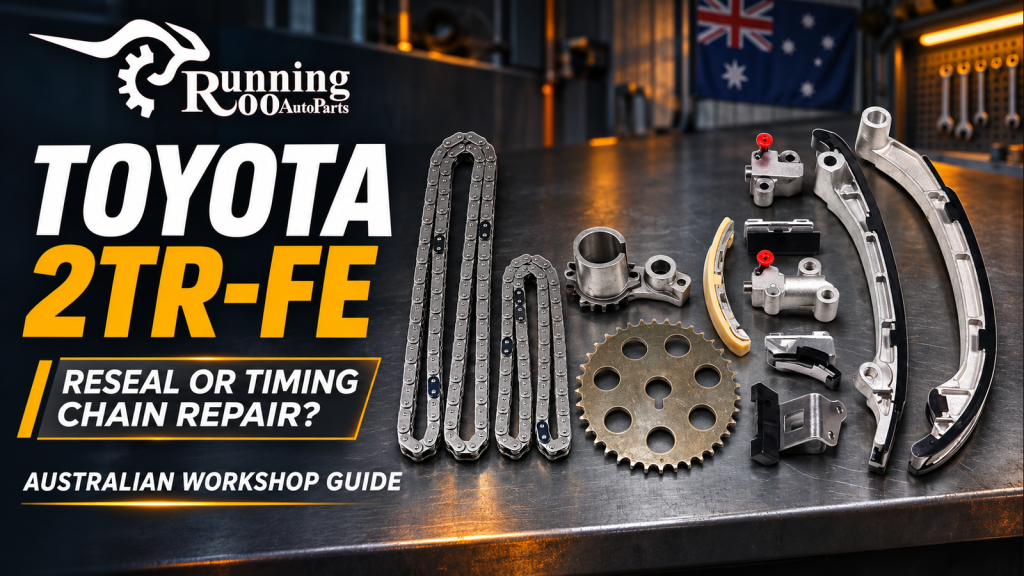
The current listing for this particular kit states two chains, one cam gear, one crank gear, six guides, two tensioners, two gaskets and one oil seal. The listing identifies the chains as 06BH124L and 05E82L. These are catalogue details to compare with the installer’s requirement; they are not a diagnosis or an instruction to select a kit from link count alone.
Do not interpret the word “gaskets” as a promise that every sealing item needed for every possible repair is included. Equally, a listed cam gear should not be assumed to mean that a particular VVT actuator is supplied without clarification. Ask the workshop to compare its complete parts requirement against the actual package before installation begins. Any unresolved item should be named explicitly.
Review Timing Chain Kit Fits Hilux Hiace 2.7L 2TR-FE 2005–2015 with Guides — RunningRoo for the current description and photographs, or use the matching RunningRoo eBay listing if you prefer ordering through that platform. Confirm the current inventory with RunningRoo rather than relying on an old screenshot. Product photos help identify the offer, while the written confirmation should establish the parts being supplied for your order.
Make “while it is apart” a documented recommendation
An owner may hear that it makes sense to replace additional components while access is available. That can be a reasonable topic for discussion, but the phrase itself does not explain the condition of a component, the expected benefit or the alternatives. Ask the repairer to separate required work from optional work and to state the reason for each recommendation.
The answer should be specific enough to support an informed choice. It might refer to an inspection finding, an applicable procedure or an agreed preventative scope. Do not turn a workshop’s vehicle-specific recommendation into a universal replacement interval for every 2TR-FE. This article does not assign a mileage at which a sound chain must be replaced, and the retail listing cannot establish such an interval.
If you decline optional work, make sure the final job description still accurately reflects what is authorised. If you approve it, ask for the additional components to be identified before purchasing. Both choices benefit from a clear record. The purpose is to remove ambiguity, not to tell the owner which mechanical decision to make without inspecting the vehicle.
Identify the fitted engine before confirming the order
Provide the VIN privately, the fitted engine code, build information and relevant OE references requested by the supplier or installer. Model names and registration years are useful starting points, but they should not be the whole fitment check. If an engine replacement is known, tell both parties rather than assuming the original vehicle record describes every component currently installed.
Use photographs of accessible identification labels or removed components when the workshop considers them useful. Do not dismantle the engine simply to obtain a shopping photograph. Where a number is unclear, send the clearest available image and say that the reading is uncertain. A guessed character can be more misleading than an openly incomplete reference.
The product title mentions Hilux and HiAce applications with a year range. That description is not permission to bypass verification. The correct result is a supplier-confirmed match to the installer’s identified requirement, not a match based only on the vehicle badge. Keep the confirmation with the invoice so the basis of the purchase remains available later.
Plan the Australian workshop booking and parts handover
Before arranging delivery or Melbourne local pickup, ask whether the workshop accepts customer-supplied parts and who will inspect the package. Some owners assume that a parcel reaching reception means the technician has checked every item. Agree on a practical handover point so that discrepancies are raised before the vehicle is committed to the next stage of work.
RunningRoo’s Blackburn location can be useful for Melbourne customers coordinating a repair, but pickup requires an appointment. Call 0425 890 125 to discuss the order and collection arrangements. For delivery, ask about fast dispatch for confirmed available stock and distinguish dispatch timing from the carrier’s delivery estimate. Do not book a completion date solely on the assumption that an online order will arrive immediately.
Keep the workshop informed if the scope or order changes. A chain kit purchased for a confirmed drive repair is different from a sealing-only order. One clear, current parts list is more useful than several messages containing different versions. Friendly RunningRoo support can help clarify the product enquiry while the repairer remains responsible for the diagnosis and installation.
Ask for a handover record that answers the original complaint
At collection, request an itemised description of the work performed and a summary of the checks used to assess the original complaint. “Timing job completed” is less informative than a record separating sealing work from chain, guide, tensioner or gear replacement. The invoice should describe actual work, not every component that happened to appear in an initial estimate.
If a concern remains, record it with the workshop rather than assuming that a new chain kit must address every unrelated symptom. Retain the original observations, the diagnostic explanation, the confirmed parts list and the final invoice together. This gives a future repairer a clear account of what was found and changed without relying on memory or a broad label such as “engine rebuilt”.
Resolve conflicting catalogue information before payment
During preparation, the linked eBay page displayed a compatibility table containing 1FZ-FE Land Cruiser entries despite its 2TR-FE Hilux/HiAce title. That inconsistency should not be used as fitment evidence. Ask RunningRoo to confirm the intended application directly using your VIN, fitted engine code and the workshop’s identified requirement. This article does not extend the offer to the unrelated entries in that table.
More generally, keep a copy of the clarification when a title, table and component reference do not agree. The useful purchasing result is a confirmed match for the specific order. It is not a decision to trust whichever field happens to support the desired purchase. A professional installer should review that confirmation before fitting the parts.
Frequently asked questions
Does an oil leak prove that my 2TR-FE timing chain is worn?
No. A leak observation and a timing-drive finding answer different questions. The repairer needs to establish the leak source and separately explain any recommendation to replace the chain. Buying a chain kit because oil is visible near the cover skips that distinction and may leave the actual scope unclear.
Should the chain always be replaced when the cover is removed?
This guide does not prescribe automatic replacement or automatic reuse. Ask the qualified repairer to explain its recommendation using the vehicle’s condition and applicable Toyota procedure. Shared access is a planning consideration, but it should be supported by a clear explanation rather than treated as a diagnosis by itself.
Does the listed kit contain everything for a complete reseal?
Do not assume that it does. The current listing states two gaskets and one oil seal alongside the timing components, but the installer must check the complete sealing requirement for the specific job. Confirm additional items separately before installation rather than interpreting the kit name as an unlimited completeness claim.
Can I choose using Hilux or HiAce and the registration year alone?
Use those details to begin the enquiry, then provide the VIN, fitted engine code and relevant OE references. Build details and known engine changes should also be disclosed. RunningRoo and the installer need enough information to confirm the actual requirement, particularly where the available identification is incomplete or uncertain.
Can RunningRoo help before I approve the workshop’s final scope?
RunningRoo can help clarify the listed product and the information needed for a fitment enquiry. The repairer must decide what the vehicle needs. You can compare Timing Chain Kit Fits Hilux Hiace 2.7L 2TR-FE 2005–2015 with Guides — RunningRoo with the matching RunningRoo eBay listing, then call 0425 890 125 when the installer has supplied a clear requirement. Melbourne pickup is by appointment and dispatch depends on confirmed stock.
Related reading and RunningRoo video
Read the related RunningRoo product-identification guide. Use that guide for the catalogue discussion and this article for the specific workshop question above.
Watch RunningRoo: Toyota 2TR-FE Timing Chain Assembly | 2.7L Engine Close-Up. This is general background from the RunningRoo AutoParts channel, not a demonstration of this exact supplied component, confirmation of fitment or a substitute for the vehicle-specific repair procedure.
Confirm your parts enquiry with RunningRoo
Send your VIN privately, fitted engine code, relevant OE number and the installer-approved parts list before ordering. Contact RunningRoo support or call 0425 890 125. RunningRoo is Australian-operated in Blackburn, Victoria. Melbourne local pickup is by appointment; ask about fast dispatch after stock, fitment and order timing are confirmed. Friendly support can help clarify the product enquiry while the qualified repairer remains responsible for diagnosis and installation.
Technical references and scope
Toyota RM1151E, 2TR-FE chain component drawings (archived original). Manufacturer material provides the limited technical background cited in the article. Additional technical sources, where used, are linked beside the relevant discussion. Archived training and general system explanations are not current VIN-specific repair instructions. The discussion questions and planning examples are editorial guidance. Retail descriptions establish the seller’s stated offer, not manufacturer approval or universal compatibility.