
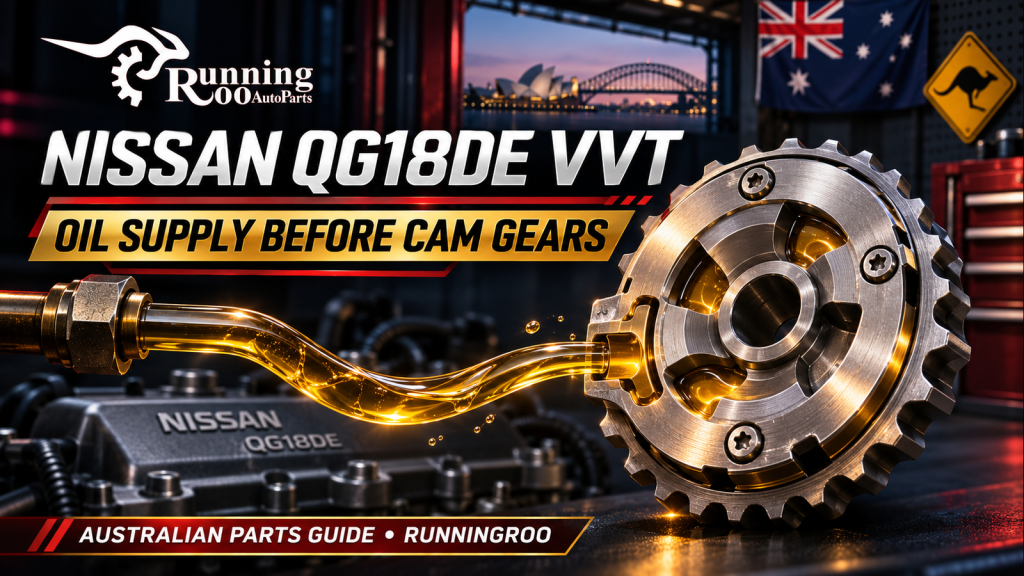
A Nissan QG18DE VVT gear enquiry should ask more than whether a replacement sprocket fits. If the workshop suspects a camshaft adjustment problem, the useful question is whether the evidence identifies the gear itself or an issue elsewhere in the system that operates it. Buying a new cam gear before that distinction is made can leave the owner with the correct part for an unconfirmed repair.
This Australian guide focuses on the oil-supply questions and records that belong in a professional VVT assessment. It does not provide a do-it-yourself oil-pressure test or a universal diagnosis for a Pulsar N16. The relevant RunningRoo single-gear offer is Camshaft VVT Gear For Pulsar Almera 1.6 1.8L N16 QG18DE 13025-AU000 — RunningRoo, with the corresponding matching RunningRoo eBay listing listing available for comparison. Call 0425 890 125 with the workshop's findings, VIN, engine code and OE reference before ordering.

The technical principle, and its limits
Motorservice's manufacturer technical explanation describes hydraulic camshaft adjustment in which controlled engine-oil flow changes the camshaft's position relative to its drive. That establishes a system-level distinction between the adjusting component and the oil-control function. It does not certify the exact internal design, pressure limit or test procedure of every QG18DE variant. Those details must come from the applicable Nissan service information. Motorservice manufacturer technical explanation: camshaft adjustment
For the owner, the practical implication is a question rather than a conclusion: has the workshop assessed the operating conditions relevant to the adjustment system before recommending a gear? A component can be correctly identified in a catalogue while the reason for replacing it remains unproven. Fitment checking and diagnosis answer different questions, and a good repair enquiry needs both.
Avoid interpreting “oil supply” as an instruction to pour in a treatment or use a different lubricant. This article makes no such recommendation. The workshop should determine which checks are appropriate and how to interpret them. An owner can provide maintenance records and describe the complaint without opening oil passages, applying pressure or dismantling the phaser.
Establish which engine and gear are fitted
The selected RunningRoo listing uses the reference 13025-AU000 and describes one camshaft VVT gear for specified Pulsar and Almera QG applications. The listing's model and year descriptions are starting points for confirmation, not a guarantee for every QG16DE or QG18DE engine. Send the VIN and the actual engine code, and ask the installer to identify the relevant OE reference for the fitted assembly.
If there has been an engine change, include the available information about that replacement. A registration lookup can describe the vehicle while failing to explain what is currently fitted. The installer should resolve that distinction before the supplier is asked to choose a component. A clear photograph of the removed part can help, but it should be accompanied by the readable markings and the workshop's interpretation.
Do not assume that two sprockets are interchangeable because their outer teeth appear similar. Likewise, do not infer a complete VVT package from a listing for one gear. The supplier's written confirmation should identify what is being supplied and the basis for matching it to the job. Keep that response with the order instead of relying on a verbal recollection.
Bring the service history into the assessment
Useful documents include the latest oil-service invoice, any recent work on the cylinder head or timing drive and records of earlier attempts to address the same complaint. Arrange them chronologically. If an oil specification or service date is unknown, mark it as unknown. A technician can work with an honest gap in the record more effectively than a guessed detail presented as fact.
Describe any changes made after the symptom began. If a sensor, solenoid or other component has already been replaced, provide the invoice or part reference. Do not combine those events into the phrase “the VVT was replaced” unless that accurately describes the work. The distinction matters when the workshop is deciding what has actually been checked and what remains open.
Record when the complaint occurs: at a first start, after warming, during ordinary acceleration or under another observed condition. This information should guide the appointment, not become a diagnosis by itself. If there is an active warning or abnormal engine behaviour, ask the workshop whether the vehicle should be driven or transported. An online parts page cannot answer that condition-specific question.
Ask for findings that distinguish the possible repair paths
A useful report separates the original symptom, the observations made during assessment, the checks performed and the recommended repair. Ask whether the gear is confirmed as the required replacement or whether further investigation is needed. If the workshop uses the phrase “oil pressure problem”, ask it to explain what was measured, under which conditions and against which applicable specification.
Do not supply a pressure number from another engine or demand that the technician use an internet test. A reading without its temperature, operating condition and reference can be misleading. The owner's role is to understand the evidence and authorise the work, while the technician selects the safe procedure and interprets the result using the correct Nissan information.
If the workshop recommends attention elsewhere in the system, make sure that recommendation is not lost when contacting the supplier. A message asking only for a gear may omit an important part of the repair plan. Ask for a written list that distinguishes components to replace, items to inspect and any work needed before a new gear is installed.
An oil-supply discussion checklist
| Question | Evidence to request | Ordering implication |
|---|---|---|
| Is engine identity confirmed? | VIN, fitted engine code and relevant reference | Prevents a model-name-only purchase |
| What is the complaint? | Dated symptom description and scan information | Keeps diagnosis separate from part selection |
| What service details are known? | Available oil and repair invoices | Provides context without guessing |
| What system checks were performed? | Workshop findings and applicable specification | Explains why the gear is or is not implicated |
| Is replacement justified? | Clear recommendation linked to evidence | Establishes the actual shopping list |
| What else is required? | Associated parts and work identified separately | Avoids treating one gear as a complete repair |
| What will be reassessed? | Original symptom and agreed completion checks | Creates a useful handover record |
The checklist is intended for communication, not for instructing a workshop how to repair the engine. It is acceptable for an initial assessment to conclude that more investigation is needed. The important point is to identify that uncertainty before purchasing and fitting a part as though the cause were already established.
Keep the gear, control component and sensor descriptions separate
Owners often receive several unfamiliar component names in one conversation. Ask the workshop to label the part it is recommending, preferably with an OE reference or a clear diagram from its service information. A camshaft gear, an oil-control component and a position sensor are not the same retail item. A short description such as “VVT part” can easily lead to an incomplete enquiry.
The selected RunningRoo product supplies one gear. It does not promise to include every component involved in sensing, controlling or supplying the adjustment system. If the repair requires additional items, the installer should name them separately. That simple discipline reduces the risk of the customer assuming the photographed gear contains everything needed for the job.
Check the current Camshaft VVT Gear For Pulsar Almera 1.6 1.8L N16 QG18DE 13025-AU000 — RunningRoo description alongside matching RunningRoo eBay listing, then resolve the exact package before payment. Reference numbers help identify an application; they do not by themselves prove that an aftermarket product was manufactured by Nissan. Ask about the supplied brand and product description if origin matters to your purchase. Avoid turning an OE cross-reference into an unsupported “genuine Nissan” claim.
Why a cleaning suggestion is not a complete repair plan
A recommendation to inspect or clean an accessible component should specify which component, why the work is appropriate and how its condition will be reassessed. It should not be expanded into a generic instruction to flush the whole engine or dismantle a cam gear. Different operations have different purposes, and this guide does not establish that any particular cleaning procedure is suitable for your vehicle.
If a workshop finds contamination or another underlying concern, ask how that finding changes the scope before authorising a new part. A replacement order should not become a way to avoid discussing the original finding. At the same time, do not assume that every VVT complaint involves contamination. Keep the actual evidence separate from common explanations found online.
An owner can make the process clearer by requesting a concise written summary: what was found, what action is proposed and what outcome will be checked. This is more useful than a long list of possible causes with no indication of which ones apply. The supplier can then answer the parts question while the workshop remains responsible for the repair decision.
Buying locally without skipping identification
RunningRoo is Australian-operated and supports customers in Melbourne and across Australia. Local pickup by appointment can be helpful when a workshop has confirmed the required gear, but proximity does not remove the need to check the VIN, engine code and OE reference. Call 0425 890 125 to confirm the item and collection arrangements before travelling.
For interstate customers, ask about fast dispatch after the exact stock and package are confirmed. Give the receiving postcode and, if appropriate, the workshop's delivery details. The repairer should inspect the package against the agreed list before installation. Do not schedule a car's return to service solely around an estimated freight date.
Retain the listing reference and written fitment discussion. If the received item differs from the expected package or markings, contact the supplier before fitting it. A discrepancy is easier to resolve while the component is still identifiable and unused. The owner, supplier and installer should work from the same documented requirement rather than comparing separate fragments of an earlier conversation.
What a useful handover explains
The final repair record should say what was replaced and how the original complaint was reassessed. Ask whether any associated findings remain unresolved and what follow-up, if any, is recommended. Keep the record with the earlier diagnostic findings so a future workshop can understand the sequence without repeating assumptions.
A successful parts match is not, by itself, proof of a complete diagnosis. Likewise, a changed symptom after work should be described accurately rather than used to make a general promise about engine life. The purpose of this guide is a more reliable decision process: identify the vehicle, understand the evidence, order the correct component and retain a clear account of the work.
Make the oil-supply discussion specific enough to record
A useful workshop explanation should say what was actually checked and what remains uncertain. “Oil looks fine” and “oil supply assessed under the applicable procedure” are not equally detailed statements. Ask the repairer for a plain-language summary of its findings without requesting unsupported numbers from a different engine or trying to interpret test equipment yourself.
If the technician requires further assessment before recommending the gear, keep that step separate from the parts order. A supplier's stock availability does not establish that replacement is the next diagnostic action. Equally, a completed assessment should result in a clear component request rather than a collection of possible parts selected from an online search. The purpose of this discussion is to connect the order to evidence.
Keep any relevant service records with the workshop report, including known changes made before the appointment. Where information is missing, say so rather than reconstructing it from memory as a certainty. A future repairer should be able to distinguish the customer's observations, the documented maintenance and the technician's findings. That clarity is more valuable than a broad claim that every oil-related possibility has been ruled out.
Frequently asked questions
Does a VVT fault automatically mean the gear has failed?
No. The workshop should establish the repair requirement using the appropriate Nissan information. A fault description alone does not show which component needs replacement.
Can I test oil supply using a number from another engine?
No universal specification is provided here. Ask the technician to use the applicable procedure and explain the conditions and reference behind its findings.
What does the selected product include?
The RunningRoo page describes one camshaft VVT gear using reference 13025-AU000. Confirm the current package and fitment before ordering; do not assume sensors, control valves or timing-chain parts are included.
Can an oil additive replace diagnosis?
This guide does not recommend one. Discuss any proposed change with the workshop before altering the evidence or the vehicle's specified lubrication requirements.
Can RunningRoo help with a Melbourne order?
Yes. Send the engine details and installer-approved requirement, then call for stock confirmation and a pickup appointment. Interstate dispatch can also be discussed once the correct item is established.
Related reading and RunningRoo video
Read the related RunningRoo product-identification guide. Use that guide for the catalogue discussion and this article for the specific workshop question above.
Watch RunningRoo: Variable Valve Timing Explained. This is general background from the RunningRoo AutoParts channel, not a demonstration of this exact supplied component, confirmation of fitment or a substitute for the vehicle-specific repair procedure.
Confirm your parts enquiry with RunningRoo
Send your VIN privately, fitted engine code, relevant OE number and the installer-approved parts list before ordering. Contact RunningRoo support or call 0425 890 125. RunningRoo is Australian-operated in Blackburn, Victoria. Melbourne local pickup is by appointment; ask about fast dispatch after stock, fitment and order timing are confirmed. Friendly support can help clarify the product enquiry while the qualified repairer remains responsible for diagnosis and installation.
Technical references and scope
Motorservice manufacturer technical explanation: camshaft adjustment. Manufacturer material provides the technical background described in the article. Archived training and general system explanations are not current VIN-specific repair instructions. The discussion questions and planning examples are editorial guidance. Retail descriptions establish the seller’s stated offer, not manufacturer approval or universal compatibility.