
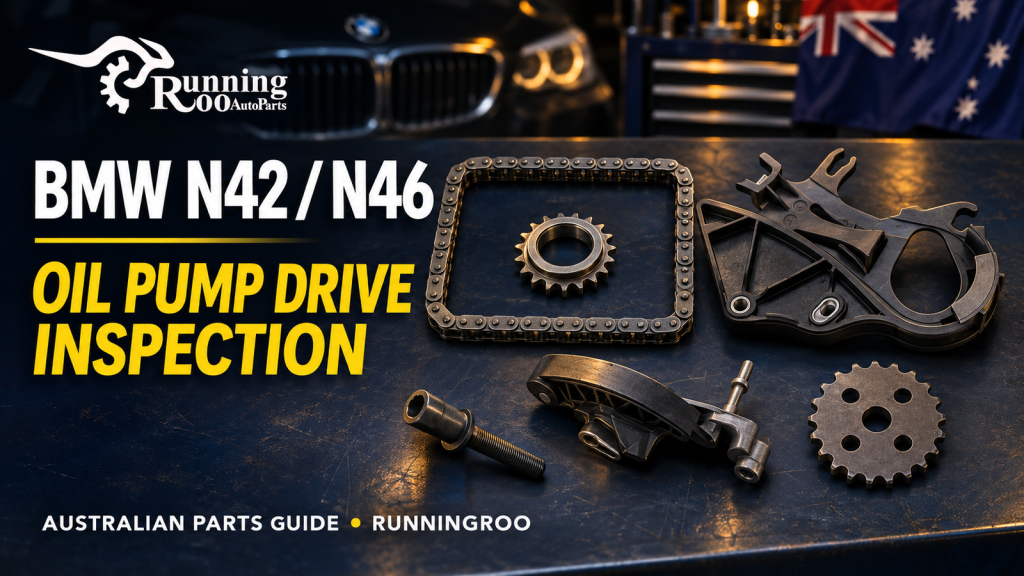
Finding fragments during a BMW N42 or N46 timing inspection creates a new question: what condition is the oil-pump drive and the surrounding assembly actually in? The right response is a documented inspection, not an automatic assumption that a new chain will restore every aspect of lubrication. A replacement drive kit supplies particular components. It does not establish the condition of the pump, explain the origin of unidentified debris or prove that the rest of the engine is undamaged.

For Australian owners discussing this work with a BMW specialist, the most useful buying decision follows a clear inspection report. This guide focuses on that report and on the boundary between drive parts and the pump assembly. It is not an instruction to dismantle the engine at home. RunningRoo's relevant oil-pump chain offer should be matched to the VIN, fitted engine code, OE references and actual repair requirements before ordering.
Identify the finding before naming the failed component
If the workshop reports debris, ask where it was found and what supports the identification. Material in a removed cover, filter or sump is evidence to investigate. Its colour or appearance in a photograph is not enough by itself to prove which component failed. A technician should relate the material to the engine inspection and record any missing or damaged parts. This prevents a guess about fragments from becoming an unnecessarily broad parts order.
Keep observations and conclusions separate on the job card. An observation might describe a damaged rail and its location. A conclusion should explain how that finding affects the proposed repair. If the origin of the material remains uncertain, say so. That uncertainty is useful information when planning the next inspection. It should not be hidden behind a confident statement that replacing the oil-pump chain will definitely resolve the concern.
Understand what the advertised drive package contains
The RunningRoo listing names an oil-pump chain, crank gear, oil-pump gear, tensioner, guide and centre bolt for the vibration damper. Confirm the current supplied inventory before purchase. Although the product title uses timing terminology, these items should be matched to the oil-pump drive task rather than treated as a promise that a complete upper camshaft timing system is included. Ask the workshop to mark the components it needs on a written list.
The page also contains broad engine naming, including N43 in the title while the detailed description focuses on N42 and N46. Do not use that difference to assume interchangeability. Provide the complete engine identity and have the exact application confirmed. Similarly, commercial statements about warranty or shipping should be checked against the current sale terms rather than copied from a historical paragraph. The repair decision depends on correct parts and professional findings, not on the broadest phrase in the listing.
A drive kit is not the complete pump unit
BMW's archived TIS instruction for N40/N42/N45/N46 oil-pump work describes the oil pump and balancing shafts as a combined unit and warns against separating them. It also identifies specialised tools and substantial preliminary access. This is useful manufacturer evidence that the task has defined assembly boundaries. The archived issue is not a substitute for the current procedure for the particular vehicle, and it does not establish the condition of a customer's engine. BMW AG TIS 11 41 000, archived manufacturer repair information
For purchasing, the consequence is straightforward: distinguish the chain-drive components from the unit they drive. If the workshop believes the pump assembly is damaged, ask it to explain that finding and specify the required remedy separately. A photograph of a chain kit does not show that a complete pump or balancing assembly is supplied. Equally, an oil-related complaint does not prove that the entire unit must be replaced without assessment.
| Inspection question | Record to obtain | Purchasing consequence |
|---|---|---|
| What material was found? | Location, photographs and technician assessment | Avoid assigning an unsupported source |
| Which drive parts are damaged? | Identified chain, guide, tensioner or gear findings | Match the kit to a confirmed requirement |
| Has the pump unit been assessed? | Relevant findings using BMW procedure | Separate drive parts from assembly replacement |
| Is the fitted engine confirmed? | VIN, engine code and OE references | Resolve title and application ambiguity |
| What extra items are needed? | Seals, fasteners, fluids and access-related requirements | Prevent a kit-only estimate from understating the job |
| How will completion be checked? | Workshop validation and follow-up record | Link the repair to the original concern |
Ask how the inspection changes the repair scope
A sensible authorisation can be staged. First approve the inspection needed to identify the problem. Then review the findings and the proposed parts. If the work uncovers an additional issue, the workshop should explain why it matters and how it changes the estimate. This is more useful than authorising every conceivable component at the beginning or insisting that the mechanic install only the originally ordered chain regardless of what is found.
For example, a hypothetical inspection may confirm a damaged drive guide while leaving the pump-unit condition to be assessed. The owner should know that distinction before treating a kit purchase as the whole repair. Another inspection may find that the original suspicion was wrong. In either case, the decision should follow the evidence. These examples describe possible decision paths, not failure rates, customer histories or a claim that all N42 and N46 engines develop the same defect.
Keep cleaning and contamination control within the repair plan
Ask the mechanic how the identified material and affected areas will be handled under the applicable procedure. Do not substitute an owner-selected flushing product for that work. The workshop needs to determine the extent of inspection and cleaning, and whether any associated component requires further assessment. A clean-looking new chain does not demonstrate that the cause or consequences of the original finding have been addressed.
The job record should explain the work performed without making impossible promises. Phrases such as completely renewed engine or all debris eliminated should not appear unless the scope and evidence genuinely support them. A more useful record identifies the inspected areas, the parts renewed and any remaining concern. That helps the owner understand what has been achieved and gives a later technician a factual history if another issue arises.
Do not use a warning-light outcome as the only test
The absence of a warning after assembly is welcome, but it is not a replacement for the checks required by the repair procedure. Ask the workshop how it will validate the original concern and whether relevant measurements are necessary. Where a measurement is taken, record the conditions and the applicable specification rather than just writing good. A number without temperature, operating context or the correct reference can be difficult to interpret.
This article does not publish a universal pressure target, priming instruction or engine-running sequence. Those details must come from the manufacturer information for the exact engine and the work completed. If an owner sees a warning or hears an unresolved abnormal noise after collection, the next step is to contact the workshop and follow its advice, not experiment with a different oil or repeatedly run the engine to see whether the concern disappears.
Reconcile the delivered kit before installation
Have the workshop compare the delivered package with the approved inventory while everything is unused. Check the relevant part references, physical interfaces and quantity of components. The centre bolt deserves its own identification check rather than being treated as a generic fastener. The current BMW procedure determines where new fasteners are required and how they are installed. The presence of a bolt in a box does not independently validate every use suggested by a broad listing title.
If something differs, take clear photographs and contact RunningRoo with the order reference and vehicle information. Avoid altering a guide, substituting an unidentified bolt or mixing uncertain components from several kits to keep the job moving. A mismatch is easier to resolve before assembly. Friendly supplier support is most effective when the enquiry includes the exact item and the mechanic's explanation of the difference.
Budget for access as well as the visible parts
The small size of an oil-pump chain package can make the repair look simpler than the workshop time suggests. BMW's referenced instruction shows that access and assembly handling form part of the task. Ask the mechanic to explain the proposed work rather than judging the estimate only by the number of parts in the box. The quotation should identify inspection, access, replacement components, consumables and validation as appropriate.
Do not compare this job directly with an external tensioner replacement or a generic upper timing-chain service. Those descriptions can involve different components and access requirements. If two quotations differ substantially, compare their scope before deciding which represents better value. A clear list can reveal that one includes additional assessment or sealing work while another assumes those items are unnecessary. Resolve that difference before the engine is dismantled.
Use an engine-specific maintenance record afterwards
Keep the completed invoice, product identification, relevant findings and oil-service information together. If the engine has previously been replaced, retain that history alongside the vehicle VIN. A later workshop should be able to see which assembly was repaired and what parts were installed. This is particularly useful where a registration search alone points to the original specification rather than the engine now in the vehicle.
Ask for any follow-up instructions in writing. Do not invent a running-in interval, a special additive requirement or a permanent service change simply because a chain was renewed. The workshop should explain any advice that follows from the actual repair. Owners can then maintain the vehicle using the appropriate information instead of accumulating conflicting recommendations from unrelated engine variants online.
Related RunningRoo reading: BMW N42/N46 Timing Chain vs Oil-Pump Chain: Kit and VANOS Guide. That article addresses a related but separate question or application; it does not establish interchangeability with this product.
Ordering with a clear scope in Australia
Send RunningRoo the VIN, engine code, OE references and a concise description of the workshop's findings. State explicitly that the enquiry concerns the oil-pump drive package. If the mechanic also needs an upper timing kit or a pump assembly, list those requirements separately. That avoids a conversation in which everyone says timing kit but means a different collection of components.
RunningRoo is Australian-operated and offers Melbourne local pickup in Blackburn VIC by appointment, fast dispatch subject to stock and preparation, and friendly support. Confirm availability before arranging workshop time or interstate delivery. The best outcome is an order that matches a verified repair plan: the right drive components, a clear understanding of what remains outside the kit, and an installer prepared to validate the work.
Frequently asked questions
Does this oil-pump chain kit include the complete oil pump?
Do not assume that it does. The linked inventory concerns the chain-drive components and a listed bolt. A complete pump or balancing assembly is a separate scope question. Ask RunningRoo to confirm the current package and have the workshop identify any additional assembly required by its findings and the applicable BMW procedure.
Can fragments in a photograph prove the oil-pump guide failed?
A photograph can support an investigation, but it should not replace identification by the technician. Record where the material was found and whether it can be related to a damaged component. If the origin remains uncertain, the repair plan should acknowledge that uncertainty and specify the further assessment needed.
Is N43 coverage confirmed by the product title?
No. The title and detailed application wording should be reconciled before ordering. Provide the VIN, fitted engine code and OE references rather than assuming that adjacent engine codes use identical hardware. RunningRoo and the installing workshop should confirm the specific configuration that will be supplied and fitted.
Should I replace the pump unit whenever the chain is replaced?
That is a diagnosis and procedure question, not an automatic consequence of buying a drive kit. Ask the workshop to explain the unit's assessment and any finding that supports replacement. The manufacturer information defines assembly boundaries, but the condition of the individual engine determines the actual repair recommendation.
Will fresh oil alone confirm that the repair worked?
No. Record the correct oil and filter details, but also ask how the original concern will be checked. The workshop should carry out the applicable validation and explain any remaining issue. Do not use a changed noise or a warning that temporarily disappears as the sole basis for declaring every lubrication concern resolved.
How can I arrange local parts supply?
Call 0425 890 125 with the product link, VIN, engine code, OE references and workshop parts request. Confirm stock and contents before arranging Melbourne pickup by appointment or delivery elsewhere in Australia. RunningRoo can clarify supply, while the qualified workshop remains responsible for diagnosis, installation and the final checks.
Related RunningRoo video
Timing Chain Rattle: Wear Symptoms & When to Replace | RunningRoo. This channel video provides related educational context. It is not proof that the filmed component is the exact supplied item, a vehicle-specific diagnosis or a substitute for current manufacturer procedures.
Sources and scope
Offer and stock information checked on 16 November 2026. Retailer descriptions identify the offered contents; the manufacturer sources support the technical points attributed to them within their stated market and model scope. The purchasing examples and suggested questions are editorial guidance. Use current vehicle-specific manufacturer information and professional diagnosis for the actual repair.