
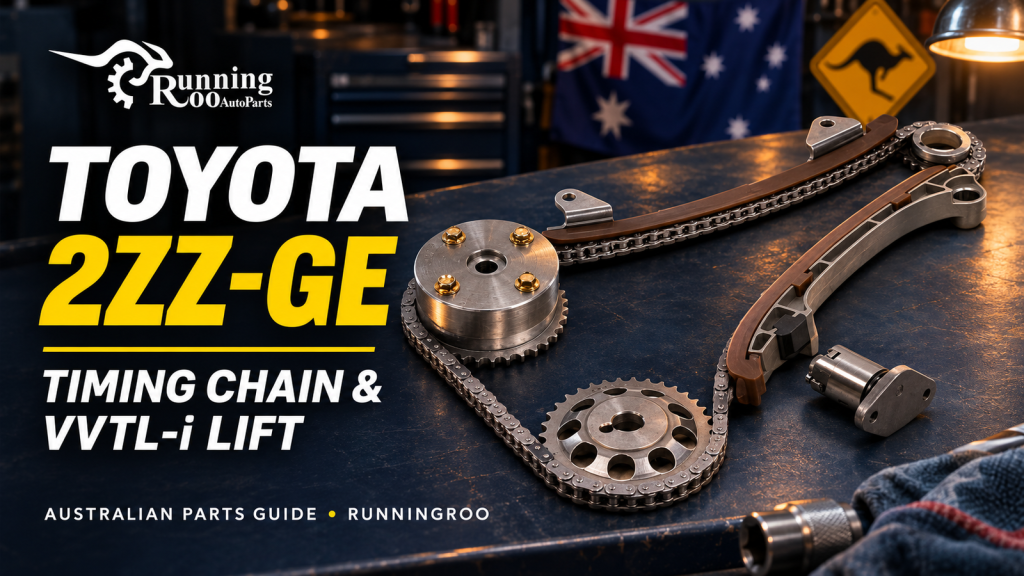
A Toyota 2ZZ-GE owner can hear the words timing, VVT and lift during the same workshop conversation, yet those words do not describe one interchangeable repair. A timing chain kit addresses a defined group of mechanical drive components. A VVT gear changes camshaft timing within the engine's control system. The lift function is another part of the VVTL-i design. Buying a package that contains a chain and a VVT gear does not establish that it will correct an unrelated lift complaint.

For Australian Celica and Corolla enquiries, the practical starting point is to separate what the driver experiences from what the mechanic has confirmed. This article explains how to organise that conversation and choose a repair package with clear boundaries. It does not provide a high-rpm test procedure or diagnose a car from a video. The exact VIN, fitted engine code, OE references and professional findings remain essential, particularly where an imported vehicle or engine conversion is involved.
Three questions that should not become one parts order
Ask first whether the workshop has found a base mechanical timing issue. Ask second whether it has found a problem with cam phasing. Ask third whether the complaint concerns the variable-lift function or another cause of reduced performance. These questions may overlap in a real diagnosis, but they should not be collapsed into the assumption that every loss of performance requires a new timing chain and actuator.
Toyota's original Celica T Sport engineering information distinguishes the continuously variable intake timing function from the system's lift-changing mechanism. That distinction supports a useful purchasing boundary: the word VVTL-i describes more than the contents of a chain-and-gear box. The Toyota publication concerns its stated vehicle and market; it is not a parts approval for every Australian car carrying a Celica or Corolla badge. Use the current vehicle-specific repair information for diagnosis and assembly. Toyota Celica T Sport launch engineering information
Describe the complaint without choosing the cause
An owner may describe the car as flat, noisy or reluctant to rev. Record the conditions and recent history, but let the technician establish the cause. Include whether the complaint is new, intermittent or present since previous work. Mention known changes to the engine, control system or servicing, without assuming that any one change caused the fault. A useful description gives the workshop evidence to investigate rather than a component to replace on speculation.
Avoid deliberately repeating a high-load or high-rpm event to prove a lift concern when the engine already has an unresolved noise or warning. Ask the workshop how it intends to evaluate the complaint safely. A phone recording can preserve the circumstances, but it does not establish chain wear, actuator condition or lift-system operation. An assessment should be based on the relevant manufacturer diagnostic path and the condition of the actual vehicle.
What the RunningRoo combination offers
The linked RunningRoo product is listed as a 2ZZ-GE timing chain kit with a VVT gear. Its inventory names the chain, camshaft gear, crankshaft gear, VVT adjuster, tensioner and guides. These are the items to reconcile with the current supplied package. Request confirmation if the website description, eBay wording or a workshop quotation uses a different package name. A complete timing solution is a retail description, not proof that every part associated with VVTL-i is included.
The offer's reference list is useful for an enquiry, but not all numbers in a combined kit refer to the same component. A chain number and a VVT-controller number serve different identification purposes. Send the complete reference for the required item rather than selecting a similar-looking number from a list. The mechanic should approve the configuration and determine whether the diagnosis calls for the combination or a narrower repair.
| Question | Evidence to request | Parts implication |
|---|---|---|
| Is base timing affected? | Vehicle-specific mechanical findings | Assess the chain drive and related components |
| Is cam phasing implicated? | Relevant diagnostic results and actuator assessment | Decide whether the VVT gear belongs in the repair |
| Is lift operation the concern? | Manufacturer-guided investigation of that function | Do not assume the chain kit includes lift-system parts |
| Is this the original engine? | VIN, engine marking and conversion history | Reconcile the vehicle record with the fitted assembly |
| What is in the package? | Confirmed inventory and exact product link | Separate supplied parts from additional requirements |
| How will repair success be checked? | Agreed validation of the original complaint | Avoid relying only on a new-parts invoice |
Do not transfer badge assumptions between markets
A model name used in an overseas listing may not map directly to an Australian trim designation. The same broad name can appear with different engines, and an older car may have been modified. Identify the fitted 2ZZ-GE through appropriate vehicle and engine information. If the paperwork and engine do not agree, resolve that disagreement before ordering. A workshop familiar with imported and modified vehicles can help determine what records are required.
The current product description contains broad application wording that should be treated as an invitation to verify, not copied into a universal fitment promise. When a retailer's title or capacity notation conflicts with the vehicle record, send both to RunningRoo and ask for clarification. Do not choose the interpretation that simply makes the order easiest. The cost of a short identification conversation is usually easier to manage than a mismatch discovered during assembly.
Build a diagnosis-led estimate
An estimate should state the confirmed problem and the proposed remedy in separate sentences. For example, a workshop may propose a chain-drive repair after a mechanical inspection, while noting that a performance complaint still needs a separate investigation. That is more informative than calling the entire job a VVTL-i repair. Ask whether any parts are provisional until inspection, and what finding would change the scope.
The estimate should also identify consumables outside the advertised kit. Sealing materials, fasteners, fluids and other vehicle-specific items need to be checked against the actual procedure. Do not assume that an included VVT gear means a solenoid, sensor or lift-related component is also supplied. Conversely, do not authorise unrelated replacements merely because the engine is already open. The workshop should explain the connection between each additional item and the work being performed.
Keep the original parts and new parts clearly separated
Before installation, compare the supplied inventory with the approved order. Ask the mechanic to check the relevant references and interfaces while the parts are still clean. Photographs should show which items are new and which were removed. If an unexpected difference is found, stop the fitment decision and ask the supplier to review it. A superficial resemblance between gears is not enough to confirm an engine-specific match.
Do not dismantle the new VVT actuator for curiosity or to compare hidden features with an internet image. Inspection and handling must follow the manufacturer's applicable requirements and the supplier's instructions for the supplied component. If the package arrives with transport damage or an uncertain marking, document that condition before use. Good receiving records protect the repair plan without turning the owner into an installer.
Separate technical references from repair instructions
Toyota's engineering description explains why timing control and lift control are distinct concepts. It does not replace the service procedure for the vehicle being repaired. The workshop needs the appropriate instructions for timing alignment, special tools, fasteners and any required checks. This guide avoids publishing a generic chain installation sequence because a simplified sequence can omit conditions that matter during the real job.
Similarly, a related RunningRoo video can make terminology easier to understand without proving a component is faulty. Treat educational content as preparation for the workshop conversation. It should help the owner ask a clearer question, such as which part of the timing or lift system has been tested, rather than encourage a parts order based on an illustration alone. The product link identifies an available offer; it does not certify the diagnosis.
What a useful repair report says
A useful report records the vehicle and fitted engine, the original findings, the parts installed and the checks performed afterwards. If the original concern involved performance, ask whether that concern was evaluated after the mechanical work or remains outstanding. The wording should be specific enough that another workshop could understand the distinction. A statement that all timing parts are new says little about an unrelated lift-system complaint.
If the car improves after a repair, that is a valuable observation, but it should not be turned into a claim that the same package will fix every similar symptom. Different vehicles can reach a similar complaint through different faults. Keep the report factual. For a vehicle with a complicated ownership or modification history, a clear repair record can be especially useful when planning later maintenance or discussing a new concern.
Budget for the complete confirmed job
When comparing a combined chain-and-VVT offer with individual parts, compare the actual contents and required extras. A lower advertised price may cover a smaller package, while a larger package may contain items the workshop has not found necessary. Ask for a parts list that can be checked line by line. That makes a purchasing decision more useful than relying on the word complete or on the number of items in a photograph.
RunningRoo offers Australian-operated support, Melbourne local pickup in Blackburn VIC by appointment and fast dispatch subject to confirmed stock and preparation. Share the workshop's approved list before booking collection or arranging shipment to an installer. If the order needs to change after further diagnosis, confirm the revised package explicitly. This helps keep the supplier, owner and mechanic working from the same understanding of the repair.
Related RunningRoo reading: Toyota 2ZZ-GE Timing Chain & VVT Gear Rattle: Diagnosis and Repair Options. That article addresses a related but separate question or application; it does not establish interchangeability with this product.
A practical way to explain the job to an owner
Imagine a hypothetical Celica owner who asks for a kit because the car no longer feels as lively. The workshop first establishes the actual engine and investigates the complaint. If it finds a chain-drive defect, it can justify the timing repair. If the evidence points elsewhere, a chain kit is not automatically the appropriate purchase. The example illustrates a decision process; it is not a customer case study or a claim that one symptom reliably identifies one fault.
The best buying enquiry therefore says what has been confirmed and what remains uncertain. Include the VIN, engine code, OE references and the exact RunningRoo product being considered. If the mechanic recommends retaining or replacing the VVT actuator, ask for the reason. Clear boundaries reduce unnecessary spending and help the finished repair address the real complaint rather than the most familiar term in an online search.
Frequently asked questions
Does a timing chain kit repair the VVTL-i lift mechanism?
Not automatically. Check the supplied inventory and the diagnosed fault. The linked combination concerns the chain drive and VVT gear; it should not be assumed to contain all lift-system components. Toyota's description separates variable timing from lift changeover, so the workshop should establish which function is involved before recommending parts.
Is every Celica or Corolla with a 1.8 badge suitable?
No. Confirm the actual engine and application using the VIN, engine code and OE references. Market naming and previous engine changes can complicate identification. A vehicle badge, capacity description or photograph is not enough to approve the kit. Ask RunningRoo to review the exact vehicle and the workshop's requested configuration.
Can a loss of high-rpm performance prove chain wear?
No. It is a complaint to investigate, not a standalone measurement of chain condition. Do not deliberately stress an engine with an unresolved fault to reproduce the symptom. A qualified workshop should follow the appropriate diagnostic information, assess the vehicle and explain the evidence for any proposed timing or lift-related repair.
Should I buy the chain and VVT gear together?
A combined package can be useful when both belong in the confirmed repair scope. It should not replace diagnosis. Compare the package with the mechanic's parts list and identify any additional seals, fasteners or other requirements. If the actuator is being replaced, ask why it is included rather than assuming it must fail whenever the chain does.
What if the listing details do not match my paperwork?
Pause the order and ask for clarification. Send the VIN, engine marking, relevant OE reference and the conflicting description. Older or imported vehicles can require extra identification work. Do not resolve a discrepancy by guessing that two similar engine or model names must share the same timing hardware.
Can I collect the confirmed kit in Melbourne?
Yes, arrange pickup with RunningRoo by appointment after confirming the correct item and current stock. Call 0425 890 125 with the product link and workshop findings. Interstate buyers can ask about dispatch options. Friendly local support can help clarify the package, while diagnosis and installation remain the responsibility of the qualified workshop.
Related RunningRoo video
Timing Chain Rattle: Wear Symptoms & When to Replace | RunningRoo. This channel video provides related educational context. It is not proof that the filmed component is the exact supplied item, a vehicle-specific diagnosis or a substitute for current manufacturer procedures.
Sources and scope
Offer and stock information checked on 16 November 2026. Retailer descriptions identify the offered contents; the manufacturer sources support the technical points attributed to them within their stated market and model scope. The purchasing examples and suggested questions are editorial guidance. Use current vehicle-specific manufacturer information and professional diagnosis for the actual repair.