
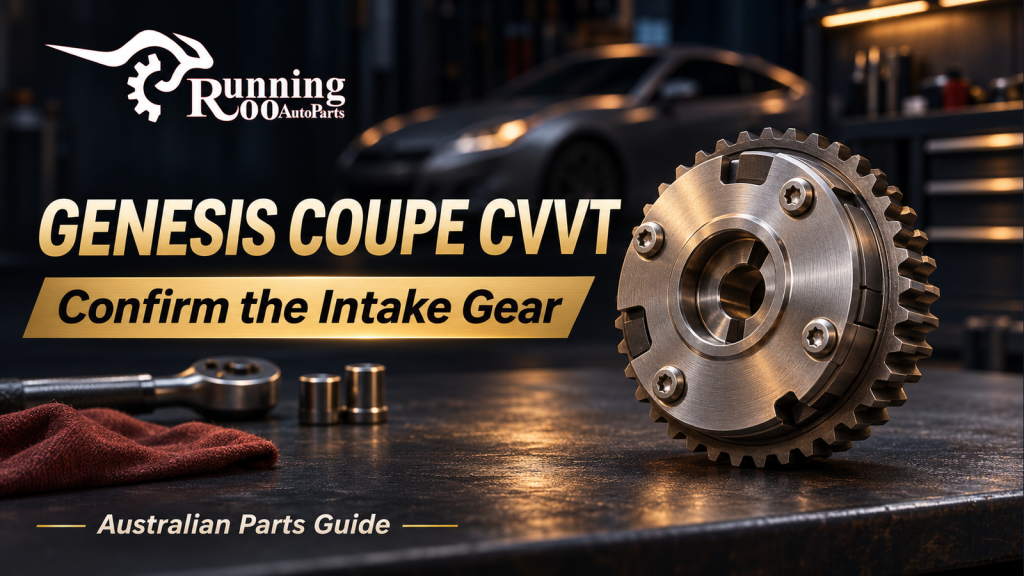
A Genesis Coupe intake CVVT gear enquiry needs more detail than the vehicle name and a search-result title. RunningRoo's linked offer identifies reference 24350-25000 and describes one intake camshaft gear, but its application wording spans several Hyundai models and engine descriptions. For an Australian buyer, the correct approach is to verify the actual engine and required OE reference before treating the listing as a confirmed match.

This guide is designed around that specific enquiry. It does not promise that every Genesis Coupe built within a broad year range uses the advertised gear, and it does not combine the intake and exhaust positions. The aim is to help the customer and workshop resolve the exact component requirement, then confirm whether the linked RunningRoo product is the appropriate supply.
Begin with the intake position
The linked website offer describes an intake CVVT gear with reference 24350-25000. That position belongs in every enquiry, quotation and order confirmation. Do not shorten it to “Genesis VVT gear” if the workshop has identified an intake-side requirement. A supplier should be able to see which side and reference are being discussed without reconstructing the conversation from several screenshots.
If the workshop has not yet identified the required position, ask it to complete that part of the diagnosis before ordering. A timing-related symptom does not establish whether an intake gear, exhaust gear, control component or another part is required. The product title is a purchasing lead, not a diagnosis of the vehicle.
What the manufacturer says about the engine design
Hyundai Motor America's 2011 Genesis Coupe release describes the turbocharged 2.0-litre engine with dual CVVT on the intake and exhaust camshafts. That is useful design context for keeping the two positions separate. It is a manufacturer release for a particular market and model period, not a parts interchange approval for the linked 24350-25000 offer across all later or imported vehicles. Hyundai Motor America: 2011 Genesis Coupe manufacturer release
The practical implication is straightforward: dual timing control does not make the two gears interchangeable, and an intake-only product should not be described as a complete pair. Ask the workshop to identify the required component and its reference, then ask RunningRoo to confirm the supplied replacement. Keep design information and part fitment as two connected but distinct checks.
Resolve the engine-code wording before payment
The product page uses Genesis Coupe 2.0T wording and includes G4KD in its application description. It also lists other Hyundai applications under G4KC and G4KD. Do not copy those lines into a universal fitment statement or assume that a shared Theta-family description is enough. The vehicle's actual engine code and required OE reference need to be checked directly.
Send the VIN, engine identification, build details and the workshop's part reference to RunningRoo. If the information on the fitted engine differs from the listing wording, make that discrepancy explicit. Ask for a written answer about the exact offered gear. Do not resolve conflicting catalogue descriptions by selecting whichever engine code is most convenient for the order.
| Enquiry detail | What to establish | Why it matters |
|---|---|---|
| Vehicle identity | VIN, build and market specification | Broad model-year wording can hide differences |
| Fitted engine | Actual engine code and replacement history | A listing family name may not identify the engine |
| Required position | Intake or exhaust, stated explicitly | A single intake offer is not a pair |
| OE reference | Full number confirmed by the workshop | Similar descriptions are not interchange proof |
| Offered component | Exact 24350-25000 supply and condition | Connects the enquiry to a specific product |
| Diagnosis | Reason the component is recommended | Fitment information does not prove failure |
An OE reference is a checking tool, not a condition claim
Reference 24350-25000 helps connect the advertised offer to a parts enquiry. It should be checked against the reference required for the actual engine, including any supersession information the supplier or workshop can verify. Do not assume that the presence of an OE number means the item is a genuine manufacturer-branded part. Ask the supplier to state the product's brand and condition accurately.
The same number also does not diagnose the car. A workshop may correctly identify a reference while still needing to establish whether that component is responsible for the complaint. Keep those questions separate: which part belongs on the vehicle, and which part actually requires replacement? A responsible order should answer both before the customer commits to installation.
Confirm the single-item inventory
The website package list names one CVVT intake gear. It does not list an exhaust gear, a timing chain, guides, tensioners, oil-control valves or a complete set of installation materials. Those items should not be inferred from the word CVVT or from other products shown nearby in a catalogue. Ask the installer to identify any additional requirement separately.
A single-gear order can be appropriate when it matches the professional repair recommendation. The purpose of checking exclusions is not to encourage unnecessary purchases. It is to make the scope clear so that the customer knows which component is being supplied and which other parts, if any, the workshop has determined are needed.
Explain the complaint in factual terms
Tell the workshop when the symptom occurs, what warnings were displayed and what work has already been carried out. Keep any scan report or written diagnosis with the enquiry. Avoid presenting a search result as proof that the intake gear has failed. Similar symptoms can lead owners to the same product page without establishing that the underlying problem is identical.
If the workshop recommends this component, ask it to state the relevant position and reference with the diagnosis. If it recommends further investigation, keep the RunningRoo enquiry provisional. The supplier can still help with product identification and availability, but those answers should not be mistaken for a remote diagnosis of the engine.
Imported vehicles and engine changes deserve explicit detail
Australian buyers may encounter vehicles whose specification differs from the market described in a product title or manufacturer press release. Include the actual chassis and build information rather than assuming a local model-year search captures every detail. If an engine has been replaced or modified, tell the installer and supplier so that the fitted hardware can be checked.
Do not use a photograph of a similar coupe to settle a reference question. A vehicle's appearance may be familiar while its powertrain details require closer identification. The useful evidence is the VIN, engine information and workshop-confirmed part requirement. Where a label or reference is unclear, acknowledge the uncertainty and obtain a proper check rather than guessing.
Keep modifications separate from replacement suitability
If the engine has been modified, disclose the relevant history to the workshop. This guide does not claim that the advertised gear is a performance upgrade, supports increased power or corrects calibration changes. It is a candidate replacement component whose suitability must be confirmed for the actual application and repair scope.
Ask the supplier to explain what the offer does claim: the supplied part, reference, position, condition and any application confirmation. Do not add torque, durability or tuning promises that are not supported by the product evidence. Clear replacement language is more useful than describing every new part fitted to a modified car as an upgrade.
Plan the remaining installation materials
Have the workshop identify any required seals, fasteners, fluids and other materials using the correct manufacturer procedure. Decide who supplies them before the vehicle is dismantled. The one-gear package should not be expected to cover every material required to complete the job, and a generic parts list from another Hyundai engine should not be substituted for the actual requirement.
This article does not provide alignment marks, tightening values, actuator checks or assembly instructions. Those details are the installer's responsibility under the applicable service information. The customer's contribution is to make the component identity, additional materials and approval scope clear so that the workshop can proceed with an accurately specified order.
Compare the website and eBay offers carefully
Use the exact RunningRoo website product and corresponding eBay item in the enquiry. At the preparation check, the active eBay listing had a recorded sale and available quantity. That confirms a real trading offer, but it does not validate every model-year or engine-code line for a new buyer. Fitment still needs to be established for each order.
If one channel uses a shorter title or different descriptive wording, ask RunningRoo to reconcile it with the actual supplied gear. Do not choose one description and ignore the other when the difference affects application or contents. A clear written confirmation is more useful than assuming that all listings with the same broad product name are identical.
Make the order confirmation specific
A useful confirmation names the exact product, intake position, required OE reference and vehicle identity. It states the supplied brand or condition and identifies any unresolved application questions. If the supplier needs more information from the installer, obtain it before payment. This is particularly important where the product description and fitted engine code appear inconsistent.
Keep the confirmation with the invoice and workshop recommendation. Forward it to the installer so that the expected component can be checked on arrival. That reduces the chance of an early catalogue assumption becoming a fitting decision merely because the part has already been purchased and the vehicle is waiting for repair.
Local supply should follow the identification check
RunningRoo is Australian-operated and offers friendly support, fast dispatch subject to availability and Melbourne local pickup in Blackburn VIC by appointment. Confirm the matched component and stock before travelling or arranging workshop collection. A quick local supply option is most useful when the part identity has already been settled.
For interstate customers, discuss dispatch and delivery expectations after the exact offer is confirmed. Keep the transport estimate separate from the workshop's completion date. The installer may still need to inspect the delivered part, obtain additional materials or address another finding. A realistic schedule begins with a correct parts decision rather than a promise based only on parcel speed.
Check and document the delivered component
Ask the workshop to compare the supplied item with the agreed reference and application before fitting. Retain the packaging and labels. If anything differs from the written confirmation, contact RunningRoo with clear photographs and the order details. Do not modify or force an uncertain part into place to avoid delaying the appointment.
The final repair record should identify the intake component fitted and any other work carried out. Ask the workshop to explain its completion checks and remaining recommendations. This creates a clear history of the repair and prevents a later reader from assuming that a single intake-gear purchase renewed both camshaft actuators or the entire timing-chain system.
Related RunningRoo video
Variable Valve Timing Explained | VVT, VVT-i, VANOS & Valve Lift | RunningRoo. This channel video provides related educational context. It is not proof that the filmed component is the exact supplied item, a vehicle-specific diagnosis or a substitute for current manufacturer procedures.
Frequently asked questions
Does 24350-25000 fit every Genesis Coupe 2.0T?
This guide does not make that claim. Verify the actual VIN, engine code, build and workshop-required OE reference with RunningRoo. The listing's broad model and engine wording needs to be reconciled with the individual vehicle before the offer is treated as a confirmed match.
Is the advertised part intake or exhaust?
The website describes one intake CVVT gear. Keep the intake position explicit in the enquiry and order. If the workshop needs an exhaust component or a pair, obtain the correct separate references rather than assuming the single intake offer covers that scope.
What if my engine code differs from the listing?
Tell RunningRoo and the installer before buying. Provide the actual engine identification and required reference and ask for written clarification. Do not substitute a catalogue engine code for the fitted engine merely because the model name and capacity appear similar.
Does the OE reference mean the part is genuine Hyundai?
Not by itself. An OE reference can be used to describe the intended replacement application. Ask the supplier to confirm the brand and condition of the actual offered item, and avoid describing it as genuine manufacturer supply unless that is explicitly verified.
Will this gear fix every CVVT-related complaint?
No universal cure is claimed. A qualified workshop should establish the fault and recommend the required component. The correct part reference and the cause of the symptom are separate questions, and both should be resolved before installation is approved.
How can I arrange supply through RunningRoo?
Send the exact product link, VIN, engine code, full OE reference and diagnosis. Confirm application, contents and stock, then arrange Melbourne pickup by appointment or Australian dispatch. Friendly support is available to help make the enquiry specific and reviewable.
Related RunningRoo reading: VVT Gear vs VVT Solenoid: How to Diagnose the Right Fault. That article addresses a related but separate question or application; it does not establish interchangeability with this product.
Sources and scope
Offer and stock information checked on 14 November 2026. Retailer descriptions identify the offered contents; the manufacturer sources support the technical points attributed to them within their stated market and model scope. The purchasing examples and suggested questions are editorial guidance. Use current vehicle-specific manufacturer information and professional diagnosis for the actual repair.