
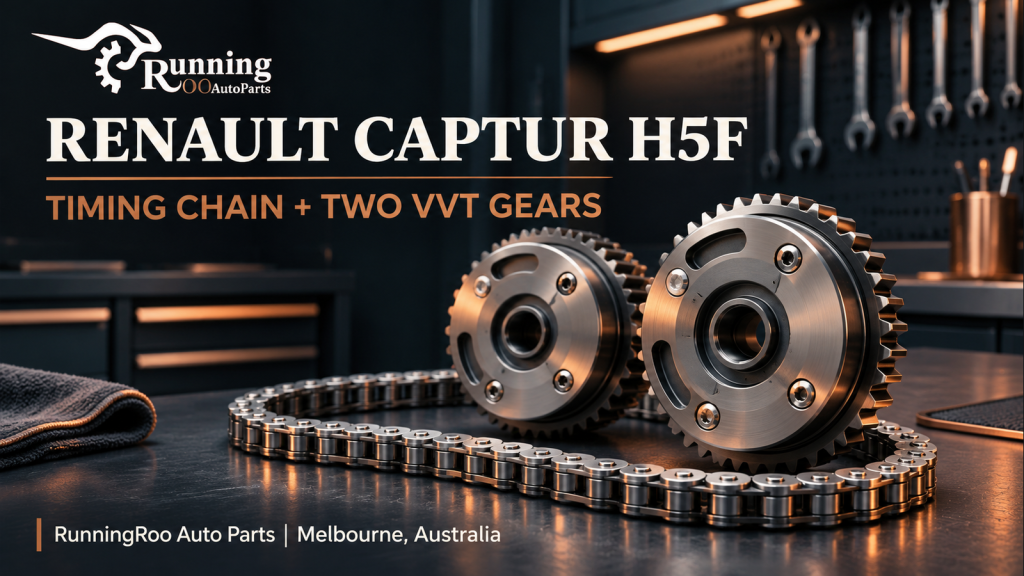
For a Renault Captur H5F timing-chain enquiry in Australia, one of the most useful distinctions is whether the proposed kit includes the camshaft adjusters. RunningRoo lists a nine-piece package with two chains, a sprocket, a tensioner, three guides and both intake and exhaust VVT gears. That is a specific package description, not a promise that every part needed for every Captur repair is inside the box. Confirm the engine identity and workshop scope before ordering.
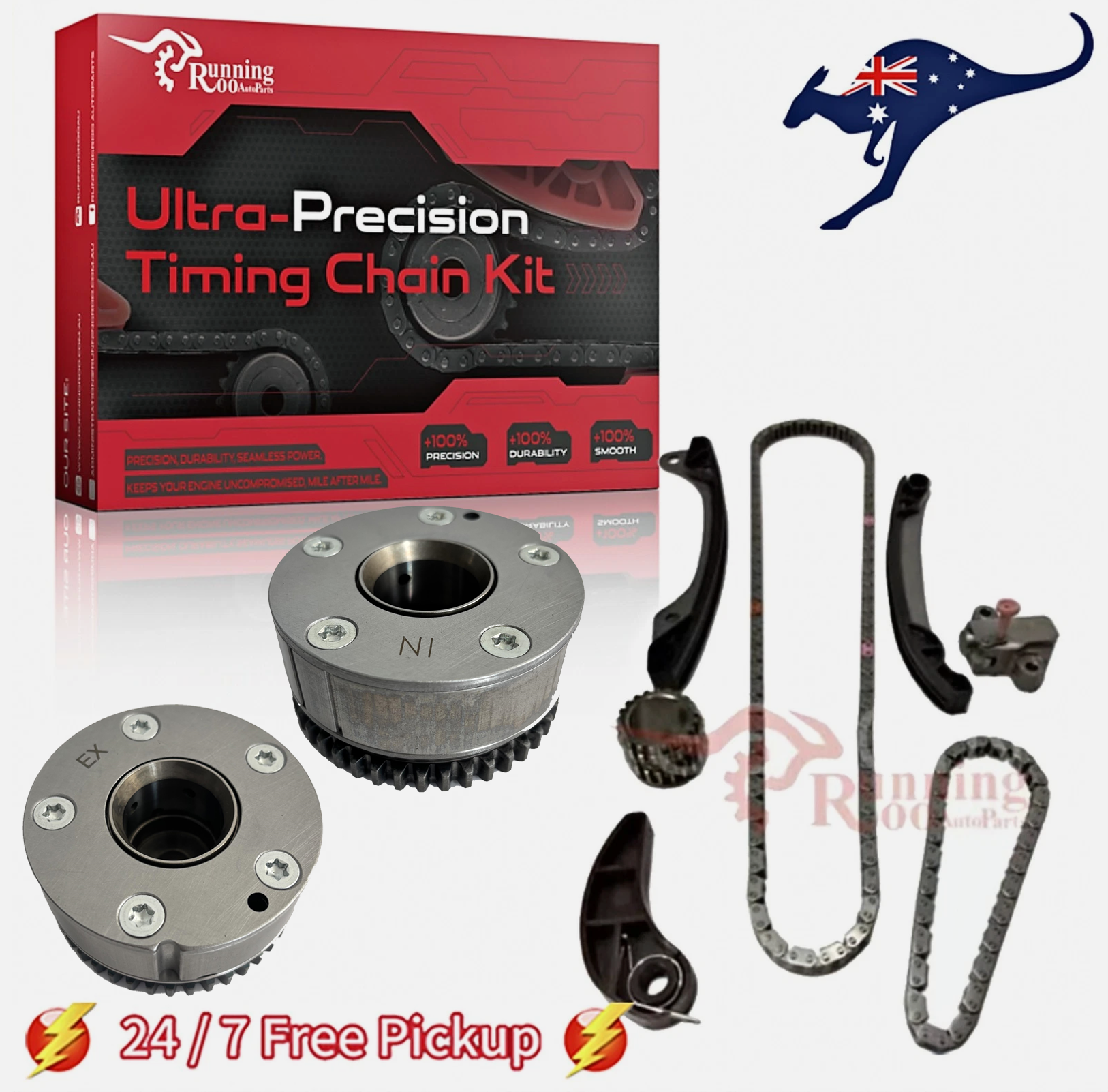
This guide focuses on that nine-piece Captur offer. It is separate from a seven-piece HRA2DDT chain package without the two adjusters, and it should not be used to combine all Renault and Nissan 1.2-litre applications into one fitment guarantee. The practical aim is to help an Australian owner and workshop decide whether the advertised contents match the diagnosed work, while keeping engine identification, camshaft-adjuster requirements and installation consumables clearly documented.
Identify the engine beyond the Captur badge
Renault's official engine-identification guidance says engine type, suffix and serial information should be included in correspondence and orders. Its engine-specification material identifies the H5F Turbo designation with the 1.2 TCe. That supports using the actual engine identifiers in a parts enquiry, rather than relying only on the model name. The manual is not an endorsement of this aftermarket kit or a confirmation of the customer's individual application. Renault Captur official handbook: engine identification and H5F specification; not aftermarket-kit approval
The RunningRoo website title describes Captur 1.2L H5F applications from 2013 to 2019. Treat that as the retailer's application range requiring confirmation. Send the VIN, build information, engine code and relevant OE numbers to the supplier. If the workshop has the engine suffix or original component references, include them without shortening the numbers. A broad year range can help locate a candidate product, but it should not be the final reason for accepting the order.
This matters particularly when registration year and build information differ or when a vehicle has an uncertain history. A registration document can be useful, but the workshop should identify the engine actually installed. If an engine has been replaced, provide that information at the start. Do not assume that a replacement engine has exactly the original component specification merely because the vehicle still carries the same badge and registration.
What the nine-piece listing contains
The listed package comprises an upper chain, lower chain, one sprocket, one tensioner, three guides and two camshaft adjusters identified as intake and exhaust. Counting the two adjusters separately produces the advertised nine pieces. These are retailer-listed contents, so the workshop should compare the current packing description with its parts list before approval. The article does not add seals, bolts, oil-control valves or tools to that package by implication.
The matching eBay offer describes the same nine-piece chain-and-cam-gear scope and includes Captur H5F entries in its seller description. Its broader application information still requires vehicle-specific checking. The title also refers to related Nissan engine naming, which should not be used to skip the Renault identification step. Share both exact links with the workshop so it can see the offer under discussion rather than a search result for a different package.
| Listed component | Advertised quantity | Ordering question |
|---|---|---|
| Upper timing chain | One | Does the supplied version match the identified engine? |
| Lower chain | One | Has the workshop included this drive in its repair scope? |
| Sprocket | One | Which required position does the supplier confirm? |
| Tensioner | One | Is the required version included? |
| Chain guides | Three | Do the supplied rails match the workshop list? |
| Intake camshaft adjuster | One | Is this the confirmed intake reference? |
| Exhaust camshaft adjuster | One | Is this the confirmed exhaust reference? |
Why two VVT gears change the purchasing question
A chain package containing both adjusters is a different offer from a package containing only chains, guides and a tensioner. The choice should follow the workshop's findings, not the assumption that a larger piece count is always better. Ask why the proposed work includes the intake adjuster, exhaust adjuster or both. If the mechanic is still investigating, identify that part of the scope as provisional rather than describing every advertised component as a confirmed failure.
The two adjusters should also be identified separately in the order. “Two gears” is less precise than an intake reference and an exhaust reference matched to the engine. Photographic similarity is not sufficient to establish position or interchangeability. Request the supplier's current component identification and let the installer compare it with the manufacturer parts information for the vehicle. This is especially valuable when several listings use similar photographs but offer different combinations.
Do not confuse the camshaft adjusters with electrical control components that may be discussed during diagnosis. If the workshop requires another part, ask for its exact description and number and quote it separately unless the supplier explicitly confirms inclusion. A complete-looking product photograph should not silently expand the agreed package. Keeping the components separate also makes quotations easier to compare and prevents the owner from paying twice for an item already included elsewhere.
Diagnose the complaint before deciding the package
An engine noise or warning is a reason for assessment, not a parts list. Ask the workshop to explain the recorded findings, the remaining uncertainty and why it recommends this particular kit. The owner should provide the service history and a plain-language description of when the concern appears. Avoid selecting the kit solely because a video of another car sounds similar. The vehicle-specific diagnosis determines whether the advertised parts are relevant.
Where the workshop refers to camshaft timing data, fault codes or mechanical inspection, ask it to retain the report. This article does not supply pass-or-fail values, timing marks or tightening instructions. Those must come from current Renault information for the exact engine. An online buying guide cannot safely replace the procedure available to a qualified installer, especially when a repair involves multiple related components and different application suffixes.
The workshop should also distinguish the repair objective from the parts count. If its objective is to correct a confirmed timing-system concern, the written scope should explain which components it intends to replace and what it intends to inspect. If further engine assessment is required before that decision, settle it before ordering a prepared package. A nine-piece label is useful for inventory, but it is not a diagnosis or a guarantee of the final outcome.
Build a complete job list around the supplied kit
Start with the nine listed components, then ask the workshop to add any separately required items under the current procedure. These may be discussed as categories such as sealing materials, fasteners, fluids or other assessed parts; this article does not claim that any specific additional item is mandatory for every H5F job. The important point is to distinguish confirmed kit contents from the rest of the workshop's requirement.
Mark each item as included, separately supplied, retained after assessment or still awaiting confirmation. That small organisational step prevents a common misunderstanding: the customer hears “complete kit” while the workshop means “the kit required for one part of the operation.” A written inventory makes the difference visible without requiring the owner to understand every internal engine detail. It also makes a supplier's answer easier to compare against the installer's list.
If a substitute component is proposed, ask the workshop and supplier to document the reason and matching evidence before it is accepted. Do not replace an uncertain reference with one from a similar Nissan application merely because the engine family appears related. The correct confirmation should be tied to the Captur being repaired and the current product being supplied. Keep any correspondence with the order so later questions can be answered consistently.
Compare seven-piece and nine-piece quotations fairly
Two quotations can use the phrase “timing chain kit” while describing materially different contents. If one includes two adjusters and another does not, a price comparison alone is incomplete. Ask each supplier for the component list and ask the workshop which list meets its diagnosed requirement. The aim is not to choose the largest package automatically, but to compare like with like and avoid a second order caused by an overlooked difference.
Also distinguish parts supply from the workshop's total repair proposal. The latter may include diagnosis, installation and additional items that are not part of the retail product. This guide does not publish a national labour figure or imply that a particular kit price represents the whole repair. Obtain the workshop's written quote for the actual vehicle and its present condition. If the scope changes, update the parts enquiry before dispatch.
An owner can make the comparison easier by sending the same information to each party: vehicle identity, engine suffix, relevant OE references and the mechanic's required contents. Avoid asking one supplier about a bare chain package and another about a kit with adjusters, then treating the replies as equivalent. A consistent enquiry is a practical way to reduce confusion and keep the final decision centred on the repair rather than the headline price.
Australian supply and workshop scheduling
RunningRoo is Australian-operated in Blackburn VIC, with friendly support and Melbourne local pickup by appointment. Once the application and contents are confirmed, ask when the order can be ready and whether dispatch or collection best suits the workshop booking. Fast dispatch depends on available stock and any preparation agreed for the order; it should not be represented as a guaranteed arrival time for every postcode.
For an interstate workshop, confirm the recipient, contact number and delivery details before the vehicle is committed to a planned appointment. Ask the installer when it wants to inspect the package against the job list. If a component differs from what was agreed, contact the supplier before installation so the discrepancy can be resolved with the original labels and paperwork available. Do not force the planned schedule to become an argument for using an unconfirmed part.
When collecting locally, bring the order reference and arrange the appointment rather than arriving without confirmation. The supplier can discuss the offer, while the qualified workshop remains responsible for the vehicle-specific repair assessment. That division keeps the conversation efficient: RunningRoo answers product and supply questions, and the installer explains the procedure and diagnosis for the Captur.
What to retain after the repair
Keep the invoice identifying the actual kit and any separately supplied components. Ask the workshop's record to distinguish the intake and exhaust adjusters where relevant, rather than listing only “engine parts.” Retain the engine identification used for the order and any explanation of a change in scope. This creates a useful service record for later maintenance without turning the repair into an unsupported claim about lifetime reliability.
If the owner notices a continuing concern, contact the attending workshop with a clear description and the repair reference. Do not assume the new kit is at fault or that a warning can be ignored because the timing components were recently replaced. The professional should evaluate the actual condition. The supplier can assist with product information as needed, but a parts invoice alone cannot establish the state of the engine after the job.
An illustrative good enquiry is straightforward: “My workshop has identified a Captur H5F application and is considering the nine-piece package including both adjusters. Here are the VIN, engine suffix, OE references and required inventory. Please confirm this exact offer and the current supply.” It asks a question that can be answered with evidence, while avoiding a broad demand for a kit that supposedly fits every 1.2 TCe.
Frequently asked questions
Is this the same as a seven-piece HRA2DDT kit?
The linked offer lists nine pieces, including intake and exhaust camshaft adjusters. Compare the actual inventories rather than assuming all related-engine kits contain the same parts. A seven-piece listing without those adjusters has a different advertised scope. The workshop should decide which contents match its findings for the Captur.
Does every Captur 1.2 use this exact package?
Do not assume that from the model and engine size alone. Confirm the VIN, engine type and suffix, build information and OE references. The retailer's model-year range is a starting point for an enquiry, not a substitute for individual fitment confirmation or the current manufacturer parts information.
Are bolts, seals and fluids included?
They are not added to the nine-piece description in this guide. Ask RunningRoo for the current packing list and ask the workshop to identify anything else its procedure requires. Keep separately supplied items on the written job list so the owner and installer understand the total repair scope.
Must both camshaft adjusters be replaced?
That is a diagnosis and procedure question for the qualified workshop. Their inclusion in a package does not prove both have failed. Ask the installer to explain its recommended scope for the actual engine and to identify the intake and exhaust references separately before the order is finalised.
Can a Nissan engine reference confirm Captur fitment?
A related designation can help locate a candidate listing, but it is not final confirmation. Use the Renault vehicle and engine identifiers and have the supplier match the exact offered parts. Do not infer unrestricted interchangeability across every model or suffix from a shared engine-family description.
Can RunningRoo supply an Australian workshop?
Yes, discuss the confirmed order with RunningRoo on 0425 890 125. Blackburn pickup is by appointment, and interstate dispatch can be arranged subject to stock and agreed details. Send the VIN, engine code, OE references and workshop diagnosis together so friendly local support can focus on the correct product.
Related reading: Nissan HRA2DDT/H5FT Timing Chain Kit: Seven-Piece Scope for the 1.2 Turbo. This guide covers a separate question or package; the link does not establish component interchangeability.
Sources and scope
Product offer and stock status checked on 12 November 2026. Retailer descriptions identify the offered parts; manufacturer material supports only the technical points attributed to it. Workshop planning examples are editorial guidance, not vehicle-specific procedures. Current manufacturer information for the actual vehicle takes priority.