
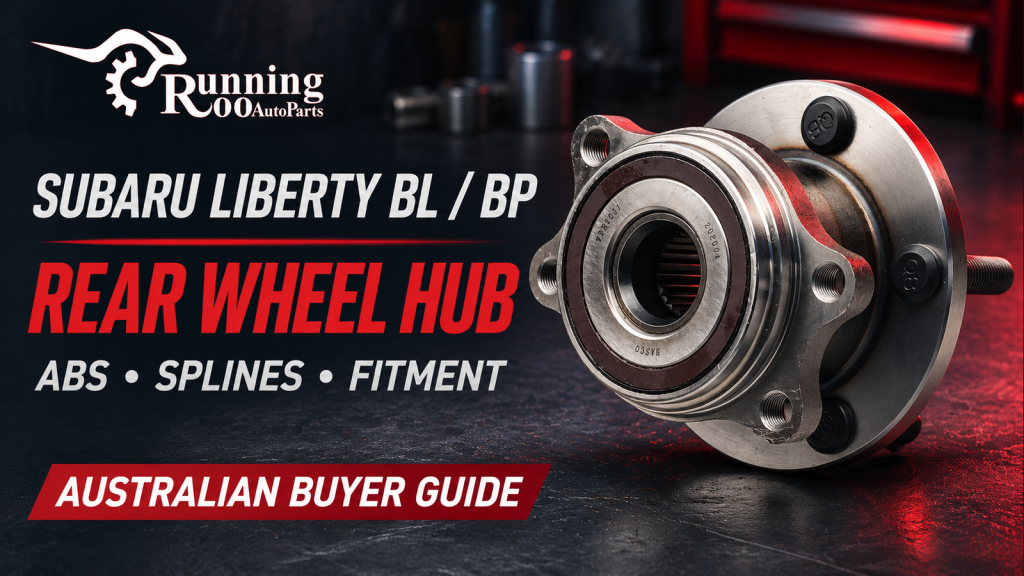
Buying a Subaru Liberty BL or BP rear wheel hub in Australia requires more than matching the number of wheel studs in a photograph. The vehicle application, axle connection, mounting dimensions and ABS-related configuration all need to agree with the workshop's requirement. A hub can look familiar while still being the wrong assembly for the particular car.

RunningRoo lists a rear wheel bearing hub with Subaru Liberty BL/BP, Outback BP and selected Impreza/WRX references. The description includes useful dimensional information and specifically warns that variations can occur. This guide turns those details into a practical fitment conversation for a Liberty owner. It does not extend the listing into a universal Subaru interchange chart or provide a replacement procedure for every model in the title.
Identify the rear corner and the actual vehicle
Tell the supplier that the enquiry is for the rear hub and provide the VIN, build details and complete model identification. Include the engine code as part of the vehicle record, even though engine information alone cannot identify a wheel-end assembly. Ask the workshop to specify the required side and quantity rather than assuming a listing covers a pair.
The current product description advertises Liberty BL/BP applications from 2004–2009, but a registration year is not the entire application. If the car is imported or has modified running gear, disclose that before ordering. The parts check should consider the current fitted configuration, not only the vehicle's original sales description.
Provide the old hub's OE reference if available and any workshop catalogue reference. If there is no readable marking, say so and let the workshop establish the requirement through the appropriate parts information. Do not borrow an OE number from a similar vehicle's online advertisement simply to fill an empty field in an enquiry.
Use the listed dimensions as a comparison record
The RunningRoo description lists 25 splines, five wheel studs, a 100 mm bolt-circle diameter and four flange mounting holes. It also lists a 55.9 mm wheel pilot, 57.9 mm brake pilot, 84 mm hub pilot, 124 mm flange diameter and 65.5 mm flange offset. These are retailer-listed values to verify against the required assembly, not measurements independently taken for this article.
Give the complete set of relevant specifications to the workshop rather than selecting one matching value. The wheel-stud pattern alone cannot establish every interface. Ask the installer to confirm the application using the vehicle's correct parts information and the supplied product details. If it finds a discrepancy, resolve that before purchase or installation.
Avoid casual measurements on an assembled vehicle where access or reference points are unclear. A dimension described as a pilot diameter is not interchangeable with another visible circular feature. If dimensional comparison is needed, the workshop should identify the feature and method. The buyer can preserve the seller's specification table without attempting to invent a measuring procedure.
| Listed feature | RunningRoo listing value | Check required |
|---|---|---|
| Spline quantity | 25 | Match the required axle interface |
| Wheel stud quantity | 5 | Confirm the complete wheel-side application |
| Bolt-circle diameter | 100 mm | Verify against the correct vehicle specification |
| Flange mounting holes | 4 | Confirm the mounting arrangement |
| Wheel pilot diameter | 55.9 mm | Verify the relevant interface, not a visual estimate |
| ABS description | Yes | Establish the actual encoder and sensor arrangement |
| Package quantity | One full hub assembly | Confirm side and required order quantity |
ABS compatibility needs more than the word “Yes”
The listing's ABS field indicates an ABS-related application, but it does not by itself provide a complete description of every supplied sensing component. Ask what is integrated into the hub and what remains on the vehicle. Do not assume a separate wheel-speed sensor or cable is included merely because general product wording mentions sensors “where applicable”.
NTN-SNR's official wheel-bearing guidance identifies several possible causes of ABS concerns, including sensor, connector and encoder issues. It also stresses careful handling of magnetic encoder surfaces and the use of vehicle-manufacturer tightening information. These are general manufacturer principles, not evidence that this offered hub is an NTN product or a substitute for Subaru's procedure. NTN-SNR official wheel-bearing failure guide: ABS and handling principles; not Subaru-specific installation or this item brand
For a car with an ABS warning, the workshop must diagnose the actual concern rather than assuming a hub will solve it. Ask it to explain the connection between its findings and the proposed replacement. A new hub is a supply decision after that assessment, not a universal response to an illuminated warning lamp.
Do not diagnose a rear bearing from a short sound description
An owner can help by describing when the noise is noticed, whether it has changed and what other symptoms are present. Give those observations to the repairer without attempting to identify a particular corner from an online sound clip. The workshop should assess the vehicle and establish whether the hub assembly is the required repair.
This article does not give a road-test manoeuvre, lifting method or play threshold for a Liberty. Those checks require suitable equipment, safe working conditions and the relevant service information. If the vehicle's behaviour is concerning, arrange professional advice before further use rather than driving solely to reproduce a noise for a parts supplier.
Once the workshop has identified the required component, obtain a clear parts recommendation. It should state the vehicle application, rear location, required quantity and any associated work. This makes the order specific and prevents a broad description such as “Subaru bearing” from being used interchangeably for a bare bearing, complete hub or another axle position.
Distinguish the assembled hub from a bare bearing
The selected RunningRoo offer describes one full hub assembly. A listing for a separate bearing may involve a different scope of supply and workshop process. When comparing prices, compare the same type of item and ask the installer what it has specified. A cheaper-looking part is not necessarily an equivalent package for the planned job.
Do not transfer installation advice for a press-in bearing to an assembled hub merely because both products contain bearings. The applicable Subaru procedure and the part's instructions must govern installation. General bearing guidance can explain why care matters, but it should not be turned into a universal sequence for removing or fitting this assembly.
Ask the workshop whether any additional hardware or related component is required and confirm whether it is included. The current package description should not be expanded into an assumed axle nut, sensor or brake component bundle. Keeping those items on separate lines makes the purchasing requirement clear before the vehicle is ready for reassembly.
One hub or two: let inspection define the quantity
The listing states one assembly. Do not assume that ordering quantity one supplies both rear sides, and do not assume that both sides must be replaced without a workshop recommendation. Ask the repairer to identify the required scope and explain any recommendation to replace more than one component.
If two assemblies are required, confirm both applications and the order quantity with RunningRoo. If only one is required, record the side in the workshop job file. Clear quantity information avoids a delivery arriving with fewer parts than the installer expects or an owner purchasing a pair based on a generic suggestion that did not consider the car.
Keep side identification consistent across the quote, order notes and workshop record. Terms such as driver side can be ambiguous when information is copied from another market. Use the repairer's explicit vehicle-side description and let it reconcile any catalogue terminology. The important outcome is that all parties are discussing the same corner of the actual vehicle.
Receiving checks before the workshop starts fitting
Keep the packaging and compare the received assembly with the confirmed product reference and specifications. If the workshop notices an unexpected connector arrangement, mounting feature or dimensional difference, contact RunningRoo before modifying or fitting the part. A clear photograph and precise description of the concern make the comparison easier.
Do not judge acceptance only by whether the new assembly can be physically placed near the mounting location. The correct fit includes the interfaces and sensing arrangement the workshop has identified. Where a feature is unclear, obtain clarification rather than assuming that a difference is cosmetic. Product identification is most useful before installation changes the condition of the part.
The installer should follow the exact vehicle procedure, including specified tightening and any required checks. This article deliberately does not publish a generic axle-nut torque or reuse rule. The listed dimensions help identify the offer; they do not constitute a fitting manual or permission to improvise around a mismatch.
Keep the post-repair record useful
Ask the workshop to record which rear hub was replaced, the supplied reference and any additional work. If there was an ABS-related concern, retain the diagnostic and completion information the workshop provides. This helps distinguish the original complaint from unrelated future issues and gives the next technician a clearer service history.
A receipt for a hub proves a purchase, while the workshop record identifies the installation. Keep both together. If the car has modified running gear, include the relevant identification in the vehicle file so a later owner does not order solely from the original VIN without understanding what is currently fitted.
If a concern remains after the work, return to the workshop with the original symptom description and repair record. Do not automatically order another hub or sensor. The professional should assess the present condition and determine whether the original diagnosis, another component or a different issue needs attention.
Melbourne supply and interstate workshop orders
RunningRoo is Australian-operated in Blackburn VIC, with friendly fitment support and Melbourne local pickup by appointment. Send the VIN, model details, engine code, OE reference where available and the workshop's diagnosis before arranging collection. Confirm the application and quantity so the collector receives the intended assembly.
For delivery elsewhere in Australia, provide the workshop address and job reference if the part is going directly to the repairer. Ask about fast dispatch subject to current stock and preparation, then confirm the carrier estimate for the actual destination. A workshop appointment and a parcel estimate should be coordinated rather than treated as the same promise.
Call 0425 890 125 if the dimensional or ABS description needs clarification. A complete enquiry can be resolved more effectively than a message asking whether a hub fits “a Subaru wagon”. The real website and matching eBay links below provide the current offer, while the workshop confirms the repair requirement.
A practical fitment comparison example
Suppose a Liberty BP owner has a workshop recommendation for one rear hub. The owner sends the VIN and the workshop's required specification to RunningRoo. The supplier's listing has five studs and 25 splines, but the owner does not stop at those two matches. The workshop checks the complete application and ABS-related configuration before confirming the order.
On receipt, the workshop compares the supplied assembly with the agreed requirement and keeps the order record with the job. If a discrepancy appears, it is resolved before installation. This example is deliberately about process rather than a universal fitment verdict: a BL/BP badge and matching stud count are useful clues, but the complete application is what makes the purchase appropriate.
Frequently asked questions
Does this hub fit every Subaru Liberty BL or BP?
Do not assume universal fitment. The listing advertises selected applications and warns of variations. Confirm the VIN, build details, installed running gear and relevant OE reference with RunningRoo and your workshop. Provide any modification or import history that could affect the current configuration.
Does the offer contain a pair of rear hubs?
The current description states one full hub assembly. Confirm the required side and quantity with the workshop and order accordingly. Do not assume a pair from a photograph or replace both sides without an inspection-based recommendation explaining the intended scope.
Are five studs and 25 splines enough to confirm fitment?
No. They are useful listed features, but the complete application includes other interfaces and the ABS-related arrangement. Have the workshop compare the relevant specifications and parts information. Similar external appearance or two matching values should not override a remaining discrepancy.
Does “ABS: Yes” mean a separate sensor is included?
Not necessarily. Ask RunningRoo to confirm exactly what is supplied and how it relates to the vehicle's existing sensing arrangement. General wording about sensors where applicable should not be read as a guaranteed separate sensor or cable in every package.
Will replacing the hub clear an ABS warning?
Only diagnosis can establish the cause of the warning and the appropriate repair. Manufacturer guidance identifies several possible fault areas, so a hub should not be ordered solely because the warning is present. Ask the workshop to connect its findings to the recommended component.
Can I collect the assembly from RunningRoo in Melbourne?
Arrange Blackburn VIC pickup by appointment after confirming fitment, quantity and stock. RunningRoo offers friendly Australian support and fast dispatch subject to availability for other destinations. Call 0425 890 125 with the workshop's recommendation and vehicle identifiers so the supply plan matches the actual repair.
Related reading: Subaru Forester SJ Rear Wheel Hub Australia: One Hub, Rear Position and ABS Checks. This separate guide covers a different component or search question; it does not establish interchangeability with the product discussed here.
Sources and scope
Product details and availability were checked on 11 November 2026. Retailer listings establish the offer; manufacturer sources below support only the technical points identified in the article. Current vehicle-specific workshop information takes priority over general background.