
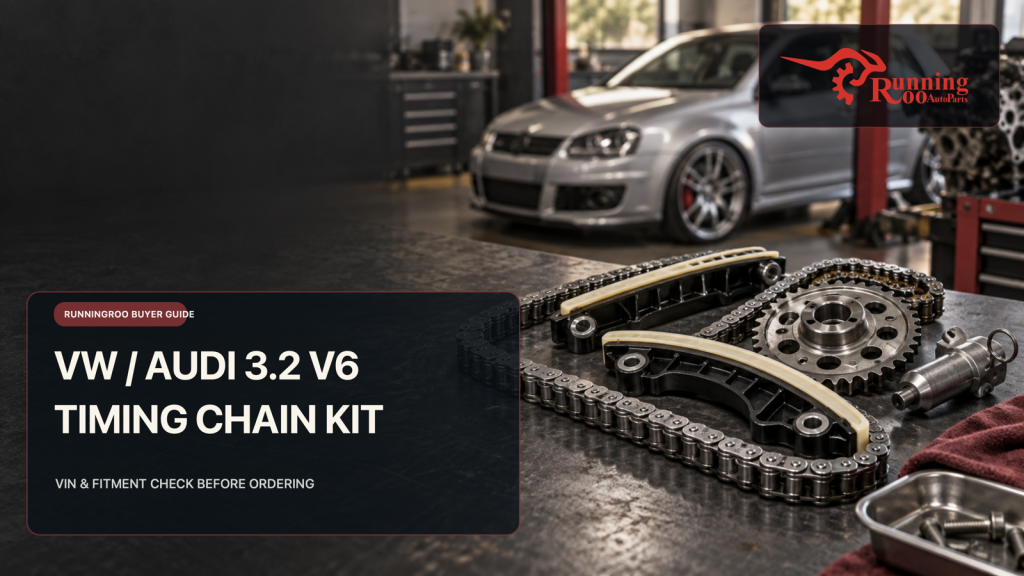
An Audi 3.2 or Volkswagen V6 timing-chain repair is a fitment-critical job. Search results often group together Audi A3 and TT, Volkswagen Golf, Passat, Touareg, Phaeton, Sharan and Transporter applications. That breadth is useful only after the vehicle’s engine code, build details and original timing-drive arrangement have been confirmed. A kit that is physically close is not necessarily a kit that belongs in the engine.
RunningRoo’s live Audi/VW V6 timing-chain kit page identifies selected 2.3, 2.8 and 3.2 applications and lists an upper chain, lower chain, upper tensioner, guides and lower tensioner. The linked RunningRoo eBay active listing is the corresponding seller listing to compare before checkout. The product page also offers a separate variant with intermediate gears; do not decide between variants from vehicle badge alone.
This is a purchase and planning guide for Australian owners and workshops. It is not a timing-alignment procedure. Only current manufacturer repair information for the exact VIN and engine can establish locking tools, cam/crank positions, torque, sealant, one-time-use fasteners and commissioning checks.
RunningRoo Auto Parts – Based in Melbourne, Australia 🇦🇺
Free 24/7 Pickup Available (Contact 0425890125)
Any questions? Message or Call us anytime! We’re here to help.
Why Choose RunningRoo?
Aussie Owned & Operated | Fast Shipping | Friendly Support
A 3.2 badge is not an engine-code confirmation
The current product description includes selected Audi 3.2 V6 and TT applications, plus selected VW, Ford Galaxy and SEAT applications. It also references some 3.6 applications in its long compatibility list. That is exactly why the engine code must be the purchase anchor. A similar displacement, related platform or compatible-looking timing cover does not establish the same timing-chain arrangement.
Collect the VIN, engine code, build month/year, workshop diagnosis and photographs/numbers from the original parts where access allows. Then ask the supplier to compare that evidence with the exact live listing. If a workshop has identified a revised component or requires intermediate gears, make this part of the written request rather than assuming the basic kit contains everything.
| Evidence | Why it matters | Weak substitute to avoid |
|---|---|---|
| VIN | Identifies the original build specification | Model and year in an online ad |
| Engine code | Distinguishes a V6/VR-style family and variant | Engine capacity only |
| Build information | Helps resolve mid-production changes | Registration date |
| Original chain/gear images | Confirms layout and visible revision | A generic product image |
| Workshop repair scope | States what has actually been diagnosed | Cold-start noise alone |
| Live product contents | Shows what will be supplied | “Full kit” wording alone |
Use all items together. A VIN is excellent evidence of original production, but a previous engine or timing repair may have changed the parts now fitted. Conversely, an original number can be superseded. The safest order is one where the current vehicle evidence, workshop scope and product contents agree.
What this kit lists
The RunningRoo listing specifies an upper chain, lower chain, upper tensioner, upper right guide, upper left guide, upper guide, lower guide and lower tensioner. The gear-including variant lists additional intermediate gears. These differences matter because the timing-drive assembly works as a system: a new chain, old guide, wrong gear arrangement or unsuitable tensioner is not a controlled repair plan.
| Listed component | General function | Confirmation needed |
|---|---|---|
| Upper and lower chains | Transfer drive through the listed timing system | Correct engine-specific chain routing |
| Upper/lower tensioners | Control chain movement as designed | Correct kit version and repair scope |
| Guide rails | Direct the chain and limit movement | Compare guide locations and profiles |
| Intermediate gears, where listed | Form part of the specific drive arrangement | Confirm the engine requires the gear version |
| Seals/hardware not stated | May be required for resealing | Add to the workshop’s job list if needed |
This description does not mean all associated repair materials are in the box. Timing-cover seals, fasteners, fluids, cleaning supplies or special hardware can be job-specific. Ask the installer to identify what it will supply, what the customer should order and what can only be decided after inspection.
Diagnose first; do not buy from a rattle alone
Timing-chain noise, a cam/correlation fault, rough running or an engine warning deserves prompt professional investigation. It does not prove that the entire chain kit is the failed part. Depending on the vehicle, possible contributors can include mechanical timing wear, a tensioner or guide concern, camshaft adjustment components, oil condition/level, sensor/wiring faults or another engine-management issue.
A product seller cannot measure oil pressure, view scan data or inspect the timing drive through a web order. The technician should follow the current official diagnostic process for the VIN and record the confirmed repair scope. This protects the buyer from spending on a kit when a different fault is responsible, and it protects the engine from an incomplete repair when mechanical wear is found.
| Reported condition | It can indicate | Appropriate next step |
|---|---|---|
| Cold-start rattle | Tensioner, chain, guide, phaser or oil-delivery issue | Record it cold and begin manufacturer-guided diagnosis |
| Cam/crank correlation code | Mechanical, sensor, wiring or control-system issue | Read live data and follow the official test path |
| Persistent noise after servicing | A continuing fault, not a reason to guess | Inspect and diagnose before parts selection |
| Confirmed guide debris or chain wear | Timing-drive mechanical damage | Plan a complete vehicle-specific repair |
| New kit differs from original layout | Possible fitment mismatch | Stop before installation and contact RunningRoo |
The manufacturer procedure—not a generic social-media video—must control the repair. Volkswagen Group’s official owner and service channels are the appropriate source for model-specific maintenance and technical information; a workshop should consult the current paid/official documentation applicable to the exact vehicle before dismantling or starting the engine.
Make the repair scope visible before labour begins
The costly part of a timing-chain job is generally access and correct reassembly. Once the workshop has confirmed that the timing drive requires work, it may be economical to address related worn components while the engine is open. That is the reason to compare a complete kit with the job plan. It is not a blanket instruction to replace every part without inspection.
Ask the workshop for a simple written breakdown: confirmed cause; components to replace; components that will be inspected; parts not supplied in the kit; and the verification plan after assembly. This gives the customer a transparent basis for ordering and avoids a vehicle sitting dismantled while a seal, gear or consumable is sourced.
| Planning checkpoint | Decision to record |
|---|---|
| Fault confirmation | What test or inspection supports the repair |
| Kit variant | Basic chain/guide kit or the gear-containing variant |
| Additional items | Seals, hardware, fluids and any related components |
| Installation reference | Current Volkswagen/Audi procedure for exact engine |
| Completion checks | Mechanical timing, leak inspection, diagnostic and road verification |
For a Melbourne pickup, confirm product variant and stock before travelling. For interstate delivery, coordinate dispatch with the workshop booking only after the VIN and engine code have been checked. The two product references are the RunningRoo website listing and matching eBay listing.
RunningRoo Auto Parts – Based in Melbourne, Australia 🇦🇺
Free 24/7 Pickup Available (Contact 0425890125)
Any questions? Message or Call us anytime! We’re here to help.
Why Choose RunningRoo?
Aussie Owned & Operated | Fast Shipping | Friendly Support
Delivery inspection protects the job
Before removing old timing components, photograph the parcel label and kit contents. Compare the invoice, chain count, guide shapes, tensioners and any included gears against the live listing and the workshop’s repair plan. Keep the packaging until the installer has visually compared the new parts with the vehicle.
If anything conflicts, do not force-fit, modify or trial-install it. Send RunningRoo the order reference, VIN, engine code, original-part images and a concise description such as “original layout uses a different intermediate gear; no installation attempted.” Preserving the parts and evidence is the quickest way to resolve an actual mismatch.
Keep product fitment and workshop diagnosis separate
This distinction saves money. RunningRoo can compare a VIN, engine code and original component evidence with its current product listing; it cannot certify an engine fault through a message. The installer can test the vehicle and choose a repair procedure; it cannot safely treat a web listing as a parts identification system. When those roles are kept separate, the purchase is based on evidence rather than pressure to find an immediate answer.
For an effective workshop-to-supplier handover, provide the VIN, engine code, a clear statement of the diagnosed timing-work scope, pictures of the removed part where available, and the exact product URL under consideration. Ask the workshop to identify any seals, hardware or related inspection items it expects to use. This does not expose its full repair method; it simply provides enough information to prevent a basic ordering mistake.
After repair, keep the seller invoice with the workshop invoice, kilometre reading and a brief description of the work. A later owner or technician then has an auditable record of which area was serviced, rather than an ambiguous note that “the chain was done.” The record does not guarantee a future outcome, but it improves the quality of future diagnosis and servicing.
Frequently asked questions
Does this kit fit every Audi 3.2 or VW 3.2?
No. The product has a broad application list, but the correct choice depends on exact engine code, build and timing-drive arrangement. Confirm VIN and original-part evidence first.
Why is there a version with intermediate gears?
Timing-drive layouts can differ. The gear version is a separate product configuration; a workshop must confirm whether the identified engine requires it.
Is a cold-start rattle enough to order a kit?
No. It is evidence that requires diagnosis. Mechanical timing, oil delivery, cam adjustment and sensor/control faults can overlap in symptoms.
Are seals and bolts included?
Only rely on the current stated kit contents. Ask the installer to list seals, fasteners, fluids and consumables required for the actual job.
Can I use a procedure from another VW or Audi V6?
No. Use the current official technical procedure for the exact VIN and engine code. Timing alignment details are not safely transferable between variants.
What do I do if the supplied kit looks different from the removed parts?
Stop before fitting or modifying it, retain packaging and contact RunningRoo with order and vehicle evidence.
Sources and editorial basis
- RunningRoo Audi/VW V6 timing-chain kit — live applications and stated kit contents.
- RunningRoo eBay active listing 365602846987 — product comparison reference, checked before drafting.
- Volkswagen Australia owners and servicing and Audi Australia owners — official owner-service entry points; workshops must use the current vehicle-specific technical procedure.
Fitment is a guide only. Confirm VIN, engine code, original component evidence, live listing information and the qualified workshop’s diagnosis before purchase or installation.
RunningRoo Auto Parts – Based in Melbourne, Australia 🇦🇺
Free 24/7 Pickup Available (Contact 0425890125)
Any questions? Message or Call us anytime! We’re here to help.
Why Choose RunningRoo?
Aussie Owned & Operated | Fast Shipping | Friendly Support