
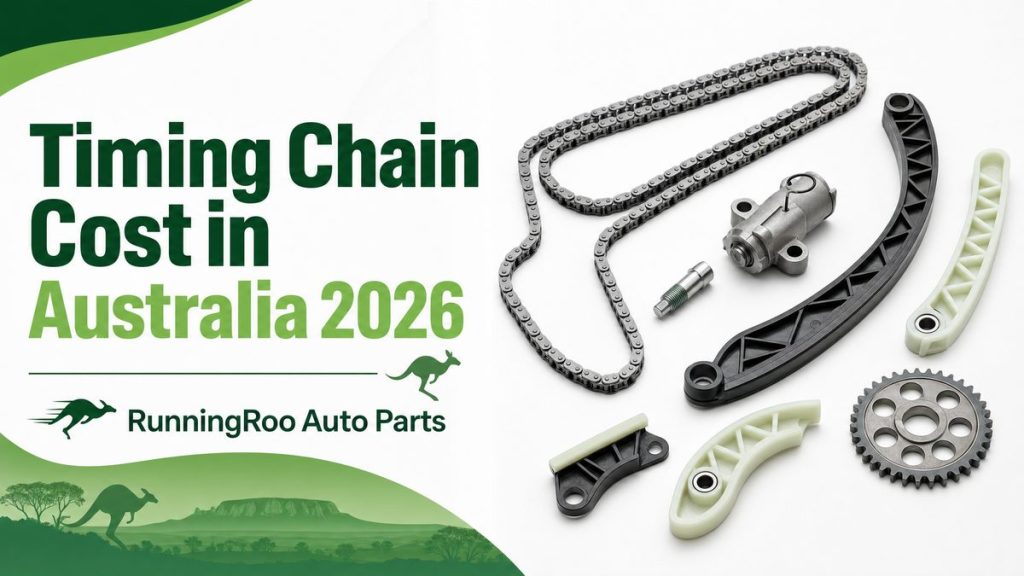
By RunningRoo Auto Parts — written from the desk of our Product Manager
Few repair quotes frighten an Australian car owner like a timing chain replacement. The part itself is often modest, but the labour is not: on many engines the chain runs at the rear of the block or buried behind covers, pumps and mounts, and accessing it can mean many hours of skilled work. If you have just been quoted for the job, or you are trying to budget before buying a car with a known chain issue, this guide explains what the work actually costs in Australia in 2026, where the money goes, and how a quality kit and a competent workshop can change the final number.
RunningRoo Auto Parts – Based in Melbourne, Australia 🇦🇺
Free 24/7 Pickup Available (Contact 0425890125)
Any questions? Message or Call us anytime! We’re here to help.
Why Choose RunningRoo?
Aussie Owned & Operated | Fast Shipping | Friendly Support
What a timing chain actually does
A timing chain connects the crankshaft to the camshaft or camshafts, so the valves open and close at exactly the right moment relative to the pistons. If the chain stretches, a tensioner fails or a guide wears, the valve timing drifts and, in the worst case, the chain can jump a tooth and allow pistons and valves to collide. That is an interference-engine failure that can destroy the engine, which is why a noisy or stretched chain is never a “see how it goes” problem.
Compared with a rubber timing belt, a metal chain is designed to last much longer and is usually lubricated by engine oil. Many modern engines are sold as having a “lifetime” chain, but in practice guides, tensioners and oil-pressure problems mean the chain system can still wear, particularly on engines known for weak tensioner designs. The key point is that the chain itself is rarely the only thing replaced: the job is normally done as a kit including the tensioner, guide rails and seals.
Why the price varies so much
The cost of a timing chain replacement depends on four things: the engine design, the vehicle’s age and condition, the quality of the parts, and who does the work. A simple four-cylinder with the chain at the front of the engine and good access is far cheaper than a V6 or V8 with the chain at the rear of the block, multiple chains, or a design that requires the engine or transmission to be removed. Luxury and performance brands add cost through part prices and higher workshop rates, while common Australian fleet vehicles such as the Holden Commodore and Toyota Hilux benefit from cheaper, widely available parts and greater workshop familiarity.
Parts quality is the part you can control. A complete, well-made aftermarket kit from a reputable supplier can cost a fraction of a dealer set while meeting or exceeding original specifications, whereas a budget kit with a substandard tensioner or guide can fail early and cost you the labour all over again. This is the single biggest lever a buyer has over the final price.
What the job costs in Australia in 2026
Australian prices are best understood as a range, because the same job on a four-cylinder hatchback and a V8 ute are not comparable. The table below gives realistic, ballpark figures in Australian dollars for the combined parts-and-labour job on common vehicle types. These are indicative only; always obtain a written quote for your exact vehicle.
| Vehicle type | Typical parts cost (quality kit) | Typical labour | Ballpark total (AUD) |
|---|---|---|---|
| Small 4-cyl hatchback (front-access chain) | $250–$550 | 5–8 hours | $900–$1,800 |
| Mid-size 4-cyl (e.g. Commodore, Camry, 1.8–2.4L) | $350–$700 | 6–10 hours | $1,200–$2,400 |
| V6 sedan / SUV (e.g. Alloytec, Pentastar) | $450–$900 | 8–14 hours | $1,600–$3,200 |
| Diesel 4×4 (e.g. Hilux, Ranger, Navara) | $400–$850 | 8–14 hours | $1,500–$3,000 |
| V8 or prestige (rear-chain, multiple chains) | $600–$1,500 | 12–20+ hours | $2,200–$4,500+ |
These ranges explain why two owners can post completely different prices online for “a timing chain replacement”. A $900 job is real, and so is a $4,000 job. The engine, not the workshop, is usually the biggest variable.
Labour is the largest cost — and why quality parts still matter
Because labour dominates the quote, it is tempting to save on parts. That logic is backwards. The parts are the cheap part of the job, and the last thing you want is to pay for ten hours of labour only to have a $50 tensioner fail and force you to repeat the work. A quality kit with a proven tensioner, hardened guides and the correct seals is the cheapest insurance you can buy on a timing chain job.
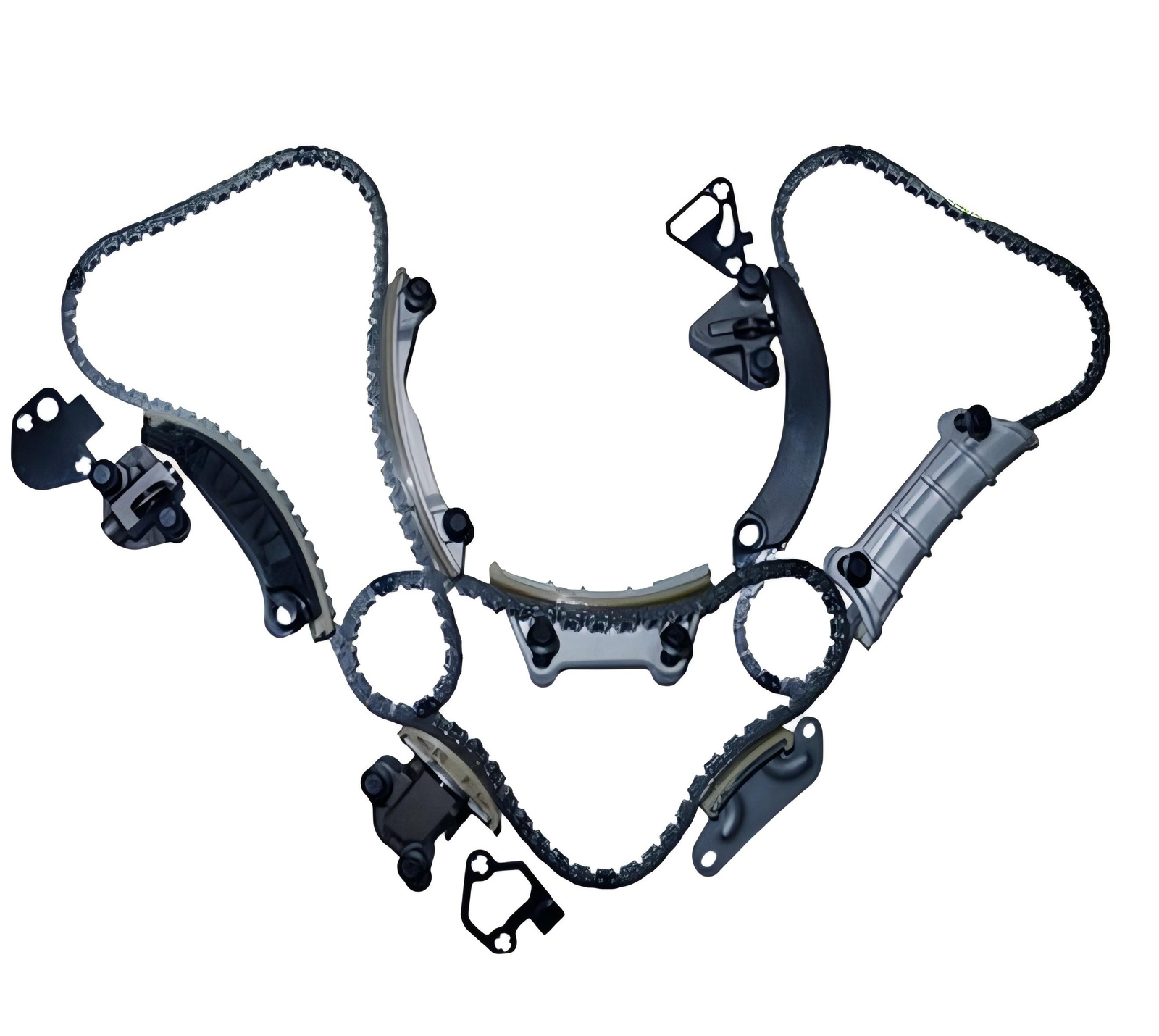
It is also worth understanding what a complete kit should include. A bare chain is not a repair. A proper kit includes the chain or chains, the tensioner, the guide rails, the sprockets or gears where required, and the seals and fasteners needed to reseal the engine properly. On engines with variable valve timing or an oil-pump chain, the VVT gears and the oil-pump chain may be part of the job as well. Buying a “chain only” to save money usually means paying for seals, guides and tensioner separately, and often discovering mid-job that something critical was omitted.
Warning signs that save you from a bigger bill
Catching a chain problem early is the difference between a kit replacement and an engine rebuild. The classic warning is a rattling noise from the engine on a cold start that lasts for a second or two as oil pressure builds; on many engines this is the tensioner allowing slack until it pressurises. Other signs include a persistent rattle or whir at idle, a check-engine light with camshaft or crankshaft correlation codes, rough running, and, in severe cases, misfires or a failure to start.
If you hear any of these, the cheapest action is an immediate professional diagnosis. Continuing to drive with a worn chain risks a catastrophic valve-to-piston failure that writes the engine off. In almost every case, the cost of the timing chain kit and labour is far less than a replacement engine.
Timing chain vs timing belt: what the price difference tells you
If your car has a timing belt rather than a chain, the cost picture is different, and it is worth knowing which you have before comparing quotes online. A timing belt is a rubber belt that the manufacturer specifies for replacement at fixed intervals — commonly every 80,000 to 160,000 kilometres, depending on the engine — and the belt job is often combined with the water pump and tensioners in a single kit. A timing chain, by contrast, is metal and is usually treated as a fit-for-life item, but its tensioner and guides can still wear, and the job is generally more labour-intensive when it is finally needed.
The practical implication for budgeting is that a belt replacement is a predictable, scheduled cost, while a chain replacement is a larger, less frequent and often unexpected one. If you are buying a used car, checking whether the engine is belt or chain driven — and whether the belt interval is due — is one of the cheapest ways to avoid a surprise four-figure bill. The timing belt question also matters because a “timing kit” for a belt engine is a completely different part from a chain kit, and the two are never interchangeable.
Regional price differences across Australia
Labour rates are not uniform across the country, and that flows directly into timing chain quotes. Metropolitan workshops in Sydney and Melbourne typically charge a higher hourly rate than regional workshops, while the price of the parts themselves is more consistent because kits are shipped nationally. That means the same Toyota or Holden job can be several hundred dollars dearer in a capital city than in a regional centre, even using an identical kit.
For owners chasing the best overall value, this has a useful consequence: the parts line of the quote is the part you can control from anywhere. Buying a quality kit yourself at trade pricing and having a regional or independent workshop fit it can close much of the metro-versus-regional gap, because the part price no longer carries a workshop markup. It is a simple way to make the same quality repair more affordable no matter where in Australia you live.
How to keep the quote honest
Get at least two written quotes and ask each workshop to itemise parts and labour separately. Confirm exactly what the kit includes and whether the quote covers VVT gears, the oil-pump chain, and the water pump where the design drives it from the timing chain. Ask whether the price includes new engine oil, coolant and a filter, because the oil and coolant are usually drained during the job. Finally, confirm the warranty on both parts and labour, and prefer a supplier and workshop who will stand behind the work in writing.
At RunningRoo, we supply complete timing chain kits for popular Australian vehicles — from Holden Commodores and Toyota Hilux diesels to Ford Falcons and BMWs — so owners can buy a quality kit at trade pricing and have their preferred workshop fit it. That single decision routinely saves hundreds of dollars on the parts line of the quote.
Frequently asked questions
Is it worth replacing a timing chain, or should I sell the car?
If the rest of the car is sound, a kit replacement is almost always cheaper than selling at a loss and buying another vehicle. On an old, low-value car with other problems, the maths can be closer.
Can I replace a timing chain myself?
It is an advanced job requiring the correct locking and timing tools, torque procedures and a clean workspace. Most Australian owners use a professional for at least the timing stage.
Does a timing chain kit come with a water pump?
Only where the water pump is driven by the timing chain on that specific engine. Always confirm this for your vehicle before ordering.
How often should a timing chain be replaced?
Many chains are designed to last the life of the engine, but tensioners and guides can wear. Replace when there are symptoms or when the engine is already apart for related work.
What happens if a timing chain breaks or jumps?
On an interference engine, pistons and valves can collide, causing severe internal damage and often requiring a rebuild or replacement engine.
Are aftermarket timing chain kits reliable?
Quality aftermarket kits from reputable suppliers can match or exceed original specifications. Cheap, unbranded kits with weak tensioners are a false economy.
How do I know if my car has a timing chain or a timing belt?
Check the owner’s manual or the engine specification for your vehicle. Belt engines have a scheduled replacement interval, while chain engines are usually treated as fit-for-life but still have serviceable tensioners and guides.
Why are timing chain quotes so different between workshops?
Labour rates, the quality of the kit, and what is included in the quote all vary. Itemised written quotes are the only way to compare like for like.
Shop the parts mentioned in this guide
- Timing Chain Kit for Holden Commodore VZ / VE / VF Alloytec 3.6L V6
- Timing Chain Kit for Toyota Hilux / Hiace / Fortuner 1GD 2GD 2.4–2.8L Diesel
- Timing Chain Kit for Toyota 1GD / 2GD Hilux, Fortuner, Hiace — eBay
- Timing Chain Kit with Gears for Ford Falcon BA / BF V8 5.4L XR8 Boss 260 — eBay
Watch on RunningRooAuto YouTube
- RunningRoo Auto Parts – trusted Melbourne parts support
- RunningRoo Auto Parts – product and fitment channel
RunningRoo Auto Parts – Based in Melbourne, Australia 🇦🇺
Free 24/7 Pickup Available (Contact 0425890125)
Any questions? Message or Call us anytime! We’re here to help.
Why Choose RunningRoo?
Aussie Owned & Operated | Fast Shipping | Friendly Support
Sources and further reading
- Timing chain — Wikipedia (construction and function)
- CarsGuide — Australian motoring advice and pricing
- RACV — car maintenance and repair guidance
- Cloyes — timing chain and kit manufacturer
RunningRoo Auto Parts – Based in Melbourne, Australia 🇦🇺
Free 24/7 Pickup Available (Contact 0425890125)
Any questions? Message or Call us anytime! We’re here to help.
Why Choose RunningRoo?
Aussie Owned & Operated | Fast Shipping | Friendly Support
Thank you , great service
Amazing service! My delivery arrived within 24 hours of ordering. Excellent value for money and great communication. Thanks!