
By RunningRoo Auto Parts — written from the desk of our Product Manager
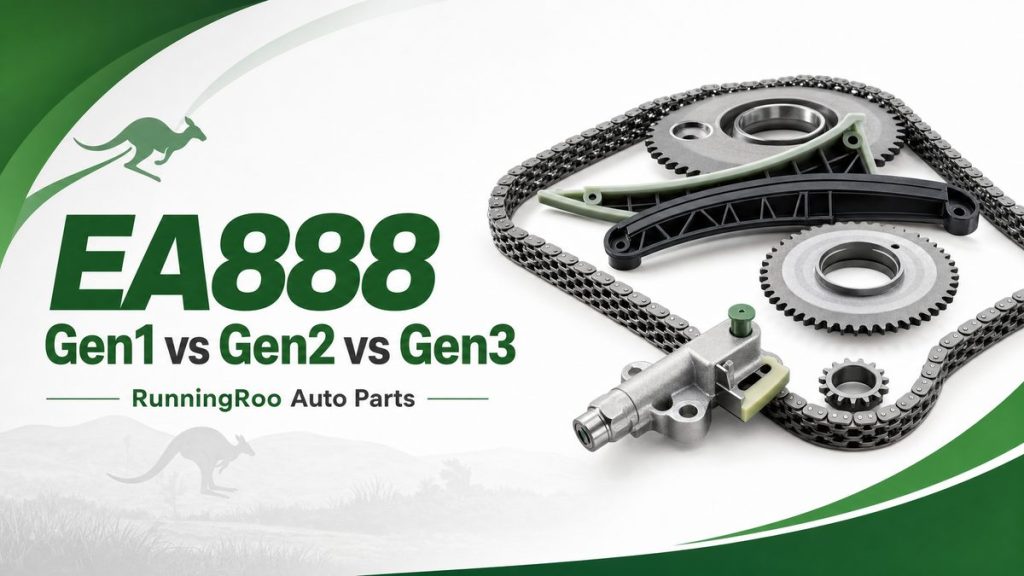
The Volkswagen Group’s EA888 engine family powers a huge share of the turbocharged petrol cars on Australian roads — Golf GTI, Jetta, Passat, Tiguan, Škoda Octavia and Superb, SEAT Leon and the Audi A3, A4, A5 and Q5 among them. It is also the engine family most often associated with timing chain questions, because the earlier generations had a well-documented tensioner weakness that could stretch the chain and, in the worst cases, destroy the engine. If you are ordering a timing chain kit for an EA888, the first thing to get right is which generation you have, because the kits are not interchangeable. This guide explains the differences clearly.
RunningRoo Auto Parts – Based in Melbourne, Australia 🇦🇺
Free 24/7 Pickup Available (Contact 0425890125)
Any questions? Message or Call us anytime! We’re here to help.
Why Choose RunningRoo?
Aussie Owned & Operated | Fast Shipping | Friendly Support
What the EA888 engine family is
EA888 is Volkswagen’s designation for a family of turbocharged, direct-injection four-cylinder petrol engines, produced in 1.8-litre and 2.0-litre versions and used across the VW Group brands. It replaced the earlier EA113 in most transverse applications and became the backbone of the Group’s performance and mainstream petrol line-up from the late 2000s onwards. The engine is used in both transverse form (Golf, Jetta, Passat, Tiguan, Octavia, Superb, Leon, A3) and longitudinal form (A4, A5, Q5).
Because the EA888 uses a timing chain rather than a belt, and because the chain is located at the rear of the engine on transverse applications, the chain is one of the more labour-intensive items to service. That makes choosing the correct kit the first time especially important — you do not want to discover a wrong part number mid-job with the transmission already removed.
The four generations at a glance
The EA888 has been developed through several generations, and the timing-chain parts changed between them. The table below summarises the practical differences that matter when ordering a kit.
| Generation | Approximate years | Common applications | Timing chain notes |
|---|---|---|---|
| Gen1 | 2007–2012 | Golf Mk6 GTI, early 2.0 TSI, A3 | Early tensioner design; prone to wear |
| Gen2 | 2011–2015 | Golf Mk6/Mk7, Jetta, A4 B8, Q5, Octavia | Revised but still has the known tensioner weakness; most commonly replaced |
| Gen3 | 2013–onwards | Golf Mk7 GTI/PP, A3, Octavia vRS, Passat | Redesigned chain and tensioner; far more robust |
| Gen3B / Gen4 | 2016–onwards | Tiguan, later models (Budack cycle / Evo4) | Further revisions; check VIN-specific fitment |
The most important practical takeaway is that Gen1 and Gen2 cars are the ones most likely to need a chain kit as a preventative or repair item, while Gen3 and later engines are dramatically less prone to the same failure. If you have a 2013-onwards Gen3, confirm fitment by VIN rather than assuming an older kit will fit.
Why the Gen1 and Gen2 chains are so well known
The EA888’s reputation for timing chain trouble comes mainly from the Gen1 and Gen2 engines. The original hydraulic tensioner could lose pressure, allowing the chain to become slack on start-up, which produced the characteristic rattling noise and, over time, allowed the chain to stretch and the timing to drift. In severe cases the chain could jump, causing valve-to-piston contact and catastrophic engine damage. Volkswagen revised the chain, tensioner and guides during the engine’s life, and the Gen3 redesign largely resolved the issue.
For an owner, the practical lesson is to treat a cold-start rattle on a Gen1 or Gen2 EA888 as an urgent warning sign. The fix is a quality timing chain kit that includes the updated tensioner and guides, fitted correctly with the engine timed using the proper locking tools. This is not a job to shortcut.
How to identify which EA888 you have
Start with the engine code on the vehicle data sticker or the engine’s own stamping. Common Gen1/Gen2 codes include CAWB, CBFA, CCTA, CCZA and CCZB, while Gen3 codes include CHHA, CHHB, CXDA and DNUE, and Gen3B/Gen4 codes vary by model and year. Cross-reference the engine code with the vehicle’s VIN and, for absolute certainty, with the original timing chain part number if the engine is already apart.
Do not rely on the model name alone. The same Golf badge spanned multiple EA888 generations over its life, and the Audi A4 and Q5 switched from Gen2 to Gen3 at different points. A VIN check against the parts catalogue is the only reliable way to confirm fitment, which is exactly why RunningRoo listings spell out the engine codes and part numbers rather than just the model name.
What a complete EA888 chain kit should include
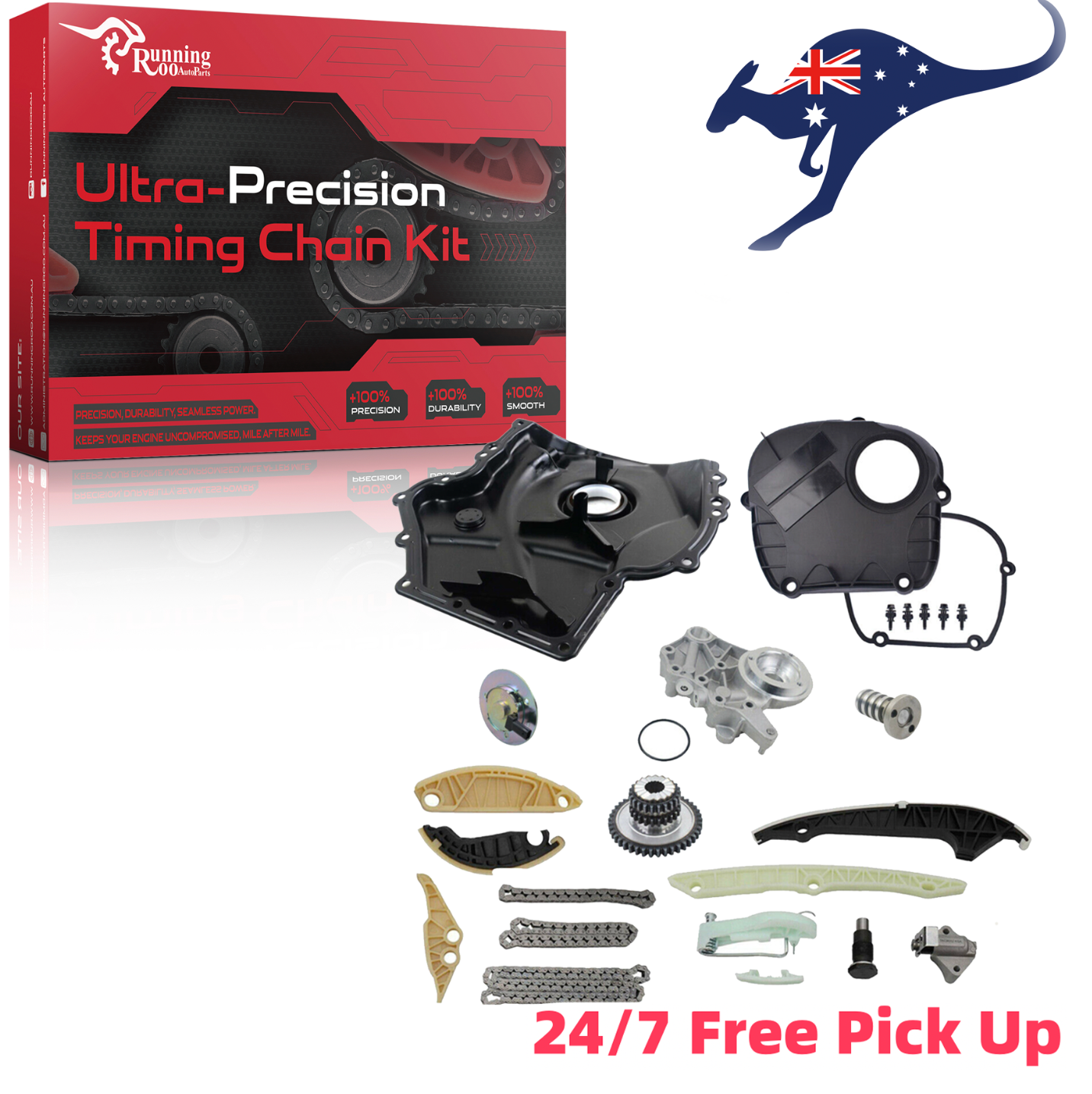
A proper EA888 timing chain kit is more than a chain. It should include the timing chain itself, the updated hydraulic tensioner, the plastic guide rails, the sprockets or adjusters where applicable, and the seals, cover gaskets and fasteners needed to reseal the engine. On engines where the balance shafts or oil pump are chain-driven, those chains and tensioners may also be part of the job, and on VVT-equipped engines the camshaft adjusters or bridge brackets should be inspected at the same time.
Buying a bare chain and tensioner to save money is a common mistake. The guides wear together with the chain, and reusing old, brittle plastic guides on a fresh chain is a known cause of repeat failure. A complete kit ensures the whole system is renewed in one hit, which is particularly important on an engine where the labour to access the chain is so high.
Fitment mistakes that cost money
The most expensive EA888 timing mistake is not the wrong chain — it is a wrong or skipped procedure. The EA888 must be timed with the correct locking and alignment tools, and the crankshaft and camshafts locked in position before the chain is removed. Bolt torque and the tensioner preload procedure must be followed exactly, and the engine should be turned over by hand before reassembly to confirm there is no valve-to-piston contact.
The second mistake is reusing the old cover seal or old one-time-use bolts. An oil leak from the timing cover after the job is done is avoidable and costly to revisit. A complete kit that includes the correct seals and fasteners eliminates this risk.
Signs your EA888 chain needs attention
The EA888 gives clear warning when its timing chain system is struggling, and the most important one to learn is the cold-start rattle. On a cold morning, a worn tensioner or stretched chain produces a metallic rattle from the rear of the engine that lasts for one to three seconds as oil pressure builds. Because the chain is at the back of the engine on transverse applications, the noise can sound like it is coming from the firewall side, which sometimes confuses owners into thinking it is a heat shield or exhaust rattle.
Other signs include camshaft-to-crankshaft correlation fault codes, a check-engine light, rough running and, in advanced cases, misfires or difficulty starting. If you own a Gen1 or Gen2 EA888 and notice any of these, have it assessed immediately. The difference between catching the problem at the tensioner stage and waiting for the chain to jump is the difference between a kit replacement and a destroyed engine.
How the timing chain kit fixes the problem
A complete EA888 timing chain kit resolves the issue by renewing the entire system in one job. The updated tensioner restores a reliable parked hold so the chain is firm on every start-up, the new chain removes the accumulated stretch, and the fresh guides restore the correct running path. Replacing all three together — rather than the chain alone — is what turns a known weak point into a durable repair, which is exactly why the kits are sold as a set.
The labour is substantial because the chain is rear-mounted, so the sensible approach is to do the job completely once. That means the correct locking and timing tools, the updated parts, and a workshop that knows the EA888 well enough to confirm the timing before the engine is first turned over.
Which kit is right for your car?
For a Gen1 or Gen2 EA888 showing a cold-start rattle, we recommend a complete timing chain kit with the updated tensioner and guides, fitted by a workshop experienced with VW Group engines. For a Gen3, confirm the VIN-specific part number and replace the chain only when there is a genuine fault or as part of related major work, since the Gen3 system is far more durable. For any engine, match the kit to the engine code and part number rather than the model badge.
At RunningRoo we stock EA888 Gen2 and Gen2/Gen3 timing chain kits, tensioner kits and cover seal kits for the popular VW, Audi, Škoda and SEAT applications, with clear engine-code fitment so Australian workshops and DIYers order the right parts first time.
Frequently asked questions
How do I know if my EA888 timing chain is stretched?
The classic sign is a rattle from the engine on a cold start, often accompanied by camshaft/crankshaft correlation fault codes. A specialist can also measure chain stretch with diagnostic equipment.
Which EA888 generation has the timing chain problem?
The Gen1 and Gen2 engines are the ones most associated with tensioner and chain-stretch failures. Gen3 and later engines have a redesigned, much more robust system.
Can I use a Gen3 kit on a Gen2 engine?
No. The chain, tensioner and related parts differ between generations, so the kit must match the engine code and generation.
Is the EA888 a timing chain or timing belt engine?
The EA888 uses a timing chain, located at the rear of the engine on transverse applications.
Should I replace the chain as preventative maintenance?
On a healthy Gen3 it is rarely necessary. On a Gen1 or Gen2 with a cold-start rattle or high mileage, replacing the kit with the updated tensioner is the recommended preventative action.
How much does an EA888 timing chain replacement cost in Australia?
Because the chain is at the rear on most transverse EA888s, labour is significant. Ballpark figures are typically $1,500–$3,500 depending on the model, so confirm a written quote for your vehicle.
What does an EA888 cold-start rattle sound like?
A metallic rattle from the rear of the engine that lasts one to three seconds on a cold start, then quietens as oil pressure builds. It is often mistaken for an exhaust or heat-shield noise.
Should I replace the chain kit or just the tensioner on my EA888?
On a Gen1 or Gen2, replacing the complete kit with the updated tensioner and guides is the recommended approach, because the chain and guides wear together with the tensioner.
Shop the parts mentioned in this guide
- Timing Chain Cover & Solenoid Kit for Audi / VW EA888 Gen2 2.0L GTI / Jetta / A4
- Timing Chain Kit for VW / SEAT / Škoda / Audi 2.0 TSI & 1.8 TSI EA888
- 12-Piece Engine Timing Chain Tensioner Kit — EA888 Gen2/Gen3 for Audi / VW / Škoda / Jetta
- Camshaft Timing Chain Tensioner Set for VW / Audi — eBay
Watch on RunningRooAuto YouTube
- RunningRoo Auto Parts – trusted Melbourne parts support
- RunningRoo Auto Parts – product and fitment channel
RunningRoo Auto Parts – Based in Melbourne, Australia 🇦🇺
Free 24/7 Pickup Available (Contact 0425890125)
Any questions? Message or Call us anytime! We’re here to help.
Why Choose RunningRoo?
Aussie Owned & Operated | Fast Shipping | Friendly Support
Sources and further reading
- List of Volkswagen Group petrol engines — Wikipedia (EA888 family)
- Schaeffler Group (INA) — engine timing systems
- Gates — timing system products
- Volkswagen Australia
RunningRoo Auto Parts – Based in Melbourne, Australia 🇦🇺
Free 24/7 Pickup Available (Contact 0425890125)
Any questions? Message or Call us anytime! We’re here to help.
Why Choose RunningRoo?
Aussie Owned & Operated | Fast Shipping | Friendly Support