
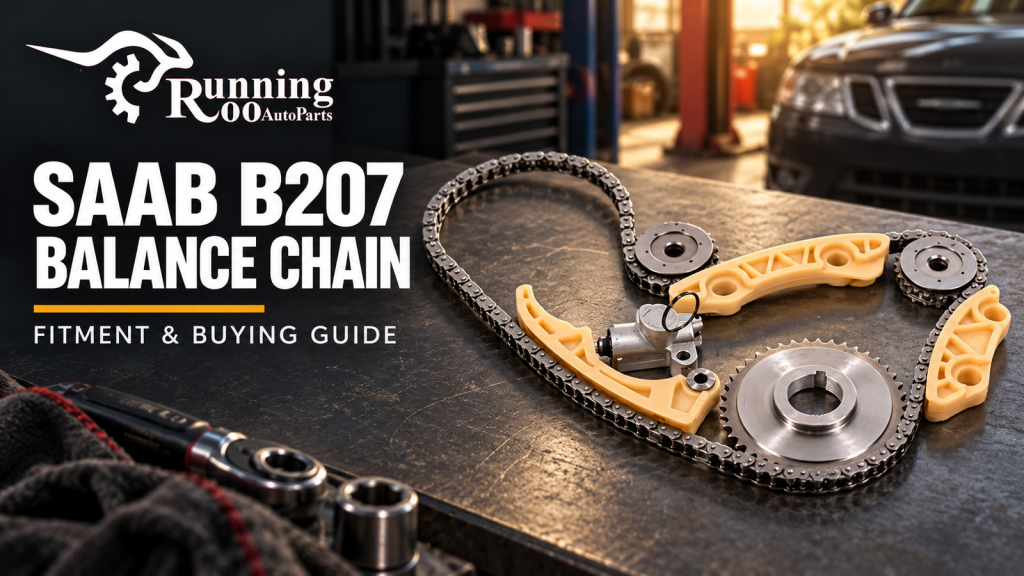
A Saab 9-3 owner asking for a “timing kit” may be discussing more than one assembly. Before comparing prices, establish whether the workshop needs the camshaft timing components, the balance-shaft chain components or work on both systems. A balance chain package should be ordered against a balance-chain repair plan, with its contents clearly identified.
The RunningRoo Saab B207 balance chain kit is the focus of this guide. Its matching eBay item was active when checked on 12 October 2026. The advertised package contains a chain, three gears, a tensioner and three guides. It is not described here as a complete camshaft timing kit, and the word “chain” should not make those two purchases interchangeable.
RunningRoo Auto Parts is Australian-operated and based in Blackburn, Melbourne. Call 0425 890 125 for friendly support with the product enquiry. Melbourne local pickup is available by appointment, and the team can discuss fast dispatch after the required parts and current stock have been confirmed.

Establish the B207 application before ordering
The checked listing names Saab 9-3 YS3F B207 applications, including 1.8T and 2.0T descriptions and selected BioPower applications. It also describes those listed engines as 1998 cc. The important purchasing point is that the badge wording is not a substitute for the actual engine identification and manufacturer’s parts references.
Send the VIN, build date, full engine code and OE references requested by the workshop. Include any known replacement-engine history. If the repairer has already inspected the chain drive, photographs of the relevant components and their markings can help clarify the enquiry. A general picture of the engine bay is less useful than a clear record of the specific component under discussion.
Do not expand the product’s year ranges into a claim about every Saab 9-3. A model name can span different engines and installations. If a seller’s abbreviated title omits B207 or uses broad wording, compare the linked item’s actual description and confirmed stock reference with the website product before deciding it is the right package.
Understand what the balance-chain package covers
The advertised inventory has eight individual items. Its supplier labels help identify the contents, but they are not represented here as Saab OE numbers. Where a label is ambiguous, the installer should compare the component with the correct manufacturer diagram rather than infer its function from a short catalogue name.
| Advertised component | Quantity | Listing reference | What the workshop should clarify |
|---|---|---|---|
| Balance chain | 1 | RC-1030, 134 links | Correct chain specification and application |
| Inner crank gear | 1 | S-851 | Required position and supplied version |
| Intermediate-shaft sprocket | 1 | S-853 | Component identity against the balance-drive diagram |
| Third listed sprocket | 1 | S-855 | Exact position; seller wording alone is insufficient |
| Tensioner | 1 | 9383 | Correct assembly for the planned repair |
| Left guide | 1 | 7385 | Required guide position |
| Right guide | 1 | 7384 | Required guide position |
| Upper guide | 1 | 7386 | Required guide position |
The seller calls S-855 an “exhaust sprocket”. That wording should not be interpreted as proof that an exhaust camshaft sprocket is included in this balance-chain kit. Ask RunningRoo and the installer to identify the supplied part against the application diagram. Keeping that ambiguity visible is more useful than silently turning a catalogue label into a technical claim.
Inspect the RunningRoo package description and matching eBay listing together. If the workshop needs a separate main timing-chain set, seals, hardware or other components, list those explicitly. The existence of a balance-chain package does not mean all of the engine’s chain-driven assemblies are contained in one box.
What Saab’s workshop information establishes
Saab’s B207 workshop information describes a specific balance-chain alignment arrangement using marked chain links and matching marks on the sprockets and block, referenced to the stated crankshaft position. The 2007 Saab WIS technical description, preserved in an independent archive, makes clear that the balance drive has its own alignment requirements.
For a buyer, the implication is straightforward: this is a timed assembly, not a collection of parts that can be installed according to appearance alone. The applicable Saab procedure should govern the repair. The brief description in this article deliberately does not provide a chain-routing sequence or substitute for the full diagrams and vehicle-specific instructions.
That source is original manufacturer workshop material hosted by an independent archive. It should be used with its model and year context intact. It does not certify the aftermarket kit’s compatibility, quality or contents. Product selection still requires the VIN, engine details, component references and confirmation of the actual supplied package.
Write the workshop request precisely
A useful request might say that the owner wants the reported noise or vibration diagnosed, with separate findings for the balance-chain drive and the camshaft timing system where relevant. It should not begin with an instruction to fit a balance-chain kit solely because a similar vehicle appeared in an online discussion.
Describe when the complaint occurs and what the driver notices. Include cold or warm conditions, engine speed or driving circumstances when safely observed, recent work and any warning lights. If the symptom began after another repair, provide the invoice and describe the timing of the change without assuming that the earlier work caused it.
Ask the technician to record the findings that support the proposed repair. A clear diagnosis should distinguish the customer’s observation from the workshop’s conclusion. “Owner reports a noise” and “inspection identifies a particular damaged component” are different statements. The parts order should follow the second kind of evidence, with any remaining uncertainty explained.
This matters for vibration complaints in particular. A buyer should not infer a balance-drive failure simply from the name “balance shaft”. Let the workshop determine the source and whether this package is relevant. The role of the supplier is to help identify the requested parts once that technical decision has been made.
Separate three different repair scenarios
In the first scenario, the workshop identifies work confined to the balance-chain assembly. The parts enquiry should focus on that package and any associated items required by the applicable procedure. A main camshaft timing kit should not be assumed to be included or necessary merely because the engine has been opened.
In the second scenario, the workshop documents concerns involving both chain systems. Ask for each scope to be listed separately, even if some access work overlaps. This makes it easier to see which kit supplies which parts and prevents an item from being omitted because both the owner and mechanic thought it belonged to the other package.
In the third scenario, the evidence is incomplete or a significant mechanical event has occurred. Agree on an inspection stage before committing to a kit as the complete solution. The mechanic may need to determine the engine’s condition and repairability. An active product listing is not evidence that replacement of its contents will restore every affected engine.
Compare quotations without confusing package size with value
A larger advertised kit is not automatically a better purchase if it covers the wrong assembly. Equally, a smaller package may omit components that the workshop has identified as necessary. Compare each quotation with the same written repair scope and confirmed application, rather than using the number of pieces as the deciding factor.
Ask the workshop to show the parts, labour and supporting materials separately. If it recommends additional work while access is available, request the reason and whether the recommendation is essential to the diagnosed repair or an optional maintenance decision. That distinction helps an owner make an informed choice without assuming every suggested item belongs inside the chain kit.
If you supply the parts, agree on that arrangement before ordering. Send the B207 balance-chain product link to the installer and ask it to review the inventory. Then use the matching eBay listing or website checkout after the package has been accepted for the job. Keep the written confirmation with the order record.
Inspect the delivered kit while everything is identifiable
A receiving check should reconcile the chain, three gears, tensioner and three guides with the confirmed order. Keep the supplier labels and packaging available. If a gear’s catalogue name was unclear during the enquiry, resolve its actual position before installation, not after the engine has been assembled.
Where an item appears different, compare the part reference and application information rather than deciding from colour alone. Photograph the component and label, then contact RunningRoo with the order number and the workshop’s question. Do not alter a part to make it resemble an expected shape before the discrepancy has been assessed.
The cover image is an editorial illustration for this guide. The actual goods are defined by the current product listing and confirmed order. Use the product photographs for recognition and the manufacturer’s information for installation decisions; neither image should be treated as a complete engineering drawing.
Plan the job around reliable parts information
A parts order becomes easier to coordinate when the workshop provides one complete list. Include the balance-chain kit, any separate main timing components and any required supporting items as distinct lines. Mark which items are already available and which still need confirmation. This reduces the chance of a second order delaying an already-started repair.
For Melbourne customers, RunningRoo’s Blackburn pickup option can help once the correct package is confirmed. Call 0425 890 125 to arrange an appointment. Do not travel on the assumption that a web listing alone means a particular order has been prepared for collection.
For customers elsewhere in Australia, ask about current stock and fast dispatch with the delivery postcode and workshop date. Transit estimates should be checked for the selected service. Australian-operated support is valuable here because the order can be discussed in the context of the actual repair schedule rather than as an isolated online transaction.
Ask for a clear handover record
At completion, retain an invoice that says which chain assembly was repaired. “Timing kit fitted” is less informative than a record distinguishing the B207 balance-chain package from any main timing-chain work. Ask the workshop to include the parts references and the reason for any additional components fitted.
The handover should also explain how the original complaint was reassessed and whether any unrelated concern remains. If the initial symptom was intermittent, the mechanic should describe the conditions in which the vehicle was checked. A useful result is specific about what was verified rather than making a permanent promise about every future engine noise.
Keep the identification and repair records for future servicing. If the vehicle changes hands, those documents help the next owner understand the actual work. If a new symptom occurs, they give the next technician a better starting point than an unsupported statement that “all chains were done”.
Relevant RunningRoo video
The video Timing Chain Rattle: Wear Symptoms & When to Replace gives general background for discussing chain-related complaints with a workshop. It is not a Saab B207 balance-chain installation guide and does not establish the diagnosis on your vehicle. Use it to prepare questions, while the applicable Saab WIS information governs the repair.
For general terminology, the RunningRoo timing chain tensioner article can also help. This B207 guide remains specifically about defining the balance-chain package and avoiding confusion with the camshaft timing assembly.
Frequently asked questions
Is this the main camshaft timing-chain kit?
It is presented as a B207 balance-chain kit. Do not assume it contains the main camshaft timing-chain package. Ask the workshop to identify the assembly being repaired and list any separate main timing components required before placing the order.
Does the 1.8T badge mean a different listed capacity?
The checked RunningRoo description lists its named 1.8T and 2.0T B207 applications as 1998 cc. That is catalogue information for the advertised product, not a universal statement about every Saab badge. Verify your car’s VIN, engine code and manufacturer parts references.
What does the S-855 “exhaust sprocket” label mean?
The seller uses that wording, but it should not be read as proof of an exhaust camshaft gear inside this balance-chain package. Ask for the supplied part’s exact position against the correct diagram. The guide deliberately leaves that point for confirmation rather than inventing a cross-reference.
Can a balance-chain kit cure any vibration?
No such claim is made. Vibration requires professional diagnosis, and the name of the component is not a diagnosis. Give the workshop a detailed description of the symptom and ask which findings support the proposed repair before buying parts.
Are the RC and S identifiers Saab OE numbers?
They are treated as supplier labels from the listing. Supply any Saab OE numbers separately and ask RunningRoo to confirm the relationship to the requested package. This avoids confusing a convenient inventory code with a verified manufacturer reference.
Where can I order and collect?
Use the RunningRoo B207 product page or matching eBay item after fitment confirmation. For friendly support, fast dispatch enquiries or Melbourne local pickup by appointment in Blackburn, call 0425 890 125 with the VIN, engine code and workshop’s parts list.