
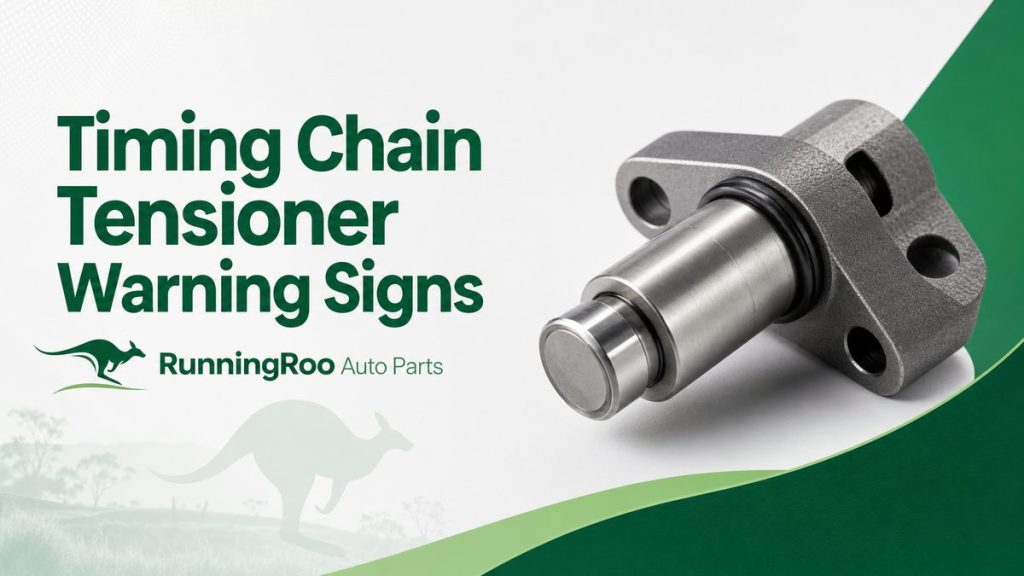
By RunningRoo Auto Parts — written from the desk of our Product Manager
The timing chain tensioner is one of the smallest parts in the engine and one of the most critical. Its entire job is to keep the timing chain at the correct tension as the chain, guides and sprockets wear, and when it fails, the consequences range from an annoying rattle to catastrophic engine damage. Because the tensioner is cheap compared with the damage it prevents, it is the part we most often tell Australian owners to treat seriously at the first sign of trouble. This guide explains what the tensioner does, how to recognise a failing one, and how to get the repair right.
RunningRoo Auto Parts – Based in Melbourne, Australia 🇦🇺
Free 24/7 Pickup Available (Contact 0425890125)
Any questions? Message or Call us anytime! We’re here to help.
Why Choose RunningRoo?
Aussie Owned & Operated | Fast Shipping | Friendly Support
What a timing chain tensioner does
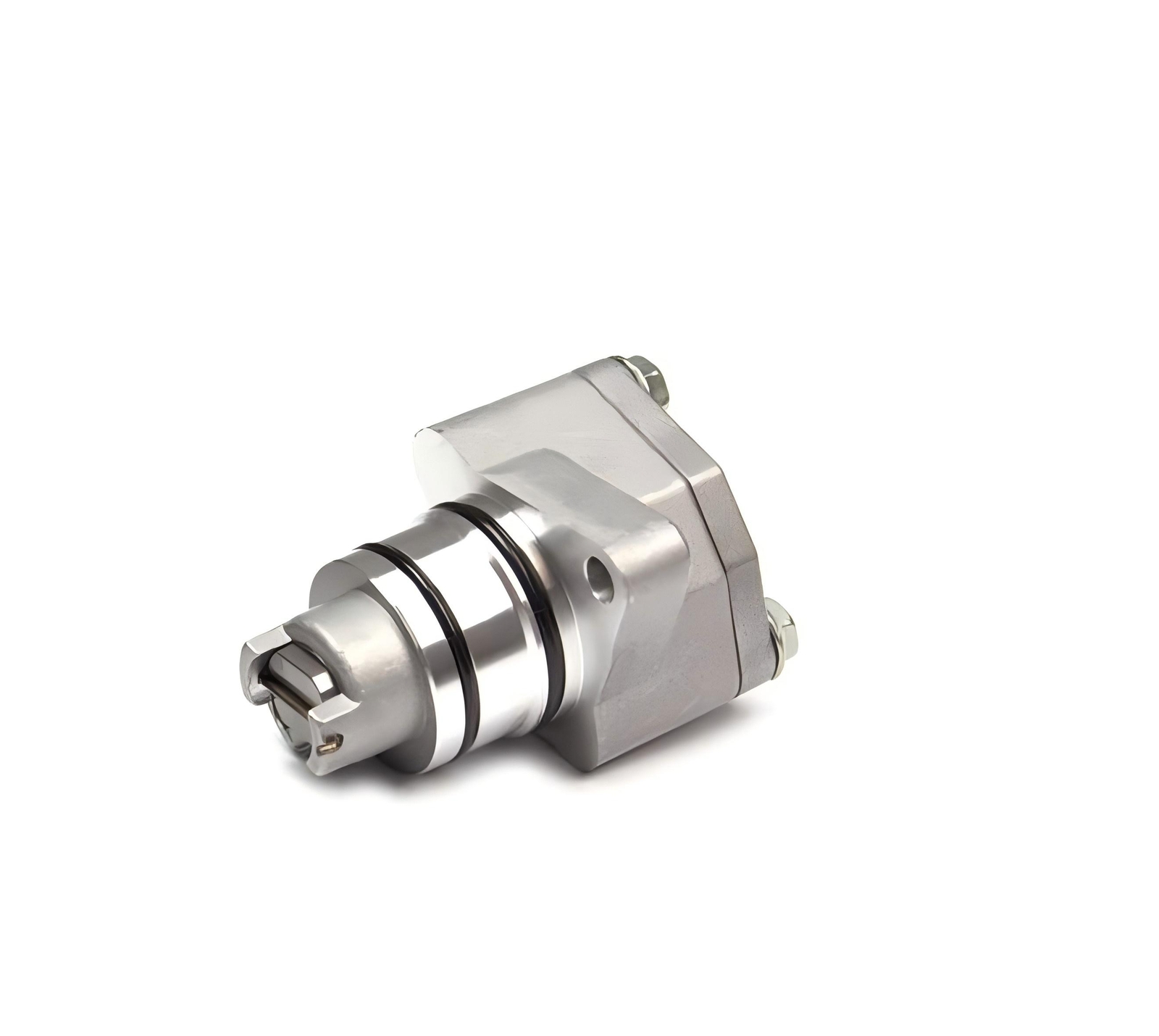
A timing chain stretches microscopically over its life, and the guides and sprockets wear with it. If the chain were left loose, it could slap, skip a tooth or derail, so the tensioner continuously takes up that slack. Most modern tensioners are hydraulic: engine oil pressure pushes a plunger against the chain guide, while a ratchet or spring holds the plunger in place when the engine is off so the chain is not loose on start-up.
This dual role — oil pressure while running, and a mechanical hold while parked — explains the classic failure symptom. When the ratchet or the internal seal wears, the tensioner loses its parked hold, and the chain rattles for a second or two on a cold start until oil pressure builds. That short rattle is the earliest and most reliable warning of tensioner trouble.
The symptoms of a failing tensioner
The signature symptom is a rattling or ticking noise from the front or rear of the engine on a cold start, lasting one to three seconds and then quietening down as oil pressure rises. As the tensioner worsens, the rattle may persist at idle or appear under load. The engine may also set camshaft-to-crankshaft correlation codes, run roughly, or lose power. In the worst case, a completely failed tensioner allows the chain to jump timing, which on an interference engine can bend valves and destroy the engine.
Because a timing chain tensioner rattle can sound similar to a VVT gear rattle, a correct diagnosis is important. The table below helps separate the most common noise sources.
| Noise pattern | Most likely source | Action |
|---|---|---|
| Rattle for 1–3 seconds on cold start | Timing chain tensioner losing its parked hold | Diagnose promptly; replace tensioner |
| Rattle that continues at idle | Worn guides, chain stretch or tensioner | Inspect the full timing system |
| Rattle plus cam/crank correlation codes | Chain stretch or jumped timing | Stop driving; professional inspection |
| Ticking that follows engine speed | VVT gear, valve train or injectors | Isolate the source before replacing parts |
What causes a tensioner to fail
The most common causes are wear and oil-related. The internal seal and ratchet mechanism wear with age and heat cycles, and once they lose their grip the tensioner can no longer hold the chain firm. Low or dirty engine oil accelerates this, because the tensioner is both lubricated and pressurised by oil — sludge or a blocked oil feed can starve it. On some engines, the tensioner is a known weak point with a revised design released later, which is why upgrading to the updated tensioner during a chain service is so strongly recommended.
This is also why a tensioner failure is often a warning about the rest of the timing system. By the time the tensioner has worn enough to rattle, the chain and guides have usually worn too, so the correct repair is frequently a complete timing chain kit rather than a tensioner in isolation.
The main types of timing chain tensioner
Timing chain tensioners come in a few basic designs, and knowing which your engine uses helps you understand why it fails. The most common modern type is the hydraulic tensioner, which uses engine oil pressure to push a plunger against the chain guide and a ratchet or spring to hold that position while the engine is parked. A mechanical or spring tensioner relies purely on spring pressure, while some designs use a ratchet mechanism that only allows the plunger to move in one direction as the chain wears.
Hydraulic tensioners dominate on modern engines because they self-adjust and run quietly, but their reliance on oil means they inherit the engine’s oil condition. The ratchet hold, in particular, is the part that wears and produces the tell-tale cold-start rattle when it can no longer hold the plunger firm overnight. That is why the same tensioner can rattle in the morning yet behave perfectly once the engine is warm and oil pressure is available.
Which engines are most prone to tensioner failure?
Certain engines have earned a reputation for timing chain tensioner trouble, and if you own one, the rattle is a signal to act rather than investigate later. The BMW N20 and N47 engines, the VW Group’s EA888 Gen1 and Gen2, the Mercedes-Benz M271 and M274, and various Ford, Nissan and Hyundai four-cylinders have all seen documented tensioner or chain issues, often addressed by a revised part released later in production.
The common thread is not the brand but the design and the maintenance history. Engines that run long oil-change intervals on the wrong oil, or that spend their lives in hot, stop-start traffic, wear their tensioners faster than the same engine maintained diligently. The best protection is a quality oil in the correct specification, changed on schedule, plus prompt attention to any cold-start noise before it escalates.
What a tensioner replacement involves
On engines where the tensioner is externally accessible, replacement can be a quick job: the old tensioner is unbolted, the new one is primed and fitted, and the engine is restarted and listened to cold the next morning. On engines where the tensioner is buried behind the timing cover, the job is effectively a timing chain service, because the covers, chain and guides are already being disturbed and are usually at a similar stage of wear.
The correct procedure matters as much as the part. Hydraulic tensioners must be primed correctly, the bolt torque and one-time-use fasteners respected, and the engine oil topped up or changed to the correct specification. After the work, a cold-start check confirms the rattle is gone; if it returns, the diagnosis was incomplete and the chain or guides are likely also worn. This is why a tensioner replacement on a high-mileage engine so often becomes a complete timing kit replacement — not because the workshop is upselling, but because the whole system wears together.
Replacing the tensioner: alone or as a kit?
On some engines the tensioner is accessible from the outside and can be replaced on its own, which is a legitimate repair when the chain and guides are still within specification. On many engines, however, the tensioner sits behind covers and the chain and guides are at a similar stage of wear, so replacing the tensioner alone simply delays the full job. A workshop can measure chain stretch and inspect the guides to advise whether a tensioner-only replacement is sensible or whether a complete kit is the better value.
The key rule is not to ignore the symptom. A rattling tensioner will not heal itself, and every cold start with a slack chain adds wear and risk. Addressing it at the tensioner stage is dramatically cheaper than waiting for the chain to jump.
Getting the repair right
Whatever the scope, the job should use a quality tensioner with the correct specification for the engine, the correct oil and filter, and the correct torque and priming procedure. Hydraulic tensioners must be primed correctly before or during installation, and one-time-use bolts and seals should be renewed. After the repair, the engine should be started and listened to cold, ideally on the following morning, to confirm the rattle is gone.
At RunningRoo we supply timing chain tensioners and complete timing kits for the engines Australians actually drive — Honda, Mercedes-Benz, BMW, VW, Audi, Toyota, Nissan, Hyundai and more — with clear engine-code fitment and Melbourne-based support to confirm the right part before you order.
One point deserves emphasis because it catches owners out: the tensioner is a safety-critical part whose failure mode is silence until it is too late. Unlike a leak or a worn brake pad, a tensioner can look and feel perfectly fine right up until the moment it can no longer hold the chain, and the only early warning is that brief cold-start rattle. Treating that noise as a “wait and see” item is the single most expensive mistake an owner can make, because the cost of a tensioner is measured in tens of dollars while the cost of a jumped chain is measured in thousands.
That is also why we recommend pairing a tensioner replacement with a careful look at the chain and guides. A new tensioner can mask chain stretch for a while, but it cannot undo wear that has already occurred, and on a high-mileage engine the honest repair is usually the complete kit. Being told the chain and guides are worn is not an upsell; it is the difference between a repair that lasts and one that returns in a year.
Frequently asked questions
How do I know if my timing chain tensioner is failing?
The most common sign is a rattle from the engine for a few seconds on a cold start, caused by the tensioner losing its parked hold overnight.
Can I drive with a rattling timing chain tensioner?
Only as far as a workshop. A failing tensioner risks chain jump and serious engine damage, so it should be diagnosed immediately.
Is a tensioner rattle the same as a VVT gear rattle?
They sound similar. A workshop can isolate the source, but both point to the timing system and warrant prompt attention.
Can I replace just the tensioner?
Sometimes, if the chain and guides are within specification and the tensioner is accessible. On many engines a complete timing kit is the better value.
What causes a tensioner to fail early?
Low or dirty engine oil, sludge, and known weak designs. Regular oil changes with the correct specification are the best prevention.
How much does a timing chain tensioner replacement cost in Australia?
It depends on access. A tensioner-only job can be a few hundred dollars, while a full chain kit replacement ranges from roughly $1,000 to $3,000+. Get a written quote.
Which cars are most prone to timing chain tensioner failure?
Several engines are well known for it, including the BMW N20 and N47, the VW Group’s EA888 Gen1 and Gen2, and the Mercedes-Benz M271 and M274. A revised tensioner is often available.
Why does my tensioner only rattle on cold starts?
Because the hydraulic tensioner’s ratchet or seal has worn and can no longer hold the chain firm while parked. The noise disappears once oil pressure builds, but the wear is still there.
Is a timing chain tensioner failure serious?
Yes. If the tensioner can no longer hold the chain firm, the chain can become slack and jump timing, which on an interference engine can bend valves and destroy the engine.
How can I make my timing chain tensioner last longer?
Use the correct specification oil and change it on schedule, because the tensioner is both lubricated and pressurised by oil. Sludge and low oil are the fastest way to wear one out.
Shop the parts mentioned in this guide
- Timing Chain Tensioner for Honda S2000 2.0L / 2.2L (NTN)
- Timing Chain Tensioner for Mercedes-Benz M271 Kompressor C200 / CLK200
- Timing Chain Tensioner Kit for Audi A1 / A3 / VW Golf 1.4 FSI / 1.4 TSI / 1.6 FSI
- Camshaft Timing Chain Tensioner Set for VW / Audi — eBay
Watch on RunningRooAuto YouTube
- RunningRoo Auto Parts – trusted Melbourne parts support
- RunningRoo Auto Parts – product and fitment channel
RunningRoo Auto Parts – Based in Melbourne, Australia 🇦🇺
Free 24/7 Pickup Available (Contact 0425890125)
Any questions? Message or Call us anytime! We’re here to help.
Why Choose RunningRoo?
Aussie Owned & Operated | Fast Shipping | Friendly Support
Sources and further reading
- Timing chain — Wikipedia (tensioner and guide function)
- Cloyes — timing chain tensioners and kits
- Gates — timing system products
- RACV — car maintenance and repair guidance
RunningRoo Auto Parts – Based in Melbourne, Australia 🇦🇺
Free 24/7 Pickup Available (Contact 0425890125)
Any questions? Message or Call us anytime! We’re here to help.
Why Choose RunningRoo?
Aussie Owned & Operated | Fast Shipping | Friendly Support