
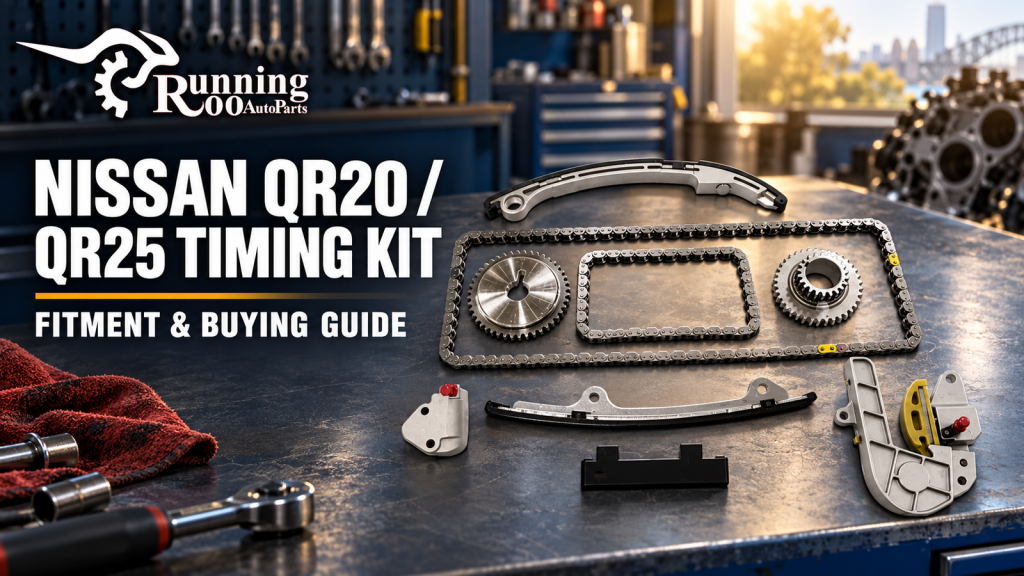
An early Nissan QR20DE or QR25DE timing-chain order should begin with the engine and the repair scope, not simply an X-Trail or Altima badge. The useful question is whether the advertised package supplies the chain circuits, guides, tensioners and gears the workshop has identified for the actual vehicle. A broad year range or a familiar engine-family name is only the beginning of that check.
The product examined here is the RunningRoo QR20/QR25-DE timing chain kit advertised for 2001–2007 applications, with its matching RunningRoo eBay listing. Both were checked as available on 12 October 2026. The website describes a nine-piece aftermarket package. This guide explains that inventory and the questions that should be settled before the order is placed.
RunningRoo is Australian-operated and based in Blackburn, Melbourne. Call 0425 890 125 for friendly support with the parts enquiry. Melbourne local pickup is by appointment, and fast dispatch can be discussed after stock, the correct application and delivery requirements are confirmed.

Identify the engine and generation precisely
The listing names QR20 and QR25-DE applications and gives a 2001–2007 range. It also mentions several vehicle names. Treat those details as advertised catalogue information, not a guarantee for every car produced during those years. The workshop should confirm the VIN, build details and full engine code before comparing the kit with the repair requirements.
Do not shorten a parts enquiry to “Nissan 2.5” or assume that every QR25DE generation uses the same package. The complete vehicle context matters. If the car has a replacement engine, tell the supplier and installer, because the original vehicle identification may no longer describe every component fitted.
A parts reference and an engine code also serve different purposes. QR25DE identifies an engine designation; it is not an OE number for each chain, guide or tensioner. Ask the mechanic to supply the component references required by the applicable Nissan parts information, then have RunningRoo check them against the current package.
Count the nine advertised pieces
The website description lists two chains, one cam sprocket, one crank sprocket, two tensioners and three guides. That adds up to the advertised nine pieces. It does not identify every item needed for an entire engine repair, nor does it promise a VVT assembly merely because a cam sprocket is included.
| Advertised component | Quantity | What to confirm |
|---|---|---|
| Upper timing chain | 1 | Correct specification and application |
| Lower timing chain | 1 | Exact drive circuit and required version |
| Cam sprocket | 1 | Which camshaft position and component type are supplied |
| Crank sprocket | 1 | Match to the identified engine and chain arrangement |
| Tensioners | 2 | Both required positions and supplied revisions |
| Chain guides | 3 | All three positions against the workshop’s list |
The words “upper” and “lower” are the seller’s package labels. The installer should map those components to the correct Nissan diagram, rather than assume a label describes the same arrangement on every engine in the listing. This is especially important when comparing a general product description with a vehicle-specific repair procedure.
Review the RunningRoo kit description and corresponding eBay item with the workshop. Ask for the current packing list if any component is unclear. If the repair needs a VVT gear, seals, oil rings, hardware or other parts, specify them separately until their inclusion or separate supply is confirmed.
What the Nissan QR25DE manual shows
The original 2005 Altima QR25DE engine-mechanical manual identifies both the main timing chain and a balancer-unit chain, with separate related tensioning components. It also lists the intake valve timing components separately in the assembly information. The manufacturer manual excerpt, hosted in an independent archive, supports treating these as distinct items when defining a repair.
The same material requires attention to alignment, component inspection and the applicable sealing and fastening instructions. Those requirements explain why a nine-piece sales list is not an installation procedure. This article does not reproduce a timing sequence or torque chart, and the Altima example should not be treated as a universal procedure for every QR20DE or QR25DE installation.
For the owner, the practical point is to ask the mechanic to identify each part by its function and application. If a quote says “lower chain”, ask which circuit it means. If it says “cam gear”, ask whether the required component is the one supplied in the package or a separate assembly. Clear terminology avoids buying a kit that leaves a necessary item unresolved.
Keep a chain-kit enquiry separate from a VVT-gear enquiry
RunningRoo already has a separate QR25DE camshaft VVT gear guide. That topic concerns a different purchasing decision. This page focuses on the early chain-kit inventory and the relationship between the advertised contents and the workshop’s scope.
A single listed cam sprocket should not be interpreted as two cam sprockets or a complete variable-timing repair package. Ask the supplier to identify the supplied component and compare it with the OE reference required by the installer. If a separate VVT assembly is needed, it should appear as its own confirmed line on the order.
Likewise, a timing-related fault code does not by itself decide between a chain kit and a VVT component. That decision follows professional diagnosis using the appropriate Nissan information. The supplier can help match the specified parts, but the choice of repair should not be made simply by selecting the product whose title resembles a code description.
Describe the complaint before requesting parts
Give the workshop a precise account of what the car does. Include whether the concern appears at startup, at idle or under particular driving conditions, and whether the engine is cold or warm. Mention recent service work and any change in the symptom. A short recording can help communicate a noise, but it cannot establish the failed component.
Provide the available maintenance records and the exact fault information recorded by the technician. If the history is incomplete, make that clear. The workshop can then assess the engine without relying on an assumed oil specification, replacement history or previous diagnosis.
Ask whether the original complaint was reproduced and what findings support the proposed chain work. The answer should distinguish observation from conclusion. “Noise reported near the engine” is different from a documented inspection finding that identifies a particular worn or damaged component.
If the engine has stopped unexpectedly or a serious mechanical problem is suspected, ask the repairer for vehicle-specific advice about transport and assessment. A parts advertisement cannot determine whether further running or starting attempts are appropriate. Establish the condition of the engine before assuming a replacement kit is the entire solution.
Define the repair scope in writing
A clear quotation should identify the chain circuits being addressed, the related components to be replaced and the supporting materials required by the applicable procedure. If the workshop recommends additional work, ask for the reason and whether it is essential to the diagnosed fault or a separate maintenance recommendation.
The distinction is useful when comparing quotations. One quote may include both chain circuits and associated components, while another may cover a narrower operation. A lower total is not necessarily better value if it describes a different job. Compare the same scope, vehicle identification and verification requirements.
Also agree on how additional findings will be handled once access is available. The workshop should explain the new issue and obtain approval for an expanded estimate. This is preferable to treating every possible component as either automatically included or automatically unnecessary before the engine has been assessed.
Avoid a “complete kit” misunderstanding
The term complete can mean complete according to a supplier’s inventory, not complete for every vehicle repair. The nine-piece package can be correctly described and still require additional items for a particular job. Ask what the installer needs beyond the listed components and which of those items it will source separately.
The Nissan manual’s assembly list includes items outside this advertised nine-piece inventory. That is a reason to compare the job with the actual package, not a claim that every illustrated item must be replaced on every car. The workshop should follow the relevant inspection and replacement instructions for the task it is performing.
Do not use the cover illustration as a packing specification. It is an editorial image intended to make the guide recognisable. The product photographs, current written description and confirmed order define the supplied goods. Any uncertainty about a component should be resolved with the supplier and installer before installation begins.
Arrange the order around the workshop’s needs
If you are supplying the kit yourself, ask the installer to review the exact RunningRoo QR20/QR25 kit before purchase. Confirm that it accepts customer-supplied parts and establish who will check the delivery. Use the matching eBay listing if that is the preferred checkout, keeping the product reference consistent throughout the conversation.
Send the VIN, full engine code, production details, requested OE references and repair list together. Include a photograph of any readable component marking if it is relevant. If the mechanic has identified a supersession, ask for that relationship to be documented rather than assuming a similar number is equivalent.
When timing matters, confirm stock before arranging the repair date. The checked website description contains different dispatch statements in different sections. Ask RunningRoo for the current arrangement for your order instead of treating either statement as a guaranteed delivery promise.
Receiving checks that prevent workshop delays
On arrival, compare the contents with the confirmed nine-piece inventory. Identify the two chains, the supplied cam and crank sprockets, the two tensioners and the three guides. Retain the packaging and labels until the installer has confirmed the application and required scope.
If the part count or a component differs from the agreed order, contact RunningRoo with the order reference and clear photographs. Do not modify or install a questionable component while its identity is unresolved. A precise account of the difference allows the supplier to distinguish a packing issue from an application misunderstanding.
The receiving check should happen before the workshop commits to an assembly stage that depends on those parts. This is a practical scheduling measure: it gives time to resolve a missing or mismatched item while the vehicle’s repair plan can still be adjusted sensibly.
Collection, dispatch and local support
Melbourne local pickup is available in Blackburn by appointment. Call 0425 890 125 and quote the confirmed product or order reference before travelling. If compatibility is still being checked, settle that first so collection concerns the correct package.
For delivery elsewhere in Australia, give the postcode and workshop’s required date. RunningRoo can discuss fast dispatch and the available shipping options, subject to current stock and order timing. Dispatch and transit are separate stages, so ask about both when planning a repair that cannot proceed without the kit.
Australian-operated service and friendly support are particularly useful when an owner and workshop need the same information. Keep one agreed parts list and share it consistently. That reduces the risk of different people ordering overlapping items or assuming that a separate assembly is already included.
Document what was repaired
At handover, ask the workshop to record the chain work performed and the fitted components. If a separate VVT assembly or additional repair was included, it should be listed clearly. This makes the service history more useful than a general note saying “timing replaced”.
Ask how the original complaint was checked after the repair and whether any unrelated issue remains. The verification should address the conditions in which the complaint occurred, with any limitations explained. Keep the diagnostic findings, invoice and product references together for future servicing.
A replacement kit does not create a universal new service interval or a promise that the engine requires no further attention. Follow the appropriate maintenance information for the vehicle and report a new symptom with its circumstances. The repair record will help the next technician understand what has already been done.
Related RunningRoo video
Watch Timing Chain Rattle: Wear Symptoms & When to Replace for general background on chain-related complaints. It is not a QR20DE or QR25DE installation demonstration and does not confirm the diagnosis on a particular car. Use the relevant Nissan service information for the actual repair and application.
Frequently asked questions
Does this fit every QR25DE engine?
No universal compatibility claim is made. The product is advertised for an early application range, and the VIN, production details, engine code and required OE references must be checked. Do not assume a later engine uses the same package because the family designation is familiar.
What are the nine pieces?
The checked description lists two chains, one cam sprocket, one crank sprocket, two tensioners and three guides. Confirm the current supplied versions and compare them with the workshop’s needs. Additional repair items should be listed separately unless expressly included.
Is a VVT gear included?
The listing says one cam sprocket, which should not be expanded into a promise of a particular VVT assembly. Ask RunningRoo to identify the supplied component and have the installer compare its reference with the required part. Keep any separate VVT order distinct.
Can I use the Altima manual for every listed vehicle?
No. The cited original Nissan manual is a specific QR25DE example explaining the separate components. The workshop must use the appropriate instructions for the actual vehicle and engine. It is not a universal access, alignment or tightening procedure.
Does a timing code mean the chain kit is required?
No. Professional diagnosis should identify the fault and required components. A code description does not establish this kit’s suitability or prove that all its contents need replacement. Ask for the findings and then confirm the parts application.
Where can I order after confirmation?
Use the RunningRoo website product page or matching eBay item. Call 0425 890 125 for friendly support, Melbourne local pickup by appointment or current fast dispatch arrangements. Provide the vehicle details and workshop’s confirmed parts list.