
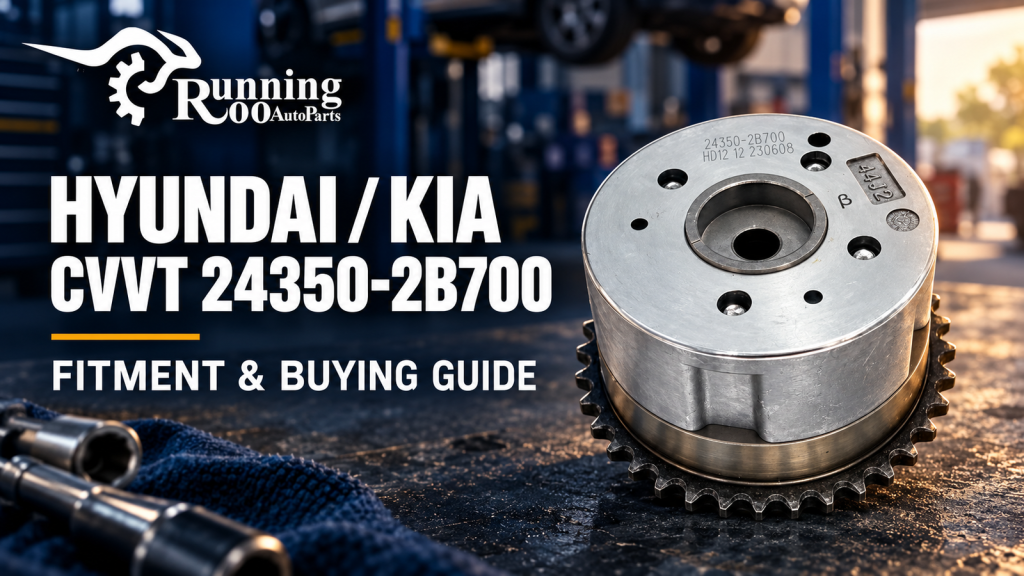
A search for 24350-2B700 often brings up several Hyundai and Kia model names. That can be convenient for finding a product, but it is not enough to establish fitment. The reliable buying decision connects the complete OE reference to the VIN, engine code, production details and the component the workshop has actually diagnosed.
This guide is about the RunningRoo CVVT timing gear advertised as 24350-2B700, with its matching RunningRoo eBay item. Both were checked as available on 12 October 2026. The website names vehicles including Kona, Elantra, Sonata, Tucson and Veloster, while its description also includes Kia applications. Those names remain advertised catalogue context, not a promise that the gear fits every engine sold under them.
For friendly support, call RunningRoo on 0425 890 125. The business is Australian-operated and based in Blackburn, Melbourne, with Melbourne local pickup by appointment. Ask about fast dispatch after the exact item, current stock and delivery requirements have been confirmed.

Make the complete reference the centre of the enquiry
Write 24350-2B700 in full, including the letter B and the final digits. The form 243502B700 removes the hyphen but preserves the reference. A different suffix is not a formatting variation and should not be treated as interchangeable without a verified parts cross-reference.
If the old assembly has a readable marking, send a sharp photograph rather than relying only on a typed transcription. Include the VIN and full engine code at the same time. If the mechanic has obtained a superseding OE number, ask it to document that relationship so RunningRoo can check the requested version clearly.
The product description does not provide a complete engine-code map for every named model. This article therefore does not invent one. A list of vehicles in a sales title is not a substitute for the manufacturer’s application information, especially when the same name appears across different production years, engines and markets.
A real manufacturer example of why “Sonata” is insufficient
Hyundai’s TSB 15-01-022-1 addresses a particular E-CVVT seal-seating issue on certain 2015 Sonata LF vehicles with 2.0T or 2.4-litre GDI engines. It identifies a specific condition associated with P0010 and prescribes a defined service operation. The bulletin’s stated repair requires no new parts.
That example is included to show why a model name and a camshaft-related code cannot automatically become a gear order. It does not establish that 24350-2B700 fits the vehicles in the bulletin, and it is not a repair procedure for this RunningRoo product. A workshop must first determine whether a bulletin or service instruction actually applies to the vehicle being assessed.
For a customer, the useful question is whether the technician has identified the exact system and relevant service information. “It is a Sonata with a timing code” leaves too much unresolved. The engine, component, diagnostic findings and required reference should be clear before a supplier is asked to confirm the part.
Distinguish a gear from the wider CVVT system
Kia’s manufacturer publication Tech Times, Volume 20 Issue 1, pages 17–18 discusses evaluating CVVT operation using the appropriate service information and diagnostic observations. It notes that a CVVT-related code can accompany a mechanical or oil-control concern, not only a simple electrical fault. The publication directs technicians to the applicable model-specific procedures.
This provides useful general context for a parts enquiry, but it does not certify the fitment of 24350-2B700. The workshop still needs to identify the system on the actual engine and determine the failed component. Do not borrow a test condition or specification from another engine merely because both use the term CVVT.
A gear assembly, an oil control valve, a camshaft sensor and related wiring are different items. The quotation should name the part being replaced and the reference required. If a mechanic uses the shorthand “VVT”, ask for the full component description before ordering. That is a practical purchasing clarification, not a request for the owner to perform the diagnosis.
The information that makes a compatibility check useful
| Item to send | Good evidence | What it resolves |
|---|---|---|
| VIN or chassis identity | Complete vehicle identifier supplied privately to the seller | Vehicle specification context |
| Build information | Production date and original market where known | Registration-year ambiguity |
| Engine code | Code confirmed by the workshop | Different engines under the same model name |
| Required OE reference | Full number, including suffix or verified supersession | Exact component identity |
| Existing component | Clear marking and relevant photographs | Transcription mistakes and physical comparison |
| Diagnosis | Workshop’s stated failed component and findings | Whether a gear is actually the required purchase |
| Repair scope | Separate list of supporting items | What is and is not included in the order |
Use the RunningRoo 24350-2B700 product page as the starting commercial reference and the matching eBay listing for the alternative checkout. Ask the installer to review the exact item before purchase, particularly if it has requested a different number or specified a particular revision.
Avoid posting a full VIN in a public comment thread when a direct parts enquiry will do. The supplier needs it for checking the application, while other readers do not. Clear information sent through the appropriate contact channel is more useful than a long public discussion based on only a model name.
Interpret symptoms without turning them into a shopping list
Record what happens, when it happens and what the workshop has observed. Include whether the engine is cold or warm, any recent work and the exact code information if it has been read. Keep those observations separate from a conclusion that the gear must be faulty.
A customer may notice hesitation, a warning light or a noise and find an online article mentioning CVVT. That can be a reason to ask for diagnosis, but it is not proof of a specific failed assembly. Ask the technician what evidence connects the complaint to the proposed part and whether any other concern remains unresolved.
If a previous replacement did not solve the problem, supply the invoice and result. The next diagnostic decision should take that history into account. Simply ordering another part with a related name can make the record more confusing and increase cost without establishing the original fault.
The manufacturer examples above support a disciplined approach: identify the actual system and apply the relevant procedure. They do not establish a universal sequence for all Hyundai and Kia engines. The workshop should decide the necessary checks and explain the result in terms an owner can use for the purchase.
Treat supersessions as evidence, not a guess
A supersession is a documented relationship between references, not an assumption based on the first five digits. If the mechanic says a newer number replaces the old one, request the exact reference and the application context. Send both numbers to RunningRoo and ask for confirmation of the supplied version.
Likewise, a seller’s search title may contain several numbers to help customers find a product. Do not assume every number in a search result is equivalent for every vehicle. Open the product description and clarify the reference needed for the actual VIN and engine. If the relationship remains uncertain, resolve it before buying.
Photographs can assist with that discussion, but they have limits. Similar holes, teeth or markings do not establish the internal specification or approved application. A visual comparison should support the manufacturer parts information and supplier confirmation, not replace them.
Understand the single-assembly scope
The product is advertised as a CVVT timing gear. Do not infer that it includes a full chain kit, oil control valve, sensor, seals or installation hardware. Ask for the current supplied contents and put every additional workshop requirement on a separate line of the parts list.
The website also contains inconsistent warranty wording. Rather than repeat one duration as a firm promise, ask RunningRoo to confirm the terms applying to the actual order. Keeping that clarification with the purchase record is more useful than relying on a copied sentence from a broad product description.
The same care applies to dispatch language. Fast dispatch is a service enquiry, not a guarantee that every item is ready for immediate collection or will arrive by a particular hour. Confirm stock, order processing and the delivery service with the team when a workshop booking depends on timing.
Compare the repair estimate with the parts order
An itemised estimate should identify diagnosis, the gear assembly, labour and any supporting materials. If additional work may be necessary after access, agree on how the workshop will obtain approval. This makes it possible to understand the total repair commitment rather than treating the online gear price as the finished-job cost.
If the owner supplies the part, confirm that arrangement before ordering. Send the installer the exact RunningRoo gear listing or eBay item, and ask it to check the reference against the job. Decide who will perform the receiving inspection and handle any discrepancy with the supplier.
Where two quotations differ substantially, compare their diagnosed scope before comparing their totals. One may involve a specific service operation, another a replacement assembly, and another additional work. The difference should be explained by findings and procedure, not hidden behind the shared word CVVT.
Receive the correct assembly and preserve the record
Keep the order confirmation, packaging label and supplied part together until the workshop has checked them. Photograph the label and any readable component reference. If the delivery differs from the confirmed order, contact RunningRoo before the item is altered or installed.
Describe a discrepancy precisely. State whether it concerns the reference, supplied quantity, physical configuration or a missing item that was expressly confirmed. Clear photographs and the order number help the supplier investigate more effectively than a message saying only that the part “looks wrong”.
The installer should follow the appropriate manufacturer procedure for the actual engine. This guide does not provide a universal torque specification or timing-mark diagram. It explains how to order the identified component, while professional service information governs its installation and the verification of the completed repair.
Melbourne support and Australian delivery
For Melbourne local pickup, call 0425 890 125 to arrange an appointment in Blackburn. Confirm the item and stock before travelling, and quote the order reference if the purchase has already been made. Friendly support is most effective when the vehicle details and requested OE number are ready.
For customers elsewhere in Australia, provide the delivery postcode and workshop date when asking about fast dispatch. Ask the team to distinguish processing time from the carrier’s transit estimate. RunningRoo is Australian-operated, so the parts enquiry and dispatch arrangements can be coordinated directly with the local business.
After installation, retain the workshop’s diagnosis, fitted reference and verification result. If a new complaint appears later, those records help the next technician distinguish the completed repair from an unrelated issue. They also preserve the exact application decision that led to the order.
Related RunningRoo video
The RunningRoo video Inside a VVT Cam Phaser: Oil Passages & Locking Pin Explained is relevant general background. It is not a teardown or test of the specific 24350-2B700 assembly, and it should not be used to assume this part’s internal construction or installation requirements. Refer to the correct manufacturer service information for the actual engine.
For an explanation of the different component names, see the VVT gear versus solenoid guide. This article remains focused on the exact-number enquiry so it does not turn into a generic list of CVVT symptoms or broad model-fitment promises.
Frequently asked questions
Does this gear fit every Kona, Sonata or Veloster?
No universal fitment claim is made. Those names appear in the seller’s catalogue context, but engine, production and market differences must be resolved through the VIN, engine code and OE reference. Ask for confirmation of the exact application before ordering.
Is the Sonata bulletin a repair guide for this part?
No. It is a specific manufacturer example showing why a model name and code do not automatically justify a gear purchase. It does not establish 24350-2B700 compatibility. The workshop must determine the relevant information for your vehicle.
Can I substitute a similar 24350 number?
Only after a verified cross-reference or supersession has been established for the application. Shared leading digits or a similar photograph do not prove interchangeability. Preserve the complete reference and ask the mechanic and supplier to resolve any difference.
What if the old number is unreadable?
Tell the supplier that it is unreadable rather than guessing. Provide the VIN, engine code and workshop’s requested OE reference, with photographs where helpful. The application should be established from reliable vehicle and parts information before purchase.
Does the gear include an OCV or timing chain?
Those items are not identified as included here. Ask RunningRoo to confirm the current supplied scope, and obtain separate references for any additional components required by the workshop. A single-assembly listing should not be expanded into a complete timing kit.
How can I order with local support?
Use the RunningRoo product page or matching eBay item after confirmation. Call 0425 890 125 for friendly support, Melbourne local pickup by appointment or a fast dispatch enquiry. Have the VIN, engine code and complete OE reference ready.