
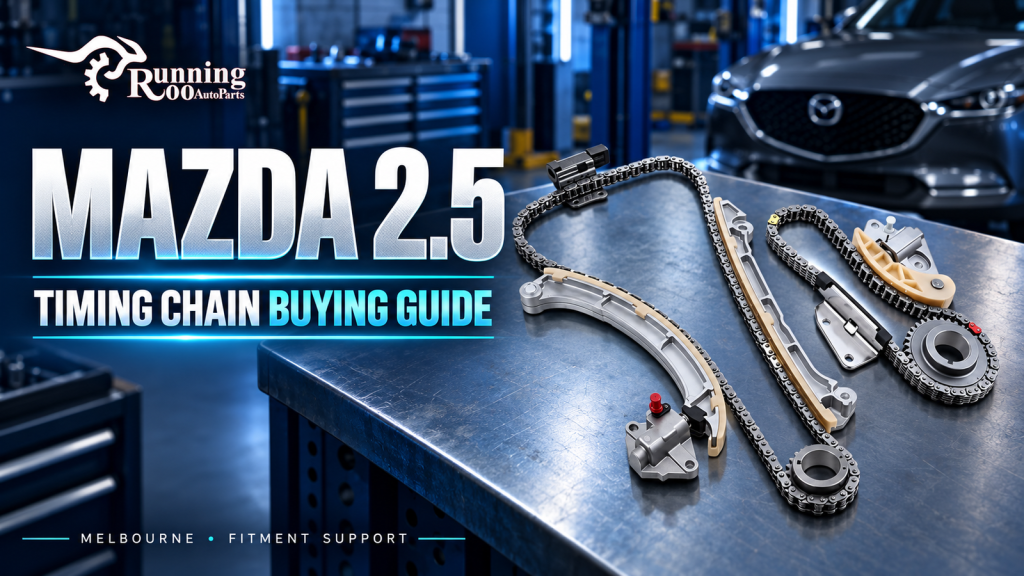
A search for a Mazda 2.5 timing chain kit can bring together Mazda3, Mazda6, CX-5 and CX-9 listings, even though those names cover different engines and production specifications. The most useful first step is to identify the exact vehicle and engine, then compare the workshop’s repair list with the particular package being sold. Capacity alone is not a fitment decision.
RunningRoo lists a 2.5-litre four-cylinder package with both timing and oil pump drive components. Review the RunningRoo Mazda 2.5 chain kit and the corresponding eBay listing, then send the VIN, installed engine code and OE references for checking. For Melbourne-based, Australian-operated assistance, call 0425 890 125. Friendly support, Blackburn pickup by appointment and fast dispatch options are available subject to stock and destination.

Why “Mazda 2.5” needs a second question
Mazda’s official announcement for the all-new CX-9 distinguishes the turbocharged SKYACTIV-G 2.5T from the naturally aspirated SKYACTIV-G 2.5 on which it was based. Mazda’s 2017 technical-review index separately identifies a newly developed 2.5 engine with cylinder deactivation. These are manufacturer-documented reasons to ask about the exact engine version, not to treat every 2.5-litre Mazda as the same parts application. See Mazda’s CX-9 engine announcement and Mazda Technical Review 2017.
The fact that engines share development history does not prove that a replacement chain, gear or guide is interchangeable. Equally, the presence of different engine technologies does not by itself prove that a particular component is different. The correct answer comes from the appropriate parts information and a VIN-based check, not from either assumption.
The selected RunningRoo product description mentions naturally aspirated model applications and a turbocharged CX-9 application. Before using that list for your own car, ask the team to confirm the installed engine specification and supplied kit version. This article describes that listing and the questions it raises; it does not independently certify its entire application range.
What is included in the listed package?
The written description identifies a timing chain with a 150L designation, three guide rails, a tensioner, a crank gear described as having 36 teeth, and an oil pump drive group. The chain and tooth counts are listing details for the enquiry. They should not be used as the sole basis for selecting parts, and they are not instructions for setting mechanical timing.
| Component group | Website description | Before ordering |
|---|---|---|
| Timing chain | 1 chain, 150L | Confirm the correct engine and component version |
| Timing guides | 3 guide rails | Check the workshop’s required positions |
| Timing tensioner | 1 tensioner | Confirm the supplied reference |
| Crank gear | 1 gear, 36 teeth | Check more than the tooth count |
| Oil pump chain and gear | 1 chain, 82L; 1 gear | Confirm their inclusion in the repair scope |
| Oil pump drive tensioner and guide | 1 of each | Compare with the engine-specific requirements |
The list contains ten individual items when the three timing guides are counted separately. That is a description of the advertised package, not a promise that ten items complete every repair. The workshop may require seals, fasteners, fluids or other components that are not listed. Get those needs identified separately before the appointment depends on the kit being complete for the job.
Neither camshaft adjusters nor a complete oil pump are named in this package list. If the diagnosis requires either, ask for an explicit quotation and fitment confirmation. An oil pump drive kit and an oil pump assembly are different supply decisions. A chain package also does not automatically resolve a concern involving another engine system.
Separate the car’s identity from the advertisement’s keywords
Prepare the VIN, model, production date and engine code. Add whether the car is turbocharged and whether the workshop has identified a relevant engine revision. If the vehicle has been imported, include its market of origin where known. Do not select an answer simply because it makes a website compatibility menu accept the vehicle.
For a CX-9 enquiry, be especially precise about engine configuration and generation. This guide concerns the listed 2.5-litre four-cylinder package, not the separate V6 timing kits that RunningRoo also sells. A shared model badge is not a bridge between those products. A photograph of the vehicle identification information and the workshop’s written engine description can prevent the wrong enquiry from progressing.
For Mazda3, Mazda6 or CX-5, avoid using a general “Skyactiv” label as a substitute for the engine designation. The brand’s technology name covers a wider range of engines than this one package. When the exact code is uncertain, ask the technician to identify it and use the VIN to support the catalogue search.
Do not let a fault description become a parts assumption
Owners often begin a search after hearing a noise or receiving a repair estimate. Preserve the original complaint in a clear form: when it began, how often it occurs, whether it follows an overnight stop, and whether there are warning messages. If a recording can be made safely during normal observation, it can help communicate the concern, but it is not a substitute for diagnosis.
Ask the workshop what evidence supports replacing the timing drive, the oil pump drive, or both. Those are separate parts of the purchase scope even when they are sold in one package. The technician should explain which findings are confirmed and which inspections are still required. A bundled product can be convenient, but the bundle itself does not establish what is wrong with the engine.
Any mechanical measurements, scan data or adjustment procedures should be assessed against the applicable Mazda information. Do not use an online rule about acceptable noise duration, mileage or chain movement as a universal limit. This article intentionally avoids prescribing a service interval or replacement threshold for all the vehicles appearing in the listing.
Compare complete repair proposals rather than kit prices alone
Request a written estimate that separates diagnosis, parts and labour. Ask whether the proposed package includes the oil pump drive group and whether any additional items are expected. If two workshops quote different work, ask each to explain its scope before deciding which total offers better value. A lower total may simply omit something the other estimate includes.
Give the workshop a copy of the exact RunningRoo product description, not just a photograph of the cover image. The component list is the useful information for planning. Ask the technician to mark any required items that are absent and any items that may only be needed after further inspection.
Discuss who will supply the parts and how questions will be handled. If you buy the kit yourself, the workshop should know the source and contents before work starts. If the workshop places the order, ask for the final component references on the invoice. Either approach can work more smoothly when responsibilities are agreed early.
Plan for service materials and official procedures
The workshop should use the engine-specific repair instructions to determine the required tools, sealing materials, fastener treatment and verification steps. A guide for a different Mazda engine is not a safe shortcut merely because a similar chain appears in its photographs. The ordering process should support the technician’s procedure rather than replace it.
Do not assume that an included or separately purchased sealant is approved for every location. Ask the workshop to specify what is needed for the actual job. The same principle applies to fluids: retain the manufacturer’s requirements and the technician’s assessment rather than changing products on the strength of a general timing-chain discussion.
Agree what happens if inspection changes the scope. A useful arrangement includes a written explanation or photographs before additional work is authorised. This is particularly helpful for a family vehicle needed every day, because it turns an uncertain repair into a sequence of decisions with a clear contact point.
Receiving the kit: a practical comparison process
Check the package against the order before the repair booking. Keep each group organised so the timing-drive components and oil pump drive components can be compared with the workshop’s list. Retain the labels and packaging while any questions are resolved. Do not mix loose parts with another kit already in the workshop.
If the appearance differs from an old component or a catalogue image, ask for clarification before fitting it. Identify the specific difference, such as a mounting feature, label or supplied quantity. A general statement that the parts look different gives the supplier less to work with than a focused photograph and the confirmed engine details.
Do not modify a part to overcome uncertainty. A valid revision needs appropriate confirmation; an incorrect item needs a supply resolution. The receiving check is the point at which those questions should be addressed, while the component remains identifiable and the repair has not been forced into a workaround.
Melbourne pickup and Australian delivery planning
You can order through the RunningRoo Mazda 2.5 eBay item or the website after the fitment check. Confirm the current package, stock and terms in your chosen channel. Prices and delivery estimates can change, so the live offer should govern the purchase rather than an old screenshot or this article.
RunningRoo offers friendly local support from Melbourne and Blackburn pickup by appointment. Confirm readiness and an agreed time before travelling. For delivery, provide the postcode and ask about fast dispatch options. Call 0425 890 125 if the repair has a firm booking date, so the supply expectation can be discussed before you commit to that date.
Related video from RunningRoo
Timing Chain Rattle: Wear Symptoms & When to Replace is a related RunningRoo educational video. It is general background, not a Mazda 2.5 installation demonstration or an approval of turbo and non-turbo interchange. Use it to frame questions for a qualified technician and follow the applicable Mazda procedure for the actual work.
How to compare a turbo enquiry with a non-turbo enquiry
Suppose a workshop has one Mazda passenger car and one CX-9 awaiting parts advice. Both owners describe their engines as “two point five”, and both send the same online product link. The supplier should receive separate vehicle records, not a combined request based on displacement. Include each VIN, installed engine identity, turbo status and workshop reference so the applications cannot be confused.
The broad Mazda model coverage in the selected advertisement should prompt checking, not a conclusion that every variant shares all timing components. Conversely, the existence of different engine technologies does not by itself prove that this particular kit is unsuitable. The correct decision requires a parts comparison for the exact application. Avoid replacing one unsupported assumption with another.
When the supplier responds, keep each confirmation attached to its own job. If a substitution is suggested, ask for the revised item link and written contents before placing the order. This makes a changed supply offer visible to the installer and prevents an old screenshot from being treated as the current specification.
For an owner comparing several listings, use the same vehicle details in every enquiry. Changing between a registration year, an overseas model year and an approximate engine description can produce apparently conflicting answers that actually address different vehicles. Consistent input makes the responses easier to assess and gives the workshop a clearer basis for approving the purchase.
Frequently asked questions
Does the same kit fit turbo and non-turbo 2.5 engines?
Do not assume that it does or that it cannot. The selected listing mentions both types of application, but your VIN, installed engine version and component references need an individual check before purchase.
Does cylinder deactivation affect the enquiry?
It is relevant identifying information to provide. Mazda documents a distinct 2.5 development with cylinder deactivation, so the workshop should identify the engine version and use the appropriate parts information rather than selecting solely by displacement.
Is an oil pump included?
The website lists oil pump drive components, including a chain and gear, not a complete oil pump. Ask separately if the workshop requires the pump assembly or other associated service parts.
Are camshaft adjusters included?
They are not named in the package list reviewed here. Confirm any required adjusters separately by position and OE reference. Do not infer their presence from a general photograph of a timing system.
Can this be used for a CX-9 V6?
This article concerns a 2.5-litre four-cylinder listing. It does not establish suitability for the V6. Identify the engine and use a separate parts enquiry for any different configuration.
What should I keep after the job?
Keep the diagnosis, order confirmation and invoice showing the installed parts and additional work. Record any recommended follow-up. These documents provide a clearer maintenance history than a general note that the engine received a timing kit.
Make the Mazda 2.5 order specific
Open the RunningRoo Mazda timing and oil pump chain kit, compare the matching eBay listing, and contact the team on 0425 890 125. With the VIN, engine code, OE information and professional diagnosis ready, you can arrange Australian-operated support, local pickup by appointment or dispatch around a properly defined repair.
Comparing a different CX-9 engine?
For the separate earlier V6 enquiry, see RunningRoo’s CX-9 V6 timing-chain buying guide. It addresses a different engine and should not be used to establish fitment for this four-cylinder package.
For collection and fitment enquiries, visit the RunningRoo contact page. Blackburn, VIC pickup is by appointment.