
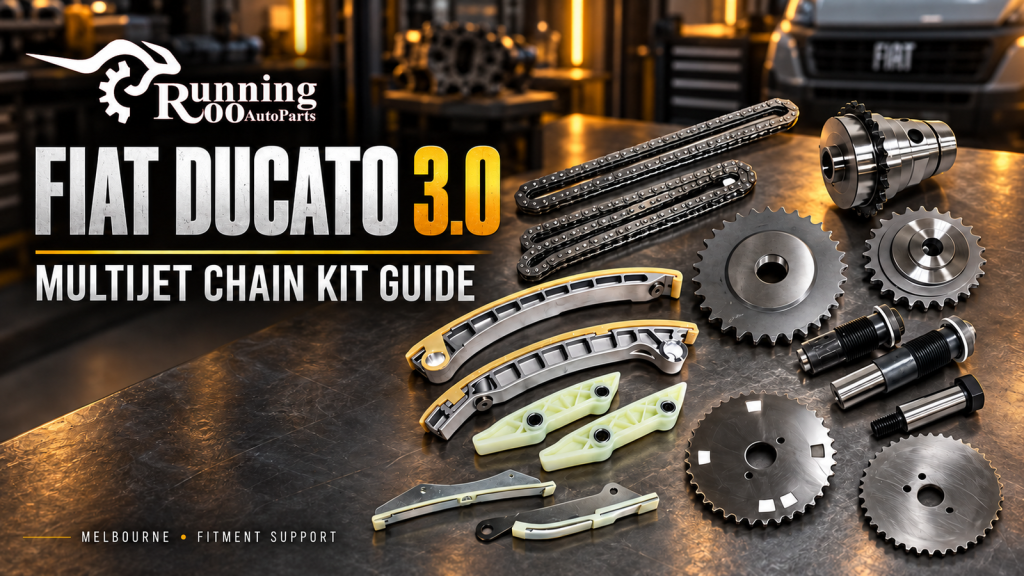
A Ducato may be a delivery van, a tradesperson’s workshop on wheels or the base of a motorhome. In each case, an incorrect timing-parts order can disrupt more than a normal commute. For the RunningRoo 3.0 Multijet package, the starting point is the vehicle’s VIN and full installed engine code, followed by a comparison between the listed components and the workshop’s required repair scope.
Review the RunningRoo Fiat Ducato 3.0 timing chain kit and the corresponding RunningRoo eBay listing. The website names F1CE0481D among several engine references and lists two chains with gears, tensioners and guides. Call 0425 890 125 for friendly Australian-operated support. RunningRoo is based in Melbourne, with Blackburn pickup by appointment and fast dispatch options subject to stock and destination.

First separate the 3.0 engine from other Ducato powertrains
Fiat’s official 2014 conversion-vehicle specifications provide a useful example of why capacity matters: the listed 180 MultiJet has a 2999 cc engine and a chain-driven timing system, while the other engines in that particular table use toothed belts. That is a specification for the documented range, not a statement about every Ducato ever produced. See Fiat’s official Ducato technical specifications.
The practical implication is straightforward: do not order this package because the vehicle is called Ducato or because a motorhome advertisement says “Multijet”. Identify the actual engine and production specification. A body conversion may have its own completion date and model name, which are useful for the habitation equipment but do not replace the base vehicle’s identity when ordering engine parts.
If your records show several dates, send them with an explanation. The base vehicle may have been built before the conversion was completed or before the vehicle was first registered. A workshop familiar with the vehicle can help distinguish those details. This is particularly worthwhile for a motorhome that has changed owners or arrived in Australia through an import process.
What the selected F1C package contains
The RunningRoo listing describes a 122L single chain and an 84L duplex chain. Those are seller-supplied package descriptions to be checked against the required application. They are not a generic chain-selection formula or an installation reference. The remaining list includes five gear entries, two tensioners, six guide entries and one bolt.
| Listed group | Advertised contents | Clarification to obtain |
|---|---|---|
| Chains | 122L single and 84L duplex | Correct versions for the confirmed engine |
| Gears | Left and right cam gears, crank gear, two oil-pump-related gear entries | Exact identity and references of each supplied gear |
| Tensioners | Left and right entries | Application and required positions |
| Guides | Six separately named guide entries | Match the workshop’s component diagram |
| Bolt | One listed bolt | Which fastener it is; other fasteners may be separate |
The website’s translated component labels should not be treated as a service-manual diagram. If the workshop needs to know which oil-pump-related gear or guide is supplied, ask RunningRoo for clarification using a photograph or reference. It is better to settle the identity than to infer it from a short label such as “right left”.
Counting the entries gives sixteen listed pieces, but a piece count cannot confirm that every part needed for the repair is included. Gaskets, seals, fluids, additional fasteners and tools are separate questions unless expressly listed. A kit can correctly contain sixteen pieces and still require other service items for a complete workshop job.
Engine suffixes matter more than a similar headline
The product description includes F1CE0481D, F1CE3481N, F1CE3481M and F1CE3481E diesel references, and also mentions a Natural Power application with another code. This article focuses on the 3.0 diesel enquiry. Do not use the presence of multiple codes to assume they all share every component or repair instruction.
Send the full installed engine identifier, the VIN and any confirmed OE references. If the engine has been exchanged, mention it explicitly. The original vehicle record and the current engine may need to be considered together. A workshop’s physical identification is especially useful when a previous invoice uses a broad description such as “replacement three-litre engine”.
For a fleet vehicle, check that the VIN belongs to the van being repaired rather than another similar vehicle on the account. Include the registration and internal fleet number as supporting administrative details, but keep the VIN and engine identity as the parts-check references. This prevents a well-organised order from being applied to the wrong vehicle.
Understand historical “life of vehicle” language carefully
Fiat’s 2011 Ducato press pack described the 3.0 engine’s chain as designed for the vehicle’s life. That historical design statement should not be converted into a guarantee that an ageing engine cannot develop a fault or that diagnosis is unnecessary. Nor should a modern article invent a universal replacement interval to replace it. See Fiat’s official 2011 Ducato press pack.
For the owner, the useful action is to follow the applicable maintenance information and have a new concern assessed. If a workshop recommends chain work, ask it to explain the evidence and the required scope. The decision should be tied to the condition and identity of your engine, not to an argument about a slogan taken from an old brochure.
Do not transfer a service interval quoted for a particular market and model year into your Australian maintenance plan without checking applicability. The workshop should use the documentation for the actual vehicle and operating requirements. This guide is about specifying a parts purchase; it does not create a new maintenance schedule for every Ducato or motorhome conversion.
Document the complaint before planning downtime
Tell the technician when the problem occurs and how the van is normally used. Note any recent maintenance, long periods of storage or previous engine work as history, without assuming any of them caused the concern. Keep warning messages and repair invoices available. A factual record is more helpful than diagnosing the problem from a sound described in another vehicle’s video.
Ask the workshop what has been confirmed and what further inspection may be needed. The estimate should explain why the timing-drive components are proposed. If the vehicle has a concerning warning or mechanical condition, seek professional advice about whether it should be moved or transported. Do not make a trip solely because a replacement kit is already on order.
For a motorhome, arrange access and parking with the workshop before delivery. For a commercial van, agree how tools or cargo will be handled. These are practical scheduling matters rather than engine specifications, but resolving them early helps the technician begin the intended work without avoidable delays.
Build the supply plan around the workshop’s requirements
Ask for a parts list that separates the selected kit from additional items. The technician should determine which sealing materials, fasteners and fluids are required by the relevant procedure. An included bolt is not evidence that all fasteners required for the operation are supplied. Confirm the necessary extras before the repair depends on them.
Discuss who will approve changes if inspection reveals another issue. A clear plan sets out how the workshop will explain the finding and obtain approval before expanding the job. This is useful for owners travelling far from home, where a short delay can affect accommodation and onward bookings as well as the repair itself.
Do not rush the application check to meet an optimistic departure date. Ask separately about stock, dispatch and the workshop’s available labour time. Those are three different constraints. A part can be in stock while the workshop has no immediate booking, or a booking can be available before the correct supporting parts arrive.
Compare the website and eBay package
The RunningRoo Ducato product page and matching eBay item are the two direct purchase references for this guide. Check the live description in your chosen channel and retain the fitment confirmation. If a title, photo or quantity differs, ask the team to resolve the difference rather than combining details from separate offers.
Prices, shipping options and availability can change. Use the live offer and your postcode to plan delivery. If the parts are going directly to the workshop, confirm the receiving name and address and provide the customer or job reference. For a large workshop, that reference can be the difference between a parcel being received and a technician knowing it is ready.
RunningRoo offers Melbourne pickup in Blackburn by appointment, along with friendly Australian-operated support. Confirm the package is ready and agree the collection time before travelling. For delivery elsewhere, ask about fast dispatch options on 0425 890 125. Keep the supplier’s dispatch expectation separate from the carrier’s estimated arrival.
Inspect and retain the right records
Before installation, compare the received chains, gears, tensioners and guides with the confirmed order. Keep components organised and preserve the packaging while questions are resolved. If something is unclear, send a focused photograph with the VIN, engine reference and order number. Do not modify a component or combine uncertain parts from another kit.
Ask the workshop to keep the final invoice specific. It should identify the parts installed and the additional work undertaken, with any relevant follow-up advice. For a motorhome or fleet vehicle, retain that record alongside the base vehicle’s service history rather than only with the conversion or equipment paperwork.
When the vehicle is returned, discuss how the original complaint was checked after the repair. If another concern appears later, report the circumstances accurately rather than assuming a particular new part is responsible. A clear service history helps the workshop investigate without reconstructing the earlier job from memory.
Related RunningRoo video
RunningRoo’s timing-chain rattle overview is useful background for discussing a concern with a technician. It is not a Ducato F1C fitting procedure or a demonstration of this sixteen-piece package. Apply the manufacturer’s vehicle-specific instructions and professional diagnosis to the actual repair.
Motorhome conversions need the base-vehicle identity
A Ducato-based motorhome may be advertised primarily under the conversion company’s name. For an engine-parts enquiry, give the supplier the base-vehicle identification and the installed engine details as well as the motorhome description. A conversion completion date is not automatically the production date of the underlying van. Keeping those dates separate avoids an unnecessary assumption during catalogue checking.
If maintenance records were supplied by a previous owner, check what they actually identify. An invoice for a different Ducato engine or a generic description of “belt service” should not be used to define the current vehicle’s timing arrangement. Ask a qualified workshop to establish the engine identity and interpret the records. The selected product is a specific three-litre chain-kit enquiry, not a replacement for that identification work.
Before a long trip, allow time for diagnosis, parts confirmation and the workshop’s completion checks. Tell the installer the intended departure date, but do not let a travel deadline turn an unverified component into an assumed solution. If additional findings change the plan, agree how the owner will be contacted and how revised work will be authorised.
For commercial operators, the equivalent record is the fleet unit number linked to the VIN and job reference. Whether the Ducato carries tools, deliveries or holiday equipment, a clear base-vehicle record makes the supplier’s task more precise and reduces confusion when several similar vans are serviced together.
Frequently asked questions
Is this a timing belt kit for a 2.3 Ducato?
No. This article concerns the listed 3.0 chain package. Fiat’s documented engine ranges include different timing-drive arrangements, so identify the engine and choose the correct product enquiry rather than ordering by the Ducato name.
Do I need the complete F1C engine code?
Yes, provide the full code where available, along with the VIN. The listing contains several suffixes, and the supplier needs a precise basis for checking the package. Ask the workshop to help if the identifier is uncertain.
Are all repair fasteners included?
The description lists one bolt, not every fastener required for every operation. Ask the workshop to identify additional fasteners and service materials under the applicable procedure and confirm them separately.
Does “life of vehicle” mean a chain fault is impossible?
No. Historical manufacturer design language is not a diagnosis of an individual engine’s condition. Follow the applicable maintenance guidance and obtain professional assessment of any new concern.
Can I order using the motorhome conversion model?
Include it as useful background, but supply the base vehicle VIN, production details and installed engine identity. The conversion name and completion date do not replace the engine information needed for parts selection.
Can RunningRoo help with an urgent supply enquiry?
Contact the team with the exact product, engine information and required location. Ask about current stock, fast dispatch or Blackburn pickup by appointment. Confirm the supply expectation before making the workshop or travel plan depend on it.
Arrange a properly specified Ducato order
Review the RunningRoo 3.0 Multijet timing chain kit, compare the eBay listing, and call 0425 890 125 with your VIN, engine code and workshop scope. That preparation makes local pickup or Australian delivery more useful and keeps the purchase aligned with the repair your vehicle actually needs.
For collection and fitment enquiries, visit the RunningRoo contact page. Blackburn, VIC pickup is by appointment.