
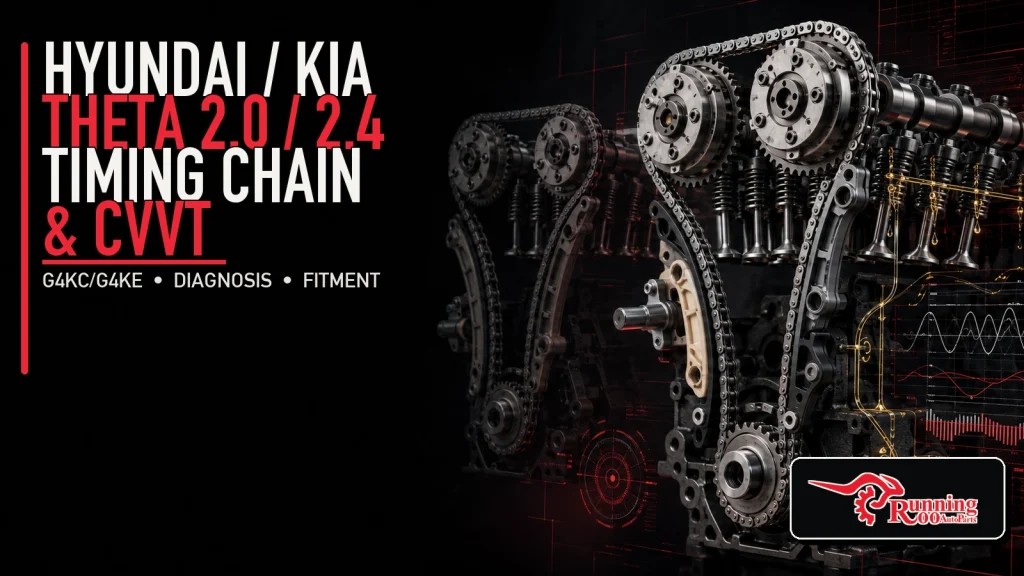
Hyundai and Kia 2.0- and 2.4-litre Theta searches bring together Sonata, Santa Fe, Tucson, Optima, Sorento, Sportage and other models. They also bring together G4KC, G4KE, turbo and later production variants that should not be ordered as one universal engine. A catalogue model list is a useful starting point; the engine code and original timing layout decide the kit.
Scope varies just as much as fitment. Some RunningRoo options focus on the chain drive, some add one cam gear and others include intake and exhaust CVVT adjusters. This guide explains how to separate base-timing wear from camshaft-control faults and compare four product routes without treating every Theta 2.0/2.4 engine as interchangeable.
Quick answer: record the VIN, engine code, aspiration, production date and original part numbers before ordering. Save timing/CVVT codes, inspect oil condition, graph requested and actual cam angles and verify base mechanical timing. Choose an early G4KC/G4KE, later Theta II or CVVT-inclusive kit only when its engine coverage and contents match the vehicle.
RunningRoo support for Hyundai/Kia Theta timing and CVVT parts
- High-quality aftermarket replacement – OEM fit
- 2-Year Warranty – reliability guaranteed
- Direct factory supply = competitive price
- Fast and friendly support
Call us: 0425 890 125
24/7 Free Pickup Available in Melbourne – By appointment only
RunningRoo Auto Parts – Based in Melbourne, Australia 🇦🇺
Why ‘Theta 2.0/2.4’ is not enough for fitment
Theta describes a broad engine family used across years, markets and fuel/boost configurations. G4KC, G4KE and turbocharged variants can differ in timing components and control systems. Even two vehicles sold as 2.4 may require different guide profiles, gears or kit contents. VIN decoding and the original hardware are stronger evidence than displacement and model name.
CVVT changes camshaft phase using engine oil and electronic control. A chain/guide problem changes base timing, while a sticking control valve, restricted oil passage or worn adjuster can affect variable timing. Both problems can coexist. Recording which bank or camshaft—where applicable—and which operating condition triggers the fault keeps the repair from becoming guesswork.
Symptoms that deserve a proper timing-system check
- Cold-start or continuous rattle near the timing cover
- Camshaft correlation or CVVT performance fault codes
- Rough idle, hesitation, reduced power or poor response
- One camshaft angle slow to follow the ECU request
- Oil warning, sludge or metal/plastic debris evidence
- Faults developing after engine or cylinder-head work
- A symptom limited to certain oil temperatures or engine loads
Choose the repair scope from evidence
| Catalogue route | Typical distinction | What must match |
|---|---|---|
| G4KC/G4KE-focused kit | Earlier/specific 2.4 application listing | VIN, engine code, date and original chain layout |
| Later Theta II kit | Selected 2.0T/2.4 models and years | Aspiration, engine code and production revision |
| Kit plus VVT gear | Chain drive with added camshaft adjuster | Which gear, part number and verified fault |
| CVVT intake/exhaust pair | Two adjusters without the chain system | Both cam positions and exact G4KC coverage |
The patterns above are diagnostic clues, not automatic replacement decisions. More than one fault can exist, especially on an engine with high kilometres, uncertain service history or previous internal work.
A step-by-step diagnostic sequence
1. Build a complete engine identity
Record VIN, build date, engine code, capacity and whether the engine is naturally aspirated or turbocharged. Confirm the relevant emissions/market specification where the catalogue requires it. Do not use a Sonata, Santa Fe or Optima badge as a substitute for the code on the engine.
2. Review lubrication and service history
Check the correct oil level and specification, filter condition and service records. Sludge, aeration or low pressure can delay tensioner fill and CVVT response. If abnormal debris is present, identify its source and plan oil-pickup or circuit inspection before installing replacement timing parts.
3. Save codes and camshaft response
Scan before clearing and distinguish correlation, actuator-circuit, sensor and general drivability faults. Graph commanded and actual cam angles at specified conditions. A slow intake response does not prove the intake gear until the oil-control valve, circuit and base timing have been checked.
4. Localise the mechanical sound
Document cold/hot duration and compare the timing cover with the accessory drive, high-pressure fuel equipment on applicable engines and other valve-train areas. Stop testing if the noise is severe or timing loss is suspected. Continued running can turn a diagnostic job into an internal-engine assessment.
5. Verify base timing and inspect wear
Use the exact engine’s locking and reference procedure. Inspect chains, guide faces, tensioner travel, sprockets, oil feeds and timing marks. If a package includes a cam gear, evaluate that adjuster independently rather than assuming chain wear has damaged it.
6. Match the kit to the workshop scope
Compare every chain, guide, tensioner, crank/cam gear, seal and fastener with the original system and repair schedule. Pay particular attention to listings spanning 2011–2018 or 2014–2019: date ranges still require the exact engine and build to be within the stated coverage.
Before ordering Hyundai/Kia Theta timing and CVVT parts parts
- High-quality aftermarket replacement – OEM fit
- 2-Year Warranty – reliability guaranteed
- Direct factory supply = competitive price
- Fast and friendly support
Call us: 0425 890 125
24/7 Free Pickup Available in Melbourne – By appointment only
RunningRoo Auto Parts – Based in Melbourne, Australia 🇦🇺
Four RunningRoo product options to compare
These are relevant catalogue links, not automatic fitment approval. Confirm the VIN, production date, engine code, original part numbers and exact kit contents with RunningRoo or a qualified workshop before ordering.
1. Kia 2.0T/2.4 Theta II timing-chain kit, 2011–2018 listing — A later Kia-focused route; confirm engine code, aspiration and exact build.
2. Hyundai 2.0T/2.4 Theta II timing-chain kit, 2014–2019 listing — A later Hyundai-focused option whose stated years are not the only fitment check.
3. G4KC timing-chain kit with VVT gear — A gear-inclusive listing for selected G4KC applications after adjuster diagnosis.
4. G4KC intake and exhaust CVVT gear pair — A two-adjuster option, not a replacement for a worn chain/guide system.
Do not mix engine generations during installation
Use the service procedure for the exact engine code, including crank/cam positioning, locking, chain-mark alignment, tensioner release, sealant and torque. Do not copy timing-mark diagrams from another Theta variant because the engine family name looks familiar. Replace specified single-use bolts and keep RTV away from oil feeds serving the tensioner and CVVT system.
After the required hand-rotation and reference recheck, start with oil pressure and noise monitored. Verify requested-versus-actual camshaft response and complete any relearn specified by the manufacturer. Road-test only after stable base operation, then recheck for cover leaks and returning faults after a heat cycle. Any remaining misfire, boost or fuel-system code should be diagnosed on its own evidence.
- VIN, G4KC/G4KE or other exact Theta code confirmed
- Natural aspiration versus turbo configuration recorded
- Oil pressure, control valves and sensor faults considered
- Base timing and each CVVT adjuster assessed separately
- Kit generation, dates and component shapes matched
- Live cam data, codes, noise and leaks verified afterward
More RunningRoo workshop videos
Continue with these related videos from the official RunningRoo Auto Parts YouTube channel:
- What’s That Engine Noise? Timing Chain, Piston Knock & More Explained
- When Should You Replace Your Timing Chain? Signs You MUST NOT Ignore!
Why Choose RunningRoo?
- High-quality aftermarket replacement – OEM fit
- 2-Year Warranty – reliability guaranteed
- Direct factory supply = competitive price
- Fast and friendly support
Call us: 0425 890 125
24/7 Free Pickup Available in Melbourne – By appointment only
RunningRoo Auto Parts – Based in Melbourne, Australia 🇦🇺
Frequently asked questions
Are all Hyundai/Kia 2.4 Theta timing kits interchangeable?
No. Confirm engine code, build date, aspiration, original numbers and physical contents. Model/capacity descriptions alone are too broad.
What is the difference between a timing kit and CVVT gears?
The timing kit services the fixed chain drive; CVVT gears vary camshaft phase under oil and ECU control. A product may include one, both or neither gear, so read the contents.
Should I replace both CVVT gears?
Only when both exact gears fit and diagnosis or inspection supports the scope. A control valve, wiring or oil problem may affect one or both cam responses.
Can low oil pressure cause start-up chain noise?
Yes, delayed hydraulic tensioner fill can contribute, but the cause may be oil level, filter, wear, restriction or a damaged chain system. Measure and inspect rather than assuming.
Final recommendation
A good Theta timing order begins with the engine code and generation, not with 2.0 or 2.4 on a search page. Separate base timing, oil-control and CVVT evidence; match the kit line by line; and use the procedure for the exact engine. That is how a broad Hyundai/Kia catalogue becomes a precise repair.
This article provides general technical information. Confirm fitment and repair procedures against current manufacturer service data, and use a suitably qualified technician for internal engine-timing work.