
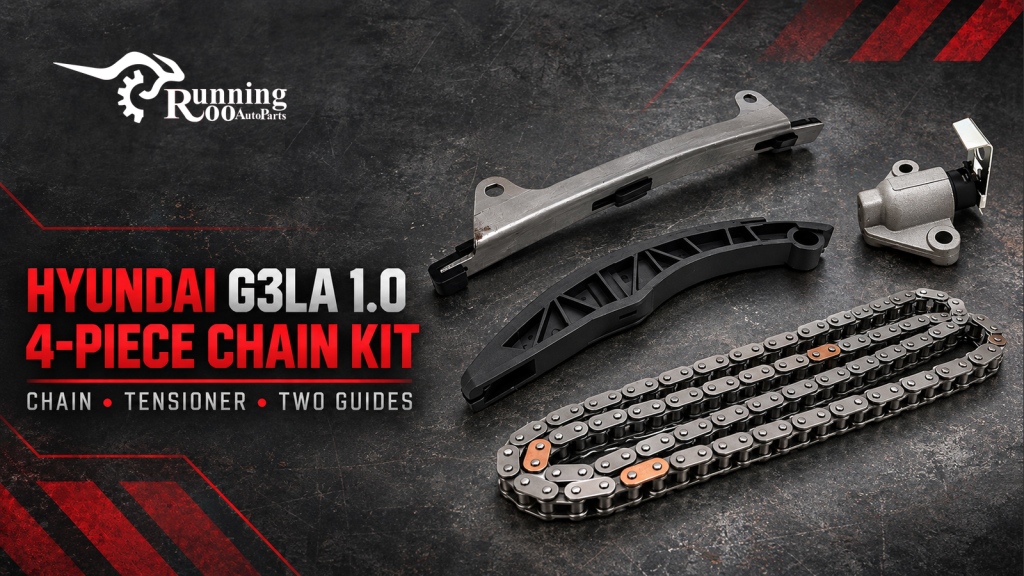
The Hyundai G3LA timing chain kit listed by RunningRoo is described as a four-piece package. That is the most useful starting point for a buyer: understand what those four pieces are, then compare them with the workshop’s actual repair requirements. A small package can be suitable for a defined job without representing every component that might be needed during an engine repair.
This guide is for Australian owners and repairers researching the G3LA 1.0-litre listing, including vehicles whose model or market history needs clarification. It explains the advertised contents, why the engine code matters more than an i10 or i20 badge, and how to organise an order without assuming gears or additional sealing parts are included.
Check the RunningRoo G3LA four-piece chain kit and the corresponding eBay item. For friendly Australian-operated support in Blackburn, Melbourne, call 0425 890 125. Ask about current stock, fast dispatch and local pickup by appointment before setting the workshop schedule.
VIN · full engine code · OE reference
Workshop diagnosis · required components
Current package · extras · stock
Pickup appointment or dispatch
Four pieces means a defined package
The checked merchant description identifies one timing chain, one tensioner and two guides. It describes the chain as having 122 links and labels the guides left and right. These are the seller’s package details, useful for checking an order rather than establishing fitment independently.
No camshaft or crankshaft gears are listed in that four-piece description. A buyer should therefore not assume gears are included because a general timing-system illustration shows them. If the mechanic requires gears or other components, those requirements need their own supply confirmation.
The package name also does not establish that all seals, gaskets, bolts or fluids required for the repair are supplied. Keep those items visible on the workshop quotation. The value of a defined four-piece kit is that its boundary can be checked clearly before anyone treats it as a complete repair order.
| Advertised piece | Merchant description | What to verify |
|---|---|---|
| Timing chain | One chain, described as 122 links | Correct application and current package reference |
| Tensioner | One | Match the workshop’s requirement |
| Left guide | One | Confirm the intended component using applicable parts information |
| Right guide | One | Confirm the paired guide and package contents |
| Gears | Not listed among the four pieces | Obtain separately if the workshop requires them |
| Seals and other materials | Not established by the four-piece list | Itemise according to the actual repair |
Identify G3LA rather than ordering by displacement
A one-litre engine description narrows the conversation, but it does not complete it. Provide the VIN, full engine code, production details and relevant OE references. The selected product specifically names G3LA, and that designation should stay in the enquiry rather than becoming simply “Hyundai 1.0.”
The product title mentions i10 and i20, but this guide does not confirm every version of either model. Do not assume a turbocharged one-litre application or a differently coded engine shares the same parts merely because the displacement sounds similar. Ask the workshop and supplier to identify the actual installed engine.
If the car was imported, record its original market where known. If it has a replacement engine, send those details separately from the original vehicle identity. A registration document can be a useful starting record, but the parts decision needs to follow the engine being repaired.
What official Hyundai information helps establish
Hyundai Motor UK’s official i10 specification release distinguishes a 1.0-litre three-cylinder Kappa engine from a 1.2-litre four-cylinder version. That manufacturer distinction is useful because it shows why the i10 name alone does not identify one engine configuration.
The release does not establish that this aftermarket G3LA package fits every i10 or i20, nor does it provide installation instructions. Its role here is limited to engine-variant context. The workshop must use the applicable Hyundai repair and parts information for the actual VIN and engine when deciding what to inspect, replace and order.
A purchasing decision should therefore combine manufacturer-specific identification with the merchant’s current packing list. Neither a model brochure nor an online kit photograph can supply the whole answer. Each source has a useful role, provided its scope is not expanded beyond what it actually establishes.
Ask why the workshop recommends this scope
Before buying, ask the technician to describe the findings behind the proposed repair. Is the four-piece package the final requirement, or is it a provisional list pending further inspection? That distinction helps the owner plan costs and delivery without turning an early estimate into a fixed diagnosis.
Give the workshop an accurate description of the concern and any recent work. Record when it happens and what has changed, but avoid deciding which component must be responsible from a short sound clip or a forum comparison. The mechanic should select the appropriate checks using the correct engine information.
Ask for the proposed parts in writing. A clear list lets the supplier confirm availability and avoids a vague instruction such as “send a complete timing kit.” If the list later changes, retain the revised version so that the final order matches the authorised work.
A kit without gears needs a separate gear decision
The absence of gears from the advertised set does not prove that the existing gears are suitable for continued use. It also does not mean they automatically need replacement. That decision belongs to the workshop after assessment under the applicable manufacturer information.
For purchasing purposes, ask the mechanic to mark gears as retained after assessment, separately required or not yet decided. This keeps the repair decision visible without making the supplier infer it. If gears are required, obtain their exact references and a separate price and availability check.
Do not let an in-stock four-piece kit dictate a repair scope that has not been assessed. Supply convenience is useful once the required work is clear. It should not cause an uncertain component to be retained simply because it is absent from the package, or replaced simply because a different kit happens to include it.
Compare the whole job on a modest-budget vehicle
Owners often want to understand whether a proposed repair makes sense for the vehicle they have. A useful discussion begins with an itemised estimate and the workshop’s assessment of the engine, rather than a universal online price or an assumption that a small engine guarantees a small job.
Separate the kit cost from labour, additional parts, consumables and completion checks. Ask whether any amounts remain provisional and how additional findings will be approved. This makes it easier to compare two quotations that might otherwise appear similar while covering different work.
The G3LA package page and matching eBay listing can be sent to the mechanic for comparison. Call 0425 890 125 with the resulting parts request. RunningRoo’s Melbourne-based friendly support can help clarify supply and arrange appointment-based pickup or confirmed fast dispatch.
Use a short, precise enquiry instead of a long guess
A useful enquiry states the selected product, the VIN, the full engine code and the workshop’s OE references. Add the production date and original market where relevant. Then ask the supplier to confirm the four advertised components, current availability and whether any requested extras are separate.
If the engine code is unknown, say that directly. Do not fill the gap by copying G3LA from the product title and presenting it as a verified fact about the car. The workshop can help identify the engine, and the order can remain provisional until that information is available.
For a local workshop, include the job reference and preferred collection arrangements. For shipping, provide the destination and the date on which the workshop hopes to receive the parts. These details help organise supply, although dispatch and delivery still require current confirmation rather than an assumed deadline.
Check the received set before opening the engine
Where the repair plan allows, receive and check the package before committing the vehicle to an extended workshop booking. Compare the chain, tensioner and both guides with the supplier’s written confirmation. Have the mechanic reconcile any uncertain identification before the parts are fitted.
Keep packaging, order details and photographs of any questioned item. If a component appears different from the expected reference, contact RunningRoo with that evidence. Do not rely on the four-piece count alone: four items can match a count while still leaving an application question unresolved.
The cover illustration is a visual introduction to the guide, not a certified packing record. Use the current listing and written confirmation for commercial contents, and the appropriate Hyundai information for installation. That separation keeps a useful image from becoming an accidental technical instruction.
Keep ordering and installation responsibilities clear
The supplier can help identify its product, confirm the supplied contents and organise delivery or collection. The technician determines the vehicle’s condition, the required repair and the appropriate installation process. The owner benefits when both roles are recorded rather than assuming one replaces the other.
Ask the workshop whether it has all required parts and applicable repair information before fitting begins. This is not a request for the owner to perform internal engine work. It is a practical handover check that the purchased package matches the work being authorised.
Do not create your own torque values, chain-position instructions or inspection limits from a generic internet diagram. Where a technical question affects the repair, ask the workshop to resolve it from the correct manufacturer information. A buying guide is most useful when it helps the right question reach the right person.
Record what was actually replaced
After the job, keep a dated invoice identifying the four-piece set and any separately supplied components. If gears were retained, that is different from a repair in which gears were replaced. Accurate wording helps future owners and workshops understand the scope without guessing from a phrase such as “new timing system.”
Retain the original findings and the workshop’s completion notes as well. If another concern develops later, those records provide context for assessment. They do not prove that a new symptom has the same cause as the previous one.
For a vehicle with import or replacement-engine history, preserve the identification details alongside the repair record. The next parts enquiry then starts with evidence rather than repeating the same model-name uncertainty. That can make future maintenance conversations more efficient even when the original owner is no longer involved.
Related RunningRoo video
Timing Chain Rattle: Wear Symptoms & When to Replace is a related video from the RunningRoo AutoParts channel. It provides general background, not a demonstration of this exact engine, selected product or installation procedure. Use it to prepare questions for the workshop; the actual repair still needs vehicle-specific manufacturer information and professional diagnosis.
Frequently asked questions
What are the four advertised pieces?
The checked description lists one timing chain, one tensioner, one left guide and one right guide. It describes the chain as having 122 links. Confirm the current supplied contents with RunningRoo, and have the workshop compare those components with the actual repair requirements before ordering.
Are camshaft and crankshaft gears included?
They are not listed as part of this four-piece package. Do not infer their inclusion from a general illustration or the words timing chain kit. If the workshop requires gears, obtain the relevant OE references and ask for separate supply and availability confirmation.
Will this fit every Hyundai i10 or i20 with a one-litre engine?
No universal application is established here. Model name and displacement are insufficient for a precise order. Provide the VIN, full engine code, production details and workshop OE references. A differently coded or turbocharged one-litre engine should not be assumed compatible with the selected G3LA listing.
Should I replace the chain because the car has reached a certain mileage?
This article does not set a replacement interval. Ask the workshop to use the applicable maintenance and diagnostic information for the actual engine and its condition. A product listing does not establish that a particular mileage requires this package, or that a reported symptom confirms a chain fault.
Can I arrange pickup from Melbourne?
Yes, RunningRoo offers local pickup by appointment in Blackburn. Confirm the selected product, stock and order details before travelling. Friendly Australian-operated support is available by phone, and customers who cannot collect can ask about fast dispatch and current shipping arrangements to their location.
What if the mechanic needs more than four pieces?
Use the kit as one line in the complete parts order, then list the additional requirements separately. Ask the workshop to distinguish definite extras from items awaiting inspection. RunningRoo can confirm its package and discuss supply, while the technician determines what the repair actually requires.
Make the four-piece boundary work for you
A clearly described package makes an order easier to check. For the G3LA listing, that means recognising the chain, tensioner and two guides, then resolving any gear, seal or other requirement outside those four items. Pair that contents check with reliable engine identification and a workshop-supported repair scope.
View the RunningRoo Hyundai G3LA kit, compare the corresponding eBay offer, and call 0425 890 125. RunningRoo offers friendly Australian-operated support, Melbourne pickup by appointment and help arranging fast dispatch once the application, stock and order have been confirmed.
Related RunningRoo reading
For the broader purchasing process, see Timing Chain Kit Fitment: How to Match the Right Kit to Your Engine and Timing Chain: Questions to Ask Your Mechanic Before the Repair. Keep the engine and component scope in this article attached to your specific enquiry.
Sources and verification scope
The RunningRoo website product and corresponding eBay Active Listing were checked on 11 October 2026. Stock and descriptions can change; confirm the current order before purchase. Manufacturer sources below support only the stated technical context, not aftermarket approval or universal fitment. Archived copies are identified.
- Hyundai Motor UK: New i10 pricing and specification — Official distinction between 1.0 three-cylinder and 1.2 four-cylinder Kappa variants; does not establish this kit fitting every i10/i20.