
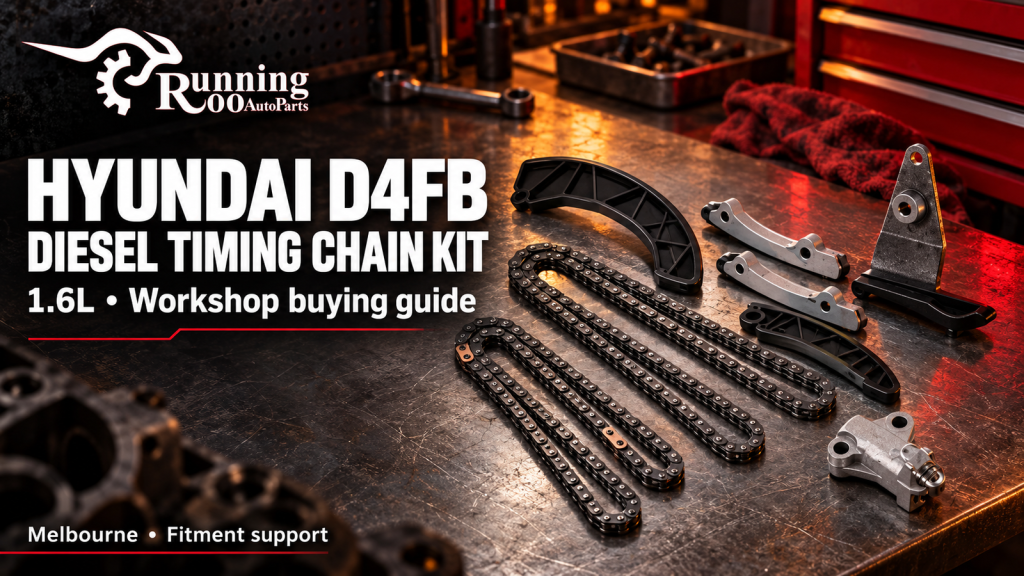
A Hyundai D4FB timing chain kit should be selected from a verified diesel-engine identification and a workshop parts request. Searching for an i30, Accent or Soul is a useful first step, but those model names do not settle the engine specification or the contents required for a particular repair. For an Australian owner trying to organise transport around a workshop booking, the most valuable purchase is the one that arrives with its application and scope already agreed.
Start with the RunningRoo D4FB 1.6-litre diesel timing chain kit and its corresponding eBay listing. Both were available when checked. Send your VIN, complete engine code, OE references and diagnosis summary before ordering. Call 0425 890 125 for friendly Australian-operated support. RunningRoo is based in Blackburn, Melbourne, offering local pickup by appointment and fast dispatch arrangements that should be confirmed against current stock and your delivery address.
VIN · full engine code · OE references
Current contents · workshop repair scope · required extras
Stock confirmation · dispatch or pickup appointment
Use D4FB as the beginning of the enquiry
The engine code is a more precise starting point than a model name, but it should travel with the rest of the vehicle information. Include the VIN, build details and any known engine replacement history. If the workshop has identified a version or additional suffix, preserve it in the enquiry rather than shortening everything to a familiar four-character code.
The selected product description names diesel applications across Hyundai and Kia models. Those references help a buyer find the offer; they do not prove that every engine described casually as a Hyundai 1.6 diesel takes the same replacement package. Ask for a check against the specific vehicle and the technician’s required parts. Do not broaden the article into a claim covering every U-family engine.
If your service records use different descriptions for the same vehicle, ask the workshop to reconcile them. An invoice might use a model name while another record uses an engine family. The supplier needs the verified details, not a choice between whichever description happens to produce more search results. Resolving that difference early makes subsequent questions about contents much easier to answer.
Manufacturer background: useful, but narrower than fitment approval
Hyundai’s September 2008 U2 diesel introduction, reproduced in the English manufacturer press-release section of this archive, describes a 1.6-litre, four-cylinder common-rail diesel with a chain-driven valvetrain. It separately discusses the auxiliary belt arrangement and structural measures intended to reduce noise. This is manufacturer-issued background on U2, not a D4FB aftermarket parts catalogue or a current workshop procedure.
The source helps explain why an accessory-belt purchase and a timing-chain purchase should not be treated as the same task. It does not establish that every component in the selected kit fits every U2 application. Historical phrases about maintenance should also not be converted into a guarantee that a particular used engine will never need attention. Have the workshop use current, vehicle-specific service information for diagnosis and repair planning.
Ask for the current contents in writing
The selected website page identifies the D4FB package and its intended application, but a buyer should request a current itemised contents list rather than infer one from the product photograph. Ask which chains, guides, tensioning components or gears are supplied, with quantities and supplier references where available. Then give that list to the workshop for comparison with its requirement.
A photograph can show several components without explaining the exact variant, quantity or relationship between them. It can also contain older promotional wording. Use it to identify the offer you are discussing, not to decide that a consumable or extra component is included. The order confirmation should make the supplied package clear enough that a receiving technician can check it without guessing.
This matters when comparing a plain D4FB listing with one that includes additional materials. An added tube of sealant does not establish that the package contains all sealing items required for your repair. Similarly, a seller’s description of a kit does not automatically define the workshop’s labour scope. Keep the supply list and the repair plan connected, but write them as separate records.
| Question for the D4FB order | Who should resolve it? | Record to keep |
|---|---|---|
| What engine is actually fitted? | Workshop using vehicle and engine evidence | VIN, complete code and build details |
| What repair is supported by the findings? | Diagnosing technician | Diagnosis summary and proposed scope |
| What is inside this exact offer? | RunningRoo | Current itemised package confirmation |
| Which original references are required? | Workshop using appropriate catalogue information | Full OE list, including relevant revisions |
| What needs to be supplied separately? | Workshop and supplier together | Additional parts and materials list |
| When can the order be collected or dispatched? | RunningRoo | Current collection appointment or dispatch arrangement |
Describe the concern without deciding its cause
An owner can provide valuable information without attempting a diagnosis. Write down what you heard or noticed, when it occurred and whether the vehicle had recently been serviced or repaired. If the concern is intermittent, describe the circumstances as accurately as possible. Avoid changing the description to match an online chain-noise example; the workshop needs your observations, not a conclusion borrowed from another vehicle.
Ask the technician to explain why the proposed chain work is appropriate for this engine. A useful answer should connect the repair recommendation to findings and explain any unresolved questions. The exact diagnostic methods belong to the workshop and the correct service information. This buying guide does not provide a shortcut test, a wear limit or a universal interpretation of a warning message.
If the vehicle is already at a workshop, send the supplier the parts request rather than only the original complaint. That moves the conversation from “my diesel sounds wrong” to “the technician requires these components for this identified engine.” RunningRoo can then discuss the relevant offer and stock instead of being asked to confirm a technical diagnosis from a brief phone description.
Separate planned replacement from conditional inspection
A clear quotation distinguishes what the workshop intends to replace from what it will inspect before deciding. Ask which lines are confirmed and which depend on access or further findings. This gives you a more realistic purchasing plan and helps prevent unnecessary duplicate orders when the technician’s assessment changes.
For example, an initial quotation might identify a timing-chain package but leave the exact additional materials to be confirmed from the relevant procedure. That is a purchasing question to resolve, not a reason to assume the cheapest bundle includes everything. Request the completed list before the vehicle is dismantled where practical, and agree how any later additions will be authorised.
Compare the current RunningRoo D4FB offer with the matching eBay item, keeping the workshop list beside it. For clarification, call 0425 890 125. Friendly Melbourne support can help identify the correct package and arrange appointment-based pickup or fast dispatch. Confirm the actual supply timing before turning a provisional workshop slot into a firm commitment.
Plan around the vehicle’s everyday role
A small diesel may be the household’s only car, a commuting vehicle or a vehicle used for work. The practical cost of a repair can therefore include transport arrangements as well as the invoice. Tell the workshop when the car is needed, but let the diagnosis and parts confirmation determine a realistic plan. An urgent deadline should not replace the application check.
Before purchasing, agree where the kit will be delivered and when it can be inspected. A workshop may prefer to verify customer-supplied parts before accepting the car for a lengthy job. Ask about that process early. If you are receiving the parcel at home, keep the shipping label and order details available so that the workshop can connect the delivery to the confirmed offer.
Melbourne customers can discuss Blackburn local pickup by appointment if collection is more convenient than delivery. Confirm the order is ready before travelling. For interstate customers, ask about fast dispatch and the available carrier estimate for the destination. Dispatch and arrival are different events, and neither should be described as a guaranteed repair completion date.
Compare quotations on evidence and scope
Two prices are only directly comparable when they cover the same goods and work. Check whether the quotes name the same engine, package, additional materials and responsibilities. A lower parts price may represent a narrower supply list; a higher quote may include labour or diagnostic work that is missing from the other estimate. Ask for the differences to be explained rather than assuming one provider has made an error.
Keep a separate record of current seller terms. Read the applicable delivery, return and warranty information at the time of purchase instead of copying a promotional banner from an older image. Ask how an apparent mismatch should be reported before installation. Accurate order records help everyone address a problem promptly if the delivered package does not match the confirmed description.
Avoid shopping by invented quality guarantees. This article does not claim that any aftermarket package is identical to every original component, will cure a particular symptom or provides a guaranteed service life. The stronger basis for choosing is a real product, a verified application, a clear contents list and a workshop prepared to use the correct repair procedure.
A useful D4FB order enquiry
A good message can be short but complete: identify the vehicle and engine, explain that a workshop has requested a timing-chain repair, attach the full parts references, and provide the selected RunningRoo link. Ask for confirmation of application, contents and current supply timing. Include a daytime contact method if the supplier needs clarification before confirming the order.
If the technician has not finished the assessment, say so. Ask for product information or a provisional quotation without presenting it as a confirmed purchase requirement. That avoids giving the impression that fitment has been approved when the underlying engine or repair scope remains uncertain. Update the enquiry once the missing information is available.
For a Hyundai or Kia with a replacement engine, include both the vehicle’s original details and the verified installed-engine information. Do not assume that the registration description answers the parts question after a replacement. The workshop should explain how it has identified the current requirement, while RunningRoo confirms whether the selected offer matches that request.
Watch related RunningRoo video background
Timing Chain Rattle: Wear Symptoms & When to Replace | RunningRoo is a related channel video for general discussion. It is not a demonstration of this engine, the selected package or a vehicle-specific installation procedure. Use it to prepare questions for your technician; fitment and repair decisions still require the correct manufacturer information and professional diagnosis.
Frequently asked questions
Does this fit every diesel i30, Accent or Soul?
No universal fitment claim is made here. These model names appear in the selected listing, but the order must be checked against your VIN, complete engine identity and relevant OE references. Model name, fuel type and engine capacity alone are not a completed application check for the particular kit being purchased.
Is the U2 press release enough to choose a kit?
No. It provides manufacturer background about an engine family and its design. It is not an application catalogue for this aftermarket package. The workshop must identify the installed engine and required components, and the supplier should confirm the selected product against that request before the purchase is treated as suitable.
Can I count the parts in the photograph?
Use the photograph as a visual reference, then request the current written packing list. Ask for quantities and component identifiers where necessary. Do not infer unlisted extras or a guaranteed kit composition from an editorial illustration, a promotional product picture or a similar listing that includes additional materials.
Is a chain kit also an accessory-belt kit?
Do not combine those purchasing descriptions. The manufacturer background distinguishes the valvetrain chain from the auxiliary belt arrangement. If the workshop recommends work on both, request separate descriptions and references so that each requirement is supplied correctly. The word kit does not make the selected package an all-engine service bundle.
Should I buy before the diagnosis is complete?
You can enquire about stock and contents, but make clear that the parts request is provisional. Ordering a package does not establish the cause of a complaint. Wait for the technician to define the repair and confirm the application information before treating a particular D4FB package as the answer for your vehicle.
What local support is available?
RunningRoo offers friendly Australian-operated support from Blackburn, Melbourne. Ask about current stock, fast dispatch to your address or local pickup by appointment. Have the VIN, engine code, OE list and exact product link ready so that the conversation can focus on a specific, traceable parts request.
Turn the enquiry into an organised repair order
The best D4FB purchase starts with an identified engine and ends with a package the workshop can check against its agreed list. Keep model references, manufacturer background and actual fitment confirmation in their proper roles. That gives you a more dependable basis for planning the job than a broad compatibility heading or an attractive photograph alone.
Review the RunningRoo D4FB timing chain kit, check the corresponding live eBay offer, and phone 0425 890 125 with your workshop details. Confirm contents, availability and delivery or collection arrangements before the repair begins. Clear information and friendly local support help keep the parts purchase aligned with the professional work your vehicle requires.
Related RunningRoo reading
For the broader purchasing process, see Timing Chain Kit Fitment: How to Match the Right Kit to Your Engine and Timing Chain: Questions to Ask Your Mechanic Before the Repair. Keep this article’s specific engine and package scope when discussing your order.
Technical source and verification scope
Product stock and corresponding eBay Active Listings were checked on 10 October 2026. Availability and supplied contents can change; confirm the current order before purchase. Manufacturer-issued background is listed below, with archive copies identified. It does not replace current vehicle-specific workshop information.
- Hyundai Motor U2 diesel press release, 22 September 2008 — English Hyundai PRESS RELEASE section reproduced on a third-party archive; U2 architecture only, not D4FB kit fitment or a service schedule.