
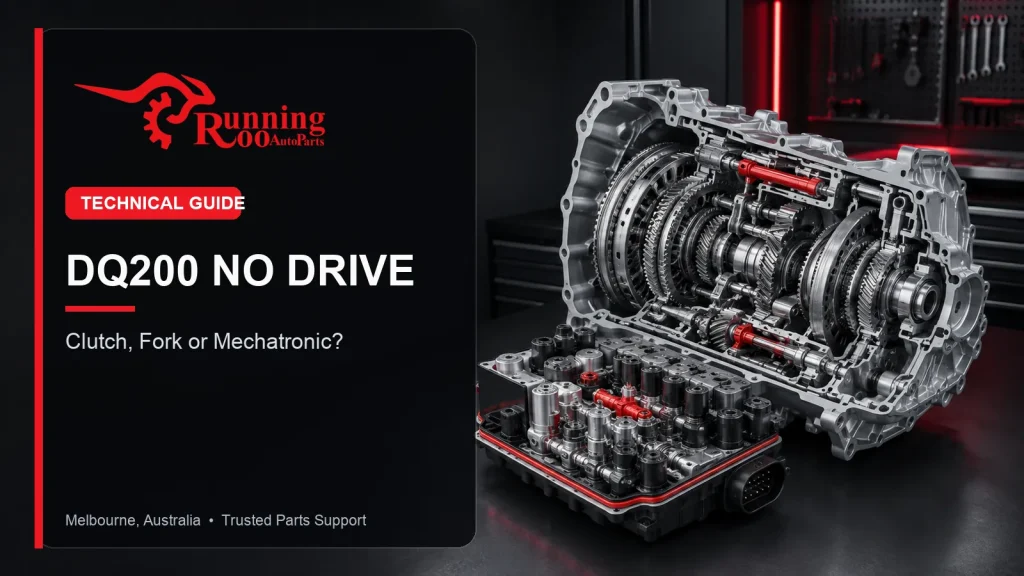
G’day everyone. I’m the Senior Product Manager here at RunningRoo Auto Parts, Australia’s trusted aftermarket automotive parts specialist. If your Volkswagen, Audi, Skoda or Seat with the seven-speed DQ200 DSG has suddenly refused to move, or has lost drive, you need to know what is going on quickly. In this guide I’ll explain the most common causes of a DQ200 that won’t move, how to tell them apart, and what each repair costs in Australia.
A DQ200 that loses drive is one of the most worrying faults a driver can face, because the car is effectively immobile. The good news is that the cause is usually one of a small number of components, and a correct diagnosis will tell you exactly what needs to be replaced.
All prices below are in Australian dollars and are indicative only. If your car is currently stuck, our Melbourne-based team can help you talk through the likely cause before you book a tow.
RunningRoo Auto Parts – Based in Melbourne, Australia 🇦🇺
Free 24/7 Pickup Available (by appointment)
Any questions? Call us anytime: 0425 890 125
Why Choose RunningRoo? Aussie Owned & Operated | Fast Shipping | Friendly Support
The three most common causes of a DQ200 that won’t move
When a DQ200 loses drive, the fault falls into one of three broad categories: a clutch that has failed, a mechatronic that can no longer supply hydraulic pressure, or a mechanical problem such as a shift fork or the gear train itself. Each one has a different fix and a different cost.
The mechatronic is the electronic and hydraulic control unit that moves the clutches and the shift forks, so when it fails the gearbox cannot engage drive. A clutch failure means the clutch can no longer transmit power, and a shift fork failure means the gear cannot be engaged mechanically.
Understanding which of these is at fault is the difference between a targeted repair and an expensive guess, which is why a proper diagnosis should always come first.
How to identify the likely cause
The most reliable starting point is to read the fault codes stored in the mechatronic. A code that points to a clutch or hydraulic pressure fault suggests the mechatronic or clutch, while a code that points to a specific gear not engaging suggests a shift fork or synchroniser problem.
The codes are the fastest way to narrow down which of the three main components is at fault, so they are always the first port of call.
You can also observe the symptoms. If the engine revs but the car does not move at all, the clutch or mechatronic is likely at fault. If the car moves but jumps out of one gear, or grinds when selecting a gear, it is more likely a mechanical shift fork issue.
The table below compares the three main causes and their typical presentation.
| Cause | Typical symptom | Common code |
|---|---|---|
| Mechatronic failure | No drive at all, limp mode | Hydraulic / communication code |
| Clutch failure | Engine revs, car doesn’t move | Clutch slip / adaptation code |
| Shift fork / gear fault | Gear jumps or grinds | Gear not engaged code |
Which DQ200 models are affected
The DQ200 is used across a huge number of Volkswagen Group vehicles, and the loss-of-drive behaviour applies across the family. The gearbox codes 0AM and 0CW are the two most common, and both use the same mechatronic, dry clutch and shift fork design.
The vehicles most affected are those fitted with the lower-torque petrol and diesel engines, where the lightweight dry clutch and mechatronic are used. If your car is one of these, the failure modes described here are the ones most likely to apply.
| Gearbox | Type | Typical vehicles |
|---|---|---|
| 0AM / 0CW DQ200 | Dry dual-clutch | VW, Audi, Skoda, Seat |
| DQ250 / 02E | Wet dual-clutch | Higher torque models |
What to do if your DQ200 won’t move
If the car has lost drive and is safe to do so, first check that the gearbox is not in a protective limp mode. Many DQ200 cars will return to normal after the engine is switched off and restarted, or after the fault is cleared, which can tell you whether the problem is a temporary protective mode or a genuine mechanical fault.
If the car will not move at all, do not try to force it or rev it hard while selecting a gear, because this can cause further damage. Instead, have the fault codes read and the car inspected before it is driven again.
If the vehicle is at home and you need to move it, it may need to be towed. In many cases the mechatronic can be removed without pulling the whole gearbox, which can reduce the labour cost.
Why a diagnosis comes before any repair
The single most important thing with a DQ200 that won’t move is to avoid guessing. Because the mechatronic, clutch and shift forks all sit inside the same assembly, a guess can easily lead to replacing the wrong component and paying double.
A proper diagnosis reads the fault codes, inspects the fluid, and where necessary opens the gearbox or mechatronic to confirm the failing part. With that information, the correct repair is usually obvious, and the total bill is far lower than a trial-and-error approach.
Mechatronic failure and loss of drive
The mechatronic is the most common cause of a DQ200 losing drive entirely. When the mechatronic fails to build or hold hydraulic pressure, it cannot move the clutches or the selector forks to engage a gear, and the gearbox effectively goes into neutral.
A mechatronic can fail for a number of reasons, including a failed accumulator, a faulty solenoid, a leaking internal seal, or an electronic control board failure. A targeted repair is often possible, but if the control board itself has failed, a replacement mechatronic is usually required.
This is why reading the fault codes matters so much. A hydraulic pressure code may point to a repairable accumulator, while an electrical code may point to a board failure that requires a replacement unit.
Clutch failure and loss of drive
The DQ200 dry clutch can also cause a loss of drive if it has worn out, glazed or been damaged. A worn or glazed clutch will slip rather than transmitting power, so the engine will rev but the car will not pull away properly or at all.
Clutch wear is often the result of repeated overheating in stop-start traffic, or the clutch simply reaching the end of its service life on a high-kilometre car. A clutch replacement is the fix, and the gearbox then needs to be re-adapted.
If the clutch has failed completely, the car may rev freely in gear without moving, which is a very clear symptom of a clutch problem rather than a mechatronic or shift fork problem.
When the gearbox gets stuck in a gear
In some cases a DQ200 will not lose drive but will get stuck in a single gear, refusing to shift up or down. This is usually a mechatronic or shift fork issue rather than a clutch problem, because the gearbox can still transmit power but cannot change gears.
If this happens, the car may be drivable at a limited speed, but it is worth having it inspected quickly because continued driving with a stuck gear can cause additional wear to the synchronisers and the gear train.
Whatever the cause, the important thing is to get a clear diagnosis before committing to a repair. A DQ200 is a complex assembly, but the fault that is causing a loss of drive is almost always one of the components described above, and fixing the right one is the fastest and cheapest path back on the road.
With quality parts and a correct adaptation procedure, a repaired DQ200 can be returned to smooth and reliable operation for many more kilometres.
Shift fork failure and loss of drive
A shift fork fault is more likely to cause a specific gear to jump out or refuse to engage, rather than a complete loss of drive. However, if the fork has broken or the sleeve has come off, it can leave the gearbox stuck in a particular gear or unable to engage a gear at all.
This is a mechanical problem inside the gearbox, so it usually requires opening the transmission to repair. A shift fork or slip bead replacement is the fix, and it is far cheaper than a full gearbox replacement if the rest of the unit is healthy.
What a repair costs in Australia
The cost of repairing a DQ200 that won’t move depends entirely on the cause. The chart below compares the indicative cost of a shift fork repair, a mechatronic repair, a clutch kit replacement, and a full mechatronic replacement, using Australian figures.
__CHART__
These figures are a guide only. The only way to get an accurate price is to have the fault properly diagnosed first.
| Repair | Indicative cost (AUD) | Notes |
|---|---|---|
| Shift fork repair | low-to-mid hundreds + labour | Gearbox-out job |
| Mechatronic repair | $450 – $1,200 | Single hydraulic fault |
| Clutch kit replacement | $1,500 – $2,800 | Includes adaptation |
| Full mechatronic | $3,000 – $5,000 | Workshop-fitted |
Where to buy DQ200 parts
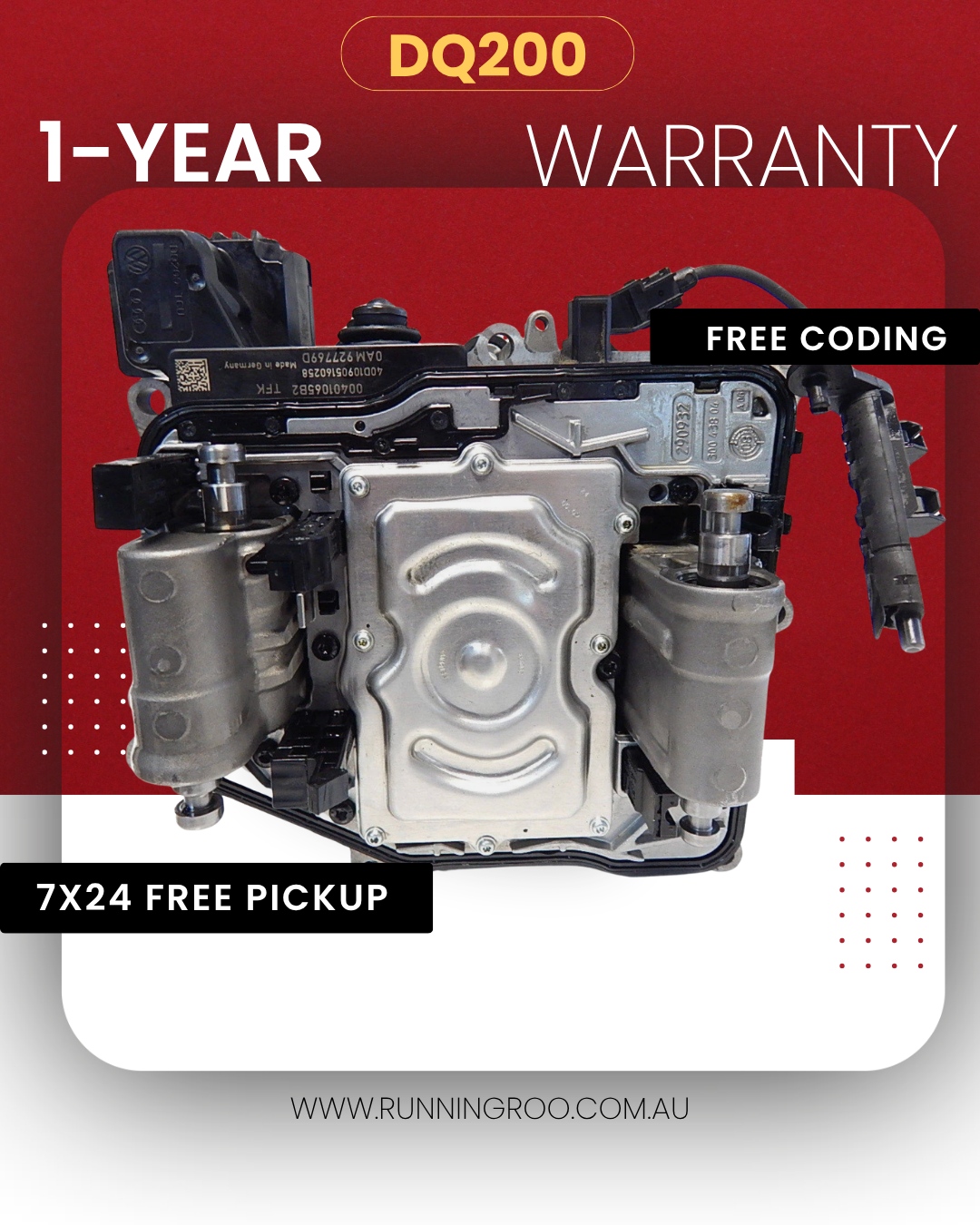
RunningRoo Auto Parts stocks mechatronic units, clutch kits and shift forks for the DQ200 DSG at a fraction of typical retail pricing, with Melbourne pickup and Australia-wide delivery.
- 0CW DQ200 7-Speed DSG Mechatronic (Valve Body & TCU)
- 0AM DQ200 DSG7 Transmission Clutch Kit Gen1 for VW / Audi
- 0AM DQ200 Transmission 7-Speed Shift Fork (Reverse) for Audi / VW / Seat
Watch what happens when a dry dual-clutch fails below, then browse the complete range on our eBay store.
Watch: What happens if a Volkswagen dry dual-clutch transmission fails?
You can also browse the full range here: RunningRoo Auto Parts on eBay Australia.
Not sure which part your DQ200 needs? Our Aussie team can help you narrow it down before you order.
RunningRoo Auto Parts – Based in Melbourne, Australia 🇦🇺
Free 24/7 Pickup Available (by appointment)
Any questions? Call us anytime: 0425 890 125
Why Choose RunningRoo? Aussie Owned & Operated | Fast Shipping | Friendly Support
Frequently asked questions
Why has my DQ200 suddenly lost drive?
The most common causes are a mechatronic failure, a worn or glazed clutch, or a mechanical shift fork problem. A scan tool is the first step to identifying which one.
Can a DQ200 in limp mode be reset?
Often yes. Switching the engine off and restarting, or clearing the fault with a scan tool, can reset a protective limp mode. If the fault is mechanical, it will usually return.
How much does it cost to fix a DQ200 that won’t move?
It depends on the cause. A shift fork repair is the cheapest, a mechatronic repair or clutch replacement is in the middle, and a full mechatronic replacement is the most expensive.
Is it safe to keep driving a DQ200 that has lost drive?
No. If the gearbox has lost drive, do not continue to drive it or force the gears, because this can cause further damage. Have it inspected before driving again.
What causes a DQ200 clutch to fail completely?
Repeated overheating in stop-start traffic, glazing, wear from high kilometres, or a mechanical failure of the clutch pack are the main causes.
Which cars use the DQ200 DSG?
The DQ200 is used across a range of Volkswagen, Skoda, Seat and Audi models, commonly with the 1.2 TSI, 1.4 TSI and 1.6 TDI engines.
Do I need to re-adapt the gearbox after the repair?
Yes. Basic settings and clutch adaptation should be carried out after a mechatronic, clutch or shift fork repair so the control module relearns the correct settings.
Still not sure what is wrong with your DQ200? Call us anytime and we’ll help you get to the bottom of it.
RunningRoo Auto Parts – Based in Melbourne, Australia 🇦🇺
Free 24/7 Pickup Available (by appointment)
Any questions? Call us anytime: 0425 890 125
Why Choose RunningRoo? Aussie Owned & Operated | Fast Shipping | Friendly Support
References
Key data in this article is drawn from the following official manufacturer sources:
- Volkswagen Group — DQ200 7-speed dry-clutch DSG technical documentation (gearbox codes 0AM / 0CW), mechatronic, clutch and gear selection system description.
- Volkswagen Australia — DSG (DQ200) voluntary safety recall announcement, June 2013.