
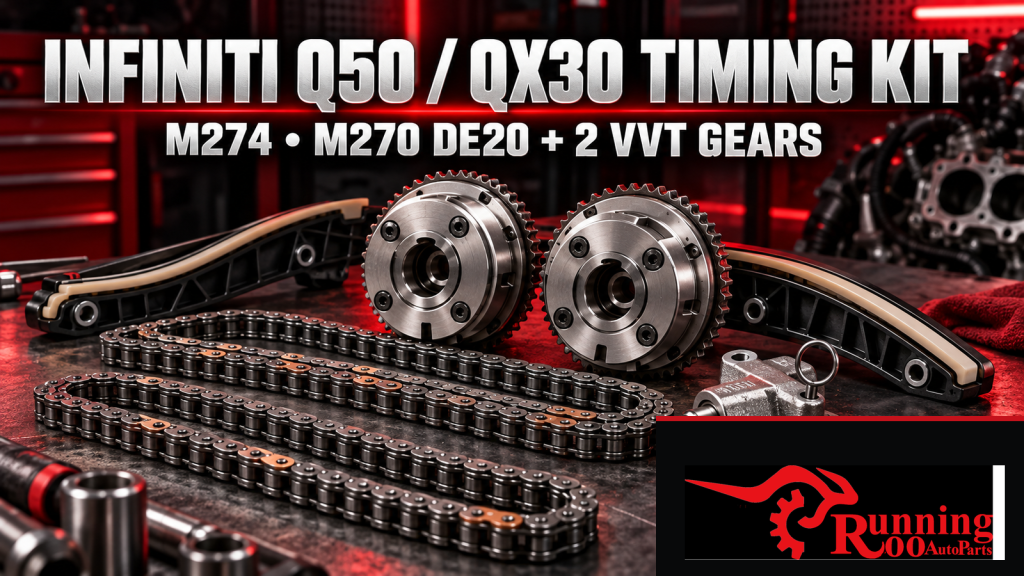
The right Infiniti Q50 timing chain kit depends on more than the 2.0-litre badge. For the RunningRoo kit covered here, the key distinction is the engine code: M274 DE20 for the Q50 and M270 DE20 for the QX30, with listed applications beginning in 2016.
This is a particularly useful package for a repair where both the chain drive and camshaft-adjuster hardware have been condemned. It includes the intake and exhaust VVT gears as well as the chains, tensioner, guides and crank gear. That broader coverage can reduce the risk of completing a high-labour timing job only to discover that a worn adjuster was not included in a chain-only kit.
View the verified product: Infiniti Q50/QX30 M274/M270 DE20 timing chain kit with two VVT gears. Provide the VIN before ordering.
Listed fitment at a glance
| Vehicle | Listed model period | Engine | Required engine code |
|---|---|---|---|
| Infiniti QX30 | 2016 onward | 2.0L | M270 DE20 |
| Infiniti Q50 | 2016 onward | 2.0L | M274 DE20 |
“2016 onward” does not mean every later Q50 or QX30 automatically uses the same parts. Market, build date, engine specification and previous repairs can change the requirement. Confirm the complete VIN and the engine code, then compare the original components before fitting.
What comes in this timing kit?
The RunningRoo product page lists:
- two timing chains;
- one timing-chain tensioner;
- three guide rails;
- one crank gear;
- one intake VVT gear; and
- one exhaust VVT gear.
The inclusion of both camshaft gears is the main commercial difference from a basic chain set. It lets a workshop quote a more complete timing-and-VVT repair when diagnosis supports replacing those parts together.
It does not remove the need to check what else the job requires. Seals, gaskets, bolts, fluids, actuators or solenoids are not automatically included simply because the product is described as a timing kit. Compare the package photos and plan ancillary items separately.
When is a chain-and-VVT kit the better choice?
A chain-only kit may be appropriate when the camshaft adjusters test and inspect correctly. A kit with both VVT gears becomes more compelling when the repair evidence shows wear or malfunction across the timing system, such as:
- confirmed chain, tensioner or guide wear together with an adjuster-related fault;
- abnormal movement, locking behaviour or physical damage at a camshaft gear;
- persistent cam timing deviation after oil, wiring and actuator checks;
- a noise source traced to the timing/VVT assembly; or
- a previous incomplete repair that left suspect adjusters in service.
Do not replace the adjusters merely because a code contains the words “camshaft timing”. Oil pressure, oil quality, control valves, wiring and sensor signals can also affect camshaft control. A complete kit is valuable only when the diagnosis is complete.
A practical diagnostic path
For an Infiniti Q50 or QX30 2.0L with start-up rattle, a warning light or timing performance faults, a workshop can reduce guesswork by working in this order:
- Record the customer’s symptom, including temperature, duration and operating conditions.
- Complete a full system scan and save codes plus freeze-frame data.
- Confirm oil level, condition, specification and service history.
- Compare requested and actual camshaft positions with appropriate diagnostic equipment.
- Check wiring, connectors, sensors and VVT control components.
- Inspect for timing-system debris or visible wear where access permits.
- Follow the manufacturer’s mechanical timing checks before ordering parts.
This turns a broad symptom into a documented repair plan. It also helps the buyer choose between the full chain-and-VVT kit, a chain-only set or a different component entirely.
M270 DE20 and M274 DE20 are not interchangeable labels
The product listing associates the transverse-layout QX30 application with M270 DE20 and the Q50 application with M274 DE20. Even when two engines share architecture, their installation, ancillary parts and catalogue references should not be assumed identical.
For ordering purposes, write the engine code exactly as recorded. Avoid dropping the “DE20” suffix or relying only on “M270/M274”. Provide RunningRoo with:
- the full 17-character VIN;
- model and build date;
- engine code;
- any original part numbers visible after inspection; and
- photos of the original timing components or labels where practical.
That information gives the supplier a stronger basis for confirmation and reduces returns caused by a broad internet search.
Installation planning: protect the new parts
Timing-chain and VVT work requires precise mechanical timing and careful oil-system preparation. The installer should use the current manufacturer procedure for the exact VIN and engine, including the specified locking tools, tightening sequence and replacement fasteners.
Before reassembly, the workshop should also investigate why the old components failed. Contaminated oil, restricted oil supply, damaged control valves or debris left in the system can shorten the life of new timing and adjuster parts.
A professional job plan should cover:
- correct identification of the intake and exhaust adjusters;
- verification of every timing reference before the engine is rotated;
- inspection of sealing surfaces and oil passages;
- any required pre-lubrication or priming under the service procedure;
- hand rotation and mechanical verification before start-up;
- post-repair diagnostic checks; and
- a controlled road test and final leak inspection.
Do not copy torque figures or timing marks from a visually similar M270/M274 application. Vehicle-specific service information controls the repair.
Buying on value, not only kit price
This RunningRoo kit is positioned for a repair that needs both VVT gears and the core chain-drive components. On a labour-intensive job, ordering the correctly scoped kit can be more economical than saving on parts and reopening the engine because an excluded adjuster was already worn.
RunningRoo is based in Melbourne, holds the product in Australian stock and offers local pickup by appointment. Workshops can also send the VIN before purchase, which is the most useful service when an engine-family description spans multiple vehicles.
Check current availability and request VIN confirmation: Q50/QX30 2.0 timing kit with intake and exhaust VVT gears.
Frequently asked questions
Does this kit fit every Infiniti Q50 2.0?
No. The product is listed for the 2.0L Q50 with engine code M274 DE20 from 2016. Confirm the VIN, engine code and original parts.
What engine does the QX30 application use?
The listing specifies the 2.0L M270 DE20 application from 2016. Other engines require separate checking.
Are both VVT gears included?
Yes. The package list includes one intake VVT gear and one exhaust VVT gear.
Does the kit include every seal and bolt needed for installation?
The product page lists the timing and VVT components, not a complete set of every workshop consumable. The technician should identify seals, gaskets, fluids and one-time-use fasteners separately.
Will this kit fix a camshaft timing code?
Only if the confirmed cause is within the supplied components. Oil supply, control valves, wiring, sensors and installation condition must also be checked.
Why is VIN confirmation important?
It helps identify production and market differences and can reveal a mismatch that a model-year search misses.
Source and fitment basis
*Fitment information is a guide. Always verify the VIN, engine code, original components and current manufacturer service information before installation.*
Professional verification before the vehicle is opened
A parts page is most useful when it helps the customer and workshop make the same decision from the same evidence. For a Infiniti Q50/QX30 M270/M274 timing kit with VVT gears enquiry, begin with VIN, engine code, camshaft position and original part numbers. Put those details in the first message rather than supplying a vehicle model alone. This gives the seller a real basis to compare the order with the current product description, and gives the installer a record it can use before work begins.
The evidence must be read as a group. A VIN may identify original build data, but it does not prove that an older vehicle has never had an engine, transmission or timing-system repair. An original number is valuable, but can be superseded. A scan result may direct the technician towards a system, but it is not a part-number instruction. The safe purchase decision is the one where the vehicle record, physical component information, workshop scope and live listing agree. If one of those sources conflicts, pause the order and resolve the difference first.
A workshop-to-seller handover that prevents delays
Ask the workshop for a short, factual note. It does not need to contain its entire repair procedure. It should identify the vehicle, the exact system or component requested, the key number or position, and whether the repair scope is confirmed. Pair that note with clear, correctly oriented photographs of labels or removed parts where available. Avoid relying on a screenshot of a similar listing or a photo from a forum. A useful handover is evidence from the actual vehicle.
| Checkpoint | Evidence | What it prevents |
|---|---|---|
| Vehicle identity | Full VIN and build information | Ordering by badge or registration year alone |
| System identity | Engine or gearbox code and repair scope | Mixing related but different applications |
| Part identity | Complete original number, suffix and photos | Near-match or revision errors |
| Listing identity | Current product title, contents and conditions | Ordering from outdated saved information |
| Installation plan | Qualified workshop confirmation | A parcel arriving without a practical fitting plan |
This table is deliberately conservative. It does not make diagnosis slower; it moves the important questions to before payment and before the vehicle is dismantled. For regional and interstate customers, it is also an effective way to avoid a vehicle sitting at a workshop while an overlooked seal, consumable, code or fitment question is resolved.
Technical statements and official information
This article is a buying and planning guide, not a substitute for a repair manual. The technical principles discussed here—vehicle-specific identification, structured diagnosis, controlled installation and post-repair verification—must be applied using the current procedure for the exact vehicle. INFINITI provides official technical-information access at INFINITI technical information. The workshop performing the work must consult the applicable official information for torque values, safety steps, programming, fluid specification, timing alignment, component testing and any one-time-use hardware.
That boundary matters. An online retailer cannot see oil pressure, wiring integrity, mechanical timing, clutch condition, cooling-system performance or software state from a message. A qualified workshop can test the vehicle and select the correct procedure. RunningRoo can then help assess whether the identified component and the current listing are aligned. Keeping those roles separate improves repair quality and prevents an online purchase being treated as a remote diagnosis.
Before ordering: make the job scope visible
A common cause of repeat labour is treating the named product as every part required for a job. A timing kit, control unit, clutch pack or electric pump may be central to the repair, but a workshop can also require gaskets, fasteners, fluids, seals, filters, adaptation work or related inspection. The product contents should be compared with the work order, not assumed to be a complete workshop package. Ask the installer what it expects to supply, what it expects the customer to supply and what it will only decide after inspection.
Be equally precise about the repair boundary. An item can be compatible with the vehicle and still not be the correct answer to its present fault. A component may be required only after a pressure test, scan-data comparison, electrical test, mechanical inspection or disassembly finding. The correct question is therefore not “will this fix it?” but “has the workshop identified this exact item as part of the repair scope, and does the current listing match that identity?”
Receiving, inspection and evidence retention
When delivery arrives, photograph the shipping label and outer package before opening it. Compare the invoice, product title, included components and visible markings with the evidence sent to the seller and with the workshop’s note. Keep all packaging, product labels and the order record together until the intended installer has inspected the item.
If anything is inconsistent, do not force a comparison by opening, programming, connecting, modifying or trial-fitting the item. Preserve its condition, record the difference and contact the seller with the order number, VIN, original information and clear photographs. A concise statement such as “the original number has a different suffix; no installation attempted” is more useful than a general claim that the part looks different. It allows a question to be resolved before the evidence is compromised.
After the repair, retain the seller invoice with the workshop invoice, vehicle kilometres and a short description of the completed work. This record assists later servicing and a future owner. It does not guarantee a future repair outcome, but it gives the next technician facts rather than an incomplete description such as “a timing part” or “a DSG part” was replaced.
Fitment decision chart
| If this is known | Appropriate next step |
|---|---|
| VIN, system identity, original number and listing align | Confirm stock, delivery and workshop schedule |
| Vehicle identity is known but the repair scope is unclear | Complete diagnosis before purchasing |
| An original number or suffix differs | Request a fitment review with photos |
| The workshop has identified extra seals, fluid or hardware | Add those items to the job plan before booking |
| Delivery has arrived but evidence does not align | Stop before installation and retain packaging |
| The installer cannot perform required commissioning or verification | Arrange a suitably equipped workshop first |
Frequently asked questions
Can I order from the vehicle model name alone?
No. Use the VIN plus the exact engine or gearbox information, and compare the current listing with the component requested by the workshop.
Does a warning light or stored fault code prove this part is needed?
No. A code is evidence for diagnosis, not a replacement instruction. The workshop must confirm the cause and repair scope using the official procedure for the vehicle.
Why does the complete OE number matter?
A number can contain revisions or suffixes that matter to identification. Copy every visible character and provide a clear photograph where possible.
Does the product listing include every item needed for installation?
Do not assume so. Check the current listed contents and ask the installer about seals, fluids, fasteners, consumables, programming or related work.
What should I do if the delivered component looks different?
Stop before fitting, modifying, connecting or programming it. Retain packaging and contact the seller with the order details and evidence from the vehicle.
Can this article replace official workshop information?
No. The article supports a safer purchase decision. Official service information and a qualified technician are required for diagnosis, safety procedures, installation and final verification.
Official source and editorial note
The official technical-information portal for the vehicle family is INFINITI technical information. It is cited for the requirement to use current, vehicle-specific repair procedures. RunningRoo is an independent parts seller and is not affiliated with or endorsed by INFINITI. Product availability, applications and contents can change, so re-check the live product page and provide the fitment evidence before ordering.