
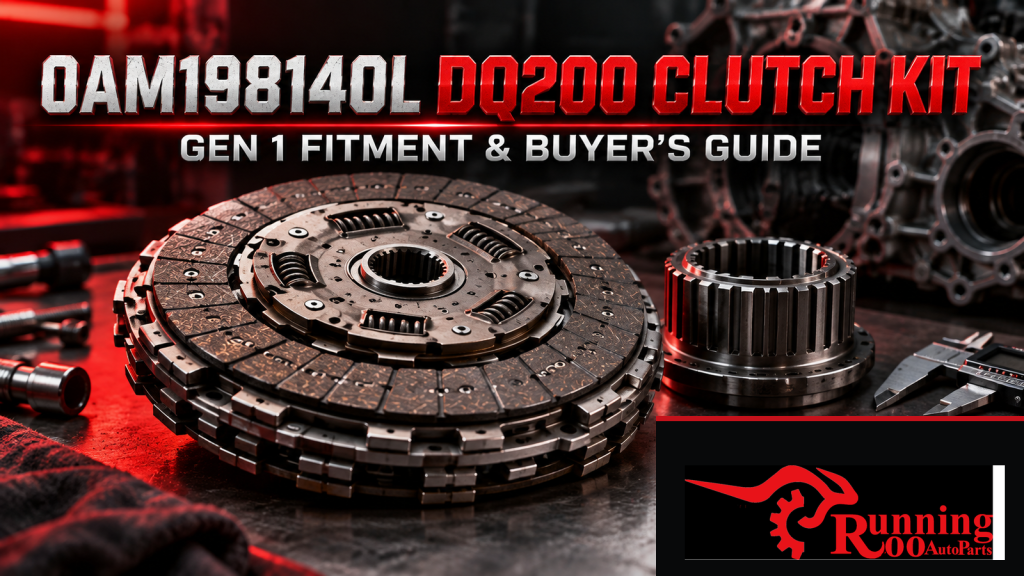
The 0AM198140L clutch kit is for a Gen 1 DQ200 0AM seven-speed dry-clutch transmission. It should be ordered only after the gearbox generation and original part number have been confirmed. “DQ200”, “DSG7” or “seven-speed DSG” on its own is not enough to prove fitment.
RunningRoo’s listed kit uses part number 602000100 and cross-references 0AM198140L. It contains the dual-clutch pack and the associated inner components supplied with the kit. It is a remanufactured replacement intended for professional installation.
Check the exact product: RunningRoo 0AM198140L / 602000100 DQ200 Gen 1 clutch kit. Match the original part number and transmission version before checkout.
Why the exact clutch reference matters
The DQ200 family has been used across many Volkswagen Group vehicles and has evolved over time. Parts that look similar or share the broad “DQ200” description are not automatically interchangeable.
The current RunningRoo listing is deliberately specific:
- transmission family: DQ200 seven-speed DSG;
- gearbox designation: 0AM;
- clutch generation: Gen 1;
- kit number: 602000100; and
- OE reference: 0AM198140L.
If any one of those details conflicts with the unit removed from the car, stop and verify the application. A vehicle model, engine size or registration search may be useful for narrowing the catalogue, but the transmission and part identifiers should decide the order.
Is the clutch actually the failed component?
Low-speed shudder, hesitation, harsh engagement or a vehicle that will not move can be associated with clutch wear—but similar complaints can also come from the mechatronic, selector mechanism, mounts, software state or another drivetrain fault.
Before ordering a clutch kit, ask the workshop to build a diagnosis from evidence:
- Driver complaint: When does the symptom occur—cold, hot, in reverse, from a standstill or during particular shifts?
- Complete scan: Record gearbox fault codes and freeze-frame data before clearing anything.
- Clutch data: Review the measurements and adaptation values supported by the correct diagnostic system.
- Basic mechanical checks: Inspect mounts, leaks, wiring, connectors and any abnormal noise.
- Mechatronic behaviour: Confirm that hydraulic control and actuator operation are not the primary cause.
- Road-test pattern: Reproduce the symptom safely and consistently rather than relying on a single warning light.
This process protects the buyer in both directions. It avoids replacing a clutch that is still serviceable and helps ensure that a genuinely worn clutch is not blamed on the TCU simply because the dashboard displayed a transmission warning.
Typical reasons a workshop may recommend a clutch pack
A workshop may move towards clutch replacement when test results support one or more of the following:
- repeatable take-off judder attributable to clutch engagement;
- excessive clutch wear values or an inability to achieve the required adjustment range;
- slipping or flare under a verified operating condition;
- heat-related clutch performance problems after other causes are excluded;
- contamination or physical damage found during inspection; or
- an unsuccessful adaptation linked to a confirmed clutch or installation issue.
None of these symptoms should be used as a DIY diagnosis by itself. The aim is to distinguish the friction assembly from the electronic and hydraulic controls before money is spent.
Pre-order fitment checklist
| Confirm before purchase | Evidence to collect |
|---|---|
| DQ200 / 0AM transmission | Gearbox code, diagnostic identification and transmission label where accessible |
| Gen 1 clutch application | Original clutch/kit reference and workshop parts data |
| 0AM198140L cross-reference | Clear photo of the original label or a trusted vehicle-specific catalogue result |
| Kit number 602000100 | Match it to the proposed repair specification |
| Vehicle identity | Full VIN, model, engine, build date and registration |
| Installer readiness | Correct clutch tools, measurement capability, diagnostic equipment and current procedure |
If the original clutch has not yet been removed, provide RunningRoo with as much identification as possible. If the gearbox has been replaced in the past, tell the supplier—the installed unit may differ from the original build specification.
What the RunningRoo kit includes
The current listing describes one DQ200 DSG7 Gen 1 clutch kit containing the dual-clutch pack plus the inner components supplied with OEM-style kit 602000100. Product photos should be used to confirm the physical contents before installation.
The listing does not include installation instructions and recommends professional fitting. That is appropriate for this repair. DQ200 clutch work is not only a remove-and-bolt-on job: the installer needs the correct tools and procedure to set up the clutch system and complete the required post-installation checks.
Consumables, seals, fasteners or other parts outside the pictured kit should be identified during job planning. Ask the technician to inspect related components after disassembly and before the car occupies a hoist waiting for another delivery.
Professional installation: what should be planned?
The workshop should follow current manufacturer information for the exact gearbox and clutch generation. A sound plan normally covers:
- safe gearbox removal and support;
- inspection for oil contamination, abnormal play and related mechanical damage;
- use of the specified clutch removal, installation and measuring equipment;
- verification of the correct component orientation and adjustment;
- replacement of required one-time-use items and seals;
- correct reassembly and fluid checks for the applicable gearbox section;
- diagnostic basic settings/adaptation; and
- a controlled road test followed by a final fault scan.
Avoid online “universal” torque values or shortcuts. The correct values and sequence belong to the vehicle- and transmission-specific workshop procedure.
Clutch kit or mechatronic unit: which product should you buy?
These parts do different jobs.
The clutch kit is the friction assembly that transfers engine torque into the two gearbox input paths. The mechatronic controls clutch and gear operation through its electronics and hydraulic system.
Choose from diagnosis, not symptom labels:
| Evidence points mainly to… | Likely repair direction |
|---|---|
| Worn or damaged dry-clutch friction assembly | Evaluate the 0AM198140L Gen 1 clutch kit |
| Internal TCU/valve-body/control fault | Evaluate the correct mechatronic or TCU solution |
| Both clutch wear and control faults | Scope both systems and plan one coordinated repair |
| Unclear or intermittent complaint | Continue diagnosis before ordering high-value parts |
Replacing both parts “just in case” can make a job unnecessarily expensive. Replacing only one part without checking the other can also leave the original symptom unresolved. A measured pre-repair assessment is the best conversion tool because it gives the customer confidence that the order has a clear technical basis.
Why RunningRoo is a practical Australian option
RunningRoo Auto Parts stocks the 0AM198140L kit in Melbourne and advertises fast dispatch, Australian support and free local pickup by appointment. That reduces international freight uncertainty for a workshop with a vehicle already dismantled.
The listing also makes the fitment limitation clear: this kit is for DQ200 0AM Gen 1 only, and the compatibility chart is a guide rather than a guarantee. That is exactly why the buyer should provide the VIN, gearbox details and original part number before purchase.
Check current stock and order only after confirmation: 0AM198140L DQ200 Gen 1 clutch kit.
Frequently asked questions
What gearbox does 0AM198140L fit?
The current RunningRoo listing specifies the 0AM DQ200 seven-speed DSG with a Gen 1 clutch application. Confirm the exact gearbox and original reference before ordering.
Is 602000100 the same reference as 0AM198140L?
The product is advertised as kit 602000100 with 0AM198140L as the OE reference. Use both identifiers during the fitment check.
Is the DQ200 clutch wet or dry?
The DQ200 application covered here uses a dry dual-clutch design. Volkswagen’s own DSG overview explains that its lower-torque DSG applications use two dry clutches, while higher-torque units use wet clutches.
Will a new clutch fix DSG shudder?
Only if diagnosis shows that the clutch assembly is the cause. Mechatronic, adaptation, mount or other mechanical faults can produce overlapping symptoms.
Can I install this kit without special tools?
Professional installation is strongly recommended. The workshop should have the correct clutch tooling, measurement capability and diagnostic equipment for basic settings and verification.
Do I need to send my VIN?
Yes, especially when the original part number or transmission generation is uncertain. A VIN plus gearbox identification and original-part photos provides a stronger check than model/year alone.
Sources and fitment basis
*Fitment information is a guide. Confirm the VIN, gearbox code, clutch generation and original part number before installation.*
Professional verification before the vehicle is opened
A parts page is most useful when it helps the customer and workshop make the same decision from the same evidence. For a 0AM198140L DQ200 Gen 1 clutch kit enquiry, begin with VIN, gearbox code, original clutch information and a workshop diagnosis. Put those details in the first message rather than supplying a vehicle model alone. This gives the seller a real basis to compare the order with the current product description, and gives the installer a record it can use before work begins.
The evidence must be read as a group. A VIN may identify original build data, but it does not prove that an older vehicle has never had an engine, transmission or timing-system repair. An original number is valuable, but can be superseded. A scan result may direct the technician towards a system, but it is not a part-number instruction. The safe purchase decision is the one where the vehicle record, physical component information, workshop scope and live listing agree. If one of those sources conflicts, pause the order and resolve the difference first.
A workshop-to-seller handover that prevents delays
Ask the workshop for a short, factual note. It does not need to contain its entire repair procedure. It should identify the vehicle, the exact system or component requested, the key number or position, and whether the repair scope is confirmed. Pair that note with clear, correctly oriented photographs of labels or removed parts where available. Avoid relying on a screenshot of a similar listing or a photo from a forum. A useful handover is evidence from the actual vehicle.
| Checkpoint | Evidence | What it prevents |
|---|---|---|
| Vehicle identity | Full VIN and build information | Ordering by badge or registration year alone |
| System identity | Engine or gearbox code and repair scope | Mixing related but different applications |
| Part identity | Complete original number, suffix and photos | Near-match or revision errors |
| Listing identity | Current product title, contents and conditions | Ordering from outdated saved information |
| Installation plan | Qualified workshop confirmation | A parcel arriving without a practical fitting plan |
This table is deliberately conservative. It does not make diagnosis slower; it moves the important questions to before payment and before the vehicle is dismantled. For regional and interstate customers, it is also an effective way to avoid a vehicle sitting at a workshop while an overlooked seal, consumable, code or fitment question is resolved.
Technical statements and official information
This article is a buying and planning guide, not a substitute for a repair manual. The technical principles discussed here—vehicle-specific identification, structured diagnosis, controlled installation and post-repair verification—must be applied using the current procedure for the exact vehicle. Volkswagen Group provides official technical-information access at Volkswagen Group technical information. The workshop performing the work must consult the applicable official information for torque values, safety steps, programming, fluid specification, timing alignment, component testing and any one-time-use hardware.
That boundary matters. An online retailer cannot see oil pressure, wiring integrity, mechanical timing, clutch condition, cooling-system performance or software state from a message. A qualified workshop can test the vehicle and select the correct procedure. RunningRoo can then help assess whether the identified component and the current listing are aligned. Keeping those roles separate improves repair quality and prevents an online purchase being treated as a remote diagnosis.
Before ordering: make the job scope visible
A common cause of repeat labour is treating the named product as every part required for a job. A timing kit, control unit, clutch pack or electric pump may be central to the repair, but a workshop can also require gaskets, fasteners, fluids, seals, filters, adaptation work or related inspection. The product contents should be compared with the work order, not assumed to be a complete workshop package. Ask the installer what it expects to supply, what it expects the customer to supply and what it will only decide after inspection.
Be equally precise about the repair boundary. An item can be compatible with the vehicle and still not be the correct answer to its present fault. A component may be required only after a pressure test, scan-data comparison, electrical test, mechanical inspection or disassembly finding. The correct question is therefore not “will this fix it?” but “has the workshop identified this exact item as part of the repair scope, and does the current listing match that identity?”
Receiving, inspection and evidence retention
When delivery arrives, photograph the shipping label and outer package before opening it. Compare the invoice, product title, included components and visible markings with the evidence sent to the seller and with the workshop’s note. Keep all packaging, product labels and the order record together until the intended installer has inspected the item.
If anything is inconsistent, do not force a comparison by opening, programming, connecting, modifying or trial-fitting the item. Preserve its condition, record the difference and contact the seller with the order number, VIN, original information and clear photographs. A concise statement such as “the original number has a different suffix; no installation attempted” is more useful than a general claim that the part looks different. It allows a question to be resolved before the evidence is compromised.
After the repair, retain the seller invoice with the workshop invoice, vehicle kilometres and a short description of the completed work. This record assists later servicing and a future owner. It does not guarantee a future repair outcome, but it gives the next technician facts rather than an incomplete description such as “a timing part” or “a DSG part” was replaced.
Fitment decision chart
| If this is known | Appropriate next step |
|---|---|
| VIN, system identity, original number and listing align | Confirm stock, delivery and workshop schedule |
| Vehicle identity is known but the repair scope is unclear | Complete diagnosis before purchasing |
| An original number or suffix differs | Request a fitment review with photos |
| The workshop has identified extra seals, fluid or hardware | Add those items to the job plan before booking |
| Delivery has arrived but evidence does not align | Stop before installation and retain packaging |
| The installer cannot perform required commissioning or verification | Arrange a suitably equipped workshop first |
Frequently asked questions
Can I order from the vehicle model name alone?
No. Use the VIN plus the exact engine or gearbox information, and compare the current listing with the component requested by the workshop.
Does a warning light or stored fault code prove this part is needed?
No. A code is evidence for diagnosis, not a replacement instruction. The workshop must confirm the cause and repair scope using the official procedure for the vehicle.
Why does the complete OE number matter?
A number can contain revisions or suffixes that matter to identification. Copy every visible character and provide a clear photograph where possible.
Does the product listing include every item needed for installation?
Do not assume so. Check the current listed contents and ask the installer about seals, fluids, fasteners, consumables, programming or related work.
What should I do if the delivered component looks different?
Stop before fitting, modifying, connecting or programming it. Retain packaging and contact the seller with the order details and evidence from the vehicle.
Can this article replace official workshop information?
No. The article supports a safer purchase decision. Official service information and a qualified technician are required for diagnosis, safety procedures, installation and final verification.
Official source and editorial note
The official technical-information portal for the vehicle family is Volkswagen Group technical information. It is cited for the requirement to use current, vehicle-specific repair procedures. RunningRoo is an independent parts seller and is not affiliated with or endorsed by Volkswagen Group. Product availability, applications and contents can change, so re-check the live product page and provide the fitment evidence before ordering.