
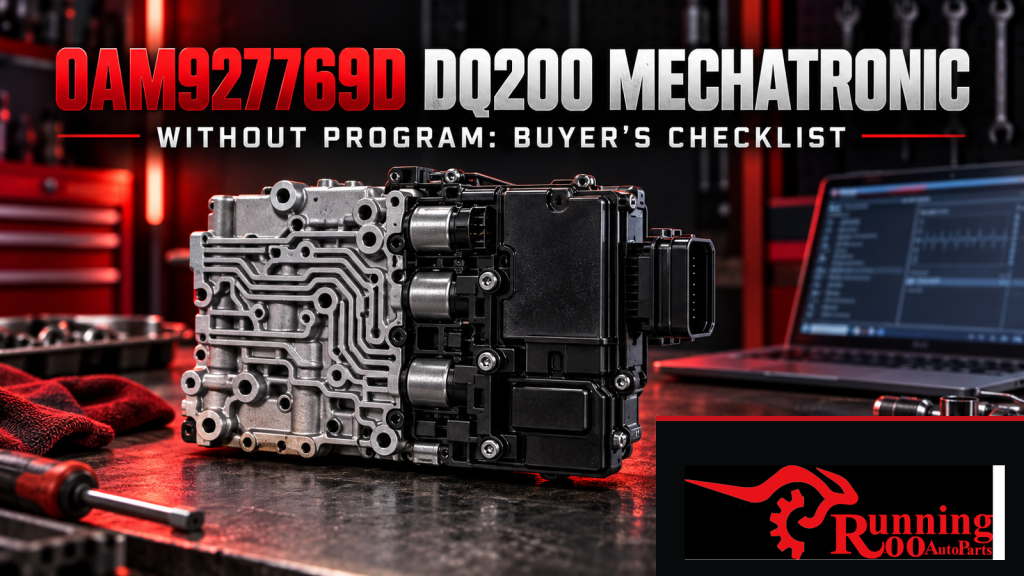
An 0AM927769D DQ200 mechatronic supplied without programming is not a universal plug-and-play repair. The part number, valve-body number, transmission generation, vehicle identification and programming plan all need to agree before the unit is installed.
That is the short answer—and it is the point most likely to prevent a costly return, a vehicle stuck in the workshop or a DSG that will not complete its setup procedure.
RunningRoo’s current unit combines a remanufactured DQ200 0AM valve body and transmission control unit (TCU). The listed identifiers are 0AM325065S for the valve body and 0AM927769D for the control unit. The product is explicitly sold without a program, so the buyer and installer must establish what software, coding and adaptation work the individual vehicle requires.
Ready to order? View the RunningRoo 0AM927769D DQ200 mechatronic unit, then send your VIN and a clear photo of the original unit before checkout.
What “without program” means
The mechatronic is the electro-hydraulic control assembly for the gearbox. It contains the hydraulic valve body, actuators and electronic control hardware that manage clutch and gear selection. “Without program” means the replacement has not been prepared with the vehicle-specific software or data required for your car.
It does not mean the hardware is incomplete. It means the programming stage is a separate part of the repair.
Depending on the vehicle, the workshop may need access to suitable diagnostic equipment, the original module data and the manufacturer’s service procedure. Coding, software transfer, immobiliser-related functions and basic settings can vary. A generic code reader is not a substitute for confirming the required workflow with the technician who will install the unit.
The safest sequence is simple:
- Diagnose the original fault and save a complete scan report.
- Record the transmission identification and all numbers on the original module.
- Confirm the replacement hardware by VIN and part number.
- Agree who will program, code and adapt the unit before the gearbox is dismantled.
Confirm these identifiers before buying
| Check | What to record | Why it matters |
|---|---|---|
| Vehicle identity | Full 17-character VIN, model, build date and engine | Model descriptions alone can hide mid-production changes. |
| Gearbox identity | DQ200/0AM designation and transmission code | “Seven-speed DSG” is not specific enough. |
| TCU number | Complete number and suffix from the original unit or diagnostic report | The target product uses 0AM927769D. A different suffix must be checked, not assumed compatible. |
| Valve-body number | Number visible on the hydraulic assembly | The listed valve body is 0AM325065S. |
| Software data | Original software number/version and a saved scan | Helps the programming specialist plan the job. |
| Fault evidence | DTCs, freeze-frame data, voltage check and hydraulic/actuator findings | Prevents a wiring, power-supply or clutch fault being misdiagnosed as a failed mechatronic. |
Do not order from the badge on the boot, the number of gears or an online compatibility chart alone. A Volkswagen Golf, Audi A3 or Skoda Octavia may have been built with different transmissions across engine, market and production-date combinations.
Vehicles shown in the current product listing
The RunningRoo listing includes applications across Volkswagen, Audi, Skoda and SEAT. Examples include certain:
- Volkswagen Golf/Golf Plus, Polo, Passat, Caddy, Beetle, Tiguan and Touran variants;
- Audi A1, A3 and Q3 variants;
- Skoda Fabia, Octavia and Superb variants; and
- SEAT Ibiza and Leon variants.
Years and engines vary by model. For example, the listing identifies selected 2007–2010 Golf/Golf Plus applications, selected 2008–2011 Audi A3 applications and selected 2009–2011 Skoda Octavia applications. Those ranges are a starting point, not final proof of fitment.
Use the product’s exact hardware numbers and your vehicle’s VIN as the decision point. If a car has had a gearbox or mechatronic replaced previously, its current hardware may not match what a catalogue predicts from the VIN alone—another reason to photograph the installed unit.
Diagnose the system, not just the warning light
A DSG warning, flashing gear indicator, loss of drive or poor shifting can lead a driver straight to the word “mechatronic”. Those symptoms are important, but they do not identify the failed component on their own.
Before replacement, a competent workshop should consider:
- battery condition, charging voltage, fuses, grounds and the module power supply;
- stored and intermittent gearbox fault codes with freeze-frame information;
- wiring and connector condition, including evidence of fluid ingress or damaged pins;
- hydraulic pressure behaviour and actuator operation where the scan tool supports it;
- clutch wear or mechanical faults that can imitate control problems; and
- whether the original module still communicates and can supply useful identification data.
The commercial benefit of this diagnosis is significant. It reduces the risk of buying a complete mechatronic when the car actually needs a clutch pack, wiring repair or another mechanical component. It also gives the programmer more information if the original controller becomes inaccessible later.
Hardware fitment and programming are separate decisions
An 0AM927769D label may confirm one part of the match, but a successful repair has two tracks:
Hardware fitment asks whether the valve body, controller, connectors and transmission application are correct.
Electronic commissioning asks whether the correct software/data can be installed and whether coding, basic settings and post-installation checks can be completed on that vehicle.
Treating those as separate checkpoints is especially important when the product is advertised without programming. Ask the workshop these questions before placing the order:
- Can you work with an unprogrammed DQ200 TCU?
- Do you need the original module to remain readable?
- What information should be saved before removal?
- Will you perform coding and the required basic settings after installation?
- What happens if the vehicle cannot complete basic settings because of a separate clutch or mechanical fault?
If the answers are uncertain, pause the order until the installer and supplier have aligned on the plan.
What is included in the RunningRoo unit?
The live product page specifies one remanufactured DQ200 0AM seven-speed DSG mechatronic assembly consisting of the valve body plus TCU. The listed valve-body number is 0AM325065S and the control-unit number is 0AM927769D.
Programming is not included. Installation instructions are not included, and professional installation is strongly recommended. That makes this product most suitable for an automotive workshop or an experienced buyer who already has a transmission specialist involved.
This is a high-value part. The most conversion-friendly action is also the most technically responsible one: send RunningRoo the VIN, original-unit photo and part-number details before buying.
Installation planning for Australian workshops
Plan the job around information capture and verification, not only mechanical removal.
Before the vehicle is disabled, save the complete diagnostic report and module identification. Photograph labels, connectors and the installed orientation. Confirm the programming path and any consumables or single-use fasteners required by the applicable workshop procedure. Keep the replacement sealed and clean until the fitment decision is final.
After installation, follow the vehicle manufacturer’s current procedure for software, coding, basic settings and road verification. Do not treat a failure to complete basic settings as automatic proof that the replacement unit is faulty; clutch condition, installation, voltage and other mechanical factors may need investigation.
Why buy from RunningRoo?
RunningRoo Auto Parts is based in Melbourne and supports Australian workshops and vehicle owners with local stock, fast dispatch and fitment help. The product page shows the unit as stocked locally and available for free Melbourne pickup by appointment.
More importantly, RunningRoo invites buyers to provide a VIN or a photo when programming or fitment needs clarification. Use that support before checkout—it is faster than resolving an avoidable mismatch after the gearbox has been opened.
Check current availability and submit your fitment details: 0AM927769D DQ200 valve body and TCU.
Frequently asked questions
Is an 0AM927769D mechatronic plug and play?
Not when it is supplied without programming. Confirm the hardware match first, then arrange the required software, coding and basic settings with a suitably equipped workshop.
Does this product include the valve body and TCU?
Yes. The current RunningRoo listing describes a remanufactured assembly containing the valve body and TCU. It identifies the valve body as 0AM325065S and the controller as 0AM927769D.
Can I buy it using only my vehicle model and year?
That is not recommended. Provide the VIN, transmission details, the original controller number and clear photos. A model/year list is only a preliminary filter.
Should I replace the clutch at the same time?
Not automatically. Clutch condition should be assessed from diagnosis and inspection. A mechatronic and a dry-clutch pack solve different faults, even though some symptoms can overlap.
Can a general mechanic install it?
Mechanical installation alone is not the full job. Confirm that the chosen workshop can perform or coordinate the required DQ200 programming, coding, basic settings and final diagnostic checks.
What should I send RunningRoo before ordering?
Send the full VIN, vehicle model and build details, gearbox information, a photo of the original mechatronic label and—if available—the scan-tool identification and fault report.
Sources and fitment basis
- RunningRoo 0AM927769D DQ200 mechatronic product page
- Volkswagen: overview of dual-clutch gearbox design
*Fitment information is a guide. Always verify the VIN, transmission code, original part number and current manufacturer workshop information before installation.*
Professional verification before the vehicle is opened
A parts page is most useful when it helps the customer and workshop make the same decision from the same evidence. For a 0AM927769D DQ200 mechatronic enquiry, begin with VIN, gearbox code, original controller number and a workshop report. Put those details in the first message rather than supplying a vehicle model alone. This gives the seller a real basis to compare the order with the current product description, and gives the installer a record it can use before work begins.
The evidence must be read as a group. A VIN may identify original build data, but it does not prove that an older vehicle has never had an engine, transmission or timing-system repair. An original number is valuable, but can be superseded. A scan result may direct the technician towards a system, but it is not a part-number instruction. The safe purchase decision is the one where the vehicle record, physical component information, workshop scope and live listing agree. If one of those sources conflicts, pause the order and resolve the difference first.
A workshop-to-seller handover that prevents delays
Ask the workshop for a short, factual note. It does not need to contain its entire repair procedure. It should identify the vehicle, the exact system or component requested, the key number or position, and whether the repair scope is confirmed. Pair that note with clear, correctly oriented photographs of labels or removed parts where available. Avoid relying on a screenshot of a similar listing or a photo from a forum. A useful handover is evidence from the actual vehicle.
| Checkpoint | Evidence | What it prevents |
|---|---|---|
| Vehicle identity | Full VIN and build information | Ordering by badge or registration year alone |
| System identity | Engine or gearbox code and repair scope | Mixing related but different applications |
| Part identity | Complete original number, suffix and photos | Near-match or revision errors |
| Listing identity | Current product title, contents and conditions | Ordering from outdated saved information |
| Installation plan | Qualified workshop confirmation | A parcel arriving without a practical fitting plan |
This table is deliberately conservative. It does not make diagnosis slower; it moves the important questions to before payment and before the vehicle is dismantled. For regional and interstate customers, it is also an effective way to avoid a vehicle sitting at a workshop while an overlooked seal, consumable, code or fitment question is resolved.
Technical statements and official information
This article is a buying and planning guide, not a substitute for a repair manual. The technical principles discussed here—vehicle-specific identification, structured diagnosis, controlled installation and post-repair verification—must be applied using the current procedure for the exact vehicle. Volkswagen Group provides official technical-information access at Volkswagen Group technical information. The workshop performing the work must consult the applicable official information for torque values, safety steps, programming, fluid specification, timing alignment, component testing and any one-time-use hardware.
That boundary matters. An online retailer cannot see oil pressure, wiring integrity, mechanical timing, clutch condition, cooling-system performance or software state from a message. A qualified workshop can test the vehicle and select the correct procedure. RunningRoo can then help assess whether the identified component and the current listing are aligned. Keeping those roles separate improves repair quality and prevents an online purchase being treated as a remote diagnosis.
Before ordering: make the job scope visible
A common cause of repeat labour is treating the named product as every part required for a job. A timing kit, control unit, clutch pack or electric pump may be central to the repair, but a workshop can also require gaskets, fasteners, fluids, seals, filters, adaptation work or related inspection. The product contents should be compared with the work order, not assumed to be a complete workshop package. Ask the installer what it expects to supply, what it expects the customer to supply and what it will only decide after inspection.
Be equally precise about the repair boundary. An item can be compatible with the vehicle and still not be the correct answer to its present fault. A component may be required only after a pressure test, scan-data comparison, electrical test, mechanical inspection or disassembly finding. The correct question is therefore not “will this fix it?” but “has the workshop identified this exact item as part of the repair scope, and does the current listing match that identity?”
Receiving, inspection and evidence retention
When delivery arrives, photograph the shipping label and outer package before opening it. Compare the invoice, product title, included components and visible markings with the evidence sent to the seller and with the workshop’s note. Keep all packaging, product labels and the order record together until the intended installer has inspected the item.
If anything is inconsistent, do not force a comparison by opening, programming, connecting, modifying or trial-fitting the item. Preserve its condition, record the difference and contact the seller with the order number, VIN, original information and clear photographs. A concise statement such as “the original number has a different suffix; no installation attempted” is more useful than a general claim that the part looks different. It allows a question to be resolved before the evidence is compromised.
After the repair, retain the seller invoice with the workshop invoice, vehicle kilometres and a short description of the completed work. This record assists later servicing and a future owner. It does not guarantee a future repair outcome, but it gives the next technician facts rather than an incomplete description such as “a timing part” or “a DSG part” was replaced.
Fitment decision chart
| If this is known | Appropriate next step |
|---|---|
| VIN, system identity, original number and listing align | Confirm stock, delivery and workshop schedule |
| Vehicle identity is known but the repair scope is unclear | Complete diagnosis before purchasing |
| An original number or suffix differs | Request a fitment review with photos |
| The workshop has identified extra seals, fluid or hardware | Add those items to the job plan before booking |
| Delivery has arrived but evidence does not align | Stop before installation and retain packaging |
| The installer cannot perform required commissioning or verification | Arrange a suitably equipped workshop first |
Frequently asked questions
Can I order from the vehicle model name alone?
No. Use the VIN plus the exact engine or gearbox information, and compare the current listing with the component requested by the workshop.
Does a warning light or stored fault code prove this part is needed?
No. A code is evidence for diagnosis, not a replacement instruction. The workshop must confirm the cause and repair scope using the official procedure for the vehicle.
Why does the complete OE number matter?
A number can contain revisions or suffixes that matter to identification. Copy every visible character and provide a clear photograph where possible.
Does the product listing include every item needed for installation?
Do not assume so. Check the current listed contents and ask the installer about seals, fluids, fasteners, consumables, programming or related work.
What should I do if the delivered component looks different?
Stop before fitting, modifying, connecting or programming it. Retain packaging and contact the seller with the order details and evidence from the vehicle.
Can this article replace official workshop information?
No. The article supports a safer purchase decision. Official service information and a qualified technician are required for diagnosis, safety procedures, installation and final verification.
Official source and editorial note
The official technical-information portal for the vehicle family is Volkswagen Group technical information. It is cited for the requirement to use current, vehicle-specific repair procedures. RunningRoo is an independent parts seller and is not affiliated with or endorsed by Volkswagen Group. Product availability, applications and contents can change, so re-check the live product page and provide the fitment evidence before ordering.