
By RunningRoo Auto Parts — written from the desk of our Product Manager
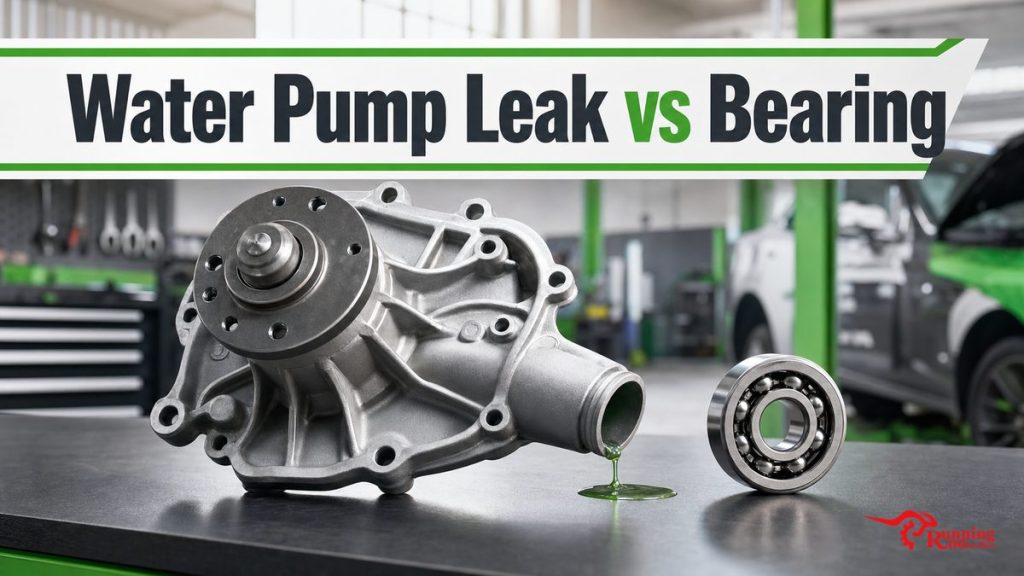
The water pump fails in two main ways, and they look and sound very different. A failing seal leaks coolant, usually from a small weep hole under the pump, while a failing bearing rumbles or whines and eventually lets the shaft wobble. The two can happen together, and both lead to the same destination if ignored: overheating and a damaged engine. Telling them apart is the first step in deciding how urgent the repair is.
This guide explains the difference between a water pump leak and a bearing failure, the warning signs of each, and what the repair involves. It is written for Australian owners who have spotted a stain or heard a noise.
RunningRoo Auto Parts – Based in Melbourne, Australia 🇦🇺
📞 Free 24/7 Pickup Available (Contact 0425890125)
💬 Any questions? Message or Call us anytime! We’re here to help.Why Choose RunningRoo?
✅ Aussie Owned & Operated | 🚚 Fast Shipping | 🤝 Friendly Support
The two failure modes
The water pump has a bearing that supports the spinning shaft and a seal that keeps the coolant inside. The bearing wears with time and load, while the seal degrades with age, heat and the condition of the coolant. A leak is the seal failing; a rumble or whine is the bearing failing, and the two often occur together because a wobbling shaft from a worn bearing quickly destroys the seal.
Understanding that relationship matters, because a leak is often the first sign of a bearing that is on its way out, not an isolated problem.
Recognising a coolant leak
A water pump leak usually appears as coolant dripping from the weep hole on the underside of the pump, or as a dried crust or stain of coolant around the pump body. Coolant is usually green, pink or orange, and it has a sweet smell. The first sign is often a slow drop in the coolant level or a small puddle under the front of the engine.
The weep hole is designed to leak slightly as a warning before the seal fails completely, which is why a small drip should be investigated rather than topped up and ignored.
Recognising a bearing failure
A failing water pump bearing produces a rumbling, whining or grinding noise from the front of the engine, often changing with engine speed. As the bearing worsens, the shaft can wobble, which damages the seal and produces a leak too. The noise is the warning that the bearing is on borrowed time.
The table below summarises the two failure modes.
| Failure mode | Typical sign |
|---|---|
| Seal leak | Coolant drip or stain, dropping level |
| Bearing failure | Rumbling or whining noise, changing with speed |
Both can be present at once, and either is a reason to act.
The symptoms they share
Both failure modes eventually lead to the same symptom: overheating. As coolant escapes or circulation fails, the temperature gauge climbs, and the engine risks warping the cylinder head or blowing the head gasket. This is why the leak and the noise are both warnings to take seriously, even when the car still runs normally.
The temperature gauge is a lagging indicator, so by the time it rises the cooling system is already struggling. The leak and the noise are the earlier, cheaper warnings.
Why the coolant condition matters
The condition of the coolant directly affects the life of the pump seal. Old, diluted or incompatible coolant loses its corrosion protection and lubricating properties, which ages the seal and can cause sludge that damages the pump and blocks the radiator. Using the correct coolant specification and concentration, and renewing it on schedule, is how the seal is protected.
This is also why a pump replacement should include fresh coolant in the correct specification, not a top-up of whatever is on the shelf.
What the repair involves
The repair for either failure mode is a water pump replacement, and on many engines the pump sits behind the timing belt or timing chain covers, so the job is a timing service in disguise. The thermostat and the coolant are renewed at the same time, and on a belt-driven engine the belt and tensioner are renewed too.
The table below summarises what a complete job includes.
| Item | Why it is included |
|---|---|
| Pump and gasket | The failed part and its seal |
| Thermostat | Cheap, lives in the same system |
| Coolant | Fresh, correct specification |
| Belt and tensioner | Renewed together on belt-driven engines |
Doing the complete job is how the repair is made to last rather than return.
Catching it early
The cheapest way to own a water pump failure is to catch it at the leak or noise stage, before the engine overheats. A small stain, a slow drop in coolant or a new rumbling noise are all signals to have the cooling system checked and pressure-tested. The pump is a cheap part relative to the engine it protects, and prompt attention keeps it that way.
Ignoring the first warning and waiting for the temperature gauge is how a pump replacement turns into a head-gasket repair.
The pressure test and diagnosis
When a leak or a noise appears, the cooling system should be pressure-tested to find the source. The test pressurises the system and reveals exactly where the coolant is escaping, which separates a pump leak from a hose, a radiator or a heater-core leak. On an electric-pump engine, the scan and a check of the pump’s power and signal are the first steps instead.
The pump should also be inspected for bearing play and leakage once the area is accessible. This is how the diagnosis confirms the pump rather than guessing at it, and it prevents replacing a good pump when the real fault is a cheap hose or a failing thermostat.
Preventing both failure modes
The best protection against both a leak and a bearing failure is routine maintenance. Keep the coolant at the correct level and specification, renew it on the manufacturer’s interval, and investigate the first stain, noise or temperature rise promptly. On a timing-belt engine, budget the pump into the belt service rather than waiting for it to fail on its own.
The coolant is the key, because its corrosion protection and lubricating properties are what keep the seal alive, and its correct specification and concentration are what protect the pump and the whole cooling system. A well-maintained pump is cheap insurance against the roadside breakdown and the engine damage that follow neglect.
Mechanical versus electric pump diagnosis
The two failure modes look different depending on whether the pump is mechanical or electric. A mechanical pump leaks from its seal and rumbles from its bearing, while an electric pump may fail through its motor or control module and announce itself with a stored cooling-fault code rather than a visible leak. The diagnosis therefore starts with a pressure test and an inspection on a mechanical pump, and with a scan and a power-and-signal test on an electric pump.
Understanding which type your car has changes where to look first. The symptoms that matter are the same, but the order in which they are checked is different, which is why a correct diagnosis is the start of a correct repair.
The cooling system as a whole
The water pump does not fail in isolation; it fails as part of a cooling system whose other components, the thermostat, the coolant, the hoses and the radiator, are all at a similar stage of life. That is why a pump replacement renews the thermostat and the coolant, and why the rest of the system is checked at the same time.
Treating the pump as a single part misses the point that the cooling system wears together. A complete job renews the working set, and that is how the repair is made to last rather than to return with the next component’s failure.
The bottom line
A water pump fails through its seal, its bearing or both, and the warning is either a coolant leak or a rumbling noise that both lead to overheating if ignored. Telling the two apart, and catching either early, is what keeps a pump replacement cheap and prevents a head-gasket repair.
The pump is a small part relative to the engine it protects, and the correct coolant and prompt attention to the first stain or noise are the whole of the protection it needs. Service the cooling system before it fails, and the pump will rarely make the decision for you.
In short, the leak and the bearing noise are the same warning in two forms: the cooling system is telling you the pump is on its way out. Read the sign early, renew the working set in one job, and you keep the repair at the price of a pump rather than the price of an engine.
Frequently asked questions
What is the difference between a water pump leak and a bearing failure?
A leak is the seal failing and shows as coolant escaping, while a bearing failure is the shaft support wearing and shows as a rumbling or whining noise.
Can the two happen together?
Yes. A wobbling shaft from a worn bearing usually damages the seal and causes a leak too.
What does a water pump leak look like?
Coolant dripping from the weep hole, or a dried stain or crust around the pump, plus a slowly dropping coolant level.
What does a bearing failure sound like?
A rumbling, whining or grinding noise from the front of the engine, changing with engine speed.
Does the coolant condition affect the pump?
Yes. Old or incorrect coolant ages the seal and can cause sludge that damages the pump.
Should I replace the thermostat with the pump?
Yes. It is cheap, lives in the same system and is best renewed whenever the cooling system is opened.
What should a complete pump job include?
The pump, gasket, thermostat, fresh coolant, and the belt and tensioner on belt-driven engines.
What happens if I ignore the warning?
The engine can overheat, risking a warped cylinder head or blown head gasket.
Shop the products mentioned in this guide
- 161A0-39035 Electric Water Pump for Toyota Camry / Lexus / Corolla Hybrid
- Cooling Additional Water Pump for Audi A4 B8 / A5 / A6 C6 C7 / Q5 Q7 / VW Amarok Touareg
- Electric Coolant Water Pump for BMW F30/F31/F10/F25/E84/E89 X1 520i 320i N20B20A
- Water pumps on eBay
Watch on RunningRooAuto YouTube
- RunningRoo Auto Parts – trusted Melbourne parts support
- RunningRoo Auto Parts – product and fitment channel
RunningRoo Auto Parts – Based in Melbourne, Australia 🇦🇺
📞 Free 24/7 Pickup Available (Contact 0425890125)
💬 Any questions? Message or Call us anytime! We’re here to help.Why Choose RunningRoo?
✅ Aussie Owned & Operated | 🚚 Fast Shipping | 🤝 Friendly Support
Sources and further reading
- ACCC – Consumer rights and guarantees
- Product Safety Australia – vehicle recalls
- RACV – car maintenance and repair guidance
- API – Engine oil standards
Cooling-system service intervals, coolant specifications and water-pump replacement procedures are set out in each manufacturer’s workshop manual. Always use the coolant specification and concentration your vehicle’s manufacturer specifies, and confirm the correct pump for your engine before ordering.
RunningRoo Auto Parts – Based in Melbourne, Australia 🇦🇺
📞 Free 24/7 Pickup Available (Contact 0425890125)
💬 Any questions? Message or Call us anytime! We’re here to help.Why Choose RunningRoo?
✅ Aussie Owned & Operated | 🚚 Fast Shipping | 🤝 Friendly Support