
By RunningRoo Auto Parts — written from the desk of our Product Manager
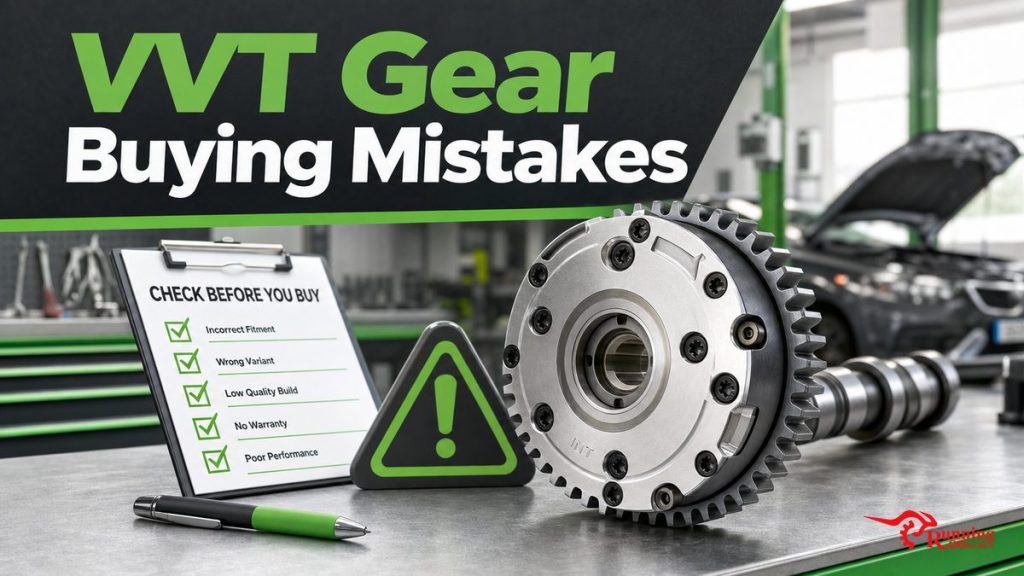
The VVT camshaft gear, or cam phaser, is a precision part buried behind the timing cover, and buying the wrong one is one of the most expensive mistakes an owner can make. The part is not the problem; the labour to reach it is, so a wrong gear, a wrong side or a cheap copy all turn a single repair into a second teardown. Most of these mistakes are avoidable with a little information before the purchase.
This guide lists the common VVT gear buying mistakes, why they cost so much, and how to avoid them. It is written for Australian owners and workshops who want to order once and fit once.
RunningRoo Auto Parts – Based in Melbourne, Australia 🇦🇺
📞 Free 24/7 Pickup Available (Contact 0425890125)
💬 Any questions? Message or Call us anytime! We’re here to help.Why Choose RunningRoo?
✅ Aussie Owned & Operated | 🚚 Fast Shipping | 🤝 Friendly Support
Mistake one: ordering by model name
The most common mistake is ordering a VVT gear by the car’s model name instead of the part number and engine code. The same model can carry different gears across years and markets, and a part that is right for one build can be wrong for another. The model name narrows the search; it does not confirm the part.
The reliable identifiers are the engine code, the VIN and the original part number. A supplier who asks for those before quoting is doing the job properly, and a supplier who quotes on a model name alone is guessing.
Mistake two: getting the side wrong
Many engines use a VVT gear on both the intake and exhaust camshafts, and the two are often different parts. They can be mirror images, rotate in different directions, or have oil passages in different positions. Fitting an intake gear to the exhaust camshaft, or vice versa, produces fault codes and poor running.
The side is part of the specification, not an optional detail. Confirm which camshaft has failed, then match the part number and side against the engine code.
Mistake three: assuming physical fit means compatibility
A gear that bolts on is not necessarily the right gear. A mirror-image or direction-specific gear can physically fit and still time the camshaft incorrectly. Physical fit and electronic or mechanical compatibility are separate questions, and confusing them is how a wrong part gets fitted before it is discovered.
The test is not whether it fits but whether the part number and side match the engine. If they do not match, the gear is wrong no matter how well it bolts on.
Mistake four: choosing the cheapest copy
The cheapest VVT gear is usually the most expensive in the end, because the labour to reach it is the dear half of the job. A cheap copy with loose tolerances or poor materials fails early, and the second teardown costs far more than the saving on the part. The table below summarises the trade-off.
| Choice | Typical outcome |
|---|---|
| Genuine or quality aftermarket | Confirmed fitment, longer life |
| Budget unbranded | Higher risk of early failure |
The part is the wrong place to save money on a job that is mostly labour.
Mistake five: ignoring the oil-control solenoid
The VVT gear is only half of the system; the oil-control solenoid is the other half, and a failing solenoid can damage a new gear by feeding it the wrong oil pressure. Renewing the gear while leaving a tired solenoid in place is a repair that invites a repeat.
The solenoid is cheap relative to the gear, and it should be renewed at the same time where there is any doubt.
Mistake six: skipping the oil change
The gear is moved by engine oil pressure, so fitting a new gear and leaving old, dirty oil in the engine is a compromised repair. A fresh oil and filter change at the time of the gear replacement is part of the job, not an optional extra, and the correct oil specification is what gives the new gear its best chance of a long life.
This is also why the oil should be checked and, where appropriate, changed during diagnosis before the gear is condemned.
How to get the order right
Before ordering, collect four facts: the engine code, the VIN, the original part number and the side that needs replacing. Give all four to the supplier and ask them to confirm whether the intake and exhaust gears are the same or different for your engine, and what the written warranty covers.
That one exchange removes most of the mistakes in this list, and it costs nothing. A correct part, confirmed once, is worth far more than a cheaper part that arrives wrong.
The value of a written warranty
A written warranty is part of your protection under Australian Consumer Law and a signal of the supplier’s confidence. A supplier who stands behind a VVT gear in writing is far more likely to be selling a properly made unit than an anonymous seller who disappears after the sale.
When comparing prices, the warranty should be part of the comparison, because a part that fails is paid for in labour rather than in the part price.
Checking the seller’s reputation
The seller matters as much as the part, and it is worth a minute to check. Look for a real business with a clear identity, a stated part number, a returns policy and a written warranty. A seller who answers fitment questions and asks for the engine code and VIN is behaving like a professional; a seller who offers only a low price and a model name is not.
The reputation is part of the warranty, because a written warranty is only as good as the business behind it. On a part buried behind the timing cover, buying from a reputable supplier is the difference between support when something goes wrong and silence.
The return and refund reality
When a VVT gear arrives wrong or fails, the hidden cost of a bargain appears. The part must be returned, the refund chased, and the labour of the failed attempt is already spent. The saving on the part disappears into freight, delay and a second teardown, which is why the cheapest gear is so often the most expensive one.
A quality supplier changes that equation, because the fitment is confirmed before you pay and a failed part is handled over the counter rather than through a faceless process. On a part that is mostly labour to reach, that support is worth more than the price difference.
A final pre-order checklist
Before you pay, run through a short checklist. Confirm the engine code and VIN, the original part number and the side that needs replacing. Ask whether the intake and exhaust gears are the same or different, what the manufacturer and warranty are, and whether the oil-control solenoid should be renewed too. If the supplier can answer all of it, order with confidence.
If any answer is missing or evasive, keep looking. The checklist is the difference between ordering once and ordering twice, and it costs nothing to run.
The cost of a wrong order
The clearest way to understand why these mistakes matter is to count what a wrong order costs. The part arrives, the engine is opened, the wrong gear is discovered, and the labour is spent. The part goes back, the correct one is ordered, and the engine is opened again. The saving on the original part is dwarfed by the second teardown.
That is why the time spent confirming fitment before ordering is the cheapest part of the whole job. A correct part, confirmed once, is worth more than any discount on a part that turns out to be wrong.
Buying with confidence
Buying a VVT gear with confidence comes down to a short list: a known manufacturer, an exact part number, a confirmed side, a written warranty and a supplier who answers questions. When all of those are present, the part is very likely to be right the first time, and the labour is protected.
The alternative, a cheap listing with none of that, is a risk measured in labour rather than part price. On a precision part buried behind the timing cover, confidence in the part is the whole point of the purchase.
The bottom line
Most VVT gear buying mistakes are avoidable with a little information before the purchase. Confirm the engine code, the VIN, the part number and the side, choose a reputable manufacturer with a written warranty, and renew the oil-control solenoid and the oil with the gear.
The part is the cheap half of the job and the labour is the expensive half, so getting the order right once is worth far more than any discount on a part that turns out to be wrong. Order once, fit once, and the repair stays cheap.
Frequently asked questions
What is the most common VVT gear buying mistake?
Ordering by model name instead of the part number, engine code and VIN.
Are the intake and exhaust gears the same?
On some engines yes, on many no. The part number and engine code decide.
Does physical fit mean the part is correct?
No. A mirror-image or direction-specific gear can fit yet still time the camshaft incorrectly.
Why is the cheapest gear usually the most expensive?
Because the labour to reach it is the dear half, and an early failure costs the labour twice.
Should I replace the oil-control solenoid with the gear?
Yes, if there is any doubt, because a failing solenoid can damage a new gear.
Should I change the oil with the gear?
Yes. Fresh, correct-specification oil is essential to the life of a new gear.
How do I confirm the right gear?
Use the engine code, VIN, original part number and the side that needs replacing.
Does the warranty matter?
Yes. It is part of your protection under Australian Consumer Law and a signal of the supplier’s confidence.
Shop the products mentioned in this guide
- 2-Piece Camshaft Adjusters for Mitsubishi Lancer Evo X 2.0 / ASX / Outlander 4B11 1147
- CVVT Timing Camshaft Gear for Hyundai Veloster / Tucson / Elantra 24370-2B700
- VVT Camshaft Gears Intake & Exhaust for Toyota Corolla 2007–2012 1.8L 2ZR-FE
- VVT camshaft gears on eBay
Watch on RunningRooAuto YouTube
- RunningRoo Auto Parts – trusted Melbourne parts support
- RunningRoo Auto Parts – product and fitment channel
RunningRoo Auto Parts – Based in Melbourne, Australia 🇦🇺
📞 Free 24/7 Pickup Available (Contact 0425890125)
💬 Any questions? Message or Call us anytime! We’re here to help.Why Choose RunningRoo?
✅ Aussie Owned & Operated | 🚚 Fast Shipping | 🤝 Friendly Support
Sources and further reading
- ACCC – Consumer rights and guarantees
- Product Safety Australia – vehicle recalls
- RACV – car maintenance and repair guidance
- API – Engine oil standards
- ACEA – European oil sequences
VVT gear part numbers, intake/exhaust differences and oil-control-solenoid operation are engine-specific and are described in each manufacturer’s workshop manual. Confirm your engine code, VIN and the correct side against the official repair information before ordering.
RunningRoo Auto Parts – Based in Melbourne, Australia 🇦🇺
📞 Free 24/7 Pickup Available (Contact 0425890125)
💬 Any questions? Message or Call us anytime! We’re here to help.Why Choose RunningRoo?
✅ Aussie Owned & Operated | 🚚 Fast Shipping | 🤝 Friendly Support