
By RunningRoo Auto Parts — written from the desk of our Product Manager
A timing chain replacement looks straightforward in a video and turns out to be one of the most precision-critical jobs in the workshop. The chain lives behind covers and mounts, must be timed with locking tools, and a single tooth of error can destroy an engine. Before deciding whether to tackle it yourself, it helps to understand exactly what tools and skills the job demands, because that is the difference between a successful repair and an expensive mistake.
This guide lists the tools a timing chain job actually needs, the skills that matter, and the honest self-assessment that tells you whether to attempt it or hand it to a specialist. It is written for Australian DIYers weighing up the decision.
RunningRoo Auto Parts – Based in Melbourne, Australia 🇦🇺
📞 Free 24/7 Pickup Available (Contact 0425890125)
💬 Any questions? Message or Call us anytime! We’re here to help.Why Choose RunningRoo?
✅ Aussie Owned & Operated | 🚚 Fast Shipping | 🤝 Friendly Support
Why this job is different from a normal repair
Most repairs can be redone if they go wrong. A timing chain job is not one of them. On an interference engine, the valves and pistons share the same space at different times, so a timing mistake turns a parts replacement into a bent-valve engine rebuild. The consequence of getting it wrong is not a redo; it is a replacement engine.
That is the context for everything else in this guide. The tools and skills are not optional extras; they are the difference between the engine surviving the job and not.
The basic tools
The job starts with a full socket and spanner set, torque wrenches for the one-time-use fasteners, and the usual workshop equipment for draining coolant and oil. A quality torque wrench matters, because the one-time-use bolts and the tensioner have exact torque specifications that cannot be guessed.
The table below lists the basic equipment and why each item matters.
| Tool | Why it matters |
|---|---|
| Socket and spanner set | General disassembly and reassembly |
| Torque wrench | One-time-use fasteners and tensioner torque |
| Drain and catch equipment | Coolant and oil handling |
| Marking tools | Recording timing and orientation |
These are the entry ticket, but they are not enough on their own.
The locking and timing tools
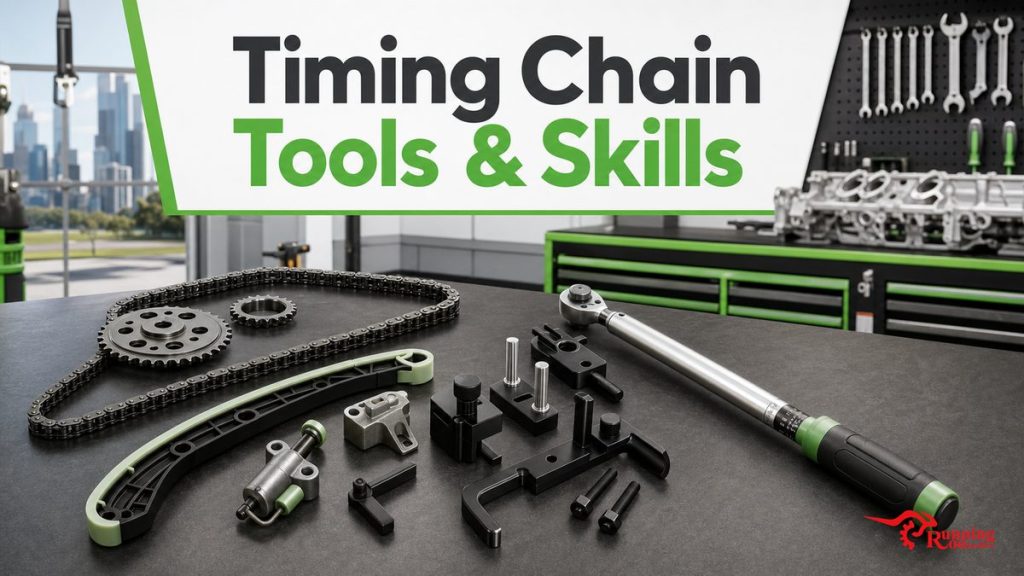
The tools that separate a timing job from a general repair are the engine-specific locking pins, camshaft holding tools and timing fixtures. They hold the crankshaft and camshafts at top dead centre so the valve timing cannot move while the chain is off, and they are essential on nearly every modern engine.
These tools are engine-specific, so a generic kit will not cover every car. The manufacturer’s workshop manual lists exactly which tools are required, and attempting the job without them is how a timing job becomes an engine rebuild.
The diagnostic tool
A diagnostic tool that can read the camshaft-to-crankshaft correlation values is the third essential. It is used before the job to confirm the diagnosis and after the job to verify the timing is correct. Without it, you are working blind on the one measurement that matters most.
The diagnostic tool is also how you read stored fault codes and confirm the engine code and software, which is part of ordering the correct kit in the first place.
The skills that matter
Beyond the tools, the job demands a specific set of skills. Reading and following the manufacturer’s procedure, working methodically without rushing, and understanding the consequences of each step are the core of it. The ability to turn the engine by hand and verify the timing before starting it is not a nice-to-have; it is the safety check that saves the engine.
The table below lists the key skills and why they matter.
| Skill | Why it matters |
|---|---|
| Reading the workshop manual | The procedure and torque values are engine-specific |
| Methodical sequencing | Skipped steps cause mistakes |
| Timing verification | Prevents a jumped tooth |
| Resealing and torque | Prevents leaks and fastener failure |
A careful, patient DIYer with these skills can do the job; a rushed one, even with the tools, is a risk.
The self-assessment before you start
Before starting, be honest about three questions. Do you have the engine-specific locking tools? Do you have a diagnostic tool that reads the correlation values? And do you have the time to do the job slowly, following the manual step by step? If the answer to any of these is no, the job is better left to a specialist.
This is not about discouraging DIY; it is about matching the job to the capability. The labour a specialist charges is partly the tools and partly the certainty that the engine survives the procedure.
When a specialist is the cheaper outcome
On engines where the chain is buried behind structural covers, the engine mount and the sump, the job is long, fiddly and unforgiving. A specialist with the correct tools and the experience to recognise a wrong routing or a missed mark is the cheaper outcome, because their labour protects against the cost of a mistake.
The same logic applies to the parts. A quality kit with all the guides, tensioner and seals is a small extra cost that protects the labour, and the specialist will supply and fit it correctly.
The cost of doing it twice
The clearest way to frame the DIY decision is the cost of doing the job twice. If the first attempt ends in a mistake, the second attempt is a full engine rebuild, and that is the most expensive outcome in the whole engine. The tools, the manual and the patience are the insurance against that second attempt.
This is why the decision is not about whether you can turn a spanner, but whether you can match the precision the job demands.
The cost of the tools versus the cost of labour
The engine-specific locking tools are not cheap, and for a one-off job they can cost a meaningful share of what a specialist would charge in labour. That comparison is the honest starting point for the DIY decision: if the tools plus the risk are close to the labour, the specialist is the better value, because they also bring the experience to recognise a wrong routing or a missed mark.
For an owner who will do the job once, hiring or borrowing the tools is sometimes possible, but the tools alone do not buy the certainty of a correct outcome. The labour a specialist charges is partly the tools and partly the guarantee that the engine survives.
A step-by-step reality check
Walk through the job mentally before starting. You will drain the coolant and oil, remove the covers and possibly the engine mount, lock the engine, remove the old kit, fit the new one, turn the engine by hand, re-check the timing, reseal everything and then road-test it. Each step has a procedure, a torque value and a consequence for getting it wrong.
If any step in that list is unfamiliar, the job is telling you something. The timing chain replacement is a sequence where the whole is only as safe as its weakest step, and a single skipped verification is what separates a repair from an engine rebuild.
Planning the job and ordering the kit
Before any spanners turn, the job should be planned and the kit ordered by engine code. A complete kit includes the chain, the guides, the tensioner, the seals and the one-time-use fasteners, and on many engines it should also include the VVT gears and the oil-pump chain. Ordering only the chain is a common way to end up opening the engine a second time.
The planning also includes the oil and coolant, which are renewed as part of the job, and a clear run of time to do the work slowly. A timing chain replacement is a job that punishes rushing, so the planning is part of the safety.
What to do if you are unsure
If, after reading the procedure and listing the tools, the job still feels beyond reach, that is a useful answer, not a failure. Handing the job to a specialist who has the tools and the experience is the cheaper outcome when the alternative is a mistake that costs an engine. The money spent on their labour buys the certainty that the timing is correct and the engine survives.
There is no shame in that decision. The timing chain is one of the few jobs where the cost of being wrong is not a redo but a replacement engine, and recognising that is the mark of a careful owner.
The bottom line
A timing chain replacement is a precision job, not a general repair, and the tools and skills it demands are what keep the engine safe. The engine-specific locking tools, a diagnostic tool and a methodical following of the manual are not optional; they are the difference between a repair and a rebuild.
If you have all three and the time to work slowly, the job is achievable. If any of them is missing, a specialist is the cheaper and safer outcome, because the cost of getting the timing wrong is not a redo but an engine.
Frequently asked questions
Can I replace a timing chain myself?
It is possible for an experienced DIYer with the correct engine-specific locking tools, a diagnostic tool and the time to follow the manual precisely.
What is the most important tool?
The engine-specific locking and timing tools, because they prevent the valve timing from moving while the chain is off.
Why is a torque wrench essential?
The one-time-use fasteners and the tensioner have exact torque specifications that cannot be guessed.
Do I need a diagnostic tool?
Yes, to read the camshaft-to-crankshaft correlation before and after the job.
What happens if I get the timing wrong?
On an interference engine the valves and pistons can meet, destroying the engine.
Should I do the job slowly?
Yes. The job cannot be rushed, and the verification steps are what save the engine.
When is a specialist the cheaper option?
When the chain is buried behind structural covers and you do not have the correct tools or experience.
What parts should I use?
A complete kit with the chain, guides, tensioner and seals, confirmed by engine code.
Shop the products mentioned in this guide
- VW GTI / SEAT / Škoda / Passat / Audi A3 A4 A5 2.0 TSI & 1.8 TSI Timing Chain Kit EA888
- Timing Chain Kit for Ford Ranger PX / Mazda BT-50 3.2 TDCi with oil-pump chain 2011–
- Timing Chain Kit for Mazda 3/6/CX-5 Skyactiv-D 2.2 Diesel SH 2013–2018
- Timing chain kits on eBay
Watch on RunningRooAuto YouTube
- RunningRoo Auto Parts – trusted Melbourne parts support
- RunningRoo Auto Parts – product and fitment channel
RunningRoo Auto Parts – Based in Melbourne, Australia 🇦🇺
📞 Free 24/7 Pickup Available (Contact 0425890125)
💬 Any questions? Message or Call us anytime! We’re here to help.Why Choose RunningRoo?
✅ Aussie Owned & Operated | 🚚 Fast Shipping | 🤝 Friendly Support
Sources and further reading
- ACCC – Consumer rights and guarantees
- Product Safety Australia – vehicle recalls
- RACV – car maintenance and repair guidance
- API – Engine oil standards
- ACEA – European oil sequences
Engine timing procedures, locking-tool requirements and one-time-use fastener specifications are engine-specific and are set out in each manufacturer’s workshop manual. Confirm the engine code and VIN against the official repair information before starting any work.
RunningRoo Auto Parts – Based in Melbourne, Australia 🇦🇺
📞 Free 24/7 Pickup Available (Contact 0425890125)
💬 Any questions? Message or Call us anytime! We’re here to help.Why Choose RunningRoo?
✅ Aussie Owned & Operated | 🚚 Fast Shipping | 🤝 Friendly Support