
By RunningRoo Auto Parts — written from the desk of our Product Manager
The timing chain and the timing belt do the same job in different ways: both keep the crankshaft and camshafts turning in exact relationship so the valves open and close at the right time. The difference is what they are made of, how long they last, and how they fail, and knowing which your engine uses matters because the service schedule and the warning signs are completely different. Confusing the two is how owners either ignore a belt that is overdue or assume a chain never needs attention.
This guide explains the difference between a timing chain and a timing belt, which engines typically use which, and how to identify what your car has. It is written for Australian owners who want to know what they are maintaining.
RunningRoo Auto Parts – Based in Melbourne, Australia 🇦🇺
📞 Free 24/7 Pickup Available (Contact 0425890125)
💬 Any questions? Message or Call us anytime! We’re here to help.Why Choose RunningRoo?
✅ Aussie Owned & Operated | 🚚 Fast Shipping | 🤝 Friendly Support
The same job, two very different parts
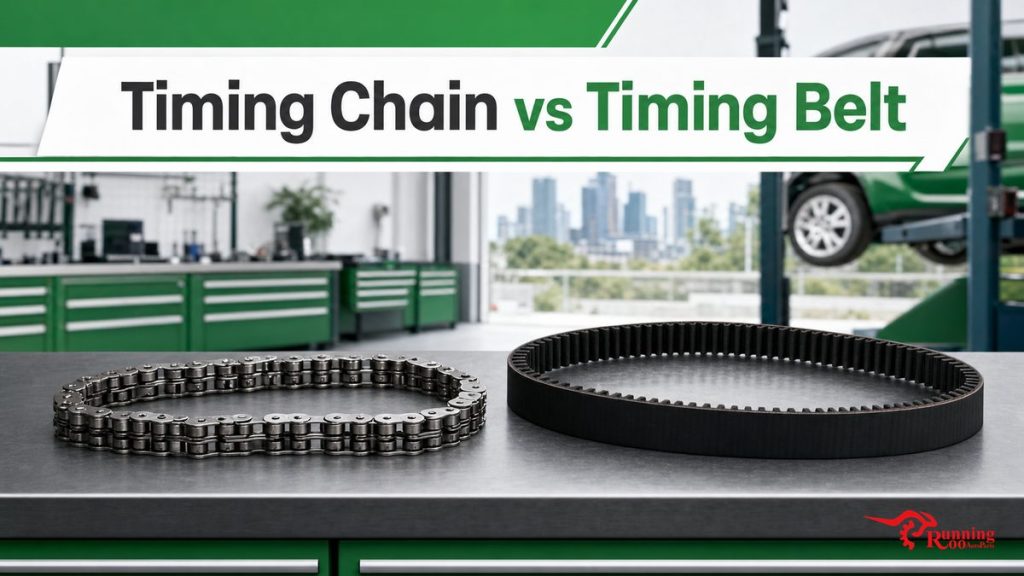
Both the chain and the belt connect the crankshaft to the camshafts so the valve timing stays synchronised with the pistons. The chain is a metal chain, lubricated by engine oil and designed to last a very long time. The belt is a reinforced rubber belt, runs dry inside a cover, and is a scheduled service item with a fixed replacement interval.
That one difference drives everything else: how the part is maintained, how it fails, and what it costs when it does. The chain is not automatically better, and the belt is not automatically worse; they are two different engineering choices with different trade-offs.
How a timing chain behaves
A timing chain is intended to last the life of the engine in ideal conditions, but it is not indestructible. Its pins and rollers wear, effectively lengthening the chain, and the tensioner that keeps it firm can wear too. The warning is usually a cold-start rattle or a camshaft-to-crankshaft correlation fault code, and the repair is a complete kit of chain, guides and tensioner.
Because the chain is lubricated by engine oil, its life is tied to the oil routine. Correct oil, changed on schedule, is the single biggest influence on how long a chain lasts.
How a timing belt behaves
A timing belt has a fixed replacement interval, usually expressed in kilometres and years, whichever comes first. It is a scheduled service item, so the failure mode is different: rather than wearing gradually with a warning, a belt that is overdue simply breaks, and on an interference engine that usually bends valves and destroys the engine.
The belt is replaced with its tensioner, idlers and often the water pump in one service, because they sit behind the same cover and are at the same stage of life. This is why a belt service is a known, budgeted event rather than a surprise.
Which engines use which
There is no brand rule, but there are broad patterns. Many modern engines, especially smaller turbocharged engines and long-life designs, use a timing chain. Many older and cost-focused engines, as well as a large number of four-cylinder designs, use a timing belt. The table below gives a rough picture, but the owner’s handbook is the only reliable answer.
| Drive type | Typical characteristics |
|---|---|
| Timing chain | Metal, oil-lubricated, long-life, no fixed interval |
| Timing belt | Rubber, dry, fixed replacement interval |
The reason the handbook matters is that the same car model can change between chain and belt across generations and markets, so a general rule will occasionally be wrong.
How to tell what your car has
The reliable ways to identify the drive type are the owner’s handbook, the service schedule, or a quick look at the engine. A chain engine usually has a metal timing cover bolted to the block, while a belt engine has a plastic or composite cover. The service schedule is the cleaner clue: a fixed belt-interval entry means a belt, while the absence of one usually means a chain.
If you are not sure, a mechanic or a supplier can confirm it from the engine code and VIN, which removes the guesswork entirely.
The cost and failure differences
The two parts fail in different ways with different costs. A belt service is a scheduled, predictable cost, while a chain replacement is usually prompted by wear and can arrive without warning. The table below summarises the practical differences.
| Factor | Timing chain | Timing belt |
|---|---|---|
| Replacement | When worn | Fixed interval |
| Early warning | Cold-start rattle, codes | Often none before breakage |
| Typical repair | Full kit | Belt, tensioner, idlers, pump |
Neither is cheaper in every case; the difference is that the belt is budgeted and the chain is discovered.
Why the “lifetime chain” claim needs care
The phrase “timing chain for the life of the engine” is often taken too literally. It describes a design intention that the chain should outlast a belt, not a guarantee that it never needs replacement. Oil neglect, heat and stop-start driving can all bring chain wear forward, so a chain should still be checked when the engine shows any sign of trouble.
Treating a chain as maintenance-free is how owners miss the cold-start rattle and end up with a jumped chain and a damaged engine.
Planning for whichever you have
The practical outcome is simple: if your car has a belt, budget for the belt service on schedule and never let it run overdue. If it has a chain, protect it with the correct oil and act on the first cold-start rattle or timing code. Both parts respond to the same principle: know what you have, and service it before it fails.
That knowledge is the cheapest insurance in engine maintenance, because the alternative to knowing is discovering the difference at the side of the road.
Interference engines and why the belt is unforgiving
The stakes of a timing failure depend on whether your engine is an interference design, and most modern engines are. In an interference engine, the valves and pistons share the same space at different times, so a broken belt or a jumped chain means the two meet and the engine is destroyed. This is why a belt that is overdue is a genuine risk rather than a service-book formality.
The belt is the more unforgiving of the two because it gives little warning before it breaks. The chain usually rattles or sets a code before it jumps, but a belt that is overdue simply lets go. That is why the belt interval is a hard deadline, not a suggestion.
A quick checklist for whichever you have
Whichever drive type your car uses, the practical checklist is short. If it has a belt, find the replacement interval in the handbook and never let it run overdue, and renew the tensioner, idlers and water pump with it. If it has a chain, use the correct oil, change it on schedule, and act on the first cold-start rattle or timing code.
The common thread is that both parts reward the owner who knows what they have and services it before it fails. The alternative is discovering the difference at the side of the road, which is the most expensive way to learn the answer.
How the drive type affects the service history
The drive type changes what a well-kept service history looks like. A belt-driven car should show the belt service performed on schedule, with the tensioner, idlers and water pump renewed, and a missing entry is a warning when buying used. A chain-driven car should show a consistent oil-change history, because the oil is the chain’s maintenance.
This is why the service history matters more than the odometer alone. A car with a complete, on-schedule belt history is a safer buy than one with fewer kilometres but no record, and the same logic applies to a chain car with a clean oil history. The record tells you how the part has been looked after.
The water pump connection
On many belt-driven engines, the water pump lives behind the same cover as the belt and is driven by it, so the two are renewed together. This is one of the reasons a belt service includes the pump, and it is a good example of how the drive type shapes the rest of the service. A chain-driven pump is less commonly part of a single scheduled job, but the same principle of renewing what is already disturbed applies.
Knowing the connection helps you read a quote, because a belt service that omits the pump is a false saving, and a pump that fails shortly after a belt service means the job has to be done again.
Frequently asked questions
What is the difference between a timing chain and a timing belt?
A chain is metal and oil-lubricated with no fixed interval, while a belt is rubber, runs dry and has a fixed replacement interval.
Which is better?
Neither is automatically better. A chain lasts longer but can still wear; a belt is cheaper to service but must be replaced on schedule.
How do I know which my car has?
Check the owner’s handbook, the service schedule or the engine cover type, or confirm by engine code and VIN.
Does a timing chain never need replacing?
It can last the life of the engine, but it can still wear and is not maintenance-free.
What happens if a timing belt breaks?
On an interference engine it usually bends valves and destroys the engine.
What should I replace with a timing belt?
The tensioner, idlers and often the water pump, because they share the same cover and service life.
What is the first sign of chain wear?
A cold-start rattle or a camshaft-to-crankshaft correlation fault code.
How do I protect either type?
Service the belt on schedule, or protect the chain with the correct oil and prompt attention to the first rattle.
Shop the products mentioned in this guide
- Timing Chain Kit for Hyundai i45 / Kia 2.4L G4KJ 2009–2017
- Timing Chain Kit for Mazda 3/5/6/Tribute 2.3L with VVT adjuster 2003–2007
- Timing Chain Kit for Nissan Teana J31/J32 VQ23DE VQ25DE VQ35DE 2003–2013
- Timing Chain Kit range — eBay
Watch on RunningRooAuto YouTube
- RunningRoo Auto Parts – trusted Melbourne parts support
- RunningRoo Auto Parts – product and fitment channel
RunningRoo Auto Parts – Based in Melbourne, Australia 🇦🇺
📞 Free 24/7 Pickup Available (Contact 0425890125)
💬 Any questions? Message or Call us anytime! We’re here to help.Why Choose RunningRoo?
✅ Aussie Owned & Operated | 🚚 Fast Shipping | 🤝 Friendly Support
Sources and further reading
- ACCC – Consumer rights and guarantees
- Product Safety Australia – vehicle recalls
- RACV – car maintenance and repair guidance
- API – Engine oil standards
- ACEA – European oil sequences
Timing-chain and timing-belt service intervals, replacement procedures and interference design are engine-specific and are set out in each manufacturer’s workshop manual and owner’s handbook. Confirm your engine code and VIN against the official repair information.
RunningRoo Auto Parts – Based in Melbourne, Australia 🇦🇺
📞 Free 24/7 Pickup Available (Contact 0425890125)
💬 Any questions? Message or Call us anytime! We’re here to help.Why Choose RunningRoo?
✅ Aussie Owned & Operated | 🚚 Fast Shipping | 🤝 Friendly Support