
By RunningRoo Auto Parts — written from the desk of our Product Manager
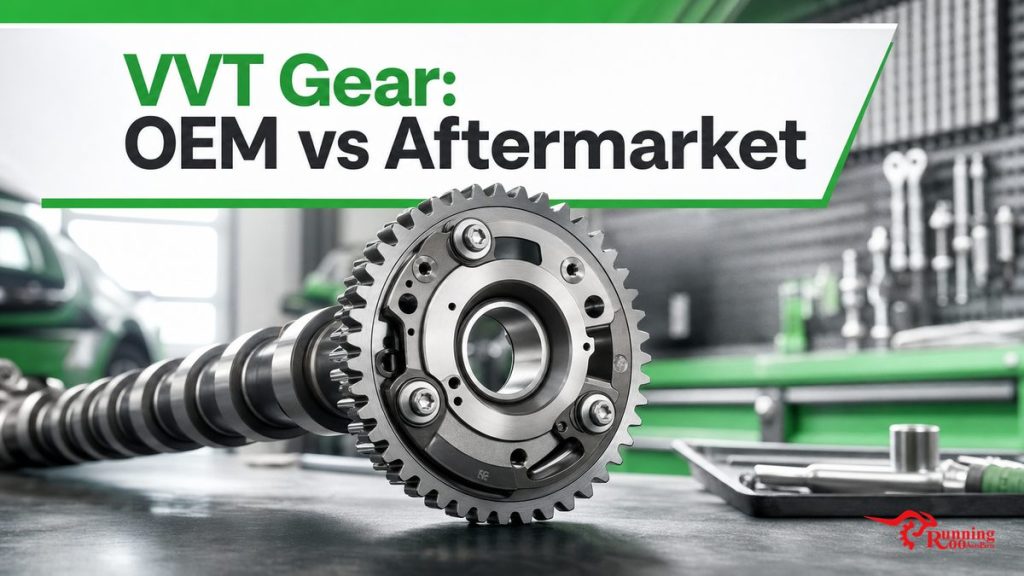
The VVT camshaft gear, or cam phaser, is a precision component that runs at engine speed under hydraulic load, and the difference between a properly made unit and a cheap copy shows up in noise, timing stability and longevity. Because the labour to reach the gear is the expensive half of the job, the gear itself is the wrong place to save a few dollars. But “OEM” and “aftermarket” are not simple good-and-bad categories, and the honest question is not which label to buy but what to look for in the part.
This guide explains the difference between genuine, OEM-quality and budget VVT gears, what to check before buying, and how to choose a part that lasts. It is written for Australian owners and workshops.
RunningRoo Auto Parts – Based in Melbourne, Australia 🇦🇺
📞 Free 24/7 Pickup Available (Contact 0425890125)
💬 Any questions? Message or Call us anytime! We’re here to help.Why Choose RunningRoo?
✅ Aussie Owned & Operated | 🚚 Fast Shipping | 🤝 Friendly Support
What the VVT gear demands from its materials
The VVT gear lives at the hottest, fastest, most oil-dependent end of the engine. Inside, close-tolerance parts slide against one another under oil pressure, and the locking pin that holds the camshaft while parked must engage and release millions of times over the life of the car. That workload demands precise machining, the correct materials and consistent tolerances.
This is why a VVT gear is not a part where “it fits, so it’s fine” applies. A unit that is a few microns out, or made from the wrong material, will rattle early, drift its timing and fail long before a properly made unit.
The three tiers of VVT gear
The market effectively offers three tiers, and each has a place depending on the vehicle and the budget.
| Tier | What it is | Typical trade-off |
|---|---|---|
| Genuine OEM | The manufacturer’s own part | Highest confidence, highest price |
| Quality aftermarket | Made to OE specification by a reputable maker | Strong value with proven quality |
| Budget unbranded | Cheapest option, unknown origin | Highest risk of early failure |
The distinction that matters is not the label but the manufacturing quality, the tolerances and the warranty behind the part.
Why a budget gear is usually the most expensive
The labour to reach a VVT gear is significant, so a cheap gear that fails early costs the labour twice. The failure is rarely subtle: an early rattle, a timing code or a loss of power, followed by another teardown to do the job again. The few dollars saved on the part are dwarfed by the second labour bill.
This is the same logic that applies to the timing chain and tensioner. On parts buried behind covers and timed precisely, the part is the cheap half of the job and the labour is the expensive half, so quality is the economical choice.
What to look for in a quality gear
When choosing a VVT gear, look for clear engine-code fitment, a known and reputable manufacturer, OE-equivalent construction and tolerances, and a written warranty. The listing should state the exact part number, the engine code and the side, not just the model name. A supplier who asks for the VIN and engine code before quoting is doing the right thing.
The table below summarises the checks that separate a quality part from a gamble.
| Check | Why it matters |
|---|---|
| Exact part number and engine code | Confirms the right gear and side |
| Reputable manufacturer | Consistent quality and tolerances |
| OE-equivalent construction | Correct materials and machining |
| Written warranty | Backs the part if it fails |
Any part that cannot pass these checks is a risk regardless of its price.
The role of the oil-control solenoid
The VVT gear is only half of the system; the oil-control solenoid is the other half, and a failing solenoid can destroy a new gear by feeding it the wrong oil pressure at the wrong time. For that reason, the solenoid should be renewed at the same time where there is any doubt, and it should come from the same quality standard as the gear.
A quality gear paired with a tired solenoid is still a compromised repair, because the solenoid is the part that commands the gear. Renewing both together is the way to make the job last.
Fitment confirmation before you buy
The most common cause of a wrong VVT gear is ordering by model name rather than by part number. Engines change mid-production, and the same model can carry different gears across years and markets. Before ordering, collect the engine code, the VIN, the original part number and the side that needs replacing.
A supplier who confirms those details and supplies the correct side first time is worth more than a cheaper listing that guesses. The cheapest advertised price is meaningless if the part is wrong.
Warranty and Australian Consumer Law
Under Australian Consumer Law, parts must be of acceptable quality and fit for purpose, and a written warranty is part of that protection. Buying from a reputable local supplier with clear engine-code fitment and a written warranty gives you recourse if the part fails, which an anonymous online bargain rarely provides.
The warranty is also a signal of confidence: a supplier who stands behind a VVT gear in writing is far more likely to be selling a properly made unit than one who disappears after the sale.
What “OE-equivalent” actually means
The term “OE-equivalent” is used a lot and means different things depending on who is saying it. At its best, it means a part manufactured to the same specification and tolerances as the original, by a reputable maker who tests its output. At its worst, it is marketing language on a part of unknown origin. The label alone is therefore not enough; the manufacturer, the stated tolerances and the warranty are what give the term substance.
The practical test is simple: does the supplier state the exact part number and engine code, name a known manufacturer, and provide a written warranty? A part that passes those three checks is far more likely to be a genuine OE-equivalent than one that only carries the phrase.
How Australian conditions affect VVT gear life
Australian conditions shorten the life of a poorly made VVT gear faster than a mild climate would, because the gear runs in hot oil and is actuated by oil pressure. Sustained heat accelerates oil degradation, and degraded oil wears the gear’s internal surfaces and locking pin more quickly. A budget gear with loose tolerances is therefore exposed sooner on Australian roads than it would be elsewhere.
This is another argument for quality. The gear is buried behind the timing cover, and reaching it is expensive, so a part that fails early in a hot climate costs the labour twice. The correct oil and a quality gear are the two halves of making the VVT system last in Australian conditions.
The cost of doing it twice
The clearest way to frame the OEM-versus-aftermarket decision is the cost of doing the job twice. The VVT gear is the cheap half of the job and the labour is the expensive half, so a budget gear that fails early turns a single repair into two labour bills. The second teardown is not a risk worth taking to save a small amount on the part.
This is why the part is the wrong place to economise. A quality gear with confirmed fitment and a written warranty is the economical choice, because it is the choice that most likely needs to be made only once.
The oil-change habit that protects a new gear
Whatever tier of VVT gear you choose, its life is decided largely by the oil that feeds it. The gear is moved by engine oil pressure, so the correct specification and a clean supply are what keep the new part quiet and stable. A fresh oil and filter change at the time of the gear replacement is therefore not a nicety; it is part of the repair.
After the job, the same discipline protects the investment: use the oil the manufacturer specifies, change it on schedule, and investigate any new cold-start rattle promptly. A quality gear in a sludged engine is still a compromised repair, because the oil is the one variable you control every service.
Making the decision
The decision between OEM and aftermarket is really a decision about risk and confidence, not about brand loyalty. A genuine part is the highest-confidence option, but a quality aftermarket gear from a known manufacturer, with confirmed fitment and a written warranty, is a sound and often better-value choice for a daily driver.
The part to avoid is the one with no name, no stated fitment and no warranty, because its failure is paid in labour rather than in the part price. Choose the gear that you would trust to stay quiet and stable for years, because that is exactly what you are paying the labour to fit.
Frequently asked questions
Is a genuine OEM VVT gear always better?
It is the highest-confidence option, but a quality aftermarket gear made to OE specification can be excellent value.
What is wrong with a budget VVT gear?
Unknown origin, loose tolerances and poor materials often mean early failure and a second labour bill.
What should I check before buying?
The exact part number, engine code, side, manufacturer reputation and written warranty.
Should I replace the oil-control solenoid with the gear?
Yes, if there is any doubt, because a failing solenoid can damage a new gear.
How do I confirm the right gear?
Use the engine code, VIN, original part number and the side that needs replacing.
Why is the part not the place to save money?
Because the labour to reach it is the expensive half, and an early failure means paying the labour twice.
Does the warranty matter?
Yes. A written warranty is part of your protection under Australian Consumer Law and a signal of the supplier’s confidence.
Can I fit a VVT gear myself?
The mechanical work is possible for a skilled DIYer, but the timing must be set and verified exactly.
Shop the products mentioned in this guide
- VVT Camshaft Gears Intake & Exhaust for Toyota Corolla 2007–2012 1.8L 2ZR-FE
- CVVT Timing Camshaft Gear for Hyundai Veloster / Tucson / Elantra 24370-2B700
- Engine VVT Timing Oil Control Valve for Mercedes-Benz SLK250 W204 A2710500578
- VVT gears and oil control valves on eBay
Watch on RunningRooAuto YouTube
- RunningRoo Auto Parts – trusted Melbourne parts support
- RunningRoo Auto Parts – product and fitment channel
RunningRoo Auto Parts – Based in Melbourne, Australia 🇦🇺
📞 Free 24/7 Pickup Available (Contact 0425890125)
💬 Any questions? Message or Call us anytime! We’re here to help.Why Choose RunningRoo?
✅ Aussie Owned & Operated | 🚚 Fast Shipping | 🤝 Friendly Support
Sources and further reading
- ACCC – Consumer rights and guarantees
- Product Safety Australia – vehicle recalls
- RACV – car maintenance and repair guidance
- API – Engine oil standards
- ACEA – European oil sequences
VVT gear part numbers, construction tolerances, oil-control-solenoid operation and timing procedures are engine-specific and are described in each manufacturer’s workshop manual. Confirm your engine code, VIN and the correct side against the official repair information before ordering.
RunningRoo Auto Parts – Based in Melbourne, Australia 🇦🇺
📞 Free 24/7 Pickup Available (Contact 0425890125)
💬 Any questions? Message or Call us anytime! We’re here to help.Why Choose RunningRoo?
✅ Aussie Owned & Operated | 🚚 Fast Shipping | 🤝 Friendly Support