
By RunningRoo Auto Parts — written from the desk of our Product Manager
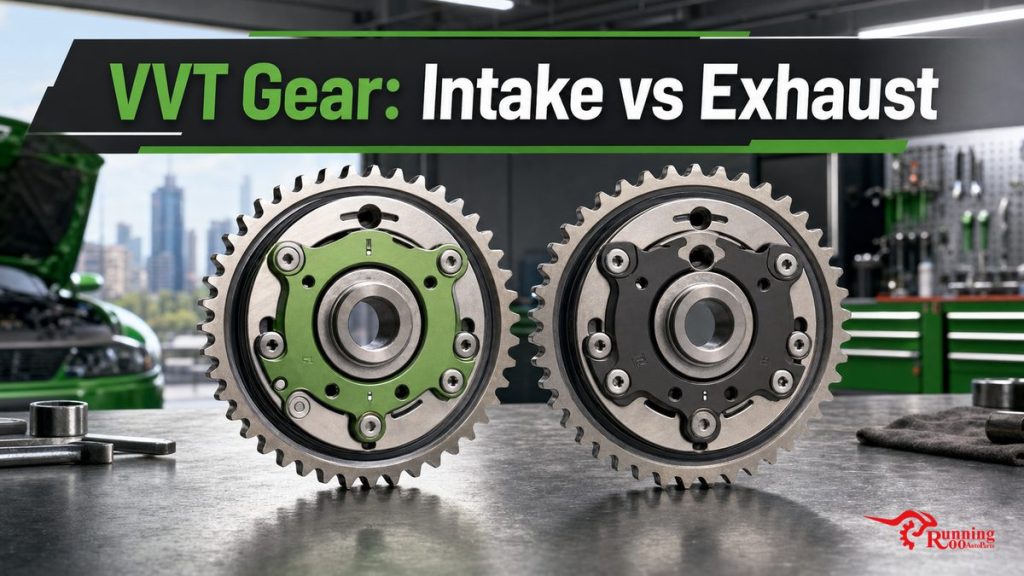
When a VVT camshaft gear, or cam phaser, is diagnosed as faulty, the natural next question is which one to order, and this is where a surprisingly common mistake happens. Many engines use a VVT gear on both the intake and exhaust camshafts, and the two are not always the same part. They can differ in direction of rotation, in the position of the oil passages, in the part number, and in how they are timed, and fitting the wrong side can produce poor running, fault codes or worse.
This guide explains why the intake and exhaust VVT gears can differ, how to confirm the correct side, and how to order the right part the first time. It is written for Australian owners and workshops.
RunningRoo Auto Parts – Based in Melbourne, Australia 🇦🇺
📞 Free 24/7 Pickup Available (Contact 0425890125)
💬 Any questions? Message or Call us anytime! We’re here to help.Why Choose RunningRoo?
✅ Aussie Owned & Operated | 🚚 Fast Shipping | 🤝 Friendly Support
What a VVT gear does on each camshaft
The VVT gear sits on the end of a camshaft and is driven by the timing chain or belt. Inside, an oil-pressure-actuated mechanism lets the engine computer rotate the camshaft slightly relative to its sprocket, advancing or retarding the valve timing. The intake side and the exhaust side are controlled independently because the engine benefits from different timing strategies on each.
That independent control is the first clue that the two gears are not necessarily identical. They are doing similar work, but they are doing it on different camshafts, rotating in relation to different valve events, and often built to different specifications.
When the two sides are the same
On some engines the intake and exhaust VVT gears are the same part number and are genuinely interchangeable. This is more common on engines where both camshafts use an identical phaser design and the direction of adjustment is handled by the oil-control solenoid rather than by the gear itself. In those cases, the same gear can be fitted to either camshaft without issue.
The key word is “some”. Whether the two sides are the same is decided by the engine’s design, not by a general rule, which is why the part number is always the final word.
When the two sides are different
On many engines the intake and exhaust gears are different part numbers and are not interchangeable. They may be mirror images of each other, rotate in opposite directions, or have oil passages and internal stops in different positions so that the direction of adjustment is correct for that camshaft. Fitting an intake gear to the exhaust camshaft, or vice versa, can produce incorrect timing, fault codes and rough running.
The table below summarises how the two sides can differ.
| Difference | Why it matters |
|---|---|
| Different part number | The two sides are not interchangeable |
| Mirror-image construction | Direction of rotation differs |
| Different oil passages | Adjustment direction is camshaft-specific |
| Different timing marks | Timing must match the correct side |
Any one of these differences is enough to make the wrong-side gear a costly mistake.
How to confirm the correct side
The reliable way is to confirm the part number and side against the engine code and VIN. The engine code identifies the exact build, and the part number identifies the exact gear, including whether it is an intake or exhaust unit. When a gear is listed with a note such as “intake” or “exhaust”, that note is part of the specification, not an optional detail.
Where the two sides carry the same part number, the supplier can confirm that it is genuinely interchangeable. Where they differ, ordering by engine code and side is the only way to get it right.
What happens if the wrong side is fitted
Fitting the wrong-side VVT gear usually produces symptoms that appear immediately or shortly after. The engine may set camshaft position codes, run roughly, idle poorly or lose power, because the valve timing is being adjusted in the wrong direction. In the worst case, an interference engine can be damaged if the incorrect gear allows the timing to move far enough.
This is why the side matters as much as the engine. A gear that fits physically is not necessarily the right gear, and physical fit is not proof of compatibility.
Ordering the right part the first time
Before ordering, collect the engine code, the VIN, the original part number and the side that needs replacing. A good supplier will want that information and will be able to tell you whether the intake and exhaust gears are the same or different for your engine. If the original part number is not available, a diagnostic scan and the vehicle’s build data can usually recover the correct side and number.
The same discipline applies to the oil-control solenoid, which may also be side-specific on some engines and should be renewed where there is any doubt.
Replacing one side or both
When one VVT gear has failed, the question is whether to replace only that side or both. The answer depends on the engine and the condition of the other gear. On some engines the gears wear at a similar rate and are best replaced as a pair while the engine is open. On others, replacing only the failed side is acceptable provided the other gear is within specification.
The honest approach is to inspect the other gear once the cover is off and to let its condition decide. Replacing one side because it failed while leaving a worn gear on the other side is a repair that invites a second teardown.
How the direction of adjustment works
The reason the two sides often differ comes down to the direction the camshaft is adjusted. The intake camshaft is typically advanced or retarded in a different direction from the exhaust camshaft to achieve the valve-overlap the engine wants, and that direction is often built into the gear itself through the position of its oil passages and internal stops. This is why a gear can look identical in a photo and still be the wrong side.
On engines where the direction is controlled by the oil-control solenoid instead of the gear, the two sides may share a part number. This is why the only reliable answer comes from the engine’s design and the part number, not from a visual comparison of the two gears.
Real-world examples of side-specific gears
The intake-versus-exhaust difference is easiest to see in the parts catalogues, where a single engine will list two different VVT gear part numbers, one marked intake and one marked exhaust. The catalogues exist precisely because the parts are not interchangeable, and the note “intake” or “exhaust” is a fitment requirement rather than a suggestion.
This is also why a supplier who asks which side you need is doing the right thing. The question is not fussiness; it is the difference between a gear that times the camshaft correctly and one that produces fault codes from the first start.
Confirming the side with a diagnostic scan
When the original gear is still fitted and the part number is hard to read, a diagnostic scan is the next best way to identify the correct side. The engine management system usually stores which camshaft set the fault code, and that tells you whether the intake or exhaust side is the one that needs replacing. Combined with the engine code and VIN, that information is enough for a supplier to confirm the correct part.
The scan is worth doing even when you think you know the answer, because it removes the guesswork that leads to ordering the wrong side. A few minutes on the diagnostic tool is far cheaper than a gear that arrives, gets fitted and then has to be swapped back out.
Replacing the oil-control solenoid with the gear
The VVT gear is only half of the system, and the oil-control solenoid is the other half. When the gear is being replaced, the solenoid should be renewed at the same time where there is any doubt, because a failing solenoid can damage a new gear by feeding it the wrong oil pressure. The solenoid is cheap relative to the gear and to the labour of reaching it.
This is the same logic as replacing the chain and tensioner together: the parts share an oil supply and a service life, and renewing the whole working set while the engine is open is how you avoid a second teardown.
A final check before you order
Before you commit to a VVT gear, put the answer to three questions in writing: which camshaft is affected, what is the engine code, and what is the original part number. Give those three to the supplier and ask them to confirm whether the intake and exhaust gears are the same or different for your engine.
That one exchange removes the most common and most expensive mistake in VVT gear ordering, and it costs you nothing. A correct side, confirmed once, is worth far more than a cheaper part that arrives wrong and has to be returned.
Frequently asked questions
Are the intake and exhaust VVT gears the same?
On some engines yes, on many engines no. The part number and engine code decide.
How do I know if I need an intake or exhaust gear?
Confirm the failed side by diagnosis, then match the part number and side against the engine code and VIN.
What happens if I fit the wrong side?
The engine may set camshaft position codes, run roughly or lose power, and an interference engine can be damaged.
Can I use the same part number on both sides?
Only if the part number is genuinely the same for both sides on your specific engine.
Should I replace both gears at once?
On engines where the two wear at a similar rate, yes. Otherwise, inspect the other gear and decide on its condition.
Is the oil-control solenoid side-specific too?
On some engines yes. Confirm the correct solenoid with the engine code.
How do I confirm the correct gear?
Use the engine code, VIN, original part number and the side that needs replacing.
Why does physical fit not mean compatibility?
Because a mirror-image or direction-specific gear can bolt on yet still time the camshaft incorrectly.
Shop the products mentioned in this guide
- 2-Piece Camshaft Adjusters for Mitsubishi Lancer Evo X 2.0 / ASX / Outlander 4B11 1147
- CVVT Timing Camshaft Gear for Hyundai Veloster / Tucson / Elantra 24370-2B700
- VVT Camshaft Gears Intake & Exhaust for Toyota Corolla 2007–2012 1.8L 2ZR-FE
- VVT camshaft gears on eBay
Watch on RunningRooAuto YouTube
- RunningRoo Auto Parts – trusted Melbourne parts support
- RunningRoo Auto Parts – product and fitment channel
RunningRoo Auto Parts – Based in Melbourne, Australia 🇦🇺
📞 Free 24/7 Pickup Available (Contact 0425890125)
💬 Any questions? Message or Call us anytime! We’re here to help.Why Choose RunningRoo?
✅ Aussie Owned & Operated | 🚚 Fast Shipping | 🤝 Friendly Support
Sources and further reading
- ACCC – Consumer rights and guarantees
- Product Safety Australia – vehicle recalls
- RACV – car maintenance and repair guidance
- API – Engine oil standards
- ACEA – European oil sequences
VVT gear part numbers, intake/exhaust differences and timing procedures are engine-specific and are described in each manufacturer’s workshop manual. Confirm your engine code, VIN and the correct side against the official repair information before ordering.
RunningRoo Auto Parts – Based in Melbourne, Australia 🇦🇺
📞 Free 24/7 Pickup Available (Contact 0425890125)
💬 Any questions? Message or Call us anytime! We’re here to help.Why Choose RunningRoo?
✅ Aussie Owned & Operated | 🚚 Fast Shipping | 🤝 Friendly Support