
By RunningRoo Auto Parts — written from the desk of our Product Manager
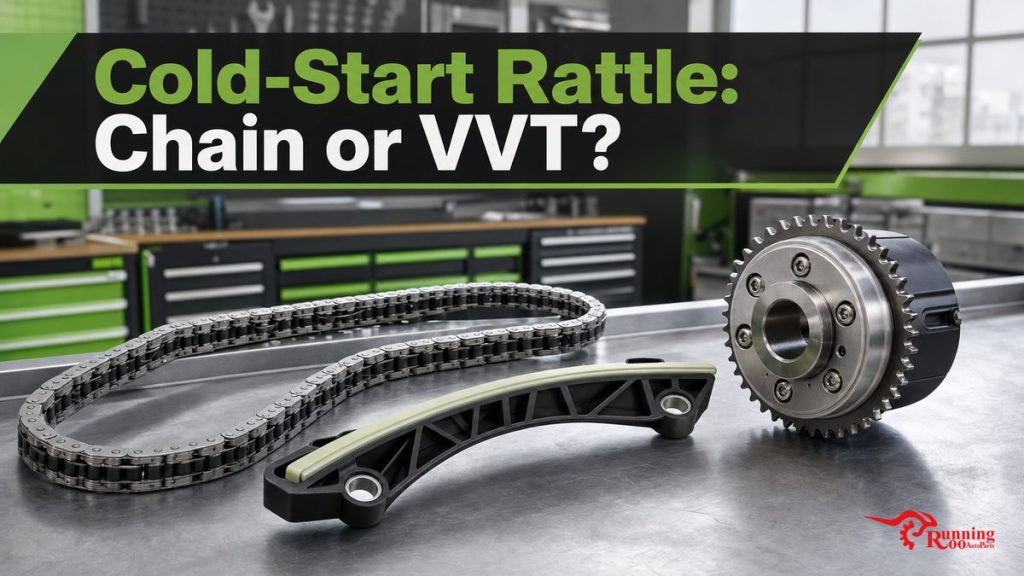
The first cold start of the morning is the most honest moment in an engine’s day. Before oil pressure builds and the warm idle hides a dozen small faults, the timing system reveals itself, and the most common revelation is a brief rattle that disappears within a second or two. That rattle is a warning, but it is a warning with three possible senders: the timing chain, the VVT gear, or the tensioner. They live together, they make a similar noise, and they wear together, which makes “which one is it?” the question that decides how much the repair costs.
This guide explains how each of the three fails, how their noises differ, and how a workshop separates them by measurement rather than guesswork. It is written for Australian owners who have heard the rattle and want to act before it becomes expensive.
RunningRoo Auto Parts – Based in Melbourne, Australia 🇦🇺
📞 Free 24/7 Pickup Available (Contact 0425890125)
💬 Any questions? Message or Call us anytime! We’re here to help.Why Choose RunningRoo?
✅ Aussie Owned & Operated | 🚚 Fast Shipping | 🤝 Friendly Support
Why the noise happens on cold start
The timing chain, its tensioner and the VVT gear all rely on engine oil pressure to work quietly. When the engine is parked overnight, that oil drains away and pressure is zero. The tensioner must hold the chain firm using only its mechanical ratchet or spring, and the VVT gear must hold its camshaft position using only its locking pin. If either of those parked holds has worn, the first second of running produces a rattle until oil pressure builds and masks the problem.
This is why the same engine can rattle on a cold morning yet behave perfectly once warm. The noise is not intermittent bad luck; it is a mechanical hold that is losing its grip, and it will get worse.
How the tensioner fails
The hydraulic tensioner holds the chain tight using oil pressure while running and a ratchet or spring while parked. When its internal seal or ratchet wears, it loses the parked hold, and the chain slaps against the guide for the first second or two until pressure arrives. The classic signature is a rattle that lasts one to three seconds, is loudest on the first start of the day, and disappears completely once warm.
The tensioner is the cheapest of the three parts to suspect, and on some engines it can be replaced on its own if the chain and guides are still within specification. On many engines, however, it sits behind the timing cover and the chain and guides are worn with it, so the repair becomes a kit.
How the chain itself fails
The chain does not “stretch” like rubber; its pins and rollers wear, increasing the pitch so the chain is effectively longer. That extra length exceeds what the tensioner can take up, and the result is a rattle that may not fully disappear once warm, along with camshaft-to-crankshaft correlation fault codes as the engine computer notices the timing drift.
A chain that has worn enough to rattle warm is well past its service limit, and the repair is a complete timing kit. The chain, guides and tensioner have all worn together, and replacing only the chain would leave the new part running on worn guides and a tired tensioner.
How the VVT gear fails
The VVT gear, or cam phaser, holds its camshaft in a fixed position while parked using a locking pin. When that pin or its bore wears, the gear rattles for a second or two on cold start, in a way that is almost identical to a tensioner rattle. The difference tends to appear in the fault codes: a VVT gear fault often produces camshaft over-advanced or over-retarded codes, while chain stretch produces correlation codes.
Because the VVT gear and the timing chain share the same oil, load and service life, they often wear together, which is why a VVT gear replacement is so frequently combined with a chain service.
Comparing the three noises
The table below summarises the tendencies of each failure mode, but it is a guide, not a diagnosis. The final answer always comes from measurement.
| Part | Typical noise | Typical fault codes |
|---|---|---|
| Tensioner | Rattle for 1–3 seconds, cold only | Often none at first |
| Timing chain | Rattle that may persist warm | Cam/crank correlation codes |
| VVT gear | Brief cold rattle, may change warm | Cam over-advanced / retarded codes |
The overlap between these rows is exactly why listening alone is not enough.
What the fault codes reveal
A full scan, including stored codes that have not yet lit the warning light, is the cheapest high-value step in the diagnosis. Correlation codes point to chain stretch or a jumped tooth. Camshaft over-advanced or over-retarded codes point to the VVT system. A “no communication” code may have nothing to do with the timing system and can be caused by a weak battery or damaged wiring.
Recording the exact codes and freeze-frame data before any parts are ordered gives a supplier the information needed to confirm the right repair and fitment.
Measuring instead of guessing
The reliable way to separate the three is measurement. A workshop measures the crankshaft-to-camshaft correlation to quantify chain stretch, tests the oil-control solenoid, checks oil pressure and, once the cover is off, inspects the tensioner extension and the condition of the guides. This sequence rules out the cheap causes before condemning the expensive part.
The value of this discipline is that it prevents the two classic mistakes: replacing a good VVT gear when the tensioner was the fault, and replacing the tensioner alone when the chain and guides were also worn. Both mistakes produce a repeat visit, which is the most expensive outcome of all.
The risk of ignoring the rattle
The rattle will not heal itself, and every cold start with a slack chain or a loose gear adds wear and risk. On an interference engine, a chain that jumps a tooth can bend valves and destroy the engine, turning a few hundred dollars of parts into a multi-thousand-dollar rebuild. The cheapest moment to act is always the first morning you hear the noise.
Treating the rattle as a “wait and see” item is the single most expensive mistake an owner can make, because the part that fails silently until it is too late gives only one reliable warning, and it is that brief cold-start noise.
The oil-pressure check
Because all three possible causes of the rattle depend on oil, a proper diagnosis checks the oil first. The workshop confirms the oil level, the condition of the oil and, where relevant, the oil pressure against the manufacturer’s specification. A tensioner that is simply struggling with low or dirty oil may quieten after a fresh oil and filter change, which is the cheapest possible outcome and the reason the oil is checked before any parts are condemned.
If the oil is clean and the level and pressure are correct, the diagnosis moves on to the correlation measurement and the physical inspection. That order protects your wallet, because it tests the cheap and likely causes before the expensive part.
Interference engines and why urgency matters
The urgency of a cold-start rattle depends heavily on whether your engine is an interference design. In an interference engine, the valves and pistons share the same space at different times, so a chain that jumps or a gear that lets go usually means the two meet and the engine is destroyed. Most modern engines are interference designs, which is why the rattle should never be treated as a “wait and see” item.
Knowing your engine’s type, and acting on the first reliable sign of trouble, is the practical difference between a timing kit and a replacement engine. The rattle is the cheapest warning you will ever get, and it is the one most worth taking seriously.
When the repair is a kit rather than one part
Because the chain, the guides and the tensioner wear together, the most common correct repair is a complete kit rather than a single part. There are legitimate exceptions: a low-kilometre engine with a single failed tensioner and a chain still within specification can have just the tensioner replaced. But on a high-kilometre engine, the answer is almost always the kit.
The decisive factors are the measured chain stretch, the condition of the guides and the extension of the tensioner. Those measurements, not the noise alone, determine whether a partial repair will last or whether it will return within a year, and a workshop that explains those measurements is giving you an honest answer.
Frequently asked questions
Why does my engine only rattle when it is cold?
Because oil pressure builds once the engine runs and temporarily takes up the slack that a worn tensioner or VVT gear can no longer hold overnight.
How do I tell the chain, the tensioner and the VVT gear apart?
The noise timing and the fault codes give strong clues, but a physical inspection and correlation measurement confirm it.
Are the chain, guides and tensioner usually worn together?
Yes. They are a matched wear set, which is why the repair is so often a complete kit.
Can a VVT gear rattle sound like a tensioner rattle?
Yes. The two are nearly identical on cold start, which is why diagnosis must use codes and measurement rather than sound alone.
What fault codes point to timing chain wear?
Camshaft-to-crankshaft correlation codes point to chain stretch or skipped timing.
Can I keep driving with a cold-start rattle?
Only to a workshop, and carefully. The rattle can precede a jumped chain and engine damage.
How do I avoid paying twice?
Have the fault measured and diagnosed properly, then repair the whole worn set in one job.
When should I act?
At the first reliable sign of a cold-start rattle, before the wear spreads to the rest of the timing system.
Shop the products mentioned in this guide
- New Mercedes-Benz M271 Kompressor C200/CLK200 Timing Chain Tensioner 2710500611
- Timing Chain Tensioner Kit for Audi A1/A3, VW Golf 1.4 FSI/TSI 1.6 FSI
- Timing Chain Tensioner W0133-1807048-NTN for Honda S2000 2.0L 2000–2009
- Timing chain tensioners and kits on eBay
Watch on RunningRooAuto YouTube
- RunningRoo Auto Parts – trusted Melbourne parts support
- RunningRoo Auto Parts – product and fitment channel
RunningRoo Auto Parts – Based in Melbourne, Australia 🇦🇺
📞 Free 24/7 Pickup Available (Contact 0425890125)
💬 Any questions? Message or Call us anytime! We’re here to help.Why Choose RunningRoo?
✅ Aussie Owned & Operated | 🚚 Fast Shipping | 🤝 Friendly Support
Sources and further reading
- ACCC – Consumer rights and guarantees
- Product Safety Australia – vehicle recalls
- RACV – car maintenance and repair guidance
- API – Engine oil standards
- ACEA – European oil sequences
Timing-chain wear limits, tensioner operation and VVT-system diagnosis are engine-specific and are described in each manufacturer’s workshop manual. Confirm your engine code and VIN against the official repair information before diagnosis or replacement.
RunningRoo Auto Parts – Based in Melbourne, Australia 🇦🇺
📞 Free 24/7 Pickup Available (Contact 0425890125)
💬 Any questions? Message or Call us anytime! We’re here to help.Why Choose RunningRoo?
✅ Aussie Owned & Operated | 🚚 Fast Shipping | 🤝 Friendly Support