
By RunningRoo Auto Parts — written from the desk of our Product Manager
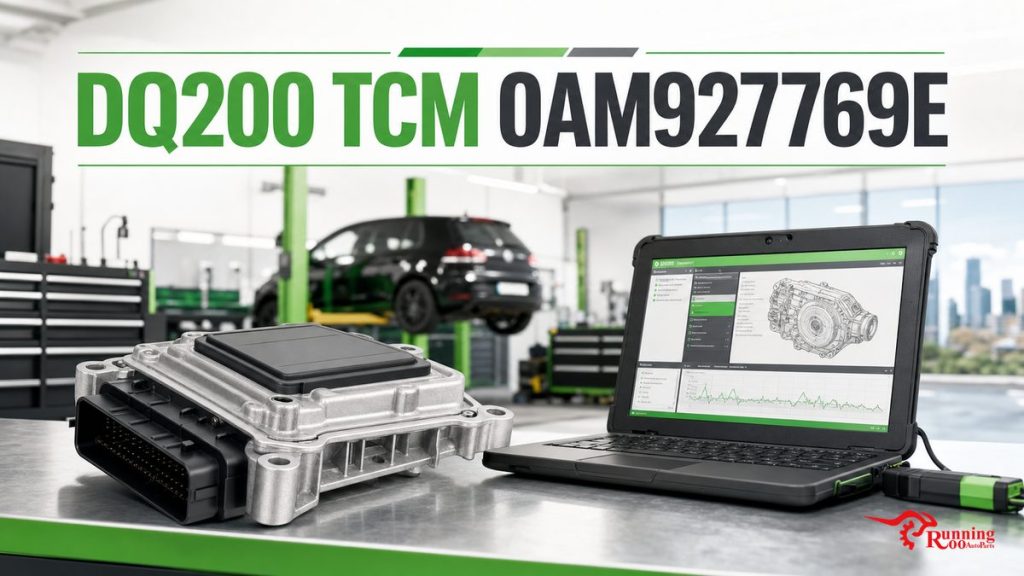
The DQ200 transmission control module, the small computer that governs every shift of Volkswagen Group’s seven-speed dual-clutch gearbox, is one of the most misdiagnosed parts in the modern workshop. When a DQ200 flashes its gear indicator, refuses to select gears or drops into limp mode, the TCM is often the first suspect, but it is not always the real culprit. The 0AM927769E version, one of the most frequently searched part numbers, is especially easy to condemn prematurely.
This guide is a working checklist. It takes you through the diagnosis in the correct order, then through the replacement and coding steps, so you replace the TCM only when it genuinely needs replacing and do the job correctly the first time. It is written for Australian owners and workshops.
RunningRoo Auto Parts – Based in Melbourne, Australia 🇦🇺
📞 Free 24/7 Pickup Available (Contact 0425890125)
💬 Any questions? Message or Call us anytime! We’re here to help.Why Choose RunningRoo?
✅ Aussie Owned & Operated | 🚚 Fast Shipping | 🤝 Friendly Support
What the 0AM927769E TCM actually is
The 0AM927769E part number identifies a specific revision of the DQ200 transmission control module. The TCM lives inside the mechatronic, reads the gearbox sensors, decides when and how to shift, and drives the solenoid valves that operate the clutches and selectors. Because it carries software, coding and component-protection data, it is a computer as much as it is a gearbox part.
The suffix E identifies a particular hardware and software family. It is not automatically interchangeable with a D, G or K suffix, which is why the part number printed on the original unit, together with the gearbox code and VIN, is the only reliable specification.
Step 1: check the battery and wiring first
Before anything else, check the battery and the wiring. A weak or failing battery is a surprisingly common cause of “no communication” codes and flashing PRNDS lights on the DQ200, and a damaged loom can produce exactly the same symptoms as a dead TCM. The battery should be load-tested and the connectors and earth points inspected for corrosion, damage and tightness.
This step costs almost nothing and saves many owners from replacing a perfectly good TCM. A full scan should be done next, reading both current and stored fault codes, because stored codes often reveal the real story before the warning light ever came on.
Step 2: read and interpret the fault codes
The fault codes are the map of the problem, but they need to be read in context. A “no communication with TCM” code points to power, wiring or the module itself. A gear-ratio or clutch code points elsewhere in the gearbox. Recording the exact codes, the freeze-frame data and the software version gives a supplier the information needed to confirm fitment and the coding path.
| Code type | What it usually points to |
|---|---|
| No communication with TCM | Battery, wiring, connector or failed module |
| Clutch / gear-ratio fault | Clutch pack or mechatronic hydraulic side |
| Component protection active | Coding / matching required |
| Camshaft or engine codes | Unrelated system — check separately |
The key discipline is not to condemn the TCM on a single “no communication” code without first proving the power supply and wiring are healthy.
Step 3: watch the live data
If the TCM is communicating, watch the live data while the gearbox is driven or cycled. Look for implausible sensor readings, lost communication, sticking solenoids or clutch-adaptation values that have run out of range. Live data is what separates a genuine electronic fault from a hydraulic or mechanical one, and it is the cheapest high-value step in the whole diagnosis.
On the DQ200, the clutch adaption values are particularly useful. Values that have reached the end of their range often point to clutch wear or a mechatronic hydraulic fault rather than the TCM electronics.
Step 4: confirm the correct part number
Once the TCM is genuinely the suspect, confirm the part number before ordering. Collect the number printed on the original module, the gearbox code, the VIN and the current software version. With those four facts, a competent supplier can confirm whether the unit you are buying is a direct match or a legitimate supersession.
Ordering by model name alone is the classic way to receive a module that does not code. The suffix and the generation both matter, and neither should be assumed.
Step 5: choose the right replacement
The three buying options carry different risk and price profiles, and the choice depends on the vehicle’s age and value.
| Option | Part cost | Coding labour | Overall risk |
|---|---|---|---|
| Tested used TCM | Lower | Fixed | Moderate; confirm warranty |
| Remanufactured TCM | Mid | Fixed | Lower; wear items replaced |
| New genuine TCM | Higher | Fixed | Lowest |
For an older daily driver, a tested or remanufactured module with a written warranty is usually the sensible middle ground. The part’s reliability matters more than a modest price difference, because the coding labour is the same regardless.
Step 6: the replacement and coding steps
After the correct module is fitted, three electronic steps are required before the car will drive properly. Component protection must be removed, the module coded to the vehicle, and a basic-settings routine performed so the gearbox relearns the clutch and fork positions. None of these happen automatically just by bolting the part in.
The gearbox oil should be renewed at the same time, because the hydraulic side of the mechatronic depends on clean oil. If the vehicle has an outstanding software update, this is the ideal moment to apply it, because the gearbox is already being coded.
Step 7: verify the repair
The repair is only complete when the fault codes are clear, the gearbox selects every gear smoothly, and a cold and warm drive confirm the fault has not returned. Shifts may feel slightly different for the first few drives and then settle as the clutches and selectors adapt. A quality supplier will support you through that process rather than disappearing after the sale.
If the fault returns after coding, the diagnosis was incomplete and the real problem was elsewhere in the gearbox. That is why the pre-replacement checks in this list matter so much.
What to expect after the module is fitted
Once the correct module is fitted, coded and given its basic settings, the gearbox will perform a relearning process over the first few drives. Shifts may feel slightly different at first and then settle as the clutches and selectors adapt to the new module. This is normal, and it is one reason the repair should be verified with a road test rather than declared finished at the workshop door.
The job is only complete when the fault codes are clear, every gear selects smoothly, and a cold and warm drive confirm the original fault has not returned. If the fault comes back after coding, the pre-replacement checks were not thorough enough and the real problem was elsewhere in the gearbox, so the diagnosis should be revisited rather than the module replaced again.
Getting a second opinion before a big quote
A TCM replacement involves a part and a coding bill, so it is reasonable to want a second opinion. The right way to ask is not “is your price cheaper?” but “what did you check, and what exactly is in the quote?” A trustworthy workshop will explain the battery and wiring checks, the fault codes, the part-number confirmation and the coding steps, and will be happy for you to confirm the fitment.
What you are looking for is a diagnosis that is complete but not padded. A quote that includes the module, the coding and a fresh gearbox oil change is usually honest; a quote that skips the diagnosis and jumps straight to a part is where you should ask more questions. The cheapest quote and the most expensive are both wrong if neither is based on a proper check.
The most common mistakes that cost owners money
The first mistake is condemning the module without checking the battery and wiring, because a weak battery is a frequent cause of “no communication” codes. The second is ordering by model name rather than part number. The third is assuming that because a unit fits physically, it will code electronically; physical fit and electronic compatibility are separate questions. The fourth is skipping the gearbox oil change when the module is replaced.
Avoiding these four mistakes does more to control the cost of a DQ200 repair than shopping around for the cheapest part, because each mistake tends to produce a second visit and a second labour bill. The checklist in this guide exists to keep you out of those traps.
Frequently asked questions
What does the E in 0AM927769E mean?
It identifies a specific hardware and software revision of the DQ200 TCM. Different suffixes are not automatically interchangeable.
Should I check the battery before replacing the TCM?
Yes. A weak battery or damaged wiring can produce a “no communication” code that looks exactly like a failed module.
How do I confirm the correct TCM?
Use the part number printed on the original unit, the gearbox code, the VIN and the current software version.
Does a replacement TCM need coding?
Yes. Component protection removal, coding and basic settings are all required.
Should I change the gearbox oil with the TCM?
Yes. The oil should be renewed and the level set correctly as part of the job.
Can I code the TCM myself?
Mechanical fit is possible for a skilled DIYer, but coding, component protection and basic settings need specialist equipment and experience.
What is component protection?
It is a Volkswagen Group security feature that prevents a module from operating until it has been matched to the vehicle.
How do I know the repair worked?
The fault codes should be clear, every gear should select smoothly, and a cold and warm drive should confirm the fault has not returned.
Shop the products mentioned in this guide
- DQ200 0AM Transmission Control Module (TCU) for Audi / VW 0AM927769D
- 0CW DQ200 7-Speed DSG Mechatronic / TCU 0AM927769K for Audi / VW / Škoda
- DQ200 TCM for Audi / VW — eBay option A
- DQ200 TCM for Audi / VW — eBay option B
Watch on RunningRooAuto YouTube
- RunningRoo Auto Parts – trusted Melbourne parts support
- RunningRoo Auto Parts – product and fitment channel
RunningRoo Auto Parts – Based in Melbourne, Australia 🇦🇺
📞 Free 24/7 Pickup Available (Contact 0425890125)
💬 Any questions? Message or Call us anytime! We’re here to help.Why Choose RunningRoo?
✅ Aussie Owned & Operated | 🚚 Fast Shipping | 🤝 Friendly Support
Sources and further reading
- ACCC – Consumer rights and guarantees
- Product Safety Australia – vehicle recalls
- Volkswagen Australia
- Volkswagen Group erWin – official repair information
- RACV – car maintenance and repair guidance
The DQ200 TCM part-number suffixes, component-protection procedure, coding and basic-settings steps are described in the Volkswagen Group workshop manuals and guided functions available through the official erWin repair-information portal. Confirm your vehicle’s exact part number, gearbox code, VIN and software version against those official sources before ordering.
RunningRoo Auto Parts – Based in Melbourne, Australia 🇦🇺
📞 Free 24/7 Pickup Available (Contact 0425890125)
💬 Any questions? Message or Call us anytime! We’re here to help.Why Choose RunningRoo?
✅ Aussie Owned & Operated | 🚚 Fast Shipping | 🤝 Friendly Support