
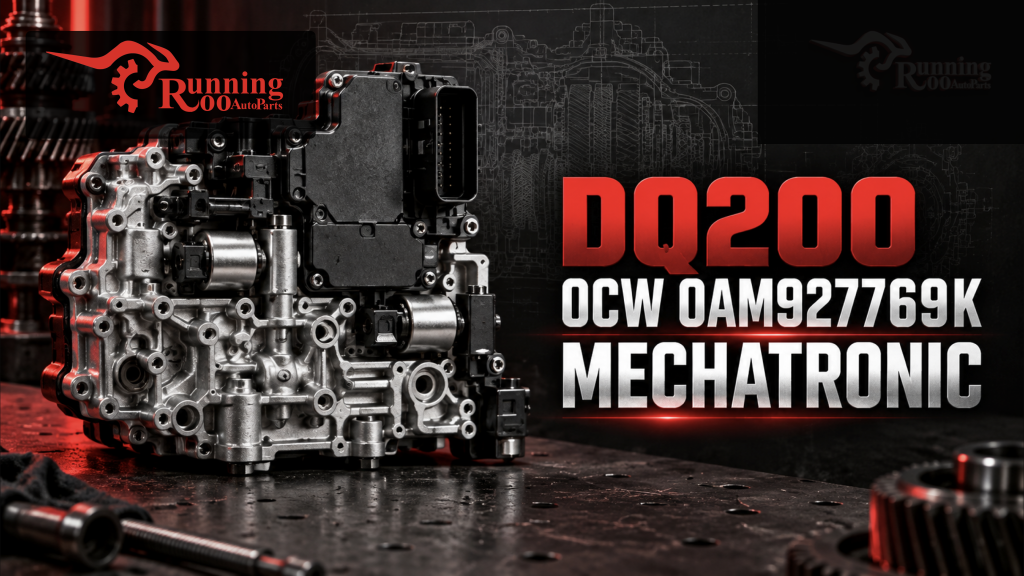
DQ200 0CW Mechatronic 0AM927769K: Workshop Pre-Order and Installation Planning
An 0AM927769K mechatronic purchase is a transmission repair decision that requires evidence. It is not a generic cure for a DSG warning, shift concern or stored code. The DQ200 0CW is commonly discussed as a seven-speed DSG application, but vehicle model, year and “DSG” wording do not by themselves identify a complete replacement mechatronic assembly or a compatible controller.
This guide concerns the RunningRoo 0CW DQ200 mechatronic/valve body/TCU listing, referenced 0AM927769K. It is intentionally different from a TCM-only article: this page targets a complete mechatronic assembly route, while a controller-only purchase must be assessed as a separate product and repair scope.
Start with the exact transmission and part identification
Before ordering, collect the VIN, gearbox code, transmission label details, current part number, workshop diagnosis and clear photographs. The workshop should state whether it is requesting a complete mechatronic assembly, a valve-body-related repair, a controller-only item or further diagnosis. Those are not interchangeable descriptions.
| Information | Why it is essential |
|---|---|
| Full VIN | Confirms vehicle specification |
| Gearbox code | Identifies the actual transmission application |
| Existing part number | Direct comparison with proposed item |
| Workshop scope | Separates complete unit from TCM-only repair |
| Fault findings | Provides context without becoming a parts list |
| Software/coding plan | Establishes installation boundary |
The live product page must be checked immediately before purchase. Listings, stock and suitability notes can change. Where part numbers show a suffix, copy every character exactly; a missing letter can turn an otherwise useful enquiry into a wrong component request.
A code or shift symptom is not a parts diagnosis
Transmission operation involves hydraulic, mechanical, electrical and software-related systems. A warning lamp, no-drive event, harsh shift, selection issue or diagnostic result should be assessed using vehicle-specific information and workshop testing. A retail listing cannot determine whether a complete mechatronic unit, a controller, wiring repair, clutch-related work, adaptation procedure or another repair is required.
Volkswagen Group service-training material explains the importance of guided diagnostic systems in modern vehicle work; see this diagnostic systems reference. It is used here only to support a structured, vehicle-specific diagnostic approach. It is not a fitment authority for a RunningRoo product, and it does not establish the cause of a fault in a particular vehicle.
Ask the installer to identify the repair scope in writing. A useful note may simply say: “DQ200 0CW, complete mechatronic assembly requested; existing number recorded; coding/adaptation to be completed by workshop.” If the workshop is still testing, wait. Buying a major transmission assembly to test an assumption can create avoidable cost and downtime.
Complete mechatronic versus TCM-only: do not merge the searches
A complete mechatronic assembly and a TCM-only product address different purchase intents. This page uses the whole-unit query because the RunningRoo item is marketed as a 0CW DQ200 mechatronic/valve body/TCU route. The separate E-suffix TCM article should be used only where the technician has specifically identified a controller-only requirement and verified its compatibility and coding path.
This distinction avoids keyword cannibalisation and improves conversion. A buyer who needs a complete unit sees a checklist for gearbox code, part number, assembly scope and workshop installation. A buyer who needs a controller sees a different checklist for controller suffix, coding and compatibility. Neither should be encouraged to substitute one for the other because the names sound related.
Pre-order decision chart
- Confirm the vehicle VIN and actual gearbox code.
- Record the original mechatronic part number and suffix.
- Obtain the workshop\’s written diagnosis and repair scope.
- Compare part number and scope with the current RunningRoo listing.
- Confirm the workshop\’s coding, adaptation and post-installation plan.
- Order only when all identifiers align.
| Situation | Appropriate next action |
|---|---|
| Gearbox and unit number align | Confirm product scope and booking |
| Workshop requests TCM only | Use controller-specific fitment process |
| Fault code without diagnosis | Continue structured diagnosis |
| Suffix differs | Seek part-number review |
| Coding plan is unclear | Confirm installer capability first |
| Vehicle is dismantled | Photograph labels and retain unit evidence |
Installation planning for Australian workshops
Mechatronic work is specialised transmission work. It should be planned with a workshop that can verify the exact gearbox configuration and complete any vehicle-specific programming, coding, adaptation and post-installation checks required for that vehicle. This guide does not give fluid, torque, programming or adaptation instructions. Those belong to current manufacturer information and the installer performing the repair.
Before a vehicle is booked in for the final replacement, discuss delivery timing, who will inspect the received item, whether related components or consumables may be needed, and how the old unit will be retained if fitment needs to be checked. A complete unit is a major purchase; a five-minute evidence review before fitting can prevent a much larger problem later.
Keep a single job file: VIN, gearbox code, original unit photograph, diagnostic report, workshop repair note, product page, invoice and post-repair invoice. This does not create a warranty or diagnose the vehicle. It makes every later conversation more accurate and gives a future technician a usable history of what was replaced.
If the delivered unit differs from the workshop\’s expected number or layout, stop before installation. Do not modify connectors, open the unit or attempt a trial fit. Contact the seller with the order number, VIN, gearbox code, old-unit images and workshop note.
How to make a complete-unit enquiry useful
A good enquiry saves time for everyone. It should identify the vehicle and transmission without asking the seller to infer the configuration from a symptom. Start with the full VIN, gearbox code and exact original unit number. Add the workshop\’s confirmed repair scope: complete mechatronic assembly, not controller only. Include high-resolution photographs of labels and connectors only where the workshop can provide them safely. Finally, state whether the installer has a plan for vehicle-specific coding, adaptation and verification.
Avoid using a vehicle model name as the whole enquiry. The same brand and model range can contain more than one transmission configuration, production revision or repair history. Avoid omitting the suffix from the old part number as well. The final character can be meaningful in a compatibility discussion. If the label is worn or unreadable, say so; do not reconstruct a number from an online image.
The seller\’s fitment review is a product comparison, not an engineering diagnosis. It can consider whether the supplied vehicle and part information align with the listing. The diagnosing workshop remains responsible for deciding whether the transmission actually requires a complete assembly. That division of responsibility is safer for the customer: it prevents a retail order from being mistaken for a repair recommendation.
What to ask before the vehicle is booked in
Before committing the car to a replacement booking, ask the workshop what stage it is at. Has it completed diagnosis? Does it require the car for an inspection appointment before ordering? Does it need the original unit present for comparison? Can it carry out the required programming or adaptation? What associated consumables, sealing items or fluid-related work may be identified after access is gained? When will it perform its post-repair checks?
These questions should not be treated as a demand for a guarantee. A transmission workshop cannot know every condition inside a vehicle before inspection. They are a planning tool. They let the owner distinguish a confirmed repair path from an early hypothesis and let the owner arrange delivery, transport and work commitments realistically.
For an interstate or regional customer, confirm the delivery address and who will receive the item. Do not send an expensive transmission component to an unattended address simply because it is convenient on an online form. It is generally better for the documented recipient, installer and vehicle booking to be part of one clear plan.
Receiving a mechatronic assembly
When the unit is delivered, preserve the condition in which it arrived. Photograph outer packaging and labels before opening. Compare the order reference, listing description and the information supplied by the workshop. Have the intended installer inspect the unit before any installation, programming or fluid-related process begins.
If questions arise, retain the packaging, any identifiers and the old-unit evidence. Do not connect the assembly merely to check whether a warning disappears. An unauthorised test can complicate evidence and does not substitute for the workshop\’s installation process. Contact the seller with a concise written description, VIN, gearbox code, order number and images. This is the fastest way to resolve an actual mismatch.
After a successful repair, retain the seller invoice and the workshop invoice together. Include the vehicle kilometres and the unit identifier recorded by the installer. This creates useful history for a future owner or service provider. It does not promise a future repair outcome, but it avoids the vague and often unhelpful statement that “the DSG was fixed”.
Why this page does not target TCM-only searches
Search intent matters for customers as well as SEO. Someone searching for 0AM927769K mechatronic has usually been given a complete-assembly requirement or needs to assess that possibility. Someone searching for 0AM927769E TCM is looking for a controller-specific path. Combining both into one page would blur the purchase decision and make it easier for a buyer to select the wrong product.
The internal link between the two articles should therefore be a clear question: “Has your workshop confirmed a complete mechatronic assembly, or a TCM-only replacement?” The answer directs the reader to the relevant checklist. It does not recommend either product, and it does not claim that a related part number is interchangeable.
Final complete-unit checklist
Use this short final check immediately before ordering. Verify the VIN and gearbox code. Verify the full original part number including suffix. Verify that the workshop has requested a complete assembly, rather than a controller-only item. Verify that it can complete coding, adaptation and road-test or post-repair checks appropriate to the vehicle. Verify the live listing, price, condition, dispatch information and recipient address. Retain all documents and photographs until the installer has confirmed the repair.
If any answer remains uncertain, the right action is to pause and obtain the missing evidence. A careful delay before dispatch is generally less costly than a transmission job interrupted by an avoidable component mismatch.
FAQ
Does a DSG warning mean I need a complete 0CW mechatronic?
No. A warning needs structured diagnosis. It does not identify a complete assembly by itself.
Is 0AM927769K the same as every DQ200 part number?
No. Confirm the exact original part number, suffix, gearbox code and live listing before purchase.
Can I use a TCM-only unit instead?
Only if the diagnosing workshop has specifically identified a controller-only requirement and confirmed compatibility. This guide is for a complete-unit scope.
Is the unit plug-and-play?
Do not assume that. Confirm the workshop\’s coding/adaptation and verification plan before ordering.
What should I send for a fitment check?
Send VIN, gearbox code, original number, clear label photos and the workshop\’s stated repair scope.
Can an owner install the assembly at home?
Use a qualified transmission workshop with the relevant vehicle-specific information and equipment.
Source and editorial note
The linked Volkswagen Group diagnostic-systems material supports only the general recommendation for structured diagnostics. RunningRoo is not affiliated with or endorsed by Volkswagen Group, Audi or Škoda. Recheck the live product listing before ordering.