
By RunningRoo Auto Parts — written from the desk of our Product Manager
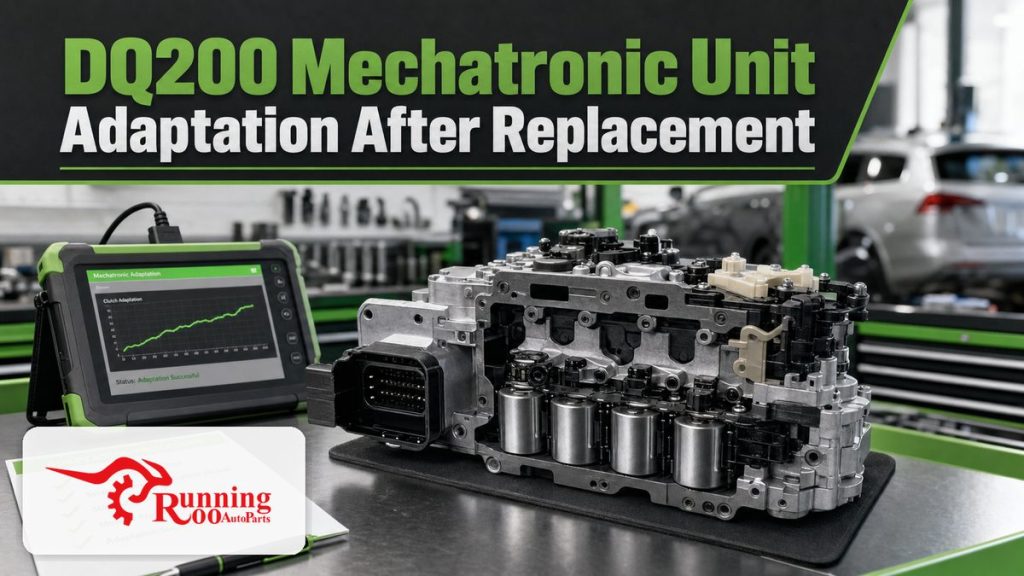
Replacing the DQ200 mechatronic unit is only half the job. The gearbox must then be adapted to the vehicle, which means component protection removal, coding and a basic-settings routine that lets the gearbox relearn the clutch and selector-fork positions. This guide explains what adaptation is, why it matters and what to expect.
RunningRoo Auto Parts – Based in Melbourne, Australia 🇦🇺
📞 Free 24/7 Pickup Available (Contact 0425890125)
💬 Any questions? Message or Call us anytime! We’re here to help.Why Choose RunningRoo?
✅ Aussie Owned & Operated | 🚚 Fast Shipping | 🤝 Friendly Support
What adaptation means
Adaptation is the process that lets the DQ200 controller learn the clutch kiss points and selector-fork positions after a new mechatronic is fitted. It is not the same as clearing fault codes. The routine uses the diagnostic tool to move the forks and measure clutch engagement, then stores those values.
Without adaptation, a mechanically perfect installation can shift harshly, flare between gears or stay in limp mode.
The stages
| Stage | What happens |
|---|---|
| Scan and confirm | Read faults and confirm communication |
| Component protection removal | Match the module to the vehicle |
| Coding | Write the vehicle configuration |
| Basic settings | Relearn clutch and fork positions |
| Road adaptation | Fine-tune shifting behaviour |
Tools used
The most common tools are VCDS and the factory-level ODIS system. VCDS can handle many DQ200 coding and basic-settings tasks, while ODIS is often used when online access or a guided procedure is required. The tool must match the vehicle and the procedure must follow the correct sequence.
Why adaptation fails
The basic-settings routine can fail if the gearbox is at the wrong temperature, a connector is not seated, a selector fork is misplaced, the oil level is wrong or the coding step was not completed. Work through those checks before blaming the new unit.
Key takeaways
DQ200 adaptation is required after mechatronic replacement. Component protection removal, coding and basic settings must be completed in the correct order. A correct part, clean installation and proper adaptation are what produce reliable shifting.
Frequently asked questions
What is DQ200 basic settings?
It is the routine that lets the gearbox relearn the clutch and selector-fork positions.
Can I skip adaptation?
No, the gearbox can shift poorly or stay in limp mode.
How long does adaptation take?
Usually around an hour, depending on the tool and gearbox temperature.
Can I do adaptation myself?
It requires specialist tools and procedure knowledge.
Why does the routine fail?
Often because of temperature, wiring, fork position, oil level or an incomplete coding step.
Does adaptation need the car to be road tested?
Yes, road adaptation helps fine-tune shifting after basic settings.
Should I change the oil before adaptation?
Use the correct oil and level before starting.
Can a weak battery affect adaptation?
Yes, keep the battery stable during coding.
Shop the parts mentioned in this guide
- DQ200 0AM 7-Speed DSG Mechatronic (Valve Body & TCU) 0AM927769D + programming
- 0CW DQ200 7-Speed DSG Mechatronic (Valve Body & TCU) 0AM927769K
- DQ200 0AM Automatic Transmission Valve Body
- DQ200 0AM DSG Mechatronic 0AM927769E — eBay
Watch on RunningRooAuto YouTube
- RunningRoo Auto Parts – trusted Melbourne parts support
- RunningRoo Auto Parts – product and fitment channel
RunningRoo Auto Parts – Based in Melbourne, Australia 🇦🇺
📞 Free 24/7 Pickup Available (Contact 0425890125)
💬 Any questions? Message or Call us anytime! We’re here to help.Why Choose RunningRoo?
✅ Aussie Owned & Operated | 🚚 Fast Shipping | 🤝 Friendly Support
Sources and further reading
- Direct-shift gearbox — Wikipedia
- BorgWarner — transmission control systems
- Volkswagen Australia
- RACV — car maintenance and repair guidance
RunningRoo Auto Parts – Based in Melbourne, Australia 🇦🇺
📞 Free 24/7 Pickup Available (Contact 0425890125)
💬 Any questions? Message or Call us anytime! We’re here to help.Why Choose RunningRoo?
✅ Aussie Owned & Operated | 🚚 Fast Shipping | 🤝 Friendly Support