
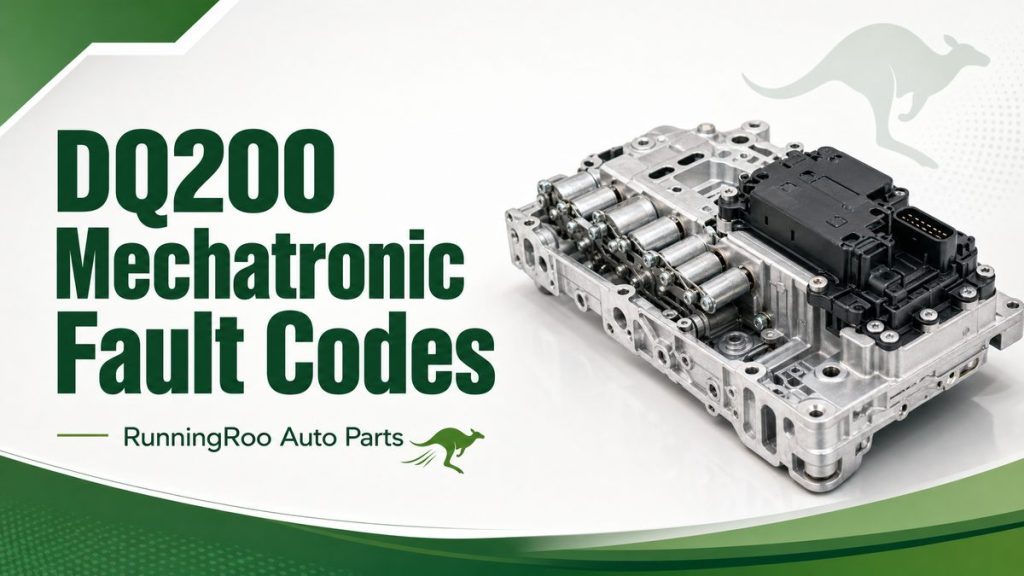
By RunningRoo Auto Parts — written from the desk of our Product Manager
When a DQ200 gearbox plays up, the fault codes it stores are the map to the problem — but only if you can read them. The mechatronic unit stores three broad families of codes, and each points to a different repair: hydraulic pressure faults, solenoid faults and electronic communication or coding faults. Understanding these families is the difference between replacing the right part and spending on a guess. This guide explains the main DQ200 fault codes, what they mean and how to fix each one.
RunningRoo Auto Parts – Based in Melbourne, Australia 🇦🇺
📞 Free 24/7 Pickup Available (Contact 0425890125)
💬 Any questions? Message or Call us anytime! We’re here to help.Why Choose RunningRoo?
✅ Aussie Owned & Operated | 🚚 Fast Shipping | 🤝 Friendly Support
Where the codes live
The DQ200 stores its fault codes in the transmission control module, not the engine computer. A generic scan tool often only shows a “transmission fault” request from the engine computer, so the transmission controller itself must be read with a suitable tool such as VCDS or ODIS. Reading the right controller is the first step to a correct diagnosis.
The three families of mechatronic faults
The DQ200 mechatronic faults fall into three groups. Hydraulic faults involve the pump, accumulator or solenoids and usually produce pressure or gear-selection codes. Electronic faults involve the TCU board and produce communication, memory or coding codes. Mechanical faults involve the clutches and shift forks and produce slip or fork codes. The table below summarises them.
| Fault family | Typical codes | Points to |
|---|---|---|
| Hydraulic pressure | Pressure / accumulator codes | Accumulator, pump, solenoids |
| Electronic | Lost communication, coding faults | TCU board or wiring |
| Mechanical | Clutch slip, shift-fork codes | Clutch pack or forks |
Hydraulic pressure faults
Pressure faults are the most common genuine mechatronic failures. The accumulator, which stores hydraulic pressure, can crack or lose its seal, and the internal pump or solenoids can wear. These faults usually produce jerky shifts, a loss of drive or a limp mode, and they are repaired by rebuilding or replacing the mechatronic unit.
Because the accumulator and solenoids are inside the sealed unit, a pressure fault is rarely fixed from the outside. A tested or remanufactured mechatronic unit with the correct part number is the normal repair.
Electronic and communication faults
Electronic faults show up as lost communication with the TCM, coding faults or random gearbox warnings. They point to the TCU board, its connector or the wiring. A bench test of the TCU separates a board fault from a wiring fault, and the repair is a tested or remanufactured TCU coded to the vehicle.
Mechanical clutch and fork faults
Clutch slip and shift-fork faults produce judder on take-off, slip under load or a refusal to engage a gear. These are mechanical rather than electronic or hydraulic, and they are repaired with a clutch pack or shift-fork replacement rather than a mechatronic unit. The fault codes tell you which of the three families you are dealing with, so a proper scan is the cheapest first step.
How to read the transmission codes
Reading the DQ200 transmission codes requires a VW-specific scan tool such as VCDS or ODIS, because a generic OBD2 scanner usually shows only a generic transmission fault. The transmission controller stores the specific codes for pressure, solenoids, clutches and the TCU, and these are what tell you which repair is needed.
Record every code before clearing anything, because the combination of codes tells the story. A pressure code together with a solenoid code points to the mechatronic, while a communication code alone points to the TCU board or wiring.
The most common specific codes
Pressure-related faults point to the accumulator or pump, solenoid faults point to the valve body, and communication or coding faults point to the TCU. Clutch-slip and shift-fork faults point to the clutch pack or forks rather than the mechatronic. The table below summarises the families again with their typical repairs.
| Code family | Typical repair |
|---|---|
| Pressure / accumulator | Rebuild or replace the mechatronic unit |
| Solenoid / valve body | Rebuild the valve body or replace the unit |
| Communication / coding | Test and replace the TCU board |
| Clutch slip / fork | Replace the clutch pack or shift forks |
Diagnose before ordering
The fault codes narrow the search, but the repair decision should still follow a diagnosis. A pressure code is confirmed with a hydraulic test, a communication code with a bench test of the TCU, and a clutch code with the clutch behaviour. Ordering a mechatronic unit on a code alone, without confirming which family is at fault, risks replacing the wrong part.
This is why a proper scan and a few tests are the cheapest part of a DQ200 repair — they prevent the expensive mistake of buying a mechatronic when the real fault was a clutch or a wiring connector.
Common misdiagnosis traps
The most common misdiagnosis on a DQ200 is assuming a communication or coding fault is a mechanical problem, or treating a clutch slip as a mechatronic fault. Reading the wrong controller, or clearing the codes before recording them, hides the information that separates the fault families.
Another trap is replacing the mechatronic on a single code without confirming the family with a test. A pressure code should be confirmed with a hydraulic test, a communication code with a bench test, and a clutch code with the clutch behaviour. Confirming before ordering prevents the expensive mistake of replacing the wrong part.
Key takeaways
The DQ200 mechatronic stores three families of faults — hydraulic, electronic and mechanical — and each points to a different repair. Reading the transmission controller’s specific codes, recording them before clearing, and confirming the family with a test are the steps that prevent a misdiagnosis.
For most owners, the correct repair is a tested or remanufactured mechatronic or TCU matched by part number and coded by a VW specialist, but only after the codes and tests confirm which part is actually at fault.
How to choose the repair path and parts
Once the codes and tests confirm which part is at fault, choose a tested or remanufactured unit with the correct part number and a written warranty. A supplier who states the part number, describes the testing and offers support is the difference between a reliable repair and a gamble.
For the coding, have a VW specialist handle the component-protection removal and basic settings, because this stage is not optional and is the most common reason a “good” unit still shifts badly. A correct part, coded properly, restores the gearbox to normal.
Quick reference: fault families at a glance
Keep this summary handy when reading DQ200 codes:
- Read the transmission controller with a VW-specific tool, not a generic scanner.
- Record every code before clearing anything.
- Pressure or accumulator codes point to the mechatronic hydraulic system.
- Solenoid or valve-body codes point to the valve body.
- Communication or coding codes point to the TCU board.
- Clutch-slip or shift-fork codes point to the clutch pack or forks, not the mechatronic.
Matching the code family to the right part, and confirming with a test before ordering, is what prevents the most expensive DQ200 mistake — replacing the wrong part.
Frequently asked questions
Where are DQ200 fault codes stored?
In the transmission control module, which needs a suitable scan tool such as VCDS or ODIS to read.
What does a pressure fault mean?
It usually points to the accumulator, pump or solenoids inside the mechatronic unit, repaired by rebuilding or replacing the unit.
What does lost communication with TCM mean?
It is an electronic fault, usually the TCU board, its connector or the wiring.
Can I read DQ200 codes with a generic scanner?
A generic scanner often shows only a generic transmission fault. A VW-specific tool is needed for the full transmission codes.
Do clutch faults mean I need a mechatronic?
No. Clutch slip and fork faults are mechanical and are repaired with a clutch pack or shift forks, not the mechatronic unit.
Can I read DQ200 codes with a generic OBD2 scanner?
Usually not fully. A VW-specific tool such as VCDS or ODIS is needed to read the transmission controller’s specific codes.
Should I clear the codes before diagnosing?
No. Record every code first, because the combination of codes identifies the faulty system.
Why is confirming the fault family important?
Because hydraulic, electronic and mechanical faults need different repairs, and replacing the mechatronic on the wrong code wastes money.
Do I need a VW specialist to code the unit?
Yes, the component-protection removal and basic settings need specialist tools, and this stage is the most common cause of a poor result.
What should I look for in a mechatronic supplier?
A stated part number, a description of the testing performed and a written warranty.
How do I know if a code is a real fault?
Clear the code after noting it, then drive and see if it returns with the same symptoms. A code that returns with the same fault is a real problem.
Can I drive with a DQ200 fault code?
For a short distance to a workshop, possibly, but a limp mode or gearbox warning should be investigated promptly to avoid further damage.
How often should the DQ200 mechatronic oil be changed?
Regular mechatronic oil changes with the correct oil help prevent the accumulator and solenoid wear that cause most faults.
Can a low battery cause a DQ200 fault code?
Yes, a weak battery or a voltage spike can trigger communication faults, which is why the battery and connections are checked before condemning the TCU.
Do all DQ200 faults show a warning light?
Not always. Some early faults only show as jerky shifts before a code or warning appears, so any change in shift behaviour is worth scanning.
How do I know if my car has the DQ200 gearbox?
It is the 7-speed dry-clutch DSG fitted to many smaller VW, Audi, Škoda and SEAT models. The transmission code or a VIN decode confirms it.
Shop the parts mentioned in this guide
- DQ200 0AM 7-Speed DSG Mechatronic (Valve Body & TCU) 0AM927769D + programming
- 0CW DQ200 7-Speed DSG Mechatronic (Valve Body & TCU) 0AM927769K
- DQ200 0AM Automatic Transmission Valve Body for VW / Audi / Škoda
- DQ200 0AM 7-Speed (Valve Body & TCU) 0AM927769D + program — eBay
Watch on RunningRooAuto YouTube
- RunningRoo Auto Parts – trusted Melbourne parts support
- RunningRoo Auto Parts – product and fitment channel
RunningRoo Auto Parts – Based in Melbourne, Australia 🇦🇺
📞 Free 24/7 Pickup Available (Contact 0425890125)
💬 Any questions? Message or Call us anytime! We’re here to help.Why Choose RunningRoo?
✅ Aussie Owned & Operated | 🚚 Fast Shipping | 🤝 Friendly Support
Sources and further reading
- Direct-shift gearbox — Wikipedia (DQ200 0AM)
- BorgWarner — transmission control systems
- Volkswagen Australia
- RACV — car maintenance and repair guidance
RunningRoo Auto Parts – Based in Melbourne, Australia 🇦🇺
📞 Free 24/7 Pickup Available (Contact 0425890125)
💬 Any questions? Message or Call us anytime! We’re here to help.Why Choose RunningRoo?
✅ Aussie Owned & Operated | 🚚 Fast Shipping | 🤝 Friendly Support