
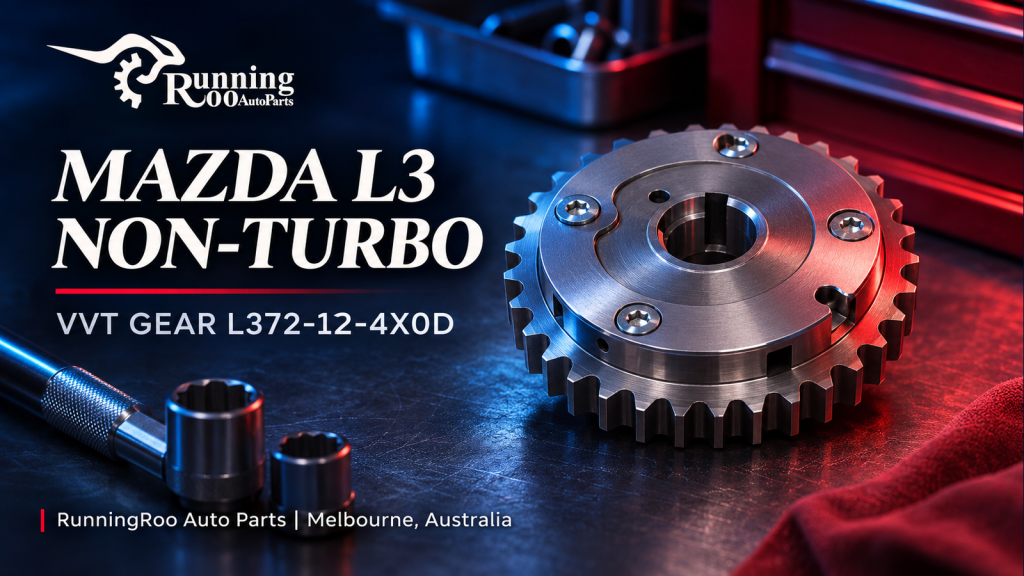
For a Mazda L3 non-turbo VVT gear enquiry in Australia, start with the complete reference L372-12-4X0D and the engine actually installed. RunningRoo lists a single camshaft VVT adjuster for the naturally aspirated 2.3-litre application range described on its product page. That is a different purchase from a complete timing chain kit and a different enquiry from the L3K9 turbo adjuster commonly discussed for Mazda MPS models.

This guide focuses on the single-gear offer, its full reference and the boundary between a camshaft-adjuster order and a broader engine repair. Mazda model names appear across multiple engine specifications, so the badge alone is not enough. Provide the VIN, engine code, OE reference and workshop diagnosis before deciding that the linked part matches the car. The objective is a precise order, with the advertised contents and the installer's requirements clearly separated.
Manufacturer context for Mazda's S-VT terminology
Mazda's original 2003 Axela announcement describes Sequential Valve Timing, abbreviated S-VT, in its engine-range discussion, including the 2.3-litre model context. This is useful manufacturer background for understanding the terminology an owner may encounter. It does not identify the RunningRoo part as a genuine Mazda component, confirm an individual VIN or establish that every vehicle called Mazda3 uses the same adjuster. Mazda original 2003 Axela announcement: S-VT terminology and model context
The parts enquiry may use terms such as VVT gear, camshaft adjuster, cam phaser or S-VT component. Rather than relying on the preferred label, connect the description to the full part reference and required position. Ask the workshop to explain which component it intends to replace. A discussion about an electrical oil-control component or a sensor should not be silently converted into an order for the mechanical adjuster pictured in this listing.
Manufacturer model information and retailer product information have different roles. The former helps establish the vehicle's technical context; the latter identifies the offered replacement. Neither should be used beyond its scope. A clear order uses the workshop's vehicle-specific parts research to connect them and asks the supplier to confirm the actual supplied item.
Non-turbo is a necessary distinction
The linked RunningRoo description explicitly refers to the 2.3-litre L3 non-turbo application. Keep that distinction visible in every enquiry. A search for “Mazda 2.3 VVT gear” can also return MPS and other turbo-related results. Do not substitute a turbo-associated reference because the displacement matches or because another article discusses a similar noise. The workshop must identify the exact engine and required component.
If the vehicle has a replacement engine or an uncertain history, tell the supplier. The VIN remains important, but the installer needs to confirm what is physically present. Avoid assuming that an earlier owner's description of an engine swap is a complete specification. Ask the mechanic to document the identifiers it has established and mark any unresolved history clearly before the order is approved.
This also applies to imported MPV or Premacy enquiries appearing in the retailer's application range. The model name can help locate the candidate product, but market and engine details still need confirmation. Do not extend a broad listing to every year or variant. Supply the actual vehicle information rather than asking the supplier to infer it from a model nickname or a photograph of the exterior.
Use the complete reference, not a shortened title
The website title includes a shortened L372-4X0D form, while the product description states L372-12-4X0D. Use the complete description reference in the enquiry and ask the supplier to confirm the current supplied marking and application. Do not treat the omission in a title as proof that two different numbers are equivalent. The written confirmation should resolve the identity before the workshop relies on the order.
Photograph any accessible original reference as the workshop advises, or provide the catalogue reference it has identified. Keep hyphens and suffixes legible. If the old component's marking is incomplete, say so instead of guessing the missing characters. A clear photo and an honest note about what cannot be read are more useful than a typed number reconstructed from a marketplace search.
If a superseding reference is proposed, ask how it applies to this specific vehicle. The article does not publish an unverified interchange chain for the Mazda part. A retailer's reference and an OE catalogue result should be reconciled by the supplier and qualified installer. Similarity between two long numbers is not sufficient evidence of compatibility.
| Check | Information to provide | Purchasing boundary |
|---|---|---|
| Engine version | Confirmed non-turbo 2.3 L3 application | Do not substitute an MPS/turbo enquiry |
| Full reference | L372-12-4X0D plus workshop OE information | Resolve shortened title wording |
| Required position | Installer's exact component description | Do not confuse gear, solenoid or sensor |
| Quantity | One adjuster advertised | No implied pair or full kit |
| Vehicle identity | VIN, build details and engine code | Model name alone is insufficient |
| Repair scope | Diagnosis and separately required items | One gear does not describe the entire repair |
What is included in the single-gear offer
The retailer description lists one camshaft VVT adjuster gear. It does not turn the offer into a timing chain kit or include every item a workshop may need to access and replace the component. Ask for the current packing details and any included accessories before purchase. Do not assume a bolt, seal or electrical component is included unless the supplier confirms it for the exact order.
The matching RunningRoo eBay listing names the same non-turbo L3-related gear and reference family. Keep both exact links with the enquiry so the supplier and installer can compare the same offer. If wording differs between channels, ask for clarification rather than combining the most generous interpretation of both into a package that was never promised. The final order should contain a clear description of what will arrive.
This single-component focus can be useful when the workshop has identified a specific requirement, but it is not an argument for replacing only one part in every case. The mechanic must assess the surrounding repair scope. Conversely, the existence of a larger timing kit does not prove the owner needs all of its contents. Let the diagnosis and applicable procedure determine the inventory, then select the appropriate supply.
Ask what has actually been diagnosed
An owner may hear the words VVT, timing and sensor during the same discussion. Ask the workshop to explain which findings support the proposed adjuster replacement and which other checks remain open. A fault description is not automatically a purchase instruction. Retain the complete report where possible so the parts enquiry reflects the professional assessment rather than a fragment remembered from a telephone call.
Provide the service history and the conditions under which the concern appears. Describe observations without converting them into a cause: a noise after starting, an intermittent warning or a change in running behaviour. The workshop can decide what assessment is appropriate. Do not repeatedly provoke the symptom to compare it with online clips, and do not use a recording from another Mazda as proof that this particular gear has failed.
This guide provides no test limits, timing-mark instructions or tightening values. The qualified installer should consult current Mazda information for the exact engine and repair. A retailer buying guide cannot replace the procedure. The useful contribution here is to ensure the workshop receives the intended part and that the customer understands the difference between a confirmed component requirement and a general VVT concern.
Decide whether the wider timing system needs separate attention
Ask the installer whether the proposed job is limited to the identified adjuster or whether its findings justify a wider scope. The answer should describe the actual vehicle, not a blanket rule that a chain must always be replaced whenever a VVT gear is discussed. If the workshop recommends additional components, list them separately with the reason for the recommendation and the appropriate references.
This is where the distinction from RunningRoo's non-turbo timing-chain article matters. That guide concerns a larger chain-drive package. The present article concerns one adjuster under the stated reference. Linking the two can help the owner understand the available categories, but the articles should not be read as instructions to purchase both. The installer should prevent overlapping orders and clarify which parts are already included in any chosen kit.
When comparing quotations, ask whether the same components are included. One proposal may describe a single adjuster, another a kit and another the full workshop job. A headline price comparison is not meaningful until those scopes are aligned. Keep diagnosis, parts and installation distinguishable so the owner can see what each amount actually covers and what remains awaiting confirmation.
Prepare a concise Mazda enquiry
A useful message states the vehicle model, build information, VIN, confirmed engine code and non-turbo status. Add the complete OE reference identified by the workshop, the exact RunningRoo link and the mechanic's required quantity. Include the diagnosis or a short professional summary. If a title-number discrepancy is the reason for asking, mention it directly so the supplier can resolve the precise question.
Avoid sending only “will this fit my Mazda6?” The supplier would still need the information that distinguishes the application. Equally, do not send pages of unrelated service paperwork when a focused identifier and report will answer the question. The workshop can tell the owner which details are necessary, and the supplier can ask for additional evidence if the current information does not support a confident match.
For a Melbourne workshop, RunningRoo's Blackburn location offers convenient pickup by appointment after confirmation. For an interstate customer, discuss the recipient and delivery requirements once the part is agreed. RunningRoo is Australian-operated and provides friendly support, with fast dispatch subject to stock and the confirmed order. Local convenience should complement the fitment check, never replace it.
Check the delivery against the agreement
When the item arrives, retain the package and compare its identity with the written confirmation before installation. The installer should raise any mismatch in reference, quantity or supplied form with RunningRoo while the original labels are available. A photograph of the received part and order reference makes that discussion more useful than a broad statement that it looks different.
Do not assume that a visually similar gear is correct, or that a visual difference is automatically an acceptable revision. Ask for the supporting application information. If the workshop is uncertain, the appropriate step is clarification before fitting. An agreed schedule should not pressure anyone into using a component whose identity has not been resolved.
Keep the final invoice and workshop report after the repair. The record should identify the actual fitted component and any additional work performed. Avoid describing the whole timing system as renewed when only the adjuster was replaced. Accurate wording helps future servicing and lets another workshop understand the vehicle's history without repeating assumptions from an abbreviated invoice line.
A worked ordering example
Imagine a non-turbo Mazda owner whose workshop requests a single adjuster and supplies the full L372-12-4X0D reference. The owner finds a website title with a shortened number and asks RunningRoo to confirm the description reference, quantity and vehicle match. The workshop reviews the answer against its parts information before the order is finalised. Any separately required items remain on the workshop list rather than being assumed to accompany the gear.
The value of this example is the resolution of a specific uncertainty. It does not claim that every non-turbo L3 vehicle uses the same version or that the part will correct every VVT-related concern. It shows how a product page becomes a reviewable order: exact identity, explicit quantity, professional diagnosis and a written supply agreement. That approach is useful whether the owner collects in Melbourne or arranges delivery elsewhere in Australia.
Related RunningRoo video
RunningRoo: variable valve timing explained. This is related educational context, not confirmation that the filmed part is the exact supplied item or that its procedure applies to this engine or transmission. Use current manufacturer information and professional diagnosis for the actual vehicle.
Frequently asked questions
Is this the Mazda MPS turbo VVT gear?
The linked offer is described for a non-turbo 2.3-litre L3 application. Do not substitute it for a turbo-related enquiry based on engine size alone. Confirm the actual engine and OE reference with the workshop. The L3K9 turbo discussion belongs to a separate product and should not be used as fitment evidence here.
Why does the title show a shortened number?
The title and description use different-length forms, with the description giving L372-12-4X0D. Ask RunningRoo to confirm the full reference and current supplied item in writing. This guide does not treat a shortened title as an independently verified interchange number. Preserve the complete workshop reference in the enquiry.
Is a timing chain included?
The described package contains one camshaft VVT adjuster gear. It is not presented here as a timing chain kit. Ask the workshop to list any additional required components and confirm them separately. Do not assume a wider package because the gear is discussed alongside the timing system.
Does a VVT fault mean the gear needs replacing?
A qualified workshop must assess the actual cause and explain its findings. The terms used in a warning or scan report do not by themselves establish a parts order. Provide the full diagnosis with the enquiry and distinguish the adjuster from other components that may be involved in the assessment.
Will it fit every Mazda3 or Mazda6 2.3?
No universal fitment claim is made here. Confirm the VIN, engine identity, build information, required position and OE reference. Market differences and vehicle history may need further checking. The retailer application list helps identify a candidate, while the supplier and installer must confirm the specific order.
Can I speak to a local Australian supplier?
Contact RunningRoo on 0425 890 125 with the complete vehicle and part information. Friendly support is available from an Australian-operated business in Blackburn VIC. Melbourne pickup is by appointment, and dispatch can be arranged subject to confirmed stock and the agreed order details.
Related reading: Mazda 2.3 Non-Turbo Timing Chain Kit Australia: Gears and Oil Pump Drive. This guide covers a separate question or package; the link does not establish component interchangeability.
Sources and scope
Product offer and stock status checked on 12 November 2026. Retailer descriptions identify the offered parts; manufacturer material supports only the technical points attributed to it. Workshop planning examples are editorial guidance, not vehicle-specific procedures. Current manufacturer information for the actual vehicle takes priority.