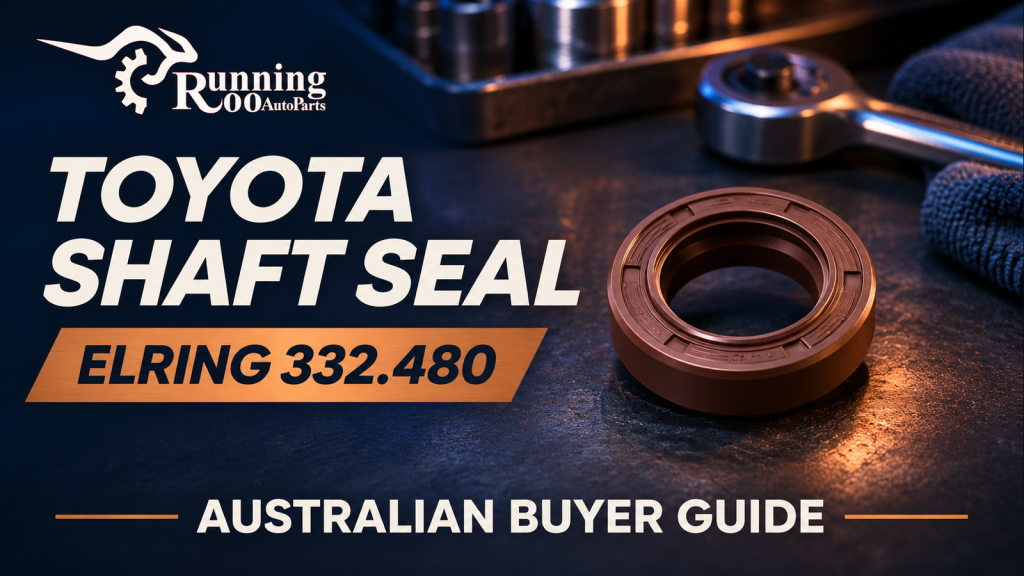
Buying a Toyota Yaris crankshaft seal in Australia should begin with identification of the leak, not just a search for the smallest inexpensive part near it. ELRING 332.480 is a specific radial shaft seal offered by RunningRoo for applications described as Toyota WiLL Cypha, WiLL Vi and Yaris. The vehicle names are useful search terms, but the correct ordering decision needs the engine code, seal location and OE reference checked together.

This guide is for owners who want to understand the parts enquiry before their workshop proceeds. It explains what can be verified about the listed seal, how to describe the repair accurately and what information to keep with the order. It does not prescribe a universal Toyota installation depth, tightening torque or removal method. Those details must come from current manufacturer information for the actual VIN and engine.
The verified part and the information it provides
RunningRoo's website and matching eBay item 365644140140 offer an ELRING crankshaft shaft seal with part number 332.480. The website lists Toyota reference numbers 90311-25020, 90311-25021, 90311-25031 and 90311-25032. Treat these as the seller's cross-reference information to be checked for your application, rather than assuming that every vehicle carrying one of the model names uses the same seal.
Elring's own radial shaft-seal table lists 332.480 with dimensions 25.5 by 37.5 by 6 millimetres and material designation FPM. That is manufacturer information about the seal, independent of a retailer's model-name list. It does not establish the installation location or engine fitment of every Toyota variant. Use the number and dimensions as identification evidence alongside the correct vehicle application. Elring official radial shaft seal table: 332.480
The website describes the item for a front crankshaft-seal replacement. Before ordering, ask the technician to confirm that this is the location being repaired. A request for a rear main seal, camshaft seal or complete gasket set is a different request. Writing the location on the order prevents a correct part number for one job from being attached to a different job by mistake.
Establish where the oil is coming from
Describe the concern to the workshop without naming a failed part prematurely. Useful information includes where oil was first noticed, whether the area was recently cleaned, whether another repair was performed and whether the engine oil level has changed. A photograph can document the visible condition, but it should not replace the technician's inspection of the source.
Ask the workshop to explain why it has identified the crankshaft seal rather than another nearby sealing area. The explanation should relate to the actual inspection. If cleaning or further observation is needed before the source can be established, record that as the next step. Buying a seal before the source is known can leave the original problem unresolved even when the supplied part is correct.
Avoid asking the seller to diagnose the leak solely from the vehicle registration. Registration and VIN information help identify the application, while diagnosis establishes what requires repair. Keeping those tasks separate makes the enquiry clearer: the workshop identifies the failed location and requests a part; RunningRoo checks the proposed item against the supplied identifiers and current stock.
Build a Toyota application check that survives an engine change
Provide the VIN, model details and build information, then add the engine code confirmed on the vehicle. If the engine has been replaced or its history is uncertain, tell the workshop and supplier. A catalogue lookup based only on the original vehicle may not describe the assembly now installed. The technician should resolve that discrepancy before approving a seal for the repair.
Photograph the packaging or markings of a previously fitted part if available, but do not assume the previous repair used the correct component. An old invoice is supporting evidence, not a substitute for checking the current application. Where the old part number differs from the proposed replacement, ask for the reason in writing rather than accepting a visual resemblance as sufficient.
For imported Toyota models such as WiLL variants, provide the full chassis information requested by the supplier. A familiar engine-family description or a shared model era may help the enquiry, but it should not be used to promise interchangeability. The most efficient question includes the vehicle identity, confirmed engine, required seal location and proposed ELRING number in one message.
| Check | Information to obtain | Why it matters to the order |
|---|---|---|
| Leak source | Workshop confirmation of the sealing location | Prevents ordering a seal for the wrong repair |
| Vehicle identity | VIN or applicable chassis identifier and build details | Establishes the application being checked |
| Engine identity | Confirmed engine code and replacement history | Helps resolve differences from original vehicle records |
| Part reference | ELRING 332.480 and checked OE cross-reference | Connects the enquiry to a specific seal |
| Manufacturer data | 25.5 × 37.5 × 6 mm, FPM in Elring's table | Supports identification, not universal fitment |
| Repair contents | Seal only and any separately required items | Avoids assuming a full gasket kit is included |
| Workshop method | Current procedure for the identified engine | Prevents applying another engine's instructions |
A radial shaft seal is not an all-purpose gasket
Elring treats radial shaft seals as their own product category and publishes installation information for different designs. That matters because instructions for one seal construction should not be transferred automatically to another. The manufacturer table identifies this number as FPM; do not describe it as a PTFE seal merely because a video about another crankshaft seal uses that term. Elring: oil seals and design-specific guidance
Ask the installer to use the instructions appropriate to the supplied part and Toyota application. The correct handling, preparation and fitting method belong in that procedure. This guide deliberately does not tell every owner to oil a lip, fit it dry, add sealant or drive it to a fixed depth. A universal instruction would ignore the design and application information the technician is expected to check.
Likewise, do not assume that replacing a seal automatically includes work on the mating shaft, cover or other surrounding components. If the workshop identifies a condition that affects the repair, it should explain the finding and the proposed scope. The customer can then approve a complete repair plan rather than treating the new seal as a guarantee independent of the surfaces around it.
Ask what is included before booking the job
The matched RunningRoo offer is for the identified seal, not a complete engine overhaul package. Ask the workshop whether its planned procedure requires other separately sourced items and whether they are included in its quotation. Do not create a generic shopping list from a different Toyota engine. The technician should specify the actual requirements after confirming the vehicle and method.
An itemised quotation should distinguish the seal from diagnosis, access work, installation and completion checks. This is useful even when the part itself is inexpensive. It helps the owner understand why the cost of a complete repair cannot be inferred from the price of the seal alone. No Australian labour-time or total-cost estimate is invented here because the vehicle and repair have not been inspected.
If other work is already planned, ask whether the tasks overlap for this particular engine. Let the workshop explain any genuine opportunity to combine work. Do not add a crankshaft seal to a timing or accessory-drive job automatically just because the vehicle is in the workshop. The condition, access and manufacturer procedure should determine the scope, with the owner's approval recorded.
Receiving and storing the seal before installation
Check that the delivered package identifies ELRING 332.480 and matches the agreed order. Compare the label with the supplier confirmation before opening the package unnecessarily. Keep the seal protected from contamination and accidental damage until the installer is ready to use it. The workshop should inspect the item according to the manufacturer's handling guidance rather than relying only on an external photograph.
If the packaging shows another reference or the item appears different from the order, ask RunningRoo to clarify before fitting. Do not stretch, trim or modify a seal to make it resemble the old one. A mismatch should be resolved through identification, not forced into an installation. Retaining the original packaging and order details makes that conversation easier.
Keep an image of the supplied label with the repair record. It can be useful later if another technician needs to understand what was fitted. The record should also say the location and engine code, because a part number by itself does not explain the whole job. This is particularly helpful for an imported car or a vehicle with a replacement engine.
What to ask after the repair
At handover, ask the workshop to describe the confirmed leak source, the part installed and the checks it completed. If surrounding oil residue was cleaned as part of the job, record that so later observations can be interpreted sensibly. The owner should understand any recommended follow-up without being expected to judge the repair from an unlabelled photograph underneath the car.
If oil is noticed afterwards, contact the installer with the date, location and circumstances. Do not immediately conclude that the new seal has failed or that a second seal is required. The workshop should assess the observation and relate it to the original repair. Keep the invoice and part identification available so the discussion starts with the actual work performed.
Ask whether any separate findings were identified during the repair and whether they require another appointment. A completion note should distinguish the resolved concern from unrelated recommendations. This avoids the impression that every oil-related issue on the engine was included in a single seal replacement. The scope agreed before the job remains the reference for the handover.
Melbourne pickup and Australian ordering
RunningRoo is Australian-operated and based in Blackburn, Victoria. Melbourne buyers can arrange local pickup by appointment, and customers elsewhere in Australia can ask about fast dispatch from confirmed stock. Check the actual availability and delivery arrangement before committing to a workshop booking. A small part still needs to be the correct part before speed becomes useful.
For friendly fitment support, call 0425 890 125 or send the VIN, engine code, required location and full OE reference through the official product enquiry. Mention ELRING 332.480 explicitly. If your workshop has provided a written parts request, use that wording rather than shortening it to “Toyota oil seal”. The detail helps distinguish the intended item from other seals in the same engine.
The website and eBay links in this guide are matched real offers checked during preparation. Prices, quantities and dispatch arrangements can change, so review the live listing when ordering. A previously recorded sale supports selecting this product for a buyer guide, but it is not a claim that the item suits your car without an application check.
Frequently asked questions
Will ELRING 332.480 fit every Toyota Yaris?
Do not assume that. The RunningRoo listing names Yaris and WiLL applications, but the order should be checked using the VIN or chassis identity, engine code, seal location and OE reference. Model name alone is not enough, particularly if the engine has been changed or the vehicle is an import.
What dimensions does Elring publish for this seal?
Elring's radial shaft-seal table lists 332.480 as 25.5 by 37.5 by 6 millimetres with FPM material designation. Those data help identify the component. They do not replace the vehicle application check or establish a universal installation procedure for every engine using a similarly sized seal.
Is this the rear main seal?
The reviewed RunningRoo website describes the item for front crankshaft-seal replacement. Have the workshop confirm the required location before ordering. A rear main seal, camshaft seal and front crankshaft seal are not interchangeable purchasing descriptions, even when an owner initially calls all of them an engine oil seal.
Should this seal be installed dry or lubricated?
Use the instructions for the supplied seal and identified Toyota application. Do not transfer a dry-installation rule from an unrelated PTFE seal video, or assume a universal lubrication instruction. The technician should verify the design-specific handling and fitting method before installation.
Will replacing the seal stop any oil leak near the pulley?
Only a proper diagnosis can establish the source and suitable repair. Ask the workshop to confirm why this location has been identified and whether surrounding components need assessment. A correct new seal cannot be promised to resolve an oil leak that originates elsewhere.
Can I collect the seal in Melbourne?
Contact RunningRoo to confirm stock and arrange pickup in Blackburn by appointment. Have the VIN, engine code, OE reference and ELRING number ready before collection. Friendly support is available on 0425 890 125, and fast dispatch can be discussed if collection is not practical.
Related reading: Toyota 2ZZ-GE Full Engine Gasket Set Australia: Rebuild Contents and Seal Checks. This separate guide covers a different component or search question; it does not establish interchangeability with the product discussed here.
Sources and scope
Product details and availability were checked on 10 November 2026. Retailer listings establish the offer; manufacturer sources below support only the technical points identified in the article. Current vehicle-specific workshop information takes priority over general background.