
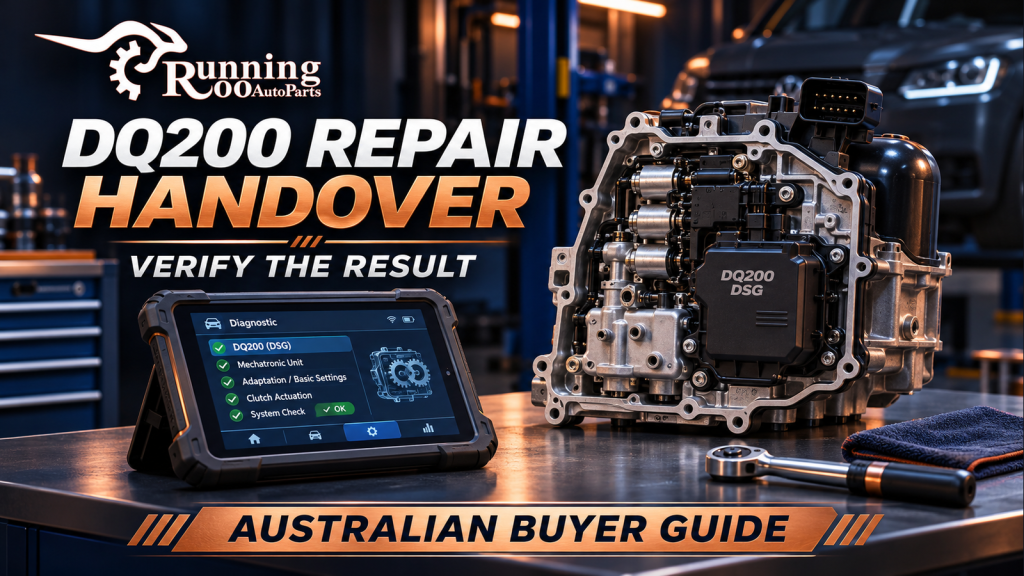
After buying an upgraded DQ200 valve-body assembly, the most useful final document is a clear record of what was installed and what the workshop checked. A description such as “DSG repaired” gives an owner very little information if a question arises later. A handover record connects the supplied unit, the agreed repair and the vehicle's observed condition at completion. It also helps distinguish a newly reported concern from the original complaint.
This Australian guide is for owners and workshops planning the handover of a vehicle fitted with RunningRoo's advertised thickened DQ200 0AM valve-body-plus-TCU assembly. It offers an evidence checklist, not a substitute for the manufacturer's workshop procedure. The installing specialist must select the correct procedures for the VIN, engine code, gearbox version and control-unit identification. No generic pressure threshold, adaptation sequence or road-test distance is prescribed here.
Agree the completion record before installation
The best time to discuss handover is when the job is quoted. Ask the workshop what it normally records after this type of repair and what will be included on the invoice or job sheet. A short, understandable completion note is more useful than an unexplained stack of scan screenshots. It should connect the original concern to the work performed and the outcome of the relevant checks.
Start with the customer's description of the problem in ordinary language. Was the concern intermittent, present from startup or noticed during a particular manoeuvre? Record the circumstances the owner actually observed, without converting them into a diagnosis. The technician can then document the assessment separately. This preserves the difference between what the customer reported and what the workshop established.
If the symptom could not be reproduced before repair, the record should say so. Acknowledging that limitation is more informative than creating a definite before-and-after claim without a baseline. The workshop can explain the evidence it did obtain and why it recommended the work. The purpose of documentation is accuracy, including uncertainty where it remains, rather than producing a flawless-looking report.
Identify the supplied unit and the work done to it
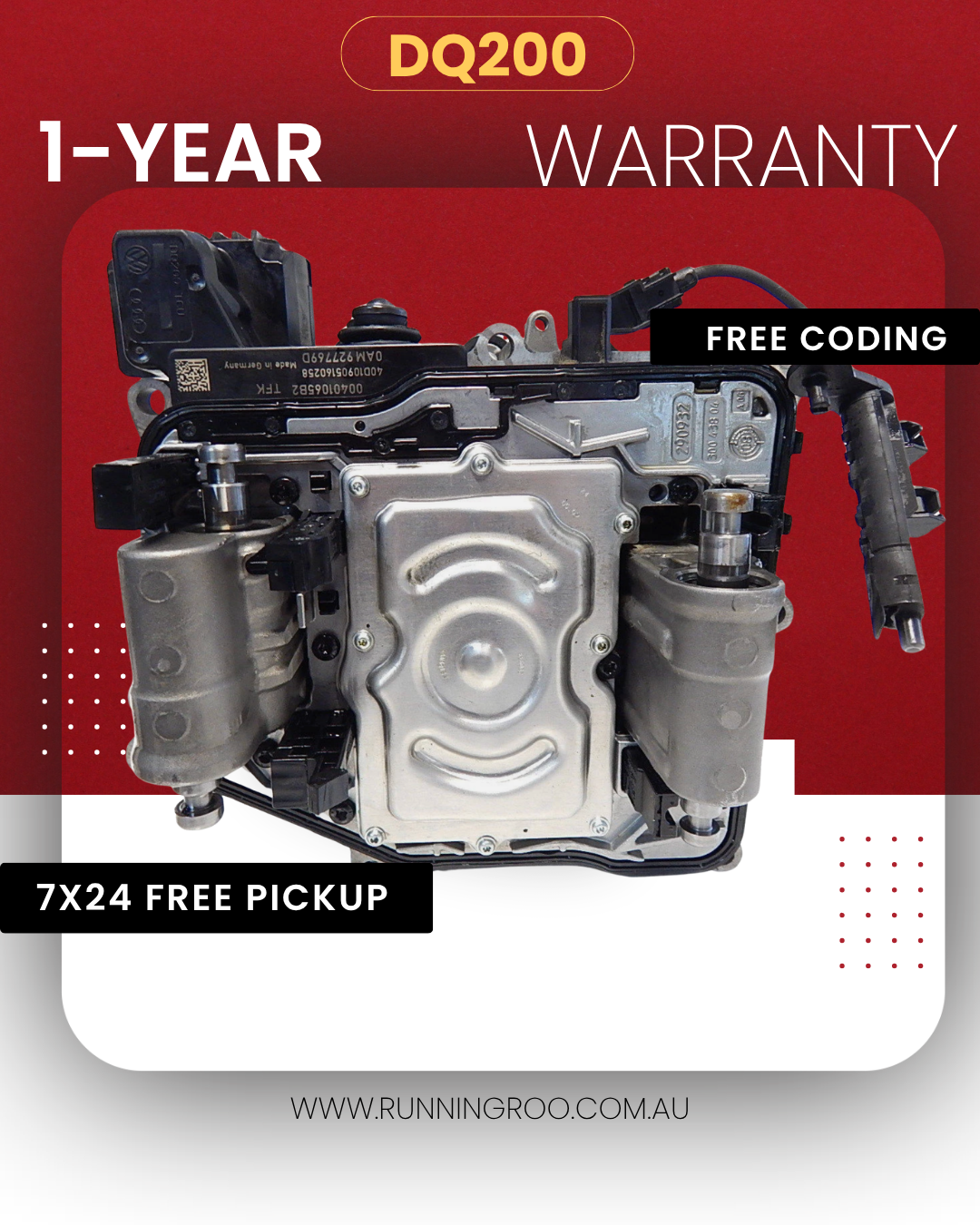
The current RunningRoo listing markets a reinforced or thickened DQ200 0AM assembly, with valve-body reference 0AM325065S and TCU reference 0AM927769D in the website description. Record the actual delivered identifiers, not just the advertising title. Where the supplier confirms a version or stock reference for the reinforced component, retain that confirmation with the order.
Programming requires particular care in the paperwork. The titles mention programming, but the detailed eBay description says it is arranged separately. The handover record should state what service was actually agreed and completed, by whom, and what vehicle-specific work the installer performed. Avoid the single unexplained word “programmed” if it could hide different stages of preparation or installation.
Keep the supplier invoice and workshop job sheet linked by an order or job reference. They need not contain identical wording, but they should describe a consistent repair. If one says a TCU-only item and another says a complete valve-body-plus-TCU assembly, ask for clarification before filing them as the permanent history. Accurate identification now can save a later technician from reconstructing the job from incomplete clues.
Separate bench evidence from vehicle evidence
A supplier may provide information about assembly preparation or testing. Ask what that information covers and how it identifies the supplied item. Do not assume that a general statement about a product range is an individual test certificate. Equally, do not dismiss useful supplier documentation simply because the workshop must still check the installed vehicle. The two types of evidence have different purposes.
Audi's manufacturer training material describes the DQ200-related 0CW architecture as including an integrated control unit, sensors and actuators, with an electrically driven hydraulic pump and accumulator. This illustrates why a complete vehicle record involves more than recognising a metal housing. It does not establish that a particular 0AM part fits a 0CW application, or provide the current repair procedure for either. Audi manufacturer training: A3 power transmission, 0CW architecture; not 0AM fitment approval
The installer should use the current vehicle-specific manufacturer information to determine the required completion work. Ask the workshop to identify the procedure it followed, rather than asking it to copy a video or an internet checklist. A recorded successful step is useful only when the step applies to that control-unit version and application. This guide deliberately leaves technical acceptance limits to the responsible specialist.
| Handover record field | Useful content | Avoid |
|---|---|---|
| Original complaint | Owner's words and circumstances | Rewriting every complaint as a proven hydraulic fault |
| Vehicle identity | VIN, engine code, gearbox and TCU identifiers | Model name alone |
| Supplied assembly | Actual part label, condition and confirmed reinforced version | Advertising title without traceability |
| Preparation and installation | Who performed each agreed stage | Unexplained “plug and play” wording |
| Completion evidence | Procedure used, date and technician's outcome | A generic pass copied from another car |
| Remaining observations | Unresolved or unrelated concerns and next steps | Saying everything is fixed without assessment |
| Customer guidance | Who to contact and what information to report | Repeated reset instructions without diagnosis |
Ask for an explained scan record
Where diagnostic scans form part of the workshop's procedure, ask for a summary the owner can understand. The summary should identify the vehicle and explain which findings relate to the repair. A code appearing in a saved report is not self-explanatory: the technician needs to interpret its context and state whether it remains relevant after the work. Avoid judging the job by counting codes without that interpretation.
If a pre-repair scan was saved, retaining it alongside the completion record can be useful. The owner should not edit the report or remove entries to make it look cleaner. Instead, ask the workshop to explain changes and any remaining observations. Keep the date and vehicle identification attached to each report so that a screenshot from another job cannot be mistaken for evidence about this car.
Do not request arbitrary values simply because another owner posted them online. Different labels, conditions and software presentations can make isolated figures difficult to compare. Ask the technician which observations are meaningful for this application and how they assessed them against the relevant information. The customer receives a conclusion supported by a method, rather than becoming responsible for interpreting raw workshop data.
Record the driving assessment in context
Ask the workshop whether a driving assessment forms part of its approved completion process and what conditions it evaluated. The record should describe what was actually done, within safe and appropriate conditions. A short trip around a yard and a more extensive assessment should not be described as the same exercise. Neither should be treated as a universal guarantee of future behaviour.
If the original concern occurred only in a particular situation, discuss whether that situation could reasonably be assessed. Weather, traffic, vehicle condition or a lack of repeatability may limit the comparison. Record those limits honestly. A useful handover can say that the reported symptom was not observed during the completed assessment while still explaining what to report if it returns.
The owner should not be asked to recreate a dangerous event to prove a fault. If drive is lost or a serious warning appears, prioritise stopping safely and obtaining professional assistance. Volkswagen's official campaign background explains that hydraulic pressure loss in affected DQ200 units can interrupt transmission of power; it should not be treated as a normal behaviour to test repeatedly on public roads. Volkswagen: mechatronics campaign background; NZ scope
Check the paperwork for the reinforced claim
If the reinforced construction influenced the purchase, confirm that the final invoice identifies the agreed version. This does not require the workshop to certify an unmeasured wall thickness or endorse a supplier's marketing statement. It requires a clear record that the supplied item matched the order. Any separate evidence of the physical change can remain with the supplier correspondence.
Avoid statements such as “all DQ200 weaknesses eliminated” in a handover summary. A repair record should describe the work and findings, not expand a component feature into a lifetime transmission promise. Similarly, a successful completion check does not establish an increased torque rating or suitability for an undisclosed engine tune. Relevant modifications should have been discussed before the order was approved.
If the customer later sells the car, the accurate description is the one supported by the invoice. An identifiable reinforced assembly and documented workshop work are useful facts. Invented claims about generation, manufacturer approval or permanent reliability can undermine that evidence. Keep the language factual so the history remains helpful to the next owner and technician.
Plan the response to a later concern
Before collection, ask whom to contact if a warning or the original symptom returns. The workshop may need the date, circumstances, warning text and vehicle details to decide the next step. A safe photograph of the displayed message can help, but it should not be taken while driving. The owner should not dismantle or alter the repair to gather evidence without professional direction.
Distinguish reporting a concern from deciding its cause. A later complaint may or may not relate to the supplied assembly, and the diagnosis should establish that connection. Keeping the original records available allows the workshop and supplier to discuss the same facts. It is more constructive than starting with an assumption that either the part or installation must be responsible.
Ask for the actual support and warranty process associated with the order. This guide does not create a new warranty term or promise a particular claim outcome. It recommends preserving the invoice, identification, installation record and correspondence so the relevant parties can assess a concern efficiently. A complete record supports a fair discussion without replacing the need for inspection.
Related RunningRoo workshop video
RunningRoo: assembly and testing of a DQ200 mechatronic unit. This is related workshop context, not proof that the filmed component is the exact supplied reinforced version. Verify all procedures against current manufacturer information for the vehicle; the video does not establish product dimensions, fitment or performance guarantees.
A practical owner collection conversation
At collection, ask the technician to explain the repair in three parts: what was found, what was changed and what was checked afterwards. If the explanation uses unfamiliar abbreviations, ask for plain language. The owner should leave knowing whether any further work has been recommended and whether any part of the original concern remains unresolved. The discussion should match the written record.
Confirm that you have the parts description, workshop invoice and contact details. Ask about the removed unit only according to the agreed retention or exchange arrangement. If it must remain with the workshop or supplier for a defined reason, record that fact. Do not assume that collecting the car automatically means every removed component can be discarded.
For a business vehicle, store the completion note with the service history and tell the regular driver how to report a concern. For a private car, keep the same information somewhere accessible rather than relying on a message thread that may later disappear. Good documentation is modest in size, but it should remain connected to the correct VIN and repair date.
RunningRoo supply support in Australia
RunningRoo is an Australian-operated business in Blackburn, Victoria. Melbourne local pickup is available by appointment, and fast dispatch can be discussed once stock and any separately arranged preparation are confirmed. Friendly support can help clarify the supplied product and order details; the installing specialist should explain the vehicle's diagnostic and completion results.
When contacting RunningRoo, quote the order reference and the full vehicle and unit identifiers. If your question concerns the thickened assembly, include the agreed version description. Call 0425 890 125 or use the linked website and eBay offers. Providing the right record at the start is more useful than sending a collection of unrelated screenshots without an explanation of the question.
Frequently asked questions
Does a clear dashboard prove the repair is complete?
It is only one observation. Ask the workshop to explain the relevant completion work and the outcome for the original complaint. The record should identify the vehicle, supplied assembly and procedure used. No single dashboard photograph replaces the specialist's assessment or creates a guarantee that every possible concern has been eliminated.
Should I ask for exact hydraulic pressure figures?
Ask which measurements are relevant and how the technician interprets them for this application. Do not impose values copied from another vehicle or software screen. The responsible workshop should use current manufacturer information and explain the conclusion. This guide intentionally does not supply generic pressure limits.
Is a supplier's bench test enough after fitting?
Supplier testing and installed-vehicle checks serve different purposes. Ask what the supplied evidence covers, then have the installer complete the appropriate vehicle-specific work. A general product statement should not be mistaken for an individual test record, and neither should be used to bypass the workshop's completion process.
What if the original symptom was intermittent?
Record the circumstances and whether the workshop reproduced it. If it was not observed during the completed assessment, that is the appropriate wording. Agree what information to report if it returns. Do not create a stronger before-and-after claim than the actual evidence supports.
Does this checklist replace basic settings?
No. It is an owner-facing documentation guide. The technician must decide and perform the correct procedures for the identified vehicle and control unit using current manufacturer information. A generic checklist or related video is not an instruction to run a particular routine on every DQ200 application.
What documents should I keep?
Keep the supplier invoice, delivered-unit identification, agreed programming scope, workshop job sheet and completion summary. Retain relevant correspondence about the reinforced version and any follow-up process. For supply questions, contact RunningRoo with that order reference on 0425 890 125; for vehicle behaviour, start with the installing specialist.
Related reading: DQ200 TCM 0AM927769E: The Complete Diagnostic and Replacement Checklist. This separate guide covers a different component or search question; it does not establish interchangeability with the product discussed here.
Sources and scope
Product details and availability were checked on 10 November 2026. Retailer listings establish the offer; manufacturer sources below support only the technical points identified in the article. Current vehicle-specific workshop information takes priority over general background.